USD/KRW: Why the Won Rose as the Dollar Hit a 19-Month High
Key summary
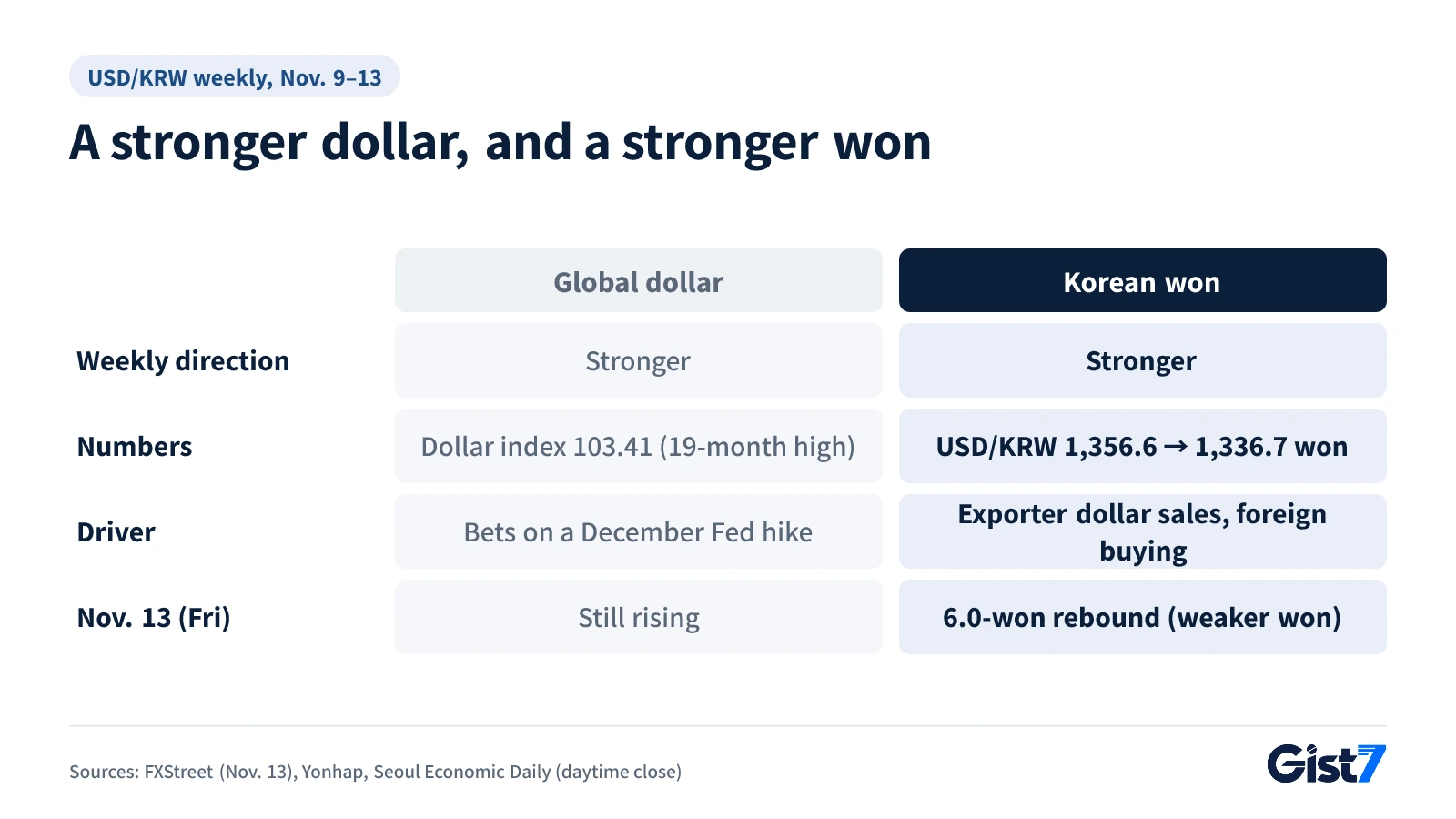
USD/KRW fell 19.9 won to 1,336.7 over Nov. 9–13, 2026, as the won strengthened. The dollar index hit a 19-month high of 103.41 on bets of a December Fed hike, but exporter dollar sales and renewed foreign stock buying lifted the won. The market sees Nov. 16–20 at 1,320 to 1,350 won.
- USD/KRW daytime close fell from 1,356.6 won (Nov. 6) to 1,336.7 won (Nov. 13), down 19.9 won (1.47%)
- Dollar index at 103.41 on Nov. 13, a 19-month high; about 90% odds of a 0.25-point December hike (CME FedWatch)
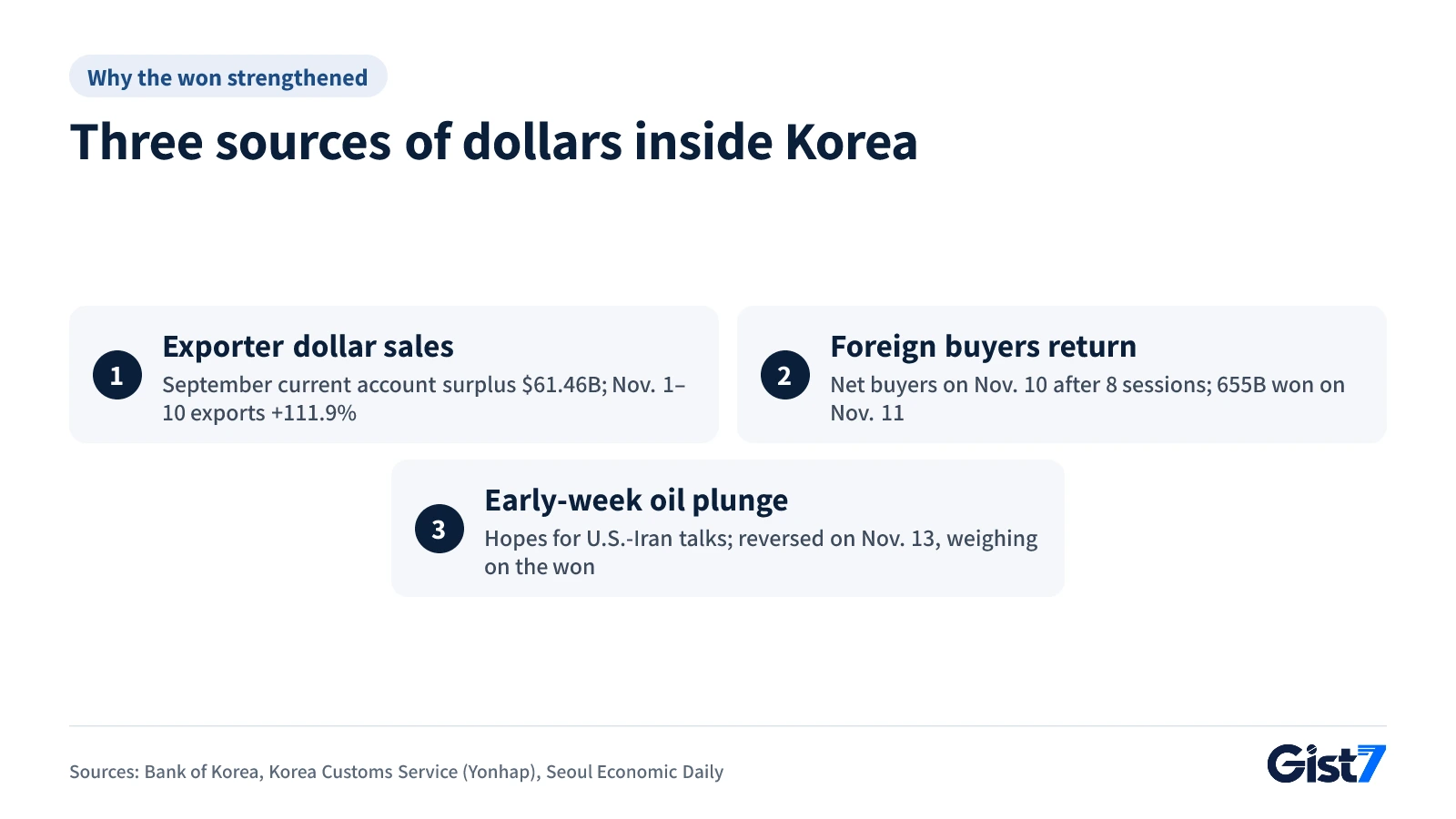
- Why the won strengthened: exporter dollar sales, foreign investors turning net buyers, an early-week oil plunge
- September current account surplus of $61.46 billion, the largest monthly surplus on record (Bank of Korea)
- Rate rebounded 6.0 won on Nov. 13 on higher oil and foreign selling; market sees 1,320–1,350 won for Nov. 16–20
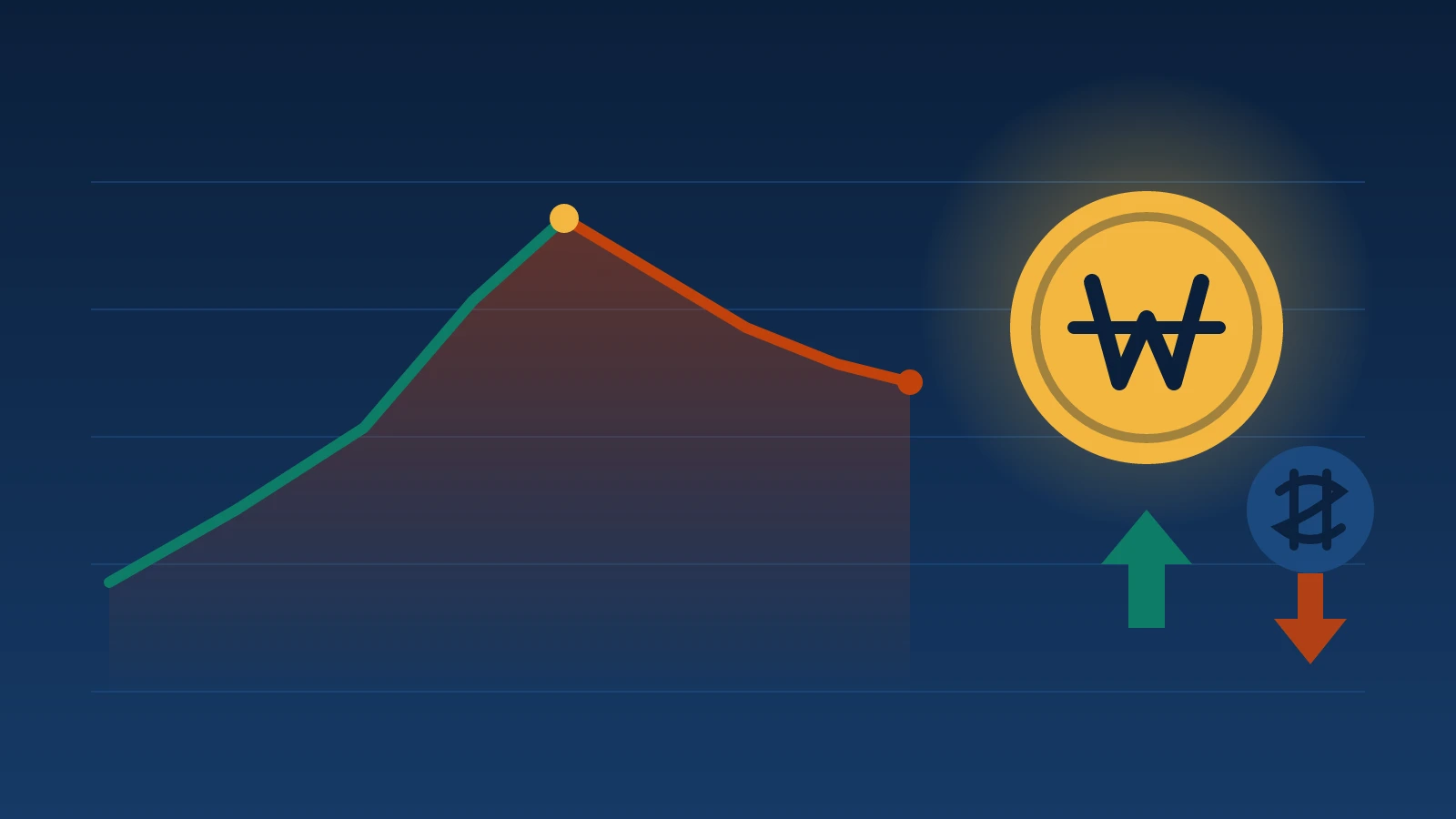
On Nov. 13, 2026, the won-dollar exchange rate (USD/KRW, the number of Korean won per U.S. dollar) closed Seoul's daytime session at 1,336.7 won (3:30 p.m. Seoul time, 1:30 a.m. ET). That was up 6.0 won on the day, the first rise in five sessions, but for the week the rate fell 19.9 won (1.47%) from 1,356.6 won on the previous Friday, Nov. 6. A lower number means a stronger won. In the same week the dollar index climbed to 103.41 on Nov. 13, its highest level in 19 months, according to FXStreet. In other words, the won got stronger in a week when the dollar was gaining almost everywhere else.
USD/KRW this week: four days down, then a 6-won rebound on Friday
The rate fell four straight days from Monday through Thursday, reaching the 1,330 level, then rose 6 won on Friday. Most of the drop came early: the rate lost 19.1 won on Nov. 9 and 10 alone, then slipped only 3.9 won on Wednesday and 2.9 won on Thursday.
| Date | Daytime close | Daily change | What moved the won |
|---|---|---|---|
| 11/6 (Fri) | 1,356.6 won | - | Previous week's close |
| 11/9 (Mon) | 1,347.1 won | -9.5 won | Opened at 1,363.0, then exporter dollar sales and a rebound in U.S. tech stocks |
| 11/10 (Tue) | 1,337.5 won | -9.6 won | Foreign investors net buyers for the first time in 8 sessions, sharp drop in oil |
| 11/11 (Wed) | 1,333.6 won | -3.9 won | Foreign net buying of 655 billion won, exporter dollar sales |
| 11/12 (Thu) | 1,330.7 won | -2.9 won | Exporter dollar sales, continued foreign buying |
| 11/13 (Fri) | 1,336.7 won | +6.0 won | Oil rebound, foreign net selling, importer payments |
Sources: Yonhap (Nov. 9, 10 and 11), Seoul Economic Daily (Nov. 13). The Nov. 6 close is derived from the change reported on Nov. 9, and the Nov. 12 close from the change reported on Nov. 13.
According to Yonhap, the rate opened at 1,363.0 won on Nov. 9 but slid to 1,346.7 won in the afternoon. Foreign investors sold a net 688.9 billion won of stocks on Korea's main board that day, their seventh straight session of net selling, yet the won still gained. Their selling had shrunk sharply from 3.4 trillion won on Nov. 5 and 2.8 trillion won on Nov. 6, and exporters sold dollars heavily.
Why the dollar was at a 19-month high
The reason behind the dollar index's 19-month high was growing conviction all week that the Federal Reserve would raise rates in December. The Fed's target range is currently 3.75% to 4.00% (Federal Reserve, Oct. 28). The October consumer price index (CPI), released Nov. 10, rose 0.4% from the prior month, above the 0.3% forecast, and October producer prices (PPI), released Nov. 13, were up 6.5% from a year earlier.
FXStreet reported that as of 20:23 GMT on Nov. 13 (3:23 p.m. ET), the dollar index stood at 103.41, up 0.23% on the day, after touching 103.42 intraday, a fresh 19-month high. The dollar index measures the dollar against six major currencies, including the euro and the yen. CME FedWatch put the probability of a 0.25-percentage-point hike in December at about 90% and a 0.5-point hike at about 10%, and the 10-year Treasury yield was 5.15%. Compared with 102.085 around the Seoul market close on Nov. 9 (Yonhap), the index gained more than a full point in a week.
The yen took the full force of the strong dollar. USD/JPY rose from 158.270 yen on Nov. 9 to 158.855 yen on Nov. 11 (Yonhap), while the won-yen cross rate fell from 851.24 won to 839.48 won per 100 yen over the same period. The cross rate is the won-yen rate calculated indirectly from USD/KRW and USD/JPY. Since the won moved opposite to the yen, local supply and demand appear to have played a large part in the won's strength this week.
Why did the won strengthen? Three sources of dollars inside Korea
The won's strength this week came not from a weaker dollar but from dollars released into Korea's own currency market. They came from three places.
The first was exporter dollar selling, which Korean dealers call "nego" volume: the dollars exporters earn and sell in the market to convert into won. In its preliminary September balance of payments released Nov. 5, the Bank of Korea reported a current account surplus of $61.46 billion, the largest monthly surplus on record (Money Today), with goods exports up 92.4% from a year earlier at $130.72 billion. Customs data reported by Yonhap showed exports for Nov. 1–10 up 111.9% year on year. The Seoul Economic Daily said that even on Nov. 13, when the rate rose, steady dollar sales by chipmakers and other exporters limited the gain.
The second was a turn in foreign stock trading. Foreign investors had been net sellers for seven straight sessions through Nov. 9 but turned net buyers on Nov. 10 and bought 655 billion won on Nov. 11 (Yonhap). To buy Korean shares, foreigners have to convert dollars into won, which creates demand for the currency. On Nov. 12, however, the won strengthened while the Kospi fell, so the two markets did not always move together.
The third was oil. Early in the week, hopes for U.S.-Iran talks sent oil prices sharply lower, raising expectations that Korea, a major crude importer, would need fewer dollars to pay for oil. That helped the won. The same factor worked in reverse on Friday.
What Friday's 6-won rebound says about the won's limits
The Nov. 13 rebound showed that once the forces supporting the won reverse, the won soon follows the strong dollar. According to the Seoul Economic Daily, as U.S.-Iran talks became uncertain, Brent crude rose 3.30% to $95.82 a barrel and WTI gained 2.55% to $88.74 on Nov. 12 (U.S. time). Higher oil fed expectations of U.S. rate hikes, and the dollar index rose as high as 103.241 during Asian trading.
Local flows turned against the won as well. Foreign investors were net sellers of stocks, and dollar buying by custody banks, which handle foreign investors' funds, combined with importers' payment demand. Even so, the intraday high was only 1,337.3 won. The Seoul Economic Daily attributed the cap to exporter dollar sales and the large current account surplus. The same day, the Kospi, Korea's benchmark stock index, rose as high as 5,504 before closing around 5,290 in an intraday reversal, part of the same Friday move as the weaker won, with foreign selling behind both.
Gist 7 sees this as a week that showed when the won can hold up against a strong dollar. Two conditions mattered: export proceeds keep flowing into the market, and foreign investors keep buying Korean stocks. When one drops out, as on Nov. 13, the won quickly tilts back toward dollar strength. Market participants quoted by the Seoul Economic Daily put the USD/KRW outlook range for Nov. 16–20 at 1,320 to 1,350 won, and expect dollar dip buying and caution over possible intervention by the authorities to put a floor under the rate around 1,320 to 1,330 won. Which way it leans within that range depends on foreign flows and U.S. rate expectations. The Bank of Korea's November rate decision is another factor, through the interest rate gap between Korea and the U.S.
For overseas investors: The stronger won added to the return on Korean stocks for investors abroad. The KOSPI rose 4.56%, from 5,059.69 on Nov. 6 (SBS Biz) to 5,290.53 on Nov. 13 (Newsis). Because the won gained about 1.5% against the dollar over the same period, the gain in dollar terms was about 6.1% (Gist 7 calculation: index close divided by USD/KRW). In a week when the won weakens, the same stock gain shrinks in dollar terms. That is one reason Korea ETFs listed overseas can perform differently from the KOSPI itself.
Market impact map
The table covers the week of Nov. 9–13.
| Asset/indicator | Direction | Strength | Link (why) |
|---|---|---|---|
| USD/KRW | ↓ (stronger won), ↑ on Nov. 13 | Medium | Exporter dollar sales and the turn to foreign net buying → from 1,356.6 to 1,336.7 won; on Friday, the oil rebound and foreign selling lifted it 6.0 won |
| Dollar index | ↑ | Strong | Expectations of a December Fed hike → 103.41 on Nov. 13, a 19-month high (FXStreet) |
| 10-year Treasury | ↑ | Medium | CPI and PPI raised hike expectations → 5.15% on Nov. 13 (FXStreet) |
| Won/yen | ↓ (stronger won) | Medium | Yen weaker against the dollar, won stronger → 851.24 won per 100 yen (Nov. 9) to 839.48 won (Nov. 11) |
| Kospi | ↑ then ↓ | Medium | Turn to foreign net buying → from 5,018.85 on Nov. 9 to 5,375.36 on Nov. 11 (Yonhap), then an intraday reversal to close around 5,290 on Nov. 13, in step with Friday's weaker won |
| Oil (WTI) | ↓ then ↑ | Medium | Early-week plunge helped the won; up 2.55% to $88.74 on Nov. 12 (U.S. time) → weighed on the won on Nov. 13 (Seoul Economic Daily) |
| Korean exporters | → | Weak | A stronger won tends to shrink the won value of dollar sales, but USD/KRW moved only about 1.5% this week and foreign buying had a bigger effect on share prices |
Little direct impact: 2-year Treasury, gold, bitcoin, S&P 500, Nasdaq (all reacted to Fed hike expectations this week, but their link to the won was weak)
- Currency exchange and overseas payments: converting $1,000 cost about 1,357,000 won at the Nov. 6 close and about 1,337,000 won at the Nov. 13 close, roughly 20,000 won less. Bank rates include fees and differ.
- Import prices and fuel: a stronger won eases the cost of imported crude, but the effect fades if oil rises again, as it did on Nov. 13.
- Overseas stocks and dollar deposits: even if dollar prices are unchanged, their value in won shifts with the exchange rate.
Market reactions can vary with other factors, and this table is not a basis for investment decisions.
What to watch next
| Date (ET) | Indicator/event | Previous | Why it matters here | If it comes in... |
|---|---|---|---|---|
| Nov. 25 (Wed) 8:30 a.m. | U.S. October PCE prices (BEA) | September 3.6% y/y (BEA) | The Fed's preferred inflation gauge; size of the December hike | Higher tends to lift the dollar and pressure the won |
| Nov. 26 (Thu), Seoul time | Bank of Korea rate decision | 3.00% (Bank of Korea, raised Aug. 27) | Korea-U.S. rate gap and the won's direction | A hike tends to support the won; a hold tends to leave more to external factors |
| Dec. 4 (Fri) 8:30 a.m. | U.S. November jobs report (BLS) | October payrolls +165,000, unemployment 4.1% (Yonhap) | Size of the December hike and the rate path after it | Strong hiring tends to raise bets on further hikes and lift the dollar |
| Dec. 9 (Wed) 2:00 p.m. | FOMC decision and projections (Dec. 8–9 meeting) | 3.75%–4.00% (Federal Reserve, Oct. 28) | The starting point of this week's dollar strength | A 0.5-point hike would tend to lift the dollar and pressure the won; 0.25 points may be seen as already priced in |
Dates are based on the BEA and BLS release calendars, the Bank of Korea's monetary policy meeting schedule and the Fed's FOMC calendar. U.S. inflation and yields are covered separately in our article on October CPI and the 10-year yield nearing 5%.
Frequently asked questions
Why did USD/KRW fall when the dollar was at a 19-month high?
Because the won was lifted by dollars flowing into Korea's market, not by a weaker dollar. Exporters kept selling the dollars they earned, and foreign investors resumed buying Korean stocks from Nov. 10, creating demand for the won. A September current account surplus of $61.46 billion, the largest monthly surplus on record, was also in the background.
Why did USD/KRW rise 6 won on Nov. 13?
Oil rose as U.S.-Iran talks became uncertain and the dollar index touched 103.241 intraday, while foreign stock selling, dollar buying by custody banks and importer payments added up. Exporter dollar sales kept the intraday high to 1,337.3 won.
What is the USD/KRW outlook for Nov. 16–20?
Market participants quoted by the Seoul Economic Daily see a range of 1,320 to 1,350 won. They expect dollar dip buying and caution over official intervention to put a floor under the rate around 1,320 to 1,330 won. Foreign flows and U.S. rate expectations are the variables that will decide which way it leans.
Is a stronger won bad for Korean exporters?
A stronger won tends to reduce the won value of the same dollar sales, which can weigh on earnings. This week USD/KRW moved only about 1.5%, so the earnings impact may be limited, but the burden tends to grow if the won keeps strengthening.
Do the dollar index and USD/KRW always move together?
They usually move in the same direction, but they can diverge, as they did this week. The dollar index tracks the dollar against six major currencies such as the euro and the yen and does not include the won, while the won is heavily influenced by local flows such as export proceeds and foreign stock trading.
References
- Won-dollar rate rebounds after five sessions, closes at 1,336.7 won — Seoul Economic Daily (2026-11-13)
- Won-dollar rate falls to 1,340s despite strong dollar, first drop in four sessions — Yonhap (via Korean Center, 2026-11-09)
- Rate falls 9.6 won to 1,337.5 won as U.S.-Iran talk hopes lift risk appetite — Yonhap (via Korean Center, 2026-11-10)
- Rate down 3.9 won at 1,333.6 won despite fears of a big Fed hike — Yonhap (via Korean Center, 2026-11-11)
- Gold faces weekly rout as high US yields fuel Fed rate hike bets — FXStreet (2026-11-13)
- September 2026 balance of payments (preliminary) — Bank of Korea (via KDI Economic Information and Education Center, 2026-11-05)
- September current account surplus hits record $61.4 billion; chip exports up 260% — Money Today (2026-11-05)
- KOSPI plunges 6%, closes at 5,059.69 — SBS Biz (2026-11-06)
- KOSPI reverses lower on foreign selling, closes at 5,290.53 — Newsis (2026-11-13)