Oil Price Plunge: Why Korean Gasoline Fell Just 0.3 Won
Key summary
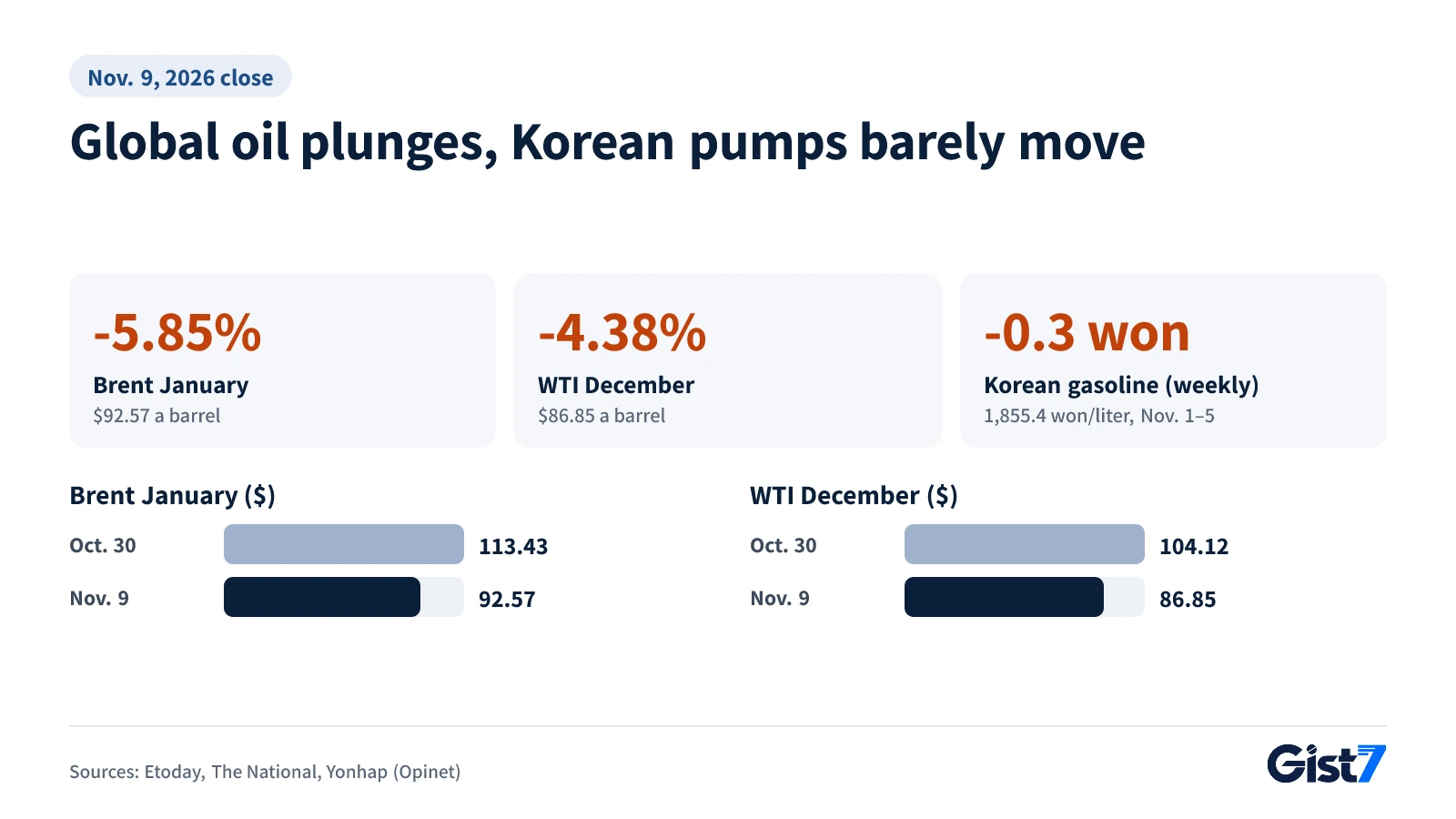
The oil price plunge followed hopes for U.S.-Iran talks: on Nov. 9, 2026, Brent fell 5.85% to $92.57 and WTI 4.38% to $86.85. Global gasoline fell about 210 won a liter in early November, but Korean pump prices fell just 0.3 won, held back by a price cap and an expiring fuel tax cut.
- Nov. 9: Brent January $92.57 (-5.85%), WTI December $86.85 (-4.38%) after Trump said new strikes on Iran were highly unlikely
- CNBC's 16% weekly drop tracks the front-month contract; the January contract alone fell about 13.3% (Gist 7 calculation). OPEC's October output rose 1.38 million bpd
- Iran's 'seven conditions' and reported ship attacks near Hormuz leave a risk of a rebound if talks stall
- Global gasoline fell about 210 won per liter in the first week of November, but Korean pump prices fell just 0.3 won to 1,855.4 won; the 1,784-won price cap and the end of a tax cut (up to 122 won) set the pace
- Cheaper oil helps Korean inflation and the won (one-month NDF at 1,340.5 won in New York on Nov. 9), but it is barely reflected in U.S. October CPI or the Bank of Korea's Nov. 26 decision yet
Brent crude for January delivery settled at $92.57 a barrel on Nov. 9, 2026, down 5.85% in a single session. According to Korea's Etoday, citing New York and London closing prices, U.S. West Texas Intermediate (WTI) for December fell 4.38% to $86.85. The trigger for the oil price plunge was President Donald Trump saying further U.S. strikes on Iran were highly unlikely as long as talks progressed. South Korean drivers saw almost none of it. The national average pump price for gasoline in the first week of November (Nov. 1–5) was 1,855.4 won per liter, down just 0.3 won from the prior week, according to Korea National Oil Corp.'s Opinet data reported by Yonhap.
Oil price plunge: why Brent lost 5.9% in a day
Three forces drove the drop. Hopes for a U.S.-Iran deal pulled the trigger, while rising supply and soft physical demand made the fall steeper. In short, the war-risk premium built into prices came out quickly.
The most direct catalyst was the prospect of talks. According to Etoday, Trump told CNN that a renewed military attack was highly unlikely if negotiations on Iran's nuclear program and the reopening of the Strait of Hormuz moved forward, and he told CBS he had no intention of escalating the fighting. A reported meeting with Qatar's prime minister and foreign minister, who has been mediating an end to the war, added to hopes for a diplomatic exit.
Supply is rising, not falling. A Reuters survey cited by CNBC put OPEC's October crude output at 22.87 million barrels per day, up 1.38 million bpd from September. JPMorgan Chase (NYSE: JPM) estimated the global oil surplus in October at around 1.4 million bpd.
Demand for prompt barrels has also weakened. Morgan Stanley (NYSE: MS) noted that Dated Brent, the price of physical North Sea cargoes, has slipped to a discount to the nearby Brent futures contract, CNBC reported. When physical oil trades below futures, it signals that there are more barrels available right now than buyers want.
According to CNBC, Brent futures fell 16% last week (Nov. 2–6), the steepest weekly decline since the start of the Covid-19 pandemic. That figure appears to track the continuous front-month contract. On Oct. 30, the front month was the December contract, which expired that day and traded at $117.64 according to The National. By Nov. 6, the front month was January, at $98.32. Linking the two gives roughly 16%. Comparing the January contract with itself, the decline was about 13.3%, from $113.43 on Oct. 30 to $98.32 on Nov. 6 (Gist 7 calculation).
| Benchmark / asset | Nov. 9 | Daily change | Comparison |
|---|---|---|---|
| Brent January | $92.57 | -$5.75 (-5.85%) | About -18.4% vs. Oct. 30 January settle of $113.43 |
| WTI December | $86.85 | -$3.98 (-4.38%) | About -16.6% vs. Oct. 30 settle of $104.12 |
| Dubai (first week of November, Opinet) | $100.30 | -$15.30 week over week | Pricing benchmark for South Korea's crude imports |
| Gold (COMEX December) | $4,114.50/oz | +1.0% | Weaker dollar, easing inflation worries |
Sources: Etoday (Nov. 9 New York and London closes), The National (Oct. 30 closes), Yonhap (weekly Opinet data). Changes vs. Oct. 30 are Gist 7 calculations.
TokenPost reported that Brent was about 20% below its Oct. 30 intraday high of $118. That $118 print came from the December contract on its expiry day. Comparing January settlements only, the decline is about 18%. We covered how cheaper oil fed into U.S. stocks in our analysis of the Wall Street rebound.
Can the decline last? The case from Hormuz
Whether prices keep falling depends on whether hopes turn into an actual agreement. For now, expectations are running ahead of the facts, and the risks have not gone away.
According to CNBC, a senior Iranian security official said Tehran has no plans to negotiate unless Washington takes practical steps to meet seven conditions set out in a June interim agreement. Both the U.S. and Iran have reported attacks on ships in and around the Strait of Hormuz. Yemen's Houthi rebels claimed an attack on an office of Saudi Aramco (Saudi Exchange: 2222) in Riyadh, and the Saudi East-West pipeline near Medina was struck and caught fire before the blaze was put out. Pipeline operations were not disrupted.
The late-October peak came from similar events. According to The National, two tankers were struck in the Strait of Hormuz within 24 hours around Oct. 30, and Brent gained about 15% in October alone. The cushion is thin as well. U.S. Energy Department data show the Strategic Petroleum Reserve has fallen to 279.5 million barrels, the lowest since October 1982 (CNBC).
In Gist 7's view, last week's slide (16% on a front-month basis, about 13% for the January contract) looks less like a real supply surge and more like the market rushing to price in a war that stops escalating. OPEC's output increase and the surplus estimates support lower prices, but a single headline about collapsed talks or another tanker attack could reverse part of the move.
When will gasoline prices follow? Lags and Korea's price cap
The gasoline price outlook in South Korea hinges on two things: timing and policy. Changes in global oil prices typically reach Korean gas stations with a lag of two to three weeks, according to Yonhap. This time, a government price cap and the scheduled end of a fuel tax cut stand in the way, so the full drop in global prices is unlikely to pass through.
According to Yonhap, average pump prices have fallen for 25 straight weeks, but gasoline has dropped by less than 1 won per liter each week since the third week of September. In the same first week of November, the international gasoline price fell $25.00 to $111.90 a barrel. One barrel holds about 159 liters, so at the Nov. 9 Seoul close of 1,347.1 won per dollar, that is roughly 210 won per liter (25.0 ÷ 159 × 1,347.1, Gist 7 calculation). This is a simple conversion on the refining-cost side, before taxes and distribution costs. Global markets shaved about 210 won off a liter of gasoline, yet pump prices fell 0.3 won. Two mechanisms explain the gap.
The gap between the cap and market prices. Under Korea's oil price ceiling, the government sets a maximum price that refiners can charge for fuel. According to the Ministry of Trade, Industry and Resources, the 11th cap, in force for four weeks from Oct. 17, was frozen at 1,784 won per liter for gasoline, 1,773 won for diesel and 1,380 won for kerosene. The government estimates the system lowered October consumer inflation by 0.8 percentage points, News Tomato reported. While the cap sits below market prices, public money goes to compensating refiners for losses (CBS Nocut News). When global prices fall, that gap is likely to shrink before pump prices do. The ministry's announcement does not say how far market-based prices are from the cap, so it cannot be confirmed whether refiners' supply prices are currently above or below it. Still, the fact that pump prices have moved by less than 1 won a week for seven weeks fits the reading that supply prices are pinned near the cap (Gist 7 interpretation).
The end of the fuel tax cut. Korea's finance ministry extended a 15% tax cut on gasoline and 25% on diesel through the end of November (SBS Biz, Sept. 18). That keeps gasoline 122 won per liter cheaper and diesel 145 won cheaper than without the cut. No decision has been made on December onward. If the cut expires, up to 122 won per liter of the global price decline could be absorbed by taxes.
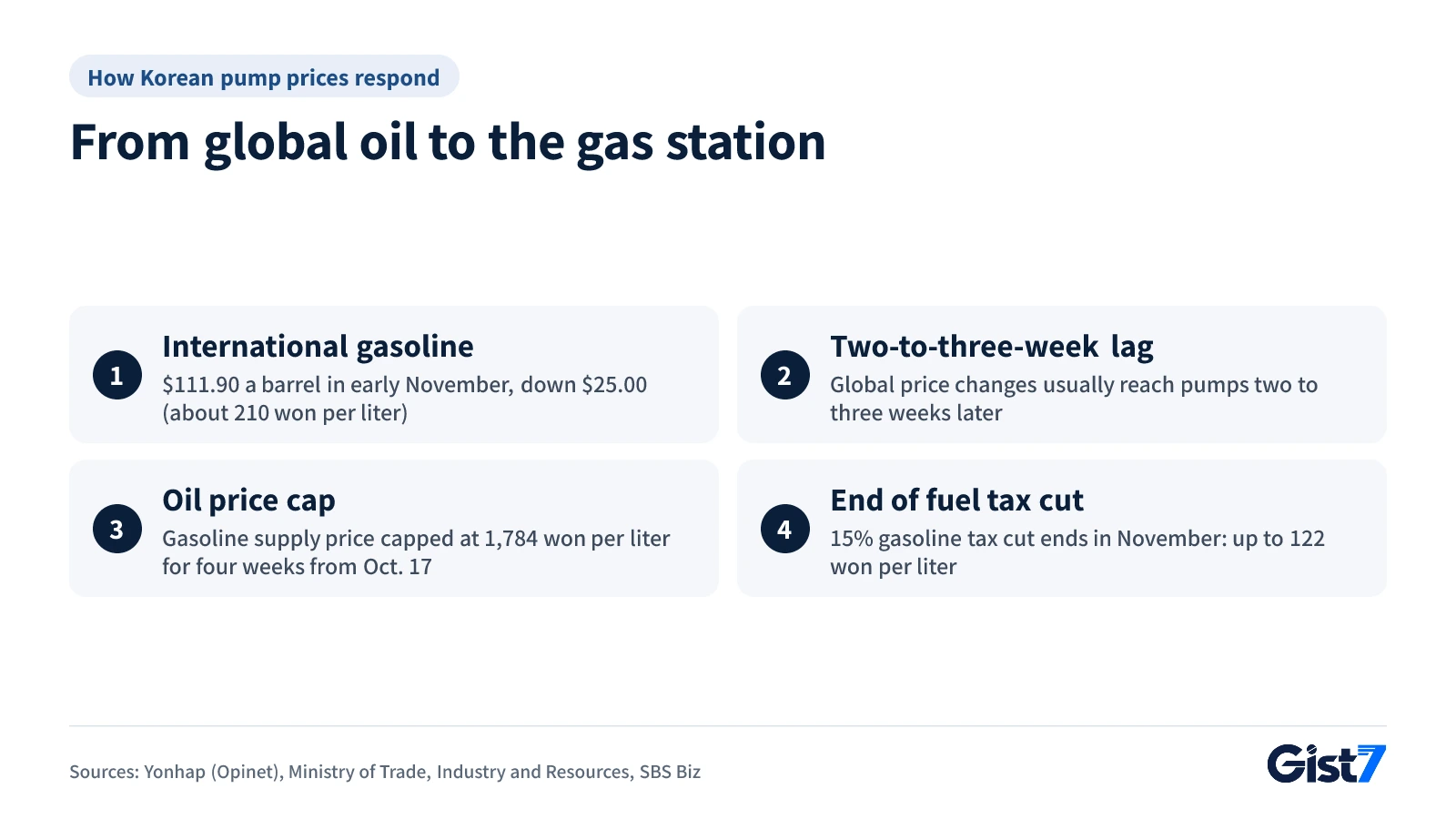
So the first effect of this oil slide in Korea may be less upward pressure on fuel prices rather than visibly cheaper gasoline. If the government uses the window to normalize the cap or scale back the tax cut, drivers could see far less relief than the 210-won calculation suggests.
What it signals for Korean inflation, the won and the Bank of Korea
The impact of falling oil on inflation is favorable for South Korea's prices and its currency. Whether it is enough to change the Bank of Korea's rate decision on Nov. 26 is too early to tell.
According to Korea's National Data Office, consumer prices rose 2.8% year over year in October. Petroleum products jumped 14.9% and added 0.56 percentage points to headline inflation, SBS Biz reported. If fuel inflation cools, overall price pressure could ease from next month. On the other hand, prices excluding food and energy also rose 2.8%, so part of the upward trend has nothing to do with oil.
The won strengthened as well. According to TokenPost, the one-month non-deliverable forward (NDF) rate in New York trading on Nov. 9, after the oil drop, was 1,340.5 won per dollar. Earlier that day, at 3:30 p.m. Seoul time, onshore trading had closed at 1,347.1 won, down 9.5 won (Korea Financial Times). Because the Seoul close was set before the oil plunge in New York (early Nov. 10 in Korea), the effect of the drop shows up in the NDF rate. A lighter import bill for crude and a stronger won tend to push import prices lower together.
The Bank of Korea's base rate stands at 3.00%. We laid out the case for a November hike in our Bank of Korea rate outlook. Cheaper oil weakens the import-price argument for a hike, but if core inflation and household lending are the main factors, the effect may be limited.
The U.S. October Consumer Price Index (CPI), due at 8:30 a.m. ET on Nov. 10, will not include this November decline. In fact, Brent rose about 15% in October (The National). According to the Bureau of Labor Statistics (BLS), energy prices were up 20.4% year over year in September and gasoline 34.2%. Any disinflationary effect from cheaper oil is more likely to show up from the November data onward. The release schedule is in our U.S. CPI and economic calendar preview.
Market impact map
| Asset / indicator | Direction | Strength | Link (why) |
|---|---|---|---|
| Oil (WTI) | ↓ | Strong | Trump's comments eased fears of supply disruption; OPEC output gains add pressure (December contract -4.38% on Nov. 9) |
| Brent and Dubai crude | ↓ | Strong | Middle East risk premium coming out; directly tied to Korea's import costs |
| Dollar index | ↓ | Weak | Easing Middle East tension reduced safe-haven demand (101.67, down 0.61%, New York trading on Nov. 9, TokenPost) |
| USD/KRW | ↓ (stronger won) | Moderate | Smaller crude import bill and a softer dollar (one-month NDF at 1,340.5 won in New York on Nov. 9, TokenPost) |
| Gold | ↑ | Weak | A weaker dollar supports dollar-priced gold (COMEX December +1.0% on Nov. 9) |
| S&P 500 and Nasdaq | ↑ | Weak | Risk appetite returned as Middle East tension eased; hopes for lower fuel and freight costs (S&P 500 +2.35% on Nov. 9, TokenPost) |
| KOSPI (Korea's main stock index) | ↑ tendency | Weak | Lower import costs and a stronger won favor airlines, transport and domestic-demand stocks; a burden for refiners |
| Airlines and travel | ↑ tendency | Moderate | Fuel is a large share of costs, so cheaper oil helps margins |
| Refiners | ↓ tendency | Moderate | A fast price drop means valuation losses on crude bought at higher prices |
Little direct impact: 2-year Treasury, 10-year Treasury, bitcoin. The 10-year yield actually rose 2 basis points to 4.88% on Nov. 9 after hawkish comments from Fed officials (TokenPost).
- Fuel: The drop in global gasoline prices (about 210 won per liter) tends to reach Korean pumps within two to three weeks, but the price cap (1,784 won per liter for gasoline) and the end of the fuel tax cut in late November (up to 122 won) could make the decline much smaller.
- Currency exchange and overseas payments: A stronger won lowers the cost of buying dollars. The U.S. CPI result could change the direction.
- Living costs: If fuel inflation turns down, transport and heating costs could ease, with a lag.
Market reactions can vary with other factors, and this table is not a basis for investment decisions.
What to watch next
| Date (ET unless noted) | Indicator / event | Previous | Why it matters here | If it comes in… |
|---|---|---|---|---|
| Nov. 10 (Tue) 8:30 a.m. ET | U.S. October CPI (BLS) | September 3.7% y/y, energy 20.4% (BLS) | Shows inflation before the oil drop | Hotter than expected: yields and dollar ↑, pressure on the won |
| Mid-November | Korea's 12th oil price cap decision (Ministry of Trade, Industry and Resources) | 11th cap: 1,784 won per liter for gasoline (ministry) | First gate for global declines to reach the pump | A cut means bigger pump-price declines; a freeze or removal limits relief |
| Nov. 26 (Thu, Seoul) | Bank of Korea rate decision | 3.00% (Bank of Korea) | Whether cheaper oil enters the inflation assessment | A hike raises borrowing costs; a hold tends to pull short-term yields back |
| Nov. 29 (Sun) | Meeting of seven OPEC+ countries (OPEC) | Decision to keep December output at September levels (OPEC) | Whether supply-side pressure continues | Higher output: more downward pressure; signs of cuts: rebound tendency |
| Nov. 30 (Mon, Seoul) | Last day of Korea's fuel tax cut (finance ministry) | Gasoline 15% and diesel 25% cuts in place | Whether taxes offset the global decline | Expiry: gasoline could rise up to 122 won per liter; extension keeps the downtrend |
The date of the 12th cap decision is estimated from the 11th cap's four-week window starting Oct. 17 and is not an officially announced schedule.
Frequently asked questions
Why did oil prices suddenly fall?
President Trump said further attacks on Iran were highly unlikely if talks progressed, easing fears of Middle East supply disruptions. Rising OPEC output in October and weak demand for physical crude added to the selling, and Brent fell 5.85% on Nov. 9, 2026.
When will lower oil prices reach Korean gas stations?
Usually two to three weeks later. Global gasoline prices fell about 210 won per liter in the first week of November (Gist 7 conversion), but Korea caps refiners' gasoline supply price at 1,784 won per liter and a 122-won fuel tax cut is due to end in late November, so pump prices are unlikely to fall as much as global prices.
Could oil prices rise again?
Yes. Iran has made seven conditions from a June interim agreement a precondition for talks, and attacks on ships around the Strait of Hormuz continue to be reported. If hopes for a deal fade, part of the decline could be reversed.
Will cheaper oil affect the Bank of Korea’s rate decision?
It weakens the import-price argument for a rate hike, but the effect may be limited. Korean prices excluding food and energy also rose 2.8% in October, so part of the inflation is not driven by oil. The decision comes on Nov. 26.
What is the difference between Brent, WTI and Dubai crude?
Brent is North Sea crude and WTI is U.S. West Texas crude, the benchmarks traded in London and New York. Dubai is the Middle East benchmark used to price most of South Korea's crude imports, so it tracks Korean fuel costs most closely.
References
- 국제유가, 미·이란 협상 기대에 급락…WTI 4.38%↓ — 이투데이
- Oil falls as Trump says new Iran attacks 'unlikely' — CNBC
- Oil prices set for sharp monthly rise on Hormuz strikes and US threat to hit Iran — The National
- [국제금융 브리핑] 미·이란 협상 기대에 브렌트유 5.9% 급락 — 토큰포스트
- [KFT 모닝 브리프] 2026.11.10 — 한국금융신문
- 주유소 기름값 25주 연속 하락…1천800원대서 사실상 횡보 (연합뉴스) — 코리안센터뉴스
- 11차 최고가격, 10차 수준으로 동결 — 산업통상부
- 다시 뛰는 국제유가에도…정부, 석유 최고가격 4주 더 동결 — CBS노컷뉴스
- 소비자물가 두 달째 '2%대 ↑'…'석유 최고가격제' 딜레마 — 뉴스토마토
- '유류세 인하' 11월 말까지 두 달 더 연장 — SBS Biz
- 2026년 10월 소비자물가동향 — 국가데이터처(정책브리핑)
- 10월 소비자물가 2.8% 올라…석유류 14.9% 급등 — SBS Biz
- Consumer Price Index – September 2026 — U.S. Bureau of Labor Statistics
- Release Calendar November 2026 — U.S. Bureau of Labor Statistics
- 통화정책방향 결정회의 일정 — 한국은행
- 한국은행 기준금리 추이 — 한국은행
- OPEC+ 7개국 회의 (2026년 11월 1일) 보도자료 — OPEC