Why the KOSPI fell: an intraday reversal from 5,504 to 5,290
Key summary
The KOSPI fell 0.98% to 5,290.53 on Nov. 13, 2026 after touching 5,504.44. Three causes: Nvidia-related export-control worries hit chips, U.S. yields and oil rose, and a policy meeting offered no concrete KOSDAQ steps. Foreigners sold a net 547.5 billion won.
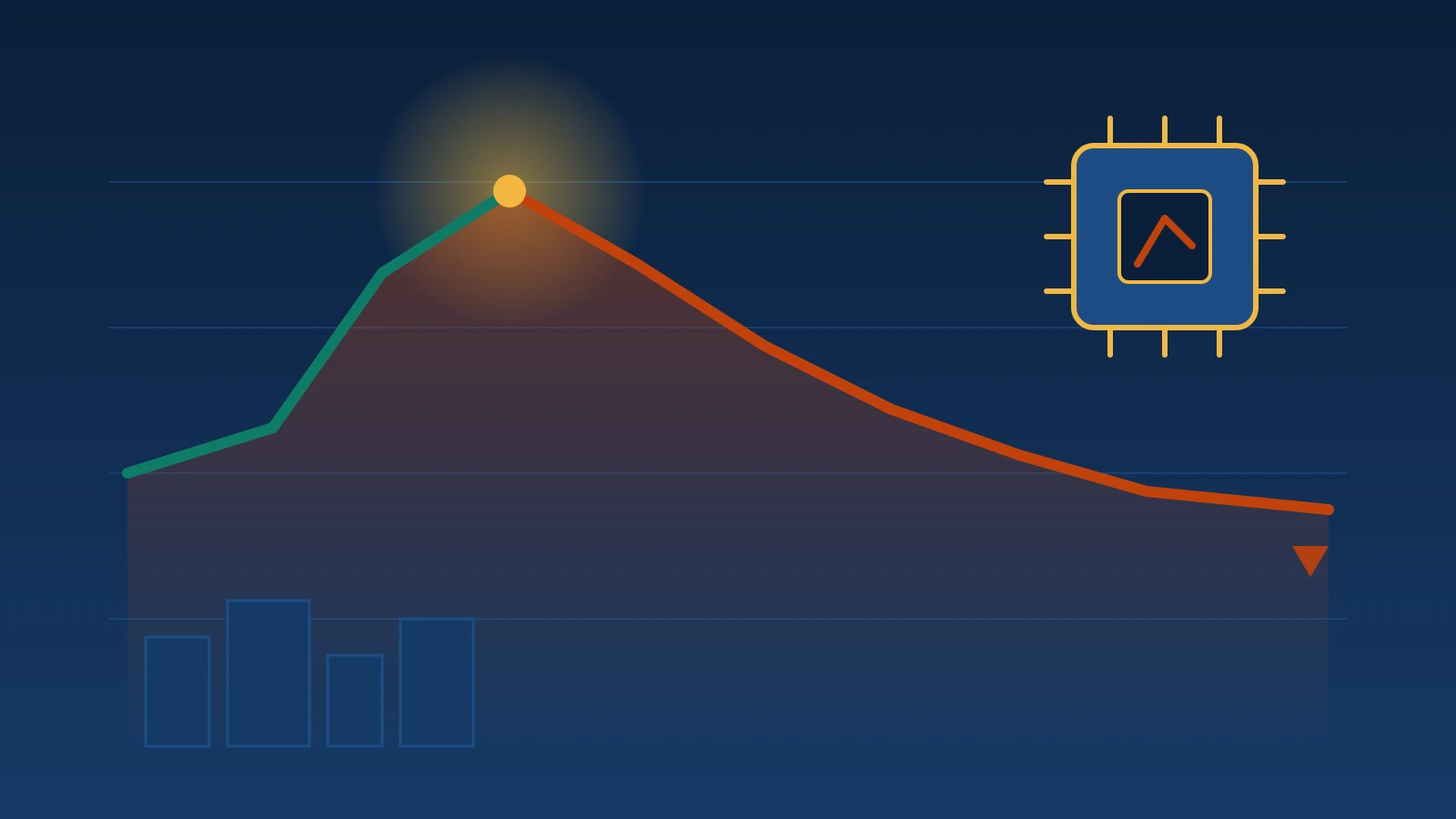
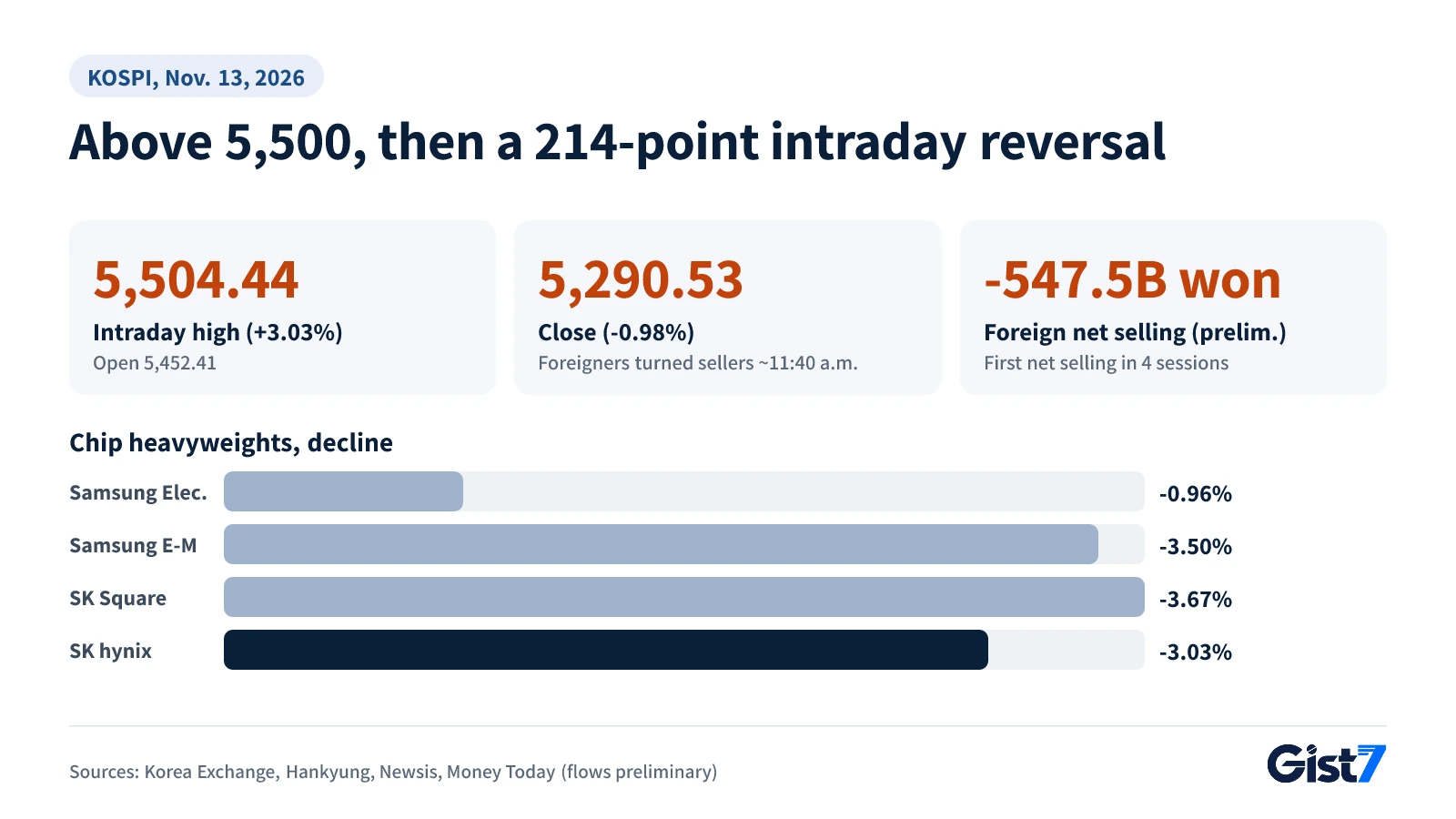
- The KOSPI opened at 5,452.41 (+2.05%), hit 5,504.44 and closed at 5,290.53 (-0.98%), a 245-point high-low range
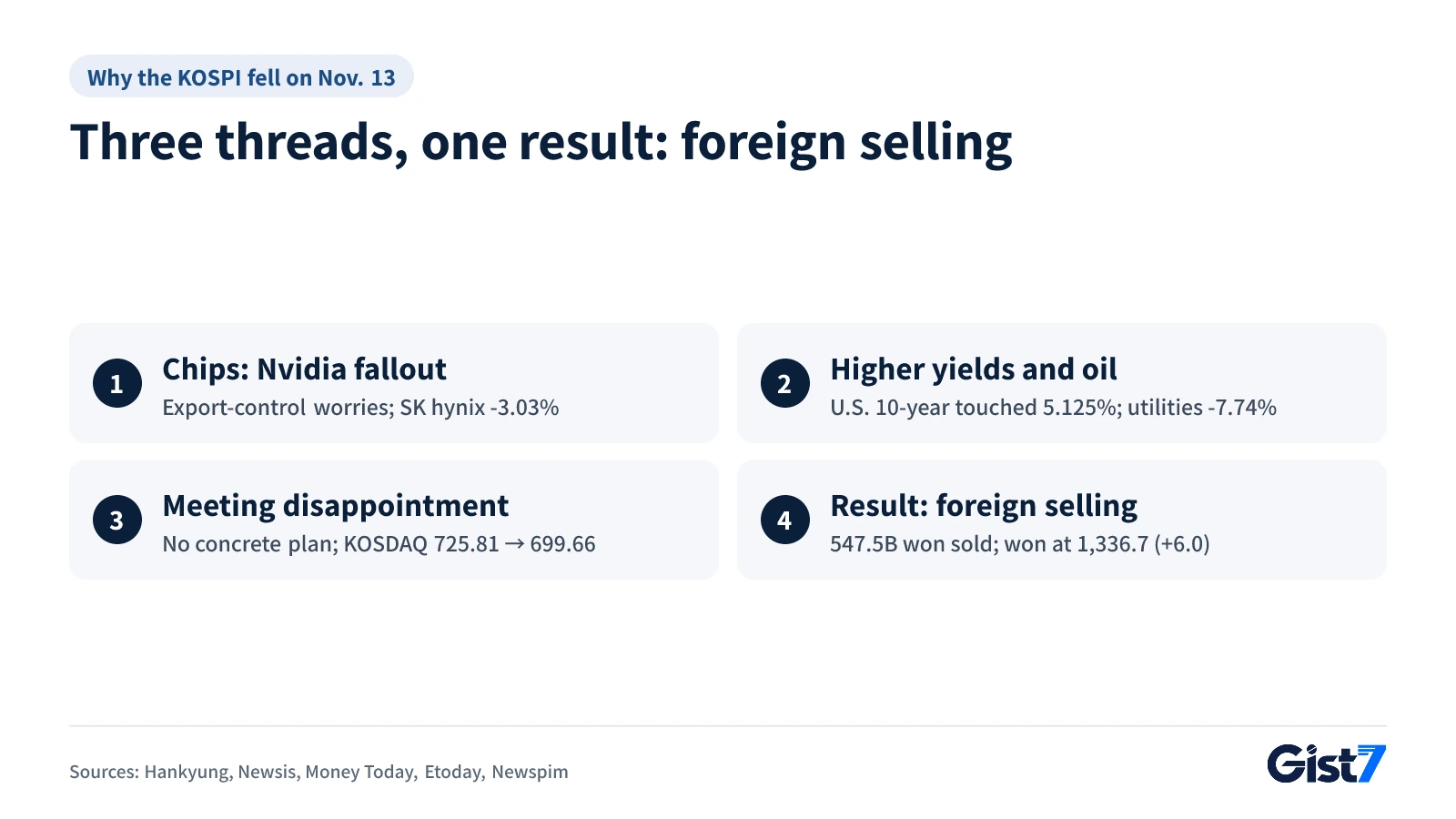
- Three threads: Nvidia-related export-control worries (chips), higher U.S. yields and oil (utilities -7.74%), and a disappointing policy meeting (mainly the KOSDAQ)
- Foreigners turned net sellers around 11:40 a.m. and sold 547.5 billion won (preliminary); the won weakened 6.0 won to 1,336.7 per dollar, its first decline in five sessions
- SK hynix -3.03%, Samsung Electro-Mechanics -3.50%, SK Square -3.67%, Samsung Electronics -0.96%. The KOSDAQ rose more than 4% to 725.81, then gave back most of it to close at 699.66 (+0.45%)
- For the week, the KOSPI gained 4.56% from the previous Friday's close (5.41% from Monday's), with all the gains on Tuesday and Wednesday
South Korea's KOSPI climbed as high as 5,504.44 early on Nov. 13, 2026, breaking above 5,500, then reversed to close at 5,290.53, down 52.20 points or 0.98%. The reasons the KOSPI fell come down to three threads: chip heavyweights shaken by Nvidia-related export-control worries, a jump in U.S. Treasury yields and oil prices overnight, and a presidential capital-market meeting that failed to deliver the KOSDAQ measures investors had hoped for. Against that backdrop, foreign investors turned net sellers around 11:40 a.m. local time, and their selling dragged the index down.
The index opened at 5,452.41 (+2.05%) and hit a low of 5,259.09, a 245-point gap between high and low, according to the Korea Economic Daily (Hankyung). A 3% gain turned into a 1% loss within a single session: a textbook intraday reversal.
Why the KOSPI fell: when did the turn come?
The index turned around 11:40 a.m. Korea time, when foreign investors switched to selling. Hankyung reported that foreigners became net sellers around then, and according to Newsis the index slipped into negative territory around 12:30 p.m. Preliminary closing data cited by Newsis and Money Today show foreigners net sold 547.5 billion won (about $410 million) of KOSPI shares, their first net selling in four sessions. Institutions (+2.3 billion won) and individuals (+17.1 billion won) were essentially flat.
| Time on Nov. 13 (KST) | KOSPI | What happened |
|---|---|---|
| 09:00 open | 5,452.41 (+2.05%) | Gapped up on the view that bad news from the U.S. was already priced in |
| Morning high | 5,504.44 (+3.03%) | Broke above 5,500 intraday |
| ~11:40 | Gains narrowing | Foreign investors turn net sellers |
| ~12:30 | Turns negative | Chip heavyweights turn lower |
| 14:13 | Intraday | Foreigners -524.4 billion won, institutions -200.5 billion won (intraday tally) |
| 15:30 close | 5,290.53 (-0.98%) | Foreigners -547.5 billion won (preliminary) |
Sources: Hankyung (timing, high and low, 2:13 p.m. tally); Newsis and Money Today (open, close, preliminary closing flows). Newspim put foreign net selling at 703.3 billion won, so figures vary by outlet.
Rates and oil were the second thread. According to Newspim, the 10-year U.S. Treasury yield touched 5.125% overnight, while West Texas Intermediate (WTI) crude reached $88.30 a barrel and Brent $95.60. Hankyung reported that oil jumped after President Trump posted that the U.S. does not need a deal with Iran. Fuel-heavy sectors took the first hit. The electricity and gas sector sank 7.74% (Newsis), and Korea Electric Power Corp. (KOSPI: 015760) fell 9.39% after third-quarter operating profit dropped 70.9% from a year earlier to 1.6441 trillion won, well short of the 2.4143 trillion won consensus (Hankyung).
The currency market showed the result. According to Etoday, the won weakened by 6.0 won to 1,336.7 per dollar at the 3:30 p.m. onshore close, the dollar's first gain against the won in five sessions. As of 3:40 p.m., the dollar index was down 0.06% at 103.11, so the won's slide owed less to global dollar strength than to higher oil and yields plus foreign stock selling. A day earlier, the won had strengthened yet the index still fell on institutional selling (KOSPI falls as institutions sell despite a stronger won). On Nov. 13, foreign selling, a weaker won and a falling index all pointed the same way.
How did Jensen Huang's resignation spread to Korean chip stocks?
Early in the session, Jensen Huang's resignation looked like news the market had already absorbed. Then worries about China-related allegations and tighter U.S. export controls took hold, and the stocks most tied to Nvidia's supply chain fell first. On Nov. 12 in New York, the day the resignation became public, Nvidia (Nasdaq: NVDA) dropped as much as 13.08% early before closing down 4.34% (Hankyung). The circumstances of the resignation and the interim CEO arrangement are covered in our piece on Huang's resignation and Nvidia shares.
The morning buying had a simple logic. Hankyung said buyers stepped in on the view that uncertainty around Nvidia's business was already reflected in prices, along with hopes for capital-market reform. What the market reassessed was the nature of the allegations. According to Newsis, reports linked a person connected to Huang with China's Ministry of State Security, and there were allegations of involvement in fundraising aimed at supplying Blackwell chips to DeepSeek. Hankyung attributed part of the KOSPI's decline to concern that U.S. export controls on China could tighten. Newspim reported that the chair of the Senate Banking Committee asked Huang and Commerce Secretary Howard Lutnick to testify on Dec. 3.
A change at the top alone might stay a corporate governance issue. Once it becomes a matter of national security and export controls, though, Nvidia's pool of buyers could shrink, and the order outlook for the Korean companies that make memory and components for its chips is shaken as well. SK hynix is regarded as a key supplier of high-bandwidth memory (HBM) for Nvidia's AI accelerators. HBM stacks multiple layers of DRAM so an AI accelerator can move large amounts of data at once.
| Stock | Change on Nov. 13 | Close |
|---|---|---|
| SK Square (KOSPI: 402340) | -3.67% | 762,000 won |
| Samsung Electro-Mechanics (KOSPI: 009150) | -3.50% | 855,000 won |
| SK hynix (KOSPI: 000660) | -3.03% | 1,216,000 won |
| Samsung Electronics (KOSPI: 005930) | -0.96% | 206,000 won |
| Shinhan Financial Group (KOSPI: 055550) | +5.65% | 89,800 won |
| KB Financial Group (KOSPI: 105560) | +4.74% | 159,000 won |
Sources: Money Today and Newsis, regular-session closing prices.
SK hynix, its shareholder SK Square and substrate maker Samsung Electro-Mechanics each lost more than 3%, while Samsung Electronics slipped less than 1%. The more a stock is seen as dependent on Nvidia, the harder it fell. Shinhan and KB Financial, by contrast, rose 4% to 5%. Gist 7 reads this as some of the money leaving chips rotating into banks and financials.
KOSDAQ hit 725, closed at 699: why did the meeting disappoint?
The tech-heavy KOSDAQ rallied more than 4% to an intraday high of 725.81, then gave back most of that gain to close at 699.66, up 0.45%. According to Money Today, President Lee Jae-myung chaired a capital-market policy meeting at the Korea Exchange in Seoul's Yeouido district at 9:30 a.m. On hopes of a KOSDAQ overhaul, the index peaked around the start of the meeting and slid after it ended. The third thread, disappointment over the meeting, showed up mainly in the KOSDAQ.
The core complaint was the absence of anything immediate. Lee Kyung-min, a researcher at Daishin Securities, said that with no immediate launch of a market stabilization fund and no concrete implementation plan, the meeting did little to meet hopes for short-term support measures (Hankyung, Money Today). A market stabilization fund is a pool of money from financial institutions used to buy shares and prop up the market during a sharp sell-off.
Institutions supported the KOSDAQ, buying a net 126 billion to 127 billion won, while foreigners sold a net 63 billion to 75 billion won (preliminary figures from Money Today and Hankyung, which differ). Rainbow Robotics (KOSDAQ: 277810) rose 5.21%, while chip-equipment names were weak, including EO Technics (KOSDAQ: 039030, -2.72%) and Wonik IPS (KOSDAQ: 240810, -1.89%). An index lifted by policy hopes tends to give back gains quickly when the announcement lacks detail.
KOSPI weekly recap: from 5,059 to 5,290
For the week of Nov. 9-13, the KOSPI rose 4.56% from the previous Friday's (Nov. 6) close of 5,059.69. Measured from Monday's close of 5,018.85, the gain was 5.41% (Gist 7 calculation). The weekly advance came entirely on Tuesday and Wednesday, and the index fell in each of the last two sessions.
| Date | Close | Change | Main story |
|---|---|---|---|
| Nov. 9 (Mon) | 5,018.85 | -0.81% | Foreigners net sell about 690 billion won |
| Nov. 10 (Tue) | 5,239.13 | +4.39% | First foreign net buying in eight sessions |
| Nov. 11 (Wed) | 5,375.36 | +2.60% | KOSDAQ buy sidecar two days in a row |
| Nov. 12 (Thu) | 5,342.73 | -0.61% | Institutional profit-taking |
| Nov. 13 (Fri) | 5,290.53 | -0.98% | Foreigners turn to net selling of 547.5 billion won |
Sources: Korea Exchange index data (via Financial News and Newsis closing reports); flows are preliminary. The Nov. 6 close is the Nov. 9 close plus that day's 40.84-point decline.
The early-week rebound is covered in our piece on the KOSPI's 4.39% rebound and foreign buying. Looking back over the week, foreign investors both lifted the index and pulled it down. The first things Gist 7 will check next week: whether the 10-year Treasury yield comes back below 5%, and how Nvidia's interim management addresses China and export controls in its earnings report. The answers will help show whether Friday's foreign selling was a one-day event.
Market impact map
Background: the 10-year U.S. Treasury yield touched 5.125% overnight and WTI crude hit $88.30 a barrel (Newspim). Both were drivers of Korea's market that day rather than assets moved by it, so they are left out of the table below.
| Asset / indicator | Direction | Strength | Link (why) |
|---|---|---|---|
| KOSPI | ↓ | Medium | Foreign net selling of 547.5 billion won → chip heavyweights turn lower → down 0.98% |
| USD/KRW | ↑ (weaker won) | Medium | Higher oil and Treasury yields, foreign stock selling → 1,336.7 won (+6.0 won) |
| Semiconductors | ↓ | Strong | Nvidia-related export-control worries → SK hynix -3.03%, Samsung Electro-Mechanics -3.50% |
| KOSDAQ | ↑ slightly | Weak | Rallied 4% on meeting hopes → gave it back with no concrete plan → +0.45% |
| Banks / financials | ↑ | Medium | Money rotating out of chips (Gist 7 reading) → Shinhan +5.65%, KB Financial +4.74% |
| Electricity / gas | ↓ | Strong | Higher oil and KEPCO's weak third quarter → sector -7.74% |
Little direct impact: 2-year Treasury, dollar index, gold, bitcoin, S&P 500, Nasdaq
- Currency exchange: the won weakened for the first time in five sessions to 1,336.7 per dollar, making dollar purchases slightly more expensive for Korean travelers and importers. Bank dealers expect a 1,320-1,350 range next week (Etoday).
- Fuel prices: higher international oil prices tend to show up in Korean gasoline and diesel prices with a lag of a few weeks.
- Equity funds and pensions: among Korean equity products, those heavy in chips and those heavy in financials had very different days.
Market reactions can vary with other factors, and this table is not a basis for investment decisions.
What to watch next
| Date (KST, with ET) | Indicator / event | Previous | Why it matters here | If it comes in... |
|---|---|---|---|---|
| Nov. 13 (Fri) 22:30 KST / 8:30 a.m. ET | U.S. October Producer Price Index (PPI) | September +1.3% m/m, +6.3% y/y (Bureau of Labor Statistics) | Treasury yields and the dollar → foreign flows into Korea | Hotter than expected: yields and dollar up, a headwind for emerging-market stocks |
| Nov. 18 (Wed) 07:00 KST / Nov. 17, 5 p.m. ET | Nvidia fiscal 2027 third-quarter earnings call | Company revenue outlook of $108.0 billion, ±2% (Nvidia) | First results under the interim CEO; Korean chip heavyweights | Confirmed AI demand: supportive for chip stocks. Bigger China or export-control uncertainty: a drag |
| Nov. 26 (Thu) | Bank of Korea monetary policy decision | Base rate 3.00% (Bank of Korea) | USD/KRW and foreign capital flows | A hike would support the won; a hold leaves external factors in charge |
| Dec. 10 (Thu) 04:00 KST / Dec. 9, 2 p.m. ET | Federal Open Market Committee (FOMC) decision (Dec. 8-9 meeting) | 3.75%-4.00% (Federal Reserve, Oct. 28) | Pressure from 10-year yields above 5% | A large hike: dollar up, pressure on emerging-market stocks; a small one: the opposite |
Dates are based on the BLS PPI release schedule, Nvidia's announcement (earnings call at 5 p.m. ET on Nov. 17), the Bank of Korea's monetary policy meeting calendar and the Fed's FOMC calendar.
Frequently asked questions
Why did the KOSPI fall today?
On Nov. 13, 2026, the KOSPI closed down 0.98% at 5,290.53 after foreign investors turned net sellers around 11:40 a.m., amid Nvidia-related export-control worries, higher U.S. yields and oil, and disappointment over a capital-market meeting. A 3% intraday gain turned into a loss.
How did Jensen Huang's resignation affect SK hynix and Samsung Electronics?
Chip stocks opened higher on the view that the news was already priced in, but SK hynix closed down 3.03% while Samsung Electronics slipped only 0.96%. Hankyung attributed the decline partly to concern over tighter U.S. export controls on China, and stocks seen as more dependent on Nvidia fell harder.
Why did the KOSDAQ hit 725 and then close at 699?
Hopes for the capital-market policy meeting chaired by President Lee Jae-myung lifted the KOSDAQ more than 4% to 725.81, but no concrete steps, such as an immediate market stabilization fund, emerged. The index gave back most of its gain and closed at 699.66, up 0.45%.
How are foreign selling and the won-dollar exchange rate linked?
Foreign investors who sell Korean shares and take money out must convert won into dollars, so heavy net selling tends to weaken the won. On Nov. 13, higher oil prices and Treasury yields added to that, and the won closed 6.0 won weaker at 1,336.7 per dollar.
How much did the KOSPI gain this week?
For Nov. 9-13, 2026, the KOSPI rose 4.56% from the previous Friday's close of 5,059.69, or 5.41% from Monday's close of 5,018.85 (Gist 7 calculation). The gains came on Tuesday (+4.39%) and Wednesday (+2.60%); Thursday and Friday were down days.
References
- 코스피, 돌아선 외국인에 하락 반전…1% 내린 5290선 마감 — 뉴시스 (2026-11-13)
- 실행안 없는 간담회에 코스닥 700 아래로…코스피, 외인 매도에 하락 — 머니투데이 (2026-11-13)
- "잘가요 젠슨 황"…불륜·사퇴 충격에 코스피 5300선 아래로 — 한국경제 (2026-11-13)
- [마켓라이브] 5500 찍고 5290으로 밀린 코스피…반도체 하락 전환, 은행주는 강세 — 한국경제 (2026-11-13)
- [환율마감] 원·달러 5거래일만 반등, 유가·미국채 금리 급등 — 이투데이 (2026-11-13)
- [마감시황] 코스피, 외인 7000억 '팔자'에 5200선 후퇴 — 뉴스핌 (2026-11-13)
- 코스피 5018.85 마감 (뉴시스, 파이낸셜뉴스 게재, 2026-11-09)
- Schedule of Releases for the Producer Price Index — 미 노동통계국(BLS)
- NVIDIA Sets Conference Call for Third-Quarter Financial Results — NVIDIA
- 통화정책방향 결정회의 일정 — 한국은행
- Meeting calendars and information — 미 연방준비제도