Hot October CPI Sends 10-Year Yield Near 5%: Fed Hike Locked In?
Key summary
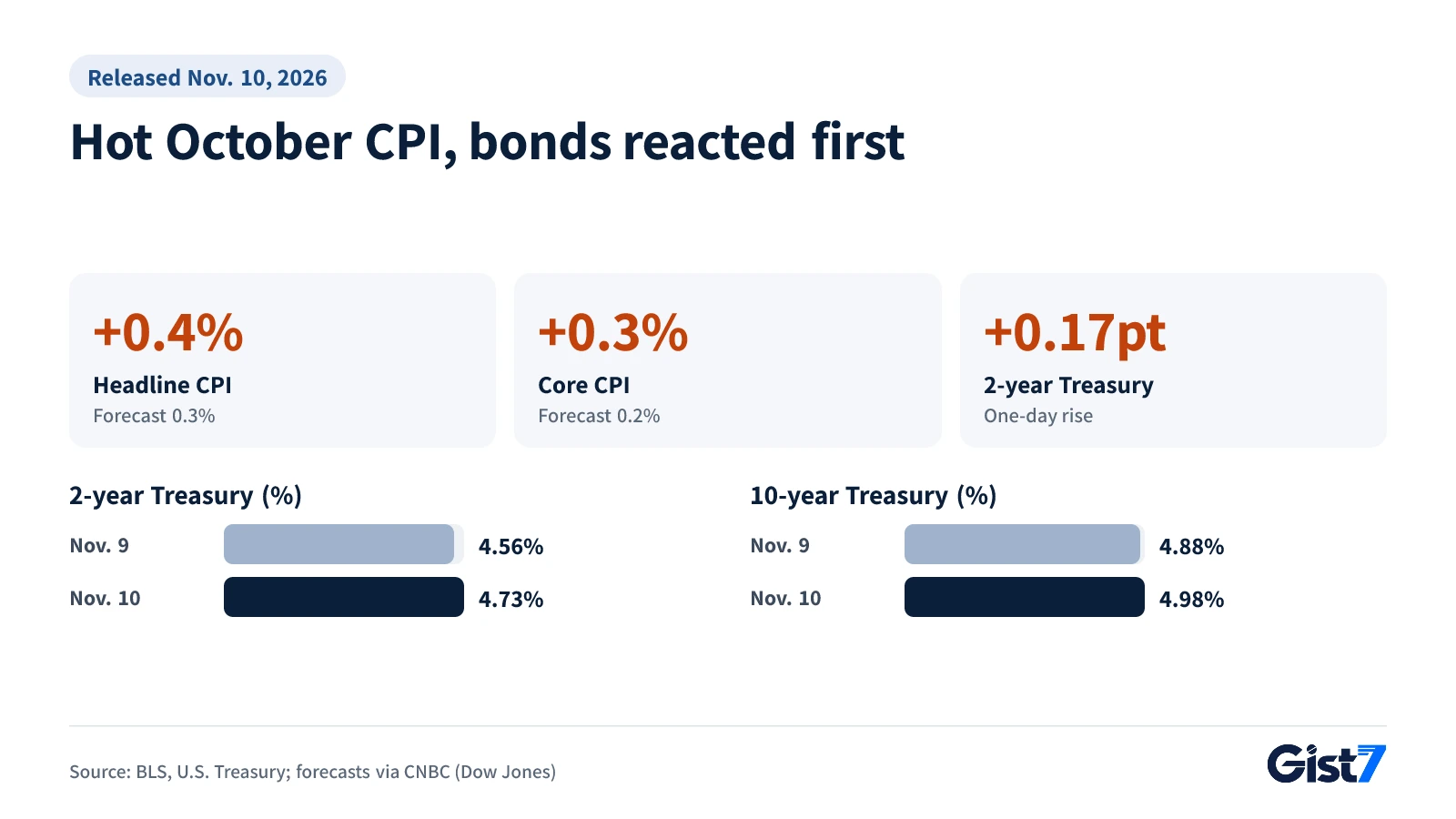
The October CPI rose 0.4% and core 0.3%, beating forecasts, the BLS said on Nov. 10, 2026. The 2-year Treasury yield jumped 0.17 point to 4.73% and the 10-year hit 4.98%. Markets fully price a December quarter-point hike, but the FOMC decides Dec. 8-9, after PPI, PCE and jobs data.
- October CPI +0.4% m/m (forecast 0.3%), core +0.3% (forecast 0.2%); no year-over-year rate because of the 2025 shutdown (BLS)
- 2-year Treasury 4.56% → 4.73% (+0.17 point), 10-year 4.88% → 4.98% (+0.10 point), Treasury Department, Nov. 10
- Waller: a 50-basis-point December hike should be considered if core is around 0.3% or higher; Logan: at least two more quarter-point hikes
- S&P 500 -0.38%, Nasdaq -0.74%, Dow -0.30% (Yahoo Finance closing data); rate-sensitive tech fell the most
- Before the December FOMC: PPI (Nov. 13), PCE (Nov. 25), jobs (Dec. 4); November CPI comes Dec. 10, after the meeting
The October CPI report showed U.S. consumer prices up 0.4% from September, the Bureau of Labor Statistics (BLS) said on November 10, 2026, topping the 0.3% economists had expected. Core CPI, which strips out food and energy, climbed 0.3% versus a 0.2% forecast. The hot October CPI report sent the 2-year Treasury yield up 0.17 percentage point in a single session and the 10-year up 0.10 point, leaving the 10-year at 4.98% (Nov. 10, Treasury Department) and within reach of 5%. Markets now price a December Fed rate hike as a near certainty, but the size of that move and the path after it are still open questions.
How hot was the October CPI report?
Both headline and core came in 0.1 point above forecasts, and core CPI has now printed 0.3% for three straight months, August through October. What unsettled investors was not a one-off surprise but the same pace showing up again and again.
| Item (month over month, seasonally adjusted) | Oct. 2026 | Sept. 2026 | Forecast |
|---|---|---|---|
| Headline CPI | +0.4% | +0.6% | +0.3% |
| Core CPI (ex food and energy) | +0.3% | +0.3% | +0.2% |
| Energy | +0.7% | +5.2% | - |
| Food | +0.5% | 0.0% | - |
| Shelter | +0.3% | +0.4% | - |
Source: BLS October CPI release; forecasts are the Dow Jones consensus as reported by CNBC.
According to the BLS, shelter accounted for more than 30% of the headline increase. CNBC noted that electricity rose 0.9% and transportation services 0.8%. The pressure came from two directions. Gasoline prices actually fell 0.7% before seasonal adjustment, but after adjustment the index rose 1.0%, which kept energy positive at +0.7%. On the core side, shelter, electricity and transportation services did the heavy lifting.
There is no year-over-year rate this time. Because of the 2025 federal government shutdown, the BLS did not collect October 2025 survey data, so there is no base month to compare against. For a longer view, Dallas Fed President Lorie Logan said in a speech the same day that the PCE price index, the Fed's preferred gauge, rose 3.6% in the 12 months through September, with core PCE up 3.1%. Our preview of the release schedule and forecasts is in this week's CPI and economic calendar.
Why did the 2-year yield jump more than the 10-year?
The 2-year note is the yield most sensitive to the next few Fed decisions, so it moved the most as bets on a December hike firmed up. Based on Treasury Department daily par yields, the 2-year rose from 4.56% on Nov. 9 to 4.73% on Nov. 10, up 0.17 point, while the 10-year climbed from 4.88% to 4.98%, up 0.10 point. The 30-year rose 0.09 point to 5.35%.
When short-term rates rise faster than long-term rates, the yield curve flattens. The gap between the 10-year and 2-year narrowed from 0.32 point to 0.25 point in one day. In other words, the market leaned toward the view that inflation is hot enough to require higher rates now. The 10-year had already touched 4.95% on Nov. 3 (Treasury), but this time a single inflation report added 0.1 point in a day. That looks like traders recalculating the Fed's rate path.
Did the CPI report lock in a December rate hike?
Markets treat a December hike as a done deal, but the decision belongs to the Federal Open Market Committee (FOMC), which meets Dec. 8-9. According to the CME FedWatch tool, as reported by CNBC, traders fully priced in a quarter-point hike after the release, and the odds of a half-point move jumped from roughly zero to 13.6%.
Voices inside the Fed are leaning the same way.
- Fed Governor Christopher Waller said in a speech in London on Nov. 10 that he is leaning toward supporting a 25-basis-point increase in December. But if October core CPI came in "around 0.3 percent or even higher," he said a 50-basis-point hike "should be considered," warning that hiking only 25 basis points "would put our credibility at risk." The core reading released that morning met his condition.
- Dallas Fed President Lorie Logan said the same day that the FOMC needs "at least two more" quarter-point increases. The Fed raised its target range by 25 basis points to 3.75%-4.00% in September and held in October, which Logan described as a matter of pace rather than a change of destination.
- The October hold itself was a 10-2 vote. The dissenters, Governor Lisa Cook and Cleveland Fed President Beth Hammack, already wanted a quarter-point hike (Fed statement).
Still, calling the hike certain skips a few hurdles. Before the December meeting come October producer prices (Nov. 13), October PCE (Nov. 25) and the November jobs report (Dec. 4). November CPI, by contrast, isn't due until Dec. 10, the day after the meeting ends. Gist 7's read: this CPI report shifted the debate away from whether the Fed hikes in December and toward how much (25 or 50 basis points) and how many more hikes follow early next year.
Why a 5% 10-year yield weighs on stocks
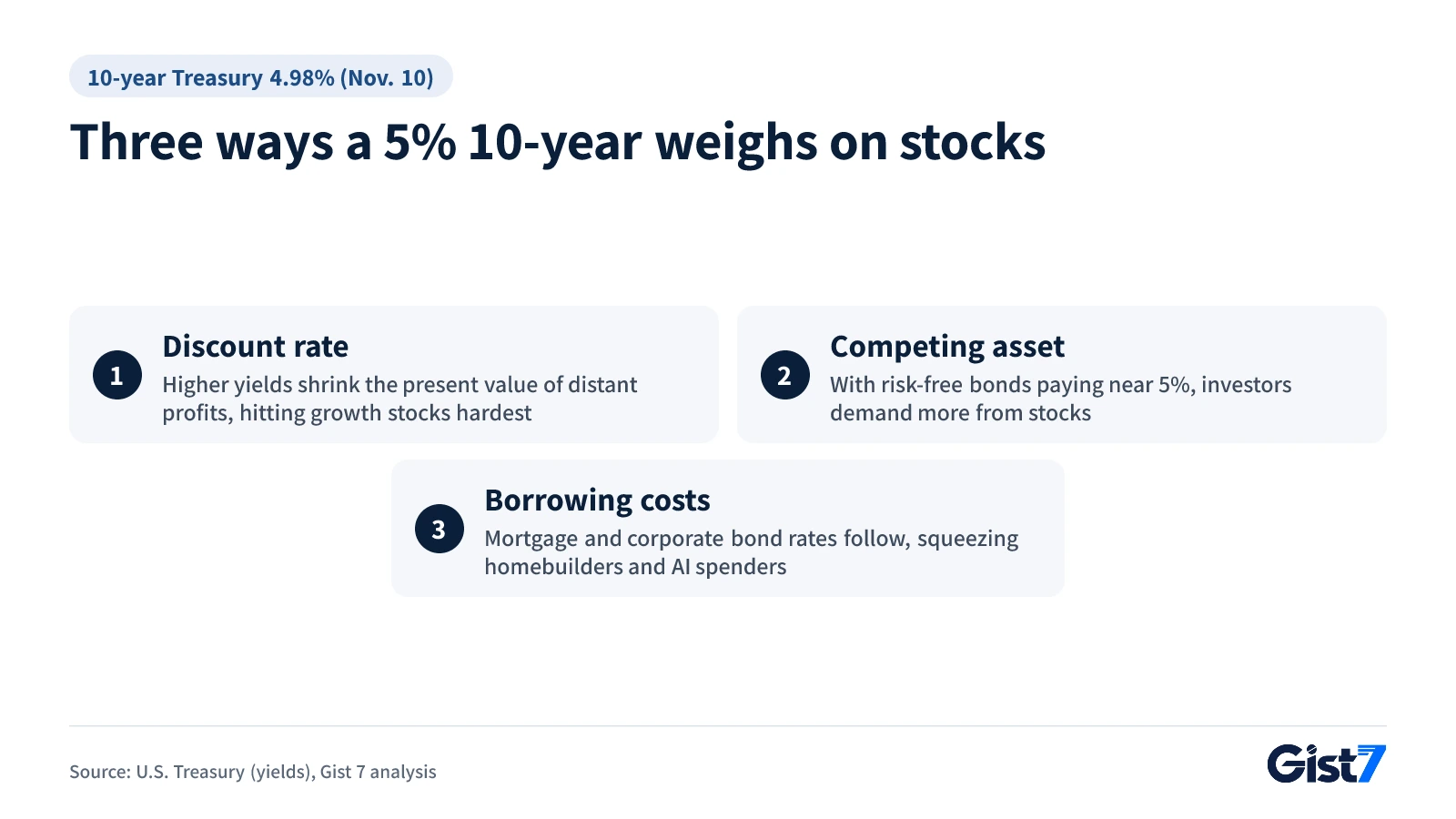
The 10-year Treasury yield anchors the discount rate investors use to value stocks, so when it pushes toward 5%, the present value of profits expected far in the future shrinks. Based on Yahoo Finance closing data, the S&P 500 fell 0.38% to 7,520.93 on Nov. 10, the Nasdaq Composite dropped 0.74% to 25,065.88 and the Dow Jones Industrial Average slipped 0.30% to 52,231.89. The tech-heavy Nasdaq, whose companies lean most on distant earnings, took the bigger hit. In Seoul, the report landed after the market had already closed with a 4.39% KOSPI rebound and the first foreign net buying in eight sessions, so any impact on Korean stocks would show up only in the Nov. 11 session.
The pressure builds through three channels: the discount rate, competition from bonds and the cost of borrowing (see the graphic below). The one to watch right now is borrowing costs. The 10-year is the benchmark for 30-year fixed mortgage rates and corporate bond yields, so homebuilders that depend on housing demand and AI companies borrowing to build data centers tend to feel it first. We looked at that debt load in our piece on CoreWeave's earnings and the AI debt burden.
Nvidia (Nasdaq: NVDA) fell nearly 6% at one point during the session. Yahoo Finance said the broader tech selloff was compounded by the board's independent investigation involving CEO Jensen Huang. With a rate shock and a company-specific overhang hitting at once, it would be a stretch to blame the whole drop on CPI.
Market impact map
| Asset / indicator | Direction | Strength | Why |
|---|---|---|---|
| 2-year Treasury | ↑ | Strong | Bets on a December hike, and possibly a half-point move, priced in immediately (4.56% → 4.73%, Treasury) |
| 10-year Treasury | ↑ | Strong | Worries about sticky inflation lifted long-term yields too (4.88% → 4.98%, Treasury) |
| Dollar index | ↑ pressure (actual move not yet confirmed) | Medium | Expectations that U.S. rates will rise faster than elsewhere tend to boost demand for dollars |
| Won/dollar (Korea's main exchange rate) | ↑ pressure | Medium | Seoul's daytime close of 1,337.5 won (down 9.6 won, Seoul Economic Daily) came before CPI; dollar strength could show up afterward |
| Gold | ↓ | Medium | Gold pays no interest and suffers when real rates rise. Gold futures about -1.8% at $4,041.40 an ounce (Yahoo Finance quotes, afternoon of Nov. 10 ET) |
| S&P 500 | ↓ | Weak | Higher discount rate weighs on valuations (-0.38%) |
| Nasdaq | ↓ | Medium | Tech stocks that rely on distant earnings are more rate-sensitive (-0.74%) |
| Bitcoin | ↓ | Medium | Higher rates tend to cool appetite for risk assets. About -1.4%, near $73,900 (Yahoo Finance quotes, afternoon of Nov. 10 ET) |
| KOSPI (Korea's benchmark index) | ↓ pressure | Weak | The 4%-plus rebound on Nov. 10 came before CPI; higher U.S. yields could dampen risk appetite |
| Homebuilders / REITs | ↓ | Medium | Mortgage rates tied to the 10-year move higher |
| Treasury yield curve (10-year minus 2-year) | Flatter | Medium | Short-term yields rose more, 0.32 point → 0.25 point |
Little direct impact: Oil (WTI). December WTI was down about 0.55% (Yahoo Finance quotes), and crude's own supply story appears to have mattered more than CPI.
- Borrowing: When U.S. yields rise, market rates elsewhere, including Korea's, tend to follow, which can put upward pressure on fixed-rate mortgages.
- Travel and overseas shopping: If the dollar strengthens again, the won could give back its Nov. 10 gains, making dollar payments more expensive for Korean consumers.
- U.S. stock investors: Portfolios heavier in growth stocks tend to swing more with rate moves.
Market reactions can vary with other factors, and this table is not a basis for investment decisions.
What to watch next
| Date (ET) | Indicator / event | Previous | Why it matters here | If it comes in... |
|---|---|---|---|---|
| Fri., Nov. 13, 8:30 a.m. | U.S. October Producer Price Index (PPI) | Sept.: +1.3% m/m, +6.3% y/y (BLS) | Shows whether pipeline prices are feeding into consumer prices | Hotter than expected: odds of a half-point hike and Treasury yields tend to rise |
| Wed., Nov. 25, 8:30 a.m. | October PCE prices + Q3 GDP second estimate (BEA) | Sept. PCE +3.6% y/y, core +3.1% (Dallas Fed speech) | The inflation gauge the Fed targets | Core above 0.3% could intensify the debate over hike size |
| Fri., Dec. 4, 8:30 a.m. | November jobs report | Oct.: payrolls +165,000, unemployment 4.1% (BLS) | Whether the economy can absorb more hikes | Strong hiring keeps the hiking path intact; a sharp slowdown argues for a slower pace |
| Wed., Dec. 9, 2:00 p.m. | FOMC rate decision and projections (Dec. 8-9 meeting) | Target range 3.75%-4.00% (Fed) | The answer to this article's central question | A half-point hike would tend to lift the 2-year and the dollar and weigh on growth stocks |
| Thu., Dec. 10, 8:30 a.m. | U.S. November CPI | Oct.: +0.4% m/m, core +0.3% (BLS) | First inflation reading after the FOMC | Another 0.3% or higher would raise bets on more hikes early next year |
Frequently asked questions
How much did U.S. CPI rise in October 2026?
The BLS said CPI rose a seasonally adjusted 0.4% in October and core CPI rose 0.3%, versus Dow Jones consensus forecasts of 0.3% and 0.2%. No annual rate was published because the 2025 shutdown prevented October 2025 data collection.
Why did Treasury yields rise after the CPI report?
The hotter-than-expected inflation data raised expectations that the Fed will hike in December and might move by more than a quarter point. On Nov. 10, the 2-year yield rose 0.17 point to 4.73% and the 10-year rose 0.10 point to 4.98%, based on Treasury Department data.
Is a December Fed rate hike certain?
Not officially, since the FOMC decides on Dec. 8-9. But CME FedWatch, as reported by CNBC, showed a quarter-point hike fully priced in, and both Governor Waller and Dallas Fed President Logan backed tightening. The open questions are the size of the move and how many more follow.
Why does a 5% 10-year Treasury yield hurt stocks?
The 10-year yield anchors the discount rate used to value stocks, so a higher yield shrinks the present value of future profits. When the 10-year hit 4.98% on Nov. 10 (Treasury), the tech-heavy Nasdaq fell 0.74%, about twice the S&P 500's 0.38% drop (Yahoo Finance closing data).
What condition did Waller set for a half-point hike?
In his Nov. 10 speech, Waller said a 50-basis-point hike should be considered in December if October core CPI came in around 0.3% or higher. Core CPI printed 0.3% that morning, and CME FedWatch odds of a half-point hike rose to 13.6% (CNBC).
Do higher U.S. rates affect loan rates in other countries like Korea?
Not directly, but when U.S. Treasury yields rise, market rates in other countries, including Korea, tend to follow, which can push up fixed-rate loans. The actual effect depends on local central bank decisions, such as the Bank of Korea's, and domestic bond markets.
References
- Consumer Price Index – October 2026 (U.S. Bureau of Labor Statistics)
- Daily Treasury Par Yield Curve Rates, November 2026 (U.S. Department of the Treasury)
- The Economic Outlook and Some Thoughts on Labor Market Dynamism, Waller (Federal Reserve)
- Economic and monetary policy outlook, Logan (Federal Reserve Bank of Dallas)
- CPI inflation report: October 2026 (CNBC)
- Stock market today: Dow, S&P 500, Nasdaq slip as hot CPI fuels rate hike odds (Yahoo Finance)
- Won-dollar rate falls for second day, closes at 1,337.5 won (Seoul Economic Daily, Korean)
- Federal Reserve issues FOMC statement, Oct. 28, 2026 (Federal Reserve)
- Release Calendar 2026 (U.S. Bureau of Labor Statistics)
- Release Schedule (U.S. Bureau of Economic Analysis)
- Meeting calendars and information (Federal Reserve)