KOSPI Rebound of 4.39%: Is Foreign Buying a Bottom Signal?
Key summary
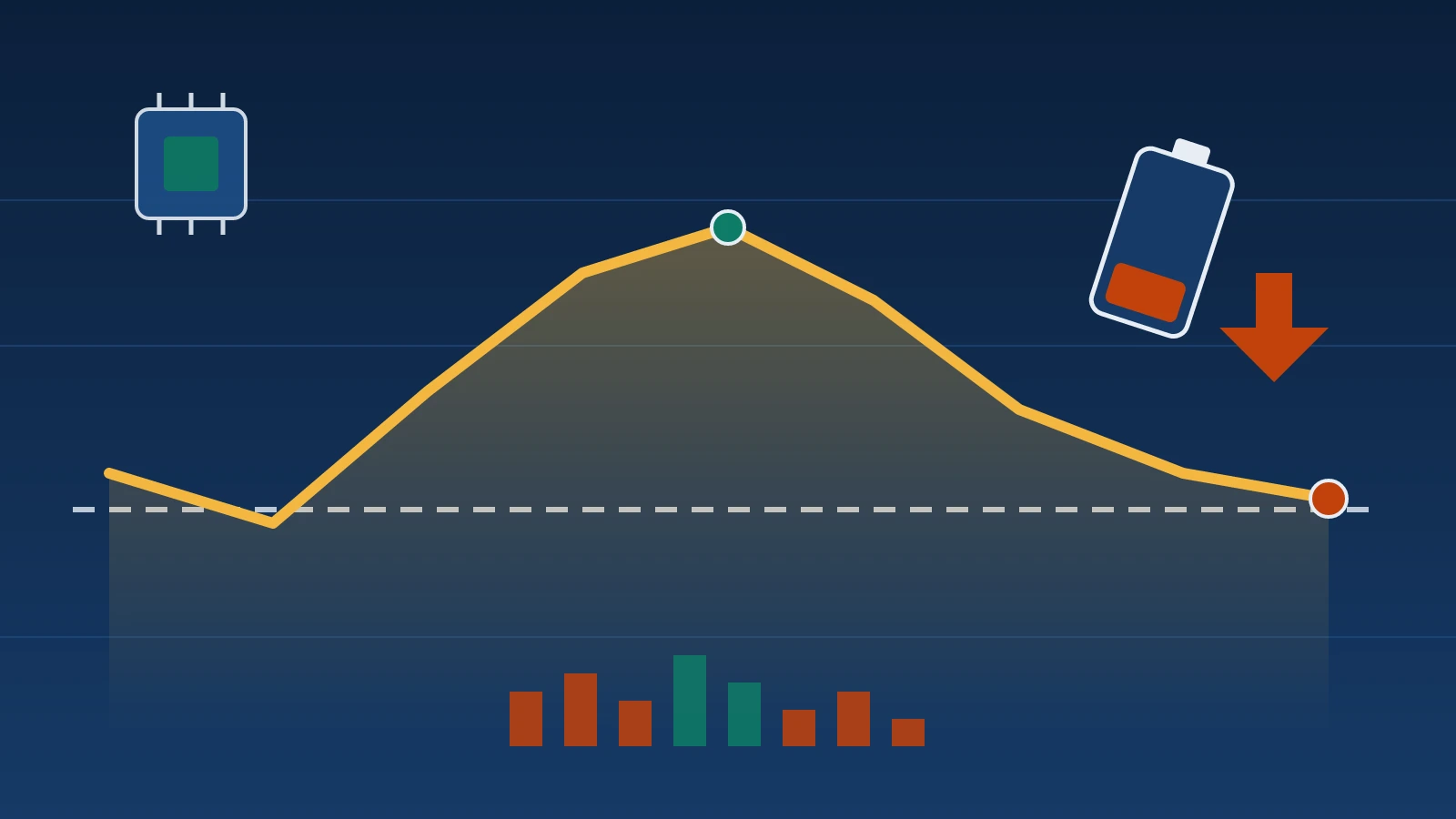
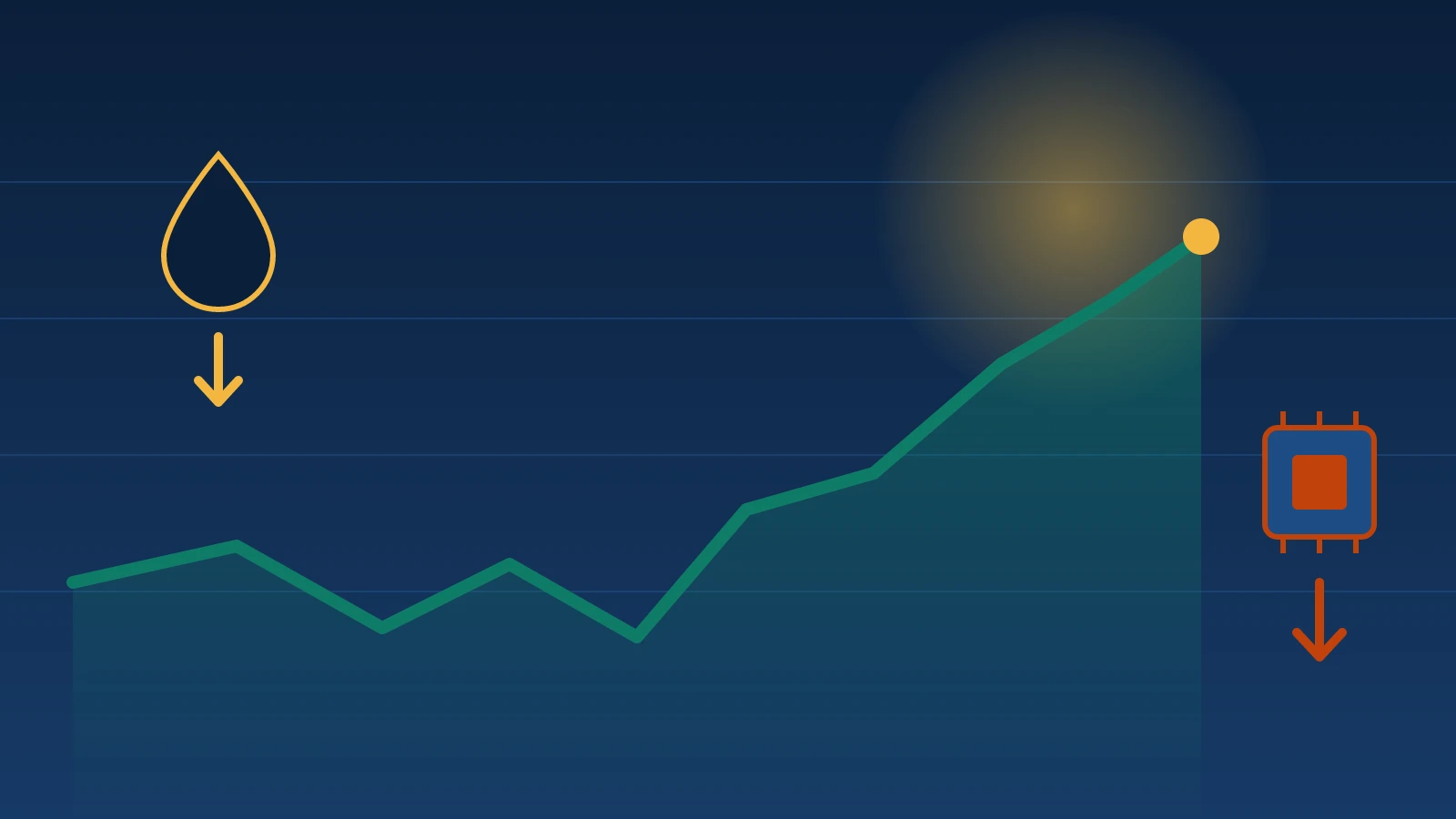
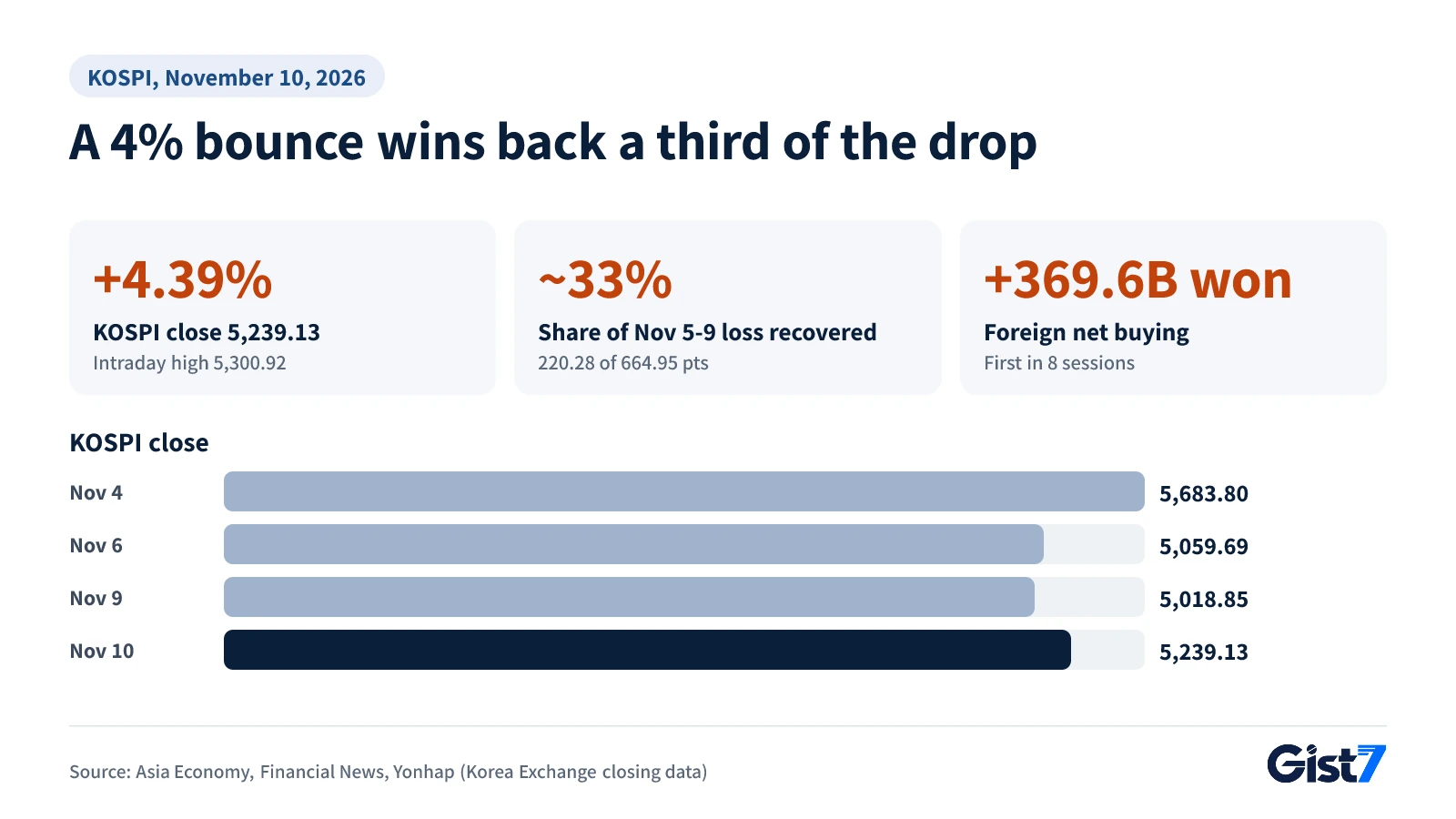
On November 10, 2026, the KOSPI jumped 4.39% to 5,239.13, a KOSPI rebound after the U.S. SOX chip index rose 6.86% and foreigners net bought about 369.6 billion won. It regained only ~33% of its 3-day loss, and that buying was 3% of the prior seven sessions' selling: too early to call a bottom.
- The KOSPI closed at 5,239.13 on Nov 10, up 220.28 points (4.39%), after touching 5,300.92 intraday
- The trigger was a 6.86% overnight surge in the Philadelphia Semiconductor Index; Samsung Electronics rose 4.74% and SK hynix 6.69%
- Foreign investors net bought about 369.6 billion won, their first net buying in eight sessions (Asia Economy), while individuals net sold about 1.3414 trillion won
- The dollar-won rate closed the day session at 1,337.5 won, down 9.6 won, a second straight day of won strength
- The index recovered only about 33% of its Nov 5-9 loss, and retail selling outweighed foreign and institutional buying combined, so a bottom call is premature
On November 10, 2026, Korea's benchmark KOSPI closed at 5,239.13, up 220.28 points or 4.39%, according to Korea Exchange closing data reported by Asia Economy. The KOSPI rebound was the first gain in four sessions. The main trigger was a 6.86% overnight jump in the Philadelphia Semiconductor Index in the U.S. (M Economy News). Six minutes after the open, at 9:06 a.m. Korea time, a buy-side "sidecar" kicked in, and the index touched an intraday high of 5,300.92. The tech-heavy KOSDAQ rose 4.48% to 667.61. Foreign investors turned net buyers for the first time in eight sessions, and the won strengthened: the dollar-won rate closed the onshore day session at 1,337.5 won per dollar, down 9.6 won (Blockmedia).
A buy-side sidecar is a Korea Exchange mechanism that suspends program buy orders for five minutes when futures prices surge. On this day it was triggered on both the KOSPI and the KOSDAQ.
How much of the three-day loss did the KOSPI rebound recover?
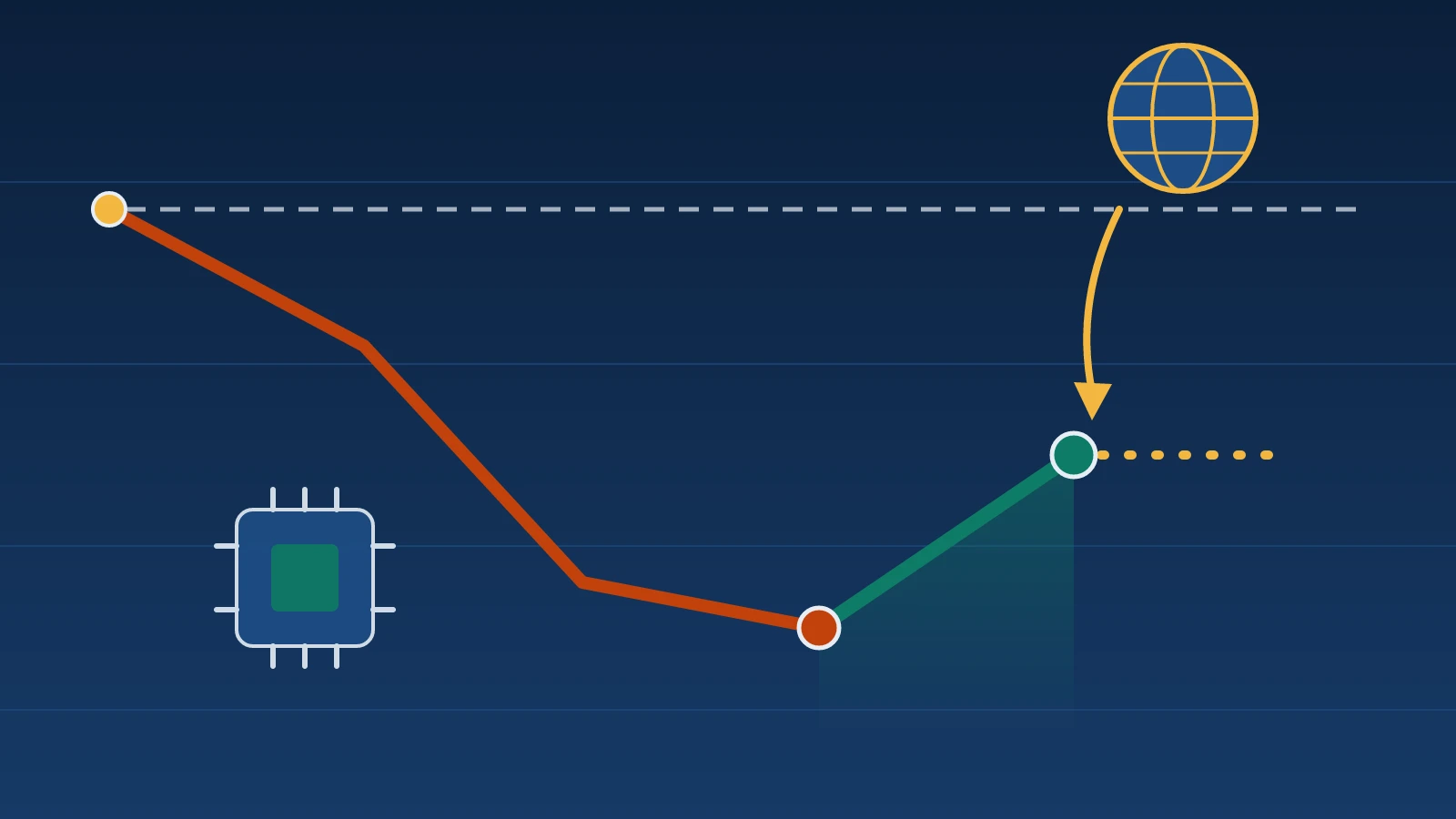
The November 10 close won back 220.28 of the 664.95 points lost on November 5, 6 and 9, or about 33%. The index still sits 444.67 points (about 7.8%) below its November 4 close of 5,683.80.
| Date | KOSPI close | Change vs. prior session |
|---|---|---|
| Nov 4 | 5,683.80 | Reference point |
| Nov 5 | 5,383.80 | -300.00 pts (-5.28%) |
| Nov 6 | 5,059.69 | -324.11 pts (-6.02%) |
| Nov 9 | 5,018.85 | -40.84 pts (-0.81%) |
| Nov 10 | 5,239.13 | +220.28 pts (+4.39%) |
Sources: Financial News (Nov 5), Yonhap (Nov 6), Asia Economy (Nov 10). The Nov 4 and Nov 9 closes, and the point changes for Nov 6 and Nov 9, are calculated from the following day's close and change.
Measured from the intraday high of 5,300.92, the index had retraced about 42% of the decline, but gains narrowed in the afternoon. Blockmedia attributed that to caution ahead of this week's U.S. consumer price index (CPI) report and earnings from AI companies. To get back to the November 4 level, the KOSPI would need to climb roughly another 8.5%.
Who bought and who sold on the KOSPI rebound day
According to Asia Economy's tally for the main board on November 10, individual investors were net sellers of about 1.3414 trillion won (roughly $1.0 billion at the day's exchange rate), while foreign investors were net buyers of about 369.6 billion won and institutions net buyers of about 488.9 billion won. Net buying means purchases exceeded sales. Preliminary figures for foreign net buying vary by outlet, from 353.2 billion to 369.6 billion won; this article uses Asia Economy's number.
Han Ji-young, a strategist at Kiwoom Securities (KOSPI: 039490), told Digital Today that the recent drop was comparable to past major crises, and that a habit of treating every bounce as a chance to sell is weighing on sentiment. Retail net selling on the 10th was larger than foreign and institutional net buying combined (about 858.5 billion won). In Gist 7's view, that selling volume, more than the fact that foreigners bought, was the defining feature of the session.
The foreign buying was also small. According to M Economy News, foreign investors sold a net 1.7929 trillion won per day on average over the seven sessions from October 30 to November 9. Over seven sessions that comes to about 12.5 trillion won (Gist 7 calculation), so the 10th's purchase was roughly 3% of it. Lee Kyung-soo of Hana Securities (unlisted; parent Hana Financial Group, KOSPI: 086790) said foreign selling has persisted for more than 10 months and become entrenched, and that a return to net foreign buying may come only "at least three months" from now (M Economy News).
The dollar-won rate jumped 14.5 won in one day to 1,356.6 won at 3:30 p.m. on November 6 (Yonhap). It then fell for two days, to 1,347.1 won on the 9th and a day-session close of 1,337.5 won on the 10th, below its level on the 5th before the spike. The shift to foreign net buying and a sharp drop in oil (WTI at $86.85 a barrel, down 4.38%, per Asia Economy) may both have played a part on the 10th. But the won also strengthened on the 9th, when foreigners were still selling, so equity flows alone do not explain the move.
How to judge whether the KOSPI has bottomed
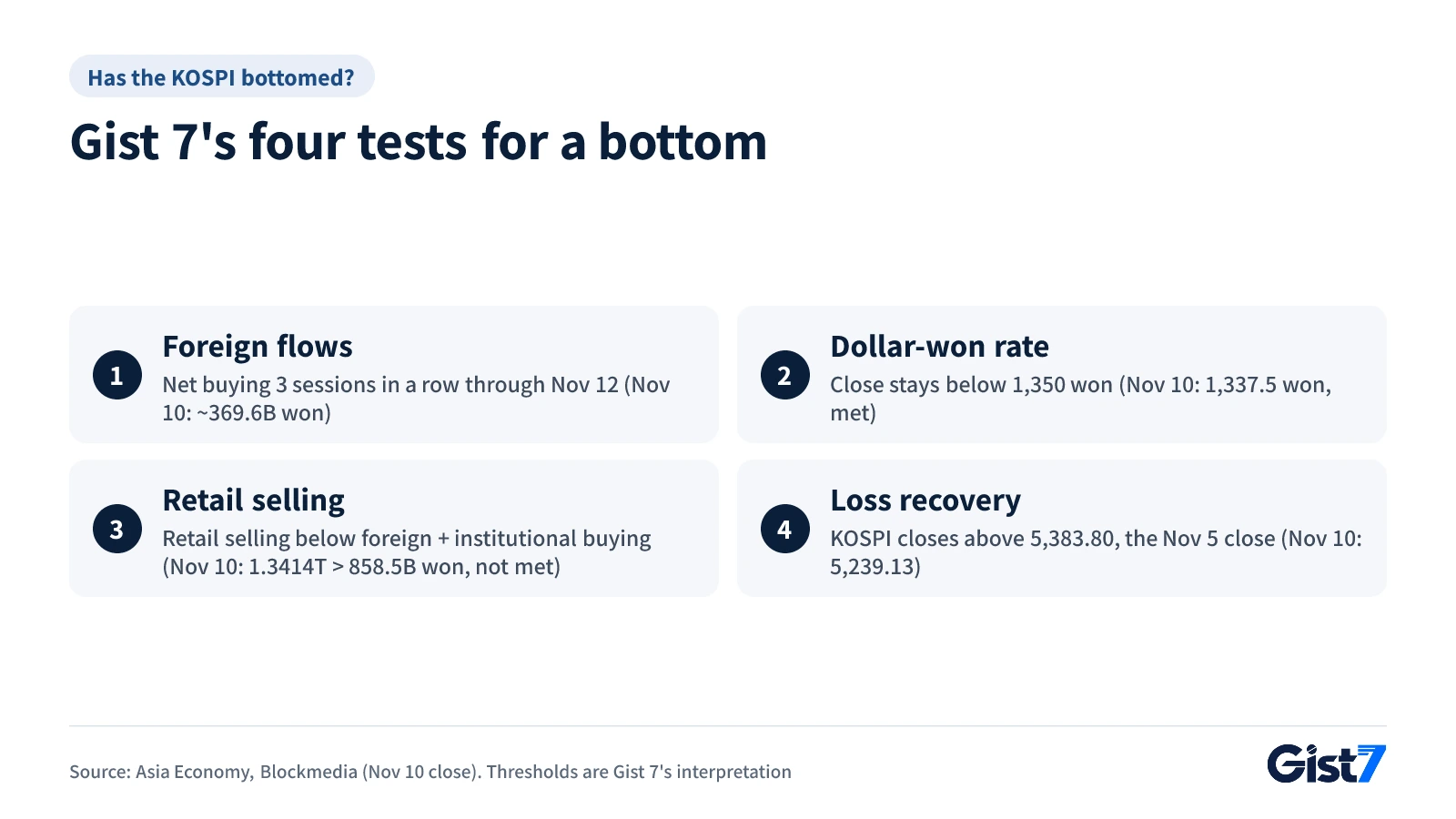
One day of gains is not enough to tell. Gist 7 uses the four thresholds below to confirm a bottom. They are this article's interpretation, not an official market standard.
| Test | Status on Nov 10 | Gist 7 threshold |
|---|---|---|
| Foreign flows | First net buying in 8 sessions, about 369.6 billion won | Net buying for 3 straight sessions through Nov 12 |
| Dollar-won rate | Day-session close 1,337.5 won, down two days in a row | Close holds below 1,350 won |
| Retail selling pressure | Retail selling exceeded foreign plus institutional buying (not met) | Retail net selling smaller than foreign plus institutional net buying |
| Loss recovery | About 33% of the three-day loss recovered | KOSPI closes above the Nov 5 close of 5,383.80 |
Only one of the four, the exchange rate, was met on the 10th. Until it is clear whether foreign buying lasts more than a day, the numbers fit a snapback after a sharp drop better than a confirmed bottom. The first outside test is the U.S. October CPI, due on the night of the 10th Korea time.
How far chips and batteries rose as only big biotech fell
On November 10, SK hynix (KOSPI: 000660) rose 6.69% and Samsung SDI (KOSPI: 006400) gained 9.88%, while Samsung Biologics (KOSPI: 207940) fell 2.78% and Celltrion (KOSPI: 068270) dropped 3.33% (Asia Economy, Newsis).
According to M Economy News, the Philadelphia Semiconductor Index rose 6.86% on November 9 (U.S. time). The index tracks major chip companies listed in the United States. Among individual names, Advanced Micro Devices (Nasdaq: AMD) jumped 13.26%, Broadcom (Nasdaq: AVGO) 8.78% and Micron Technology (Nasdaq: MU) 6.25%. Nvidia (Nasdaq: NVDA), by contrast, fell 4.27% (Asia Economy). Why Nvidia alone slipped is covered in our piece on the U.S. stock rebound and the Nvidia board probe. Lee Kyoung-min of Daishin Securities (KOSPI: 003540) told Global Economic that worries about an AI investment slowdown had been overdone.
| Stock | Change at Nov 10 close | Source |
|---|---|---|
| Samsung Electronics (KOSPI: 005930) | +4.74% (198,900 won) | Asia Economy |
| SK hynix | +6.69% (1,212,000 won) | Asia Economy |
| Samsung SDI | +9.88% | Newsis |
| LG Energy Solution (KOSPI: 373220) | +3.93% (330,500 won) | Asia Economy |
| EcoPro BM (KOSDAQ: 247540) | +8.70% (82,500 won) | Asia Economy |
| Samsung Biologics | -2.78% | Blockmedia, Newsis |
| Celltrion | -3.33% | Newsis |
Samsung SDI had closed down 11.32% at 415,000 won on the 9th (Jaekyung Ilbo) before recovering 9.88% on the 10th. Large biotech stocks moved the other way, and we found no report that directly explained why, so this article records the moves without guessing at the cause. By sector, medical and precision instruments (8.53%), machinery and equipment (7.65%), construction (7.15%) and electrical and electronics (5.73%) led the gains (Asia Economy). The previous day's sell-off is laid out in our article on the KOSPI barely holding 5,000.
Market impact map
| Asset / indicator | Direction | Strength | Link (why) |
|---|---|---|---|
| KOSPI | ↑ short term | Strong | U.S. chip rally plus foreign and institutional net buying (+4.39% on the 10th) |
| KOSDAQ | ↑ | Medium | Battery and chip-equipment stocks rallied; institutions net bought about 214.8 billion won (Asia Economy) (+4.48% on the 10th) |
| Dollar-won | ↓ (stronger won) | Medium | Foreign net buying and oil slide (WTI -4.38%) → stronger won (day-session close 1,337.5 won, -9.6 won) |
| Semiconductor sector | ↑ | Strong | Philadelphia Semiconductor Index up 6.86%, easing fears of an AI investment slowdown |
| Battery sector | ↑ | Medium | Rebound after the 9th's plunge (Samsung SDI -11.32% on the 9th, +9.88% on the 10th) |
Little direct impact: U.S. 2-year Treasury, U.S. 10-year Treasury, Dollar Index, gold, oil (WTI), bitcoin, S&P 500, Nasdaq
- Currency exchange and overseas payments: the won strengthened for a second day, making dollars slightly cheaper for Korean buyers. That could reverse if foreign selling picks up again.
- Import prices and fuel: a lower dollar-won rate tends to push down the won price of imports in Korea. How this overlaps with the oil slide (WTI at $86.85 a barrel, -4.38%, Asia Economy) is covered in our article on falling oil and Korean gasoline prices.
- Pensions and funds: Korean equity funds diverged on the same day depending on their holdings. Products heavy in Samsung Electronics (+4.74%) and SK hynix (+6.69%) rose with the index, while those weighted toward Samsung Biologics (-2.78%) and Celltrion (-3.33%) gained less. Each fund's sector mix is listed in the manager's monthly report.
Market reactions can vary with other factors, and this table is not a basis for investment decisions.
What to watch next
| Date (Korea time / ET) | Indicator / event | Previous | Why it matters here | If it comes in... |
|---|---|---|---|---|
| Nov 10 (Tue) 22:30 KST / 8:30 a.m. ET | U.S. October consumer price index (CPI) | September: 3.7% y/y, core 2.6% (BLS) | Outside driver for whether the rebound holds | Hotter than expected tends to lift the dollar and add foreign selling pressure; cooler tends to improve risk appetite |
| Nov 11 (Wed) 07:00 KST / Nov 10, 5 p.m. ET | CoreWeave (Nasdaq: CRWV) Q3 earnings call | N/A | AI investment sentiment that drove the chip rally | Steady spending plans tend to ease AI slowdown fears; cuts would weigh on chips |
| Nov 12 (Thu) 15:20 KST / 1:20 a.m. ET | Last trading day for November KOSPI 200 options (no futures expiry) | N/A | Final day of the 3-session foreign buying test | Program trading can swing flows on expiry, so check foreign buying in the cash market |
| Nov 18 (Wed) 07:00 KST / Nov 17, 5 p.m. ET | Nvidia fiscal 2027 Q3 earnings call | N/A | Memory demand outlook for Samsung Electronics and SK hynix | Strong data-center revenue tends to support foreign buying of chip stocks |
| Nov 26 (Thu) | Bank of Korea monetary policy decision | Base rate 3.00% (Bank of Korea) | Exchange rate and foreign capital flows | A hike would narrow the Korea-U.S. rate gap and tend to support the won; a hold leaves the won more sensitive to external factors |
Dates are based on the U.S. Bureau of Labor Statistics, company announcements from CoreWeave and Nvidia, Korea Exchange KOSPI 200 options specifications (last trading day = second Thursday of the month, regular session ends at 15:20), and the Bank of Korea's monetary policy meeting calendar. Earnings call times are 5 p.m. U.S. Eastern time converted to Korea time.
Frequently asked questions
Why did the KOSPI jump more than 4% today?
The Philadelphia Semiconductor Index surged 6.86% overnight in the U.S., drawing buyers into Korean chip giants such as Samsung Electronics and SK hynix. Foreign investors and institutions were both net buyers, and early gains were strong enough to trigger a buy-side sidecar right after the open.
Are foreign investors coming back to the KOSPI?
On November 10, foreign investors net bought about 369.6 billion won, their first net buying in eight sessions (Asia Economy). That is small next to the average daily net selling of 1.7929 trillion won over the previous seven sessions. Gist 7 treats three straight sessions of net buying through November 12 as the threshold for a real return.
Has the KOSPI hit bottom?
One day of gains is not enough to tell. The Nov 10 close recovered about 33% of the loss from November 5, 6 and 9. Gist 7's thresholds are three straight sessions of foreign net buying, a dollar-won close below 1,350 won, retail net selling smaller than foreign plus institutional net buying, and a KOSPI close above 5,383.80 (the Nov 5 close). Only the exchange-rate test was met on the 10th.
What is a buy-side sidecar?
It is a Korea Exchange mechanism that suspends program buy orders for five minutes when futures prices surge. On November 10 it was triggered at 9:06 a.m. on the KOSPI and 9:10 a.m. on the KOSDAQ (Korea time).
Why do reports give different foreign net buying figures?
The gap likely reflects when each outlet received the Korea Exchange's preliminary data. Reported foreign net buying figures for November 10 were 369.6 billion won (Asia Economy), 365.9 billion (Blockmedia), 358.7 billion (M Economy News) and 353.2 billion (Global Economic), and the exchange's final figure may differ slightly. Every version shows the same pattern: heavy retail selling against foreign and institutional buying.
How do foreign stock purchases relate to the dollar-won rate?
Foreign investors must convert dollars into won to buy Korean shares, so net buying tends to strengthen the won (lower the dollar-won rate). On the 10th the rate fell 9.6 won to a day-session close of 1,337.5 won, and the same-day plunge in oil (WTI -4.38%) may also have contributed. Because the won also strengthened on the 9th while foreigners were selling, flows alone do not explain it.
References
- 코스피, 급등해 5200선 마감…코스닥도 4%↑ — 아시아경제
- 코스피 4.39% 급등해 5,239선 회복...외국인 8거래일 만에 순매수 — M이코노미뉴스
- 코스피·코스닥 기관·외국인 매수에 반등 마감 — 블록미디어
- 코스피, 외국인 복귀에 4.4% 급반등 5200선 마감 — 글로벌이코노믹
- 코스피, 4거래일 만에 급반등…4%대 상승한 5230선 마감 — 뉴시스(네이트 뉴스)
- 코스피 4.39% 급등...외국인·기관 매수에 5200선 회복 — 디지털투데이
- '블루웨이브 쇼크' 원/달러 환율 한 달 만에 1,360원대 터치 — 연합뉴스 한민족센터
- 코스피 5.28% 급락 5400선 붕괴·코스닥 5%대 하락 [fn오늘의 시황] — 파이낸셜뉴스(네이트 뉴스)
- [마감분석] 삼성SDI, 11%대 급락하며 41만5000원에 거래 마감 — 재경일보
- Consumer Price Index – September 2026 — U.S. Bureau of Labor Statistics
- CPI release schedule — U.S. Bureau of Labor Statistics
- CoreWeave Announces Date of Third Quarter 2026 Financial Results and Conference Call — CoreWeave
- NVIDIA Sets Conference Call for Third-Quarter Financial Results — NVIDIA
- KOSPI 200 Options 상품 명세 — 한국거래소(KRX)
- 통화정책방향 결정회의 일정 — 한국은행
- 한국은행 기준금리 추이 — 한국은행