KOSPI falls 0.61% as institutions sell despite stronger won
Key summary
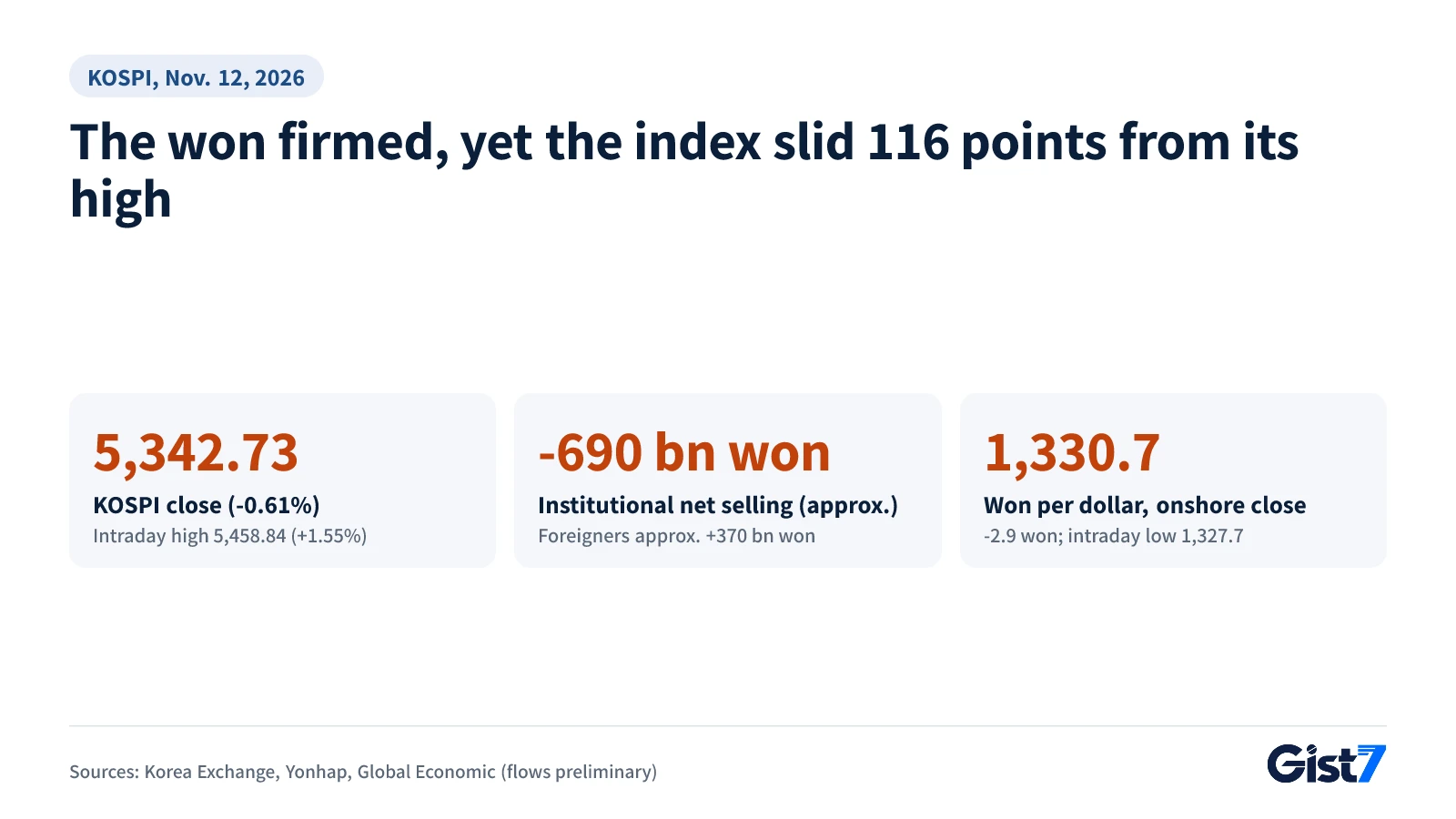
The KOSPI falls 0.61% to 5,342.73 on Nov. 12, 2026, as institutions sell about 690 billion won after a two-day rally of about 7%. The won touched 1,327.7 per dollar, but the dollar index rose: the won's gain came from exporters' dollar sales and foreign stock buying.
- KOSPI closed at 5,342.73 (-0.61%), 116 points below its intraday high of 5,458.84 (+1.55%); KOSDAQ slipped below 700 to 696.53 (-1.22%)
- KOSPI flows (preliminary): foreigners net bought about 370 bn won; institutions sold about 690 bn won and individuals about 200 bn won
- Won closed onshore at 1,330.7 per dollar (-2.9 won) after touching 1,327.7, its first visit to the 1,320s in about two weeks
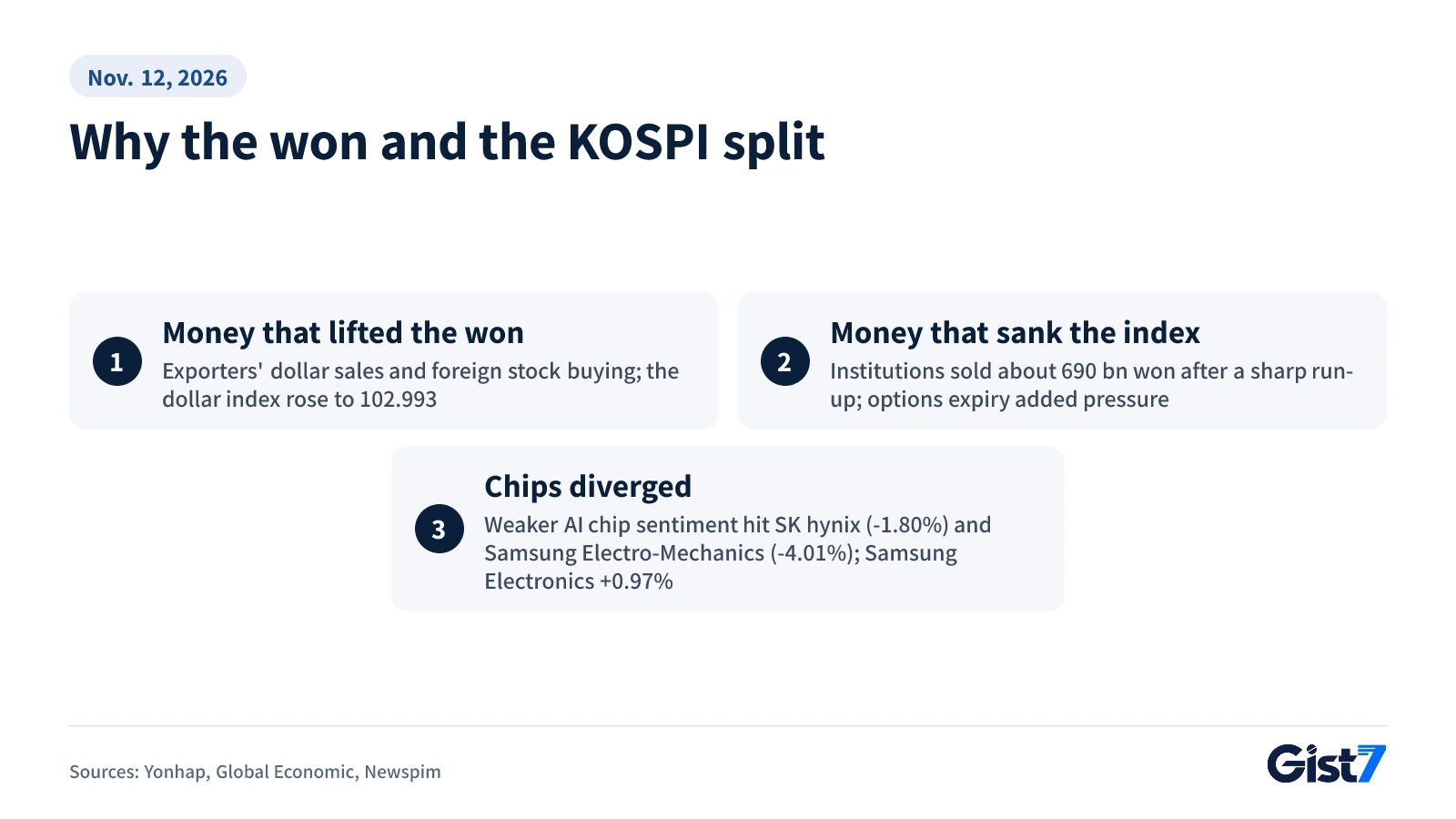
- With the dollar index up at 102.993, the won's gain reflected domestic dollar supply: exporters' nego selling and foreign stock purchases
- Profit-taking after a sharp run-up met options expiry; the stronger won's effect on exporters was limited, with the currency moving about 0.2%
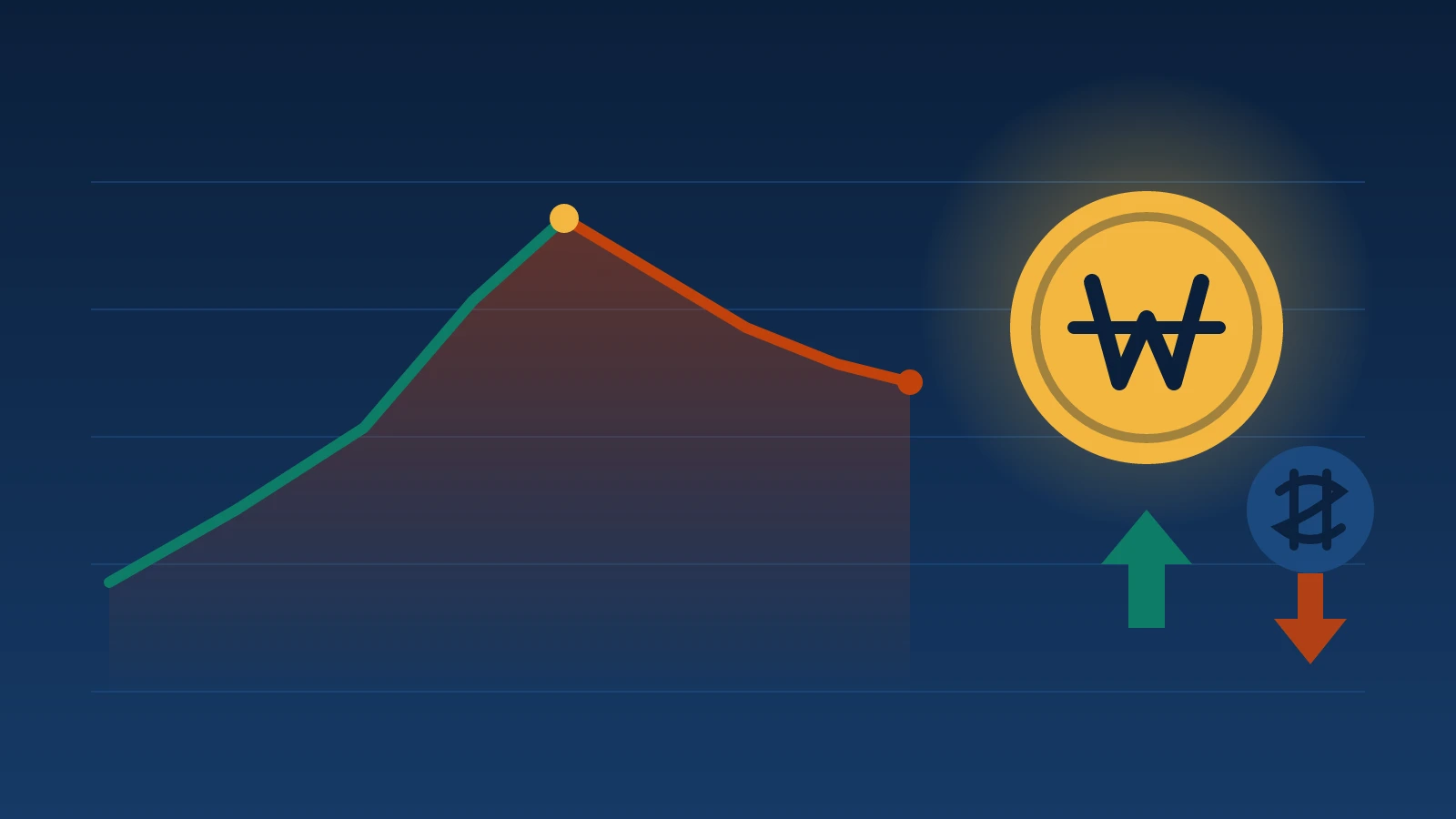
On Nov. 12, 2026, the Korean won touched 1,327.7 per dollar intraday, its first trip into the 1,320s in about two weeks, while the KOSPI closed down 0.61% at 5,342.73. Why the KOSPI falls on a day the currency strengthens comes down to who was trading what. Dollar sales by exporters and foreign buying of Korean stocks pushed the won up. Profit-taking by domestic institutions, after a two-day rally of more than 7%, pushed the index down.
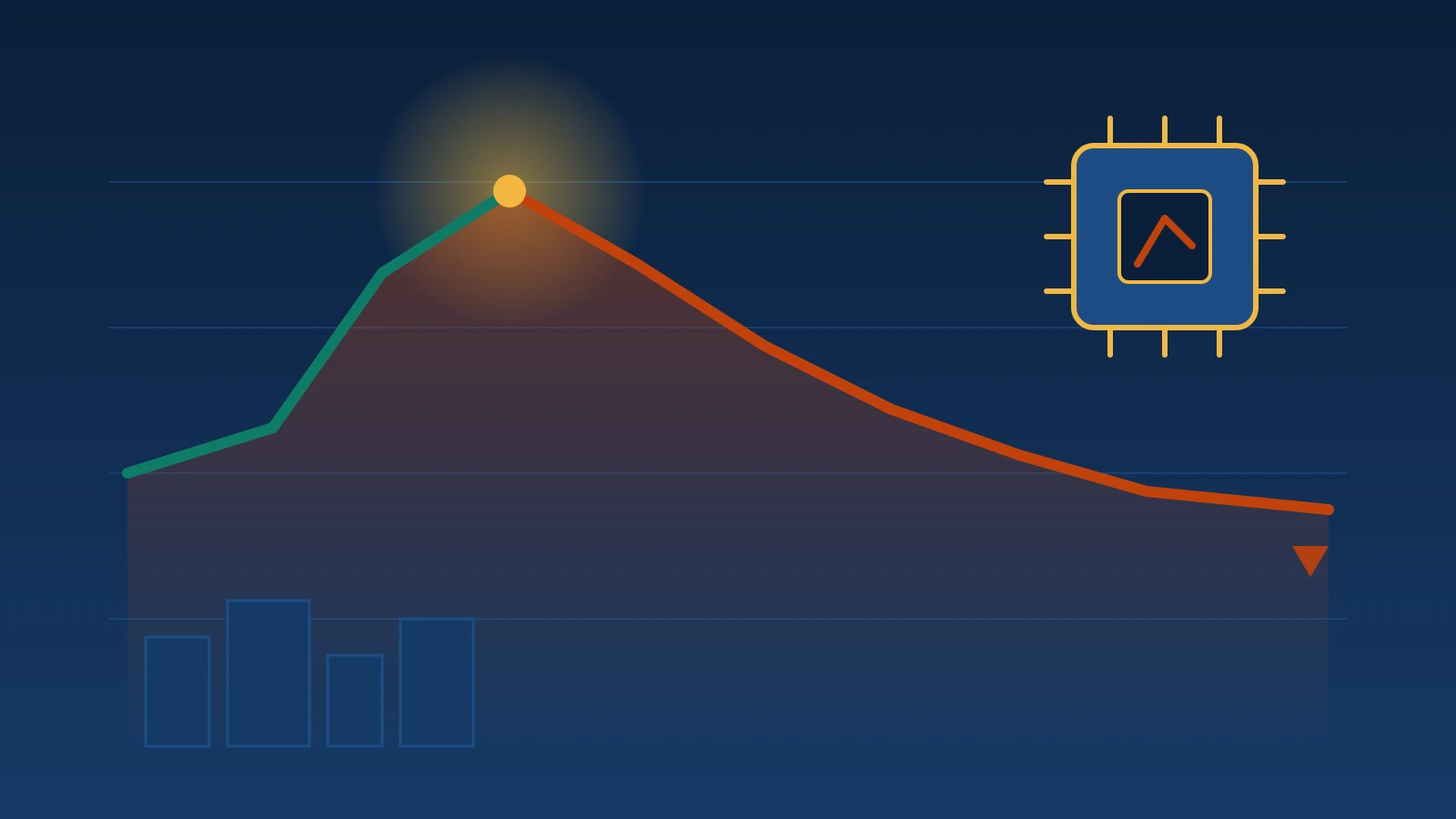
The morning looked very different. The KOSPI climbed as high as 5,458.84, up 1.55% from the previous close, before institutional selling picked up in the afternoon and dragged it into the red. The tech-heavy KOSDAQ lost 8.57 points (1.22%) to 696.53, giving back the 700 level just one day after reclaiming it. (The KOSPI is Korea's main benchmark index; the KOSDAQ is its smaller, growth-oriented market.)
Stronger won, KOSPI falls: two markets split on Nov. 12
The won and the KOSPI moved in opposite directions through the session. The won-dollar rate drifted lower (a stronger won) as the afternoon went on, while the index kept sliding. All times below are Korea Standard Time (KST).
| Nov. 12, 2026 | KOSPI | Won per dollar |
|---|---|---|
| Open | 5,385.94 | 1,336.6 |
| Intraday high | 5,458.84 (+1.55%) | 1,337.3 (10:26 a.m.) |
| Intraday low | 5,293.05 | 1,327.7 (2:24 p.m.) |
| Close | 5,342.73 (-0.61%) | 1,330.7 (-2.9 won, 3:30 p.m. onshore close) |
Sources: Korea Exchange index data; Yonhap News Agency for the currency, with the onshore daytime close at 3:30 p.m. KST.
According to Financial News (fnnews), the gap between the KOSPI's high and low reached 165.79 points. Advancers numbered 274 (including 3 that hit the daily upper limit) against 595 decliners. Large caps fell 0.57%, while mid caps (-1.03%) and small caps (-0.99%) fared worse, so the day felt rougher than the headline index suggested.
The money that moved the won vs. the money that moved stocks
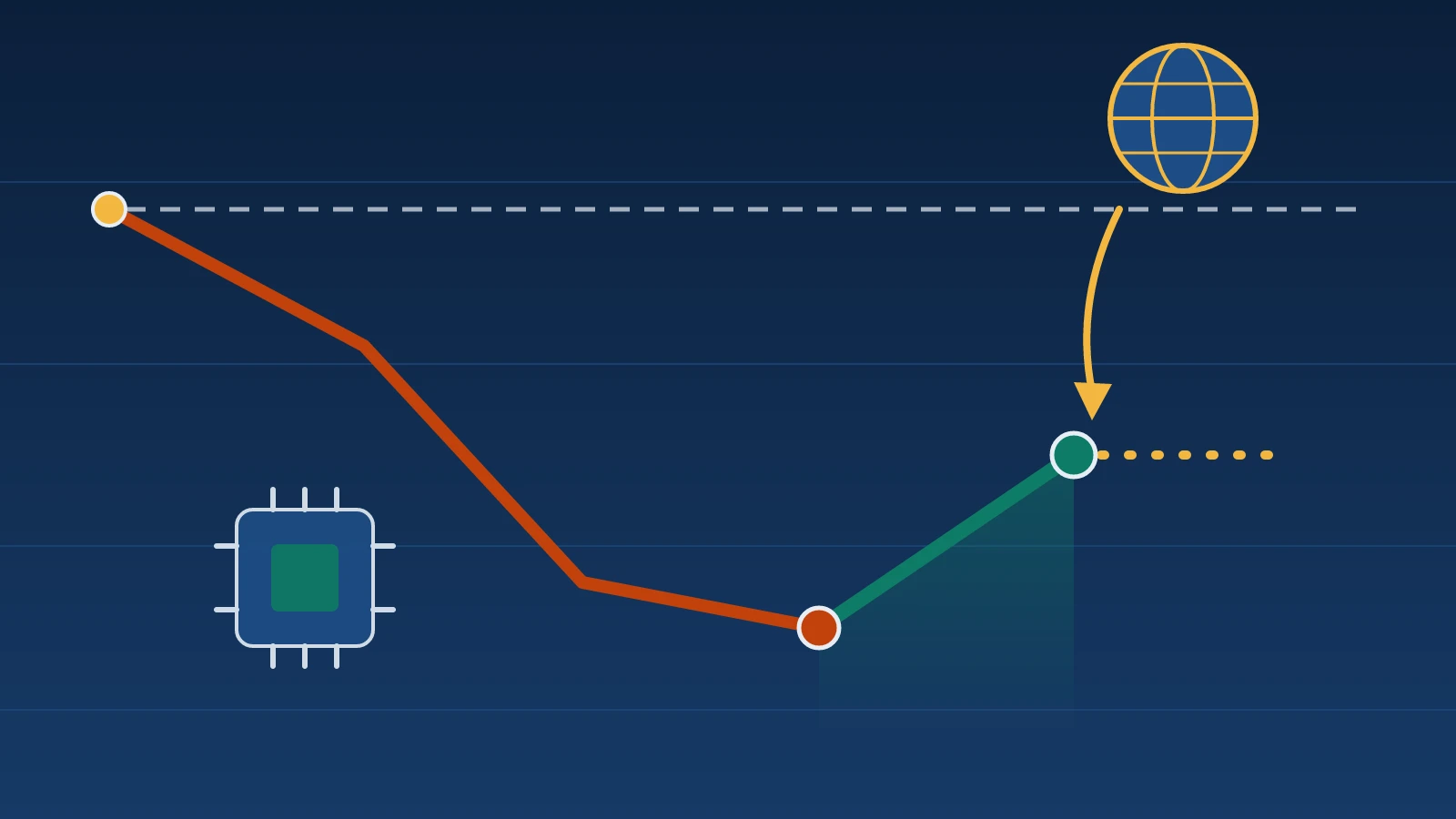
The stronger won failed to lift stocks because it did not come from a weaker dollar. It came from a domestic supply of dollars. Yonhap pointed to three drivers: exporters' "nego" selling, foreign net buying of Korean shares and expectations of more dollar inflows as exports grow. Nego selling refers to exporters converting the dollars they earn abroad into won on the local currency market.
The dollar itself was not weak. The dollar index, which tracks the greenback against six major currencies, rose 0.078 to 102.993. Yonhap attributed that strength to expectations that the Federal Reserve will raise rates in December. When the won gains on a day the dollar is firm worldwide, the most natural reading is that the push came from dollar selling inside Korea. The yen tells the same story. According to Yonhap, the dollar was nearly flat at 159.765 yen, while the won-yen cross rate fell 6.54 won to 832.94 won per 100 yen.
Stock flows ran the other way. According to Global Economic (g-enews), foreign investors bought a net 370 billion won (roughly $280 million) of KOSPI shares, while institutions sold about 690 billion won (roughly $520 million) and individual investors sold about 200 billion won. Dollar figures are Gist 7 estimates at the 1,330.7 close.
| Net buying, Nov. 12 (preliminary) | KOSPI | KOSDAQ |
|---|---|---|
| Foreign investors | approx. +370 bn won | approx. -350 bn won |
| Institutions | approx. -690 bn won | approx. +40 bn won |
| Individuals | approx. -200 bn won | approx. +310 bn won |
Source: Global Economic closing report. These are preliminary figures released right after the close. Tallies differ across outlets by tens to hundreds of billions of won, and some even disagree on whether individuals were net buyers. This article follows Global Economic's count.
When foreigners buy Korean stocks, they have to convert dollars into won, so a stronger won and rising stock prices often show up on the same day. That was the case in the Nov. 10 rally (our piece on the KOSPI's 4.39% rebound and foreign buying). Foreigners were net buyers again on Nov. 12, for a third straight session. But a 2.9-won move in the currency (about 0.2%) plus foreign buying was not enough to absorb 690 billion won of institutional selling. Gist 7 reads Nov. 12 not as a day when the currency lifted stocks, but as a day when each market followed its own flows.
How a stronger won feeds into exporters' and shippers' earnings
A stronger won shrinks the won value of the same dollar revenue, which tends to weigh on the reported earnings of exporters and shipping companies. On Nov. 12, though, the currency moved only about 0.2%, too little to explain a single day's share moves.
Shipping shows the mechanism clearly, because carriers collect freight mostly in dollars. HMM (KOSPI: 011200) reported third-quarter results on Nov. 12. According to The Herald Business, consolidated operating profit jumped 370% from a year earlier to 1.3947 trillion won, with an operating margin of 34%. Revenue rose 52% to 4.1271 trillion won. As those dollar-driven profits are converted into won, whether the exchange rate holds in the 1,330s or falls further becomes a swing factor for fourth-quarter earnings in won terms.
Automakers sit on the same chain. Hyundai Motor (KOSPI: 005380) fell 2.20%, but as Shinhan Securities analyst Kang Jin-hyuk noted in Financial News, autos and financials weakened together that day. Sector rotation after the previous day's surge looks like the bigger factor than the currency. For a stronger won to really bite into exporters' earnings, it would need to rise much further and stay there for weeks.
Profit-taking after a sharp run-up, plus options expiry
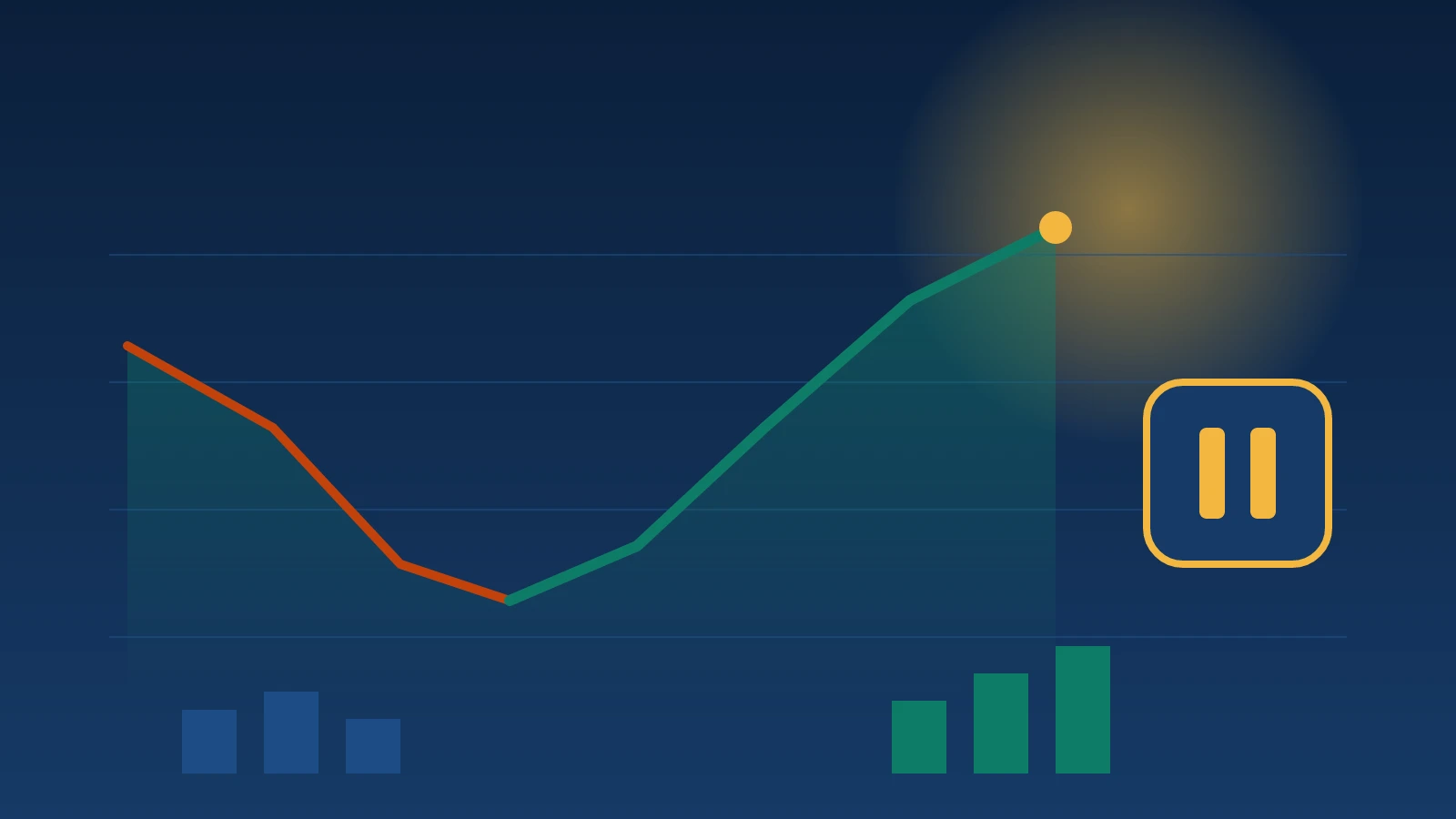
The institutional selling looked largely like profit-taking after a short, steep rally. The KOSPI rose 4.39% on Nov. 10 and 2.60% on Nov. 11, from 5,018.85 on Nov. 9, a gain of about 7.1% in two sessions (Gist 7 calculation). Profit-taking simply means selling shares that have gained in order to lock in the profit.
Han Ji-young, an analyst at Kiwoom Securities (KOSPI: 039490), cited profit-taking after the two-day surge and the options expiry as sources of selling pressure (Global Economic). Korean equity options expire on the second Thursday of each month, when KOSPI 200 options settle. Stock trades tied to those positions tend to cluster near the close, which can amplify index swings. Lee Kyung-min of Daishin Securities (KOSPI: 003540) said net selling by institutions and brokerages deepened the intraday drop (Newspim).
| Stock | Change on Nov. 12 (regular-session close) |
|---|---|
| Samsung Electronics (KOSPI: 005930) | +0.97% (208,000 won) |
| Samsung Electronics preferred (KOSPI: 005935) | +2.00% |
| SK hynix (KOSPI: 000660) | -1.80% (1,254,000 won) |
| Samsung Electro-Mechanics (KOSPI: 009150) | -4.01% |
| LG Energy Solution (KOSPI: 373220) | -1.79% |
Sources: Global Economic, Newspim. Prices that include after-hours trading may differ.
Within chips, Samsung Electronics rose while SK hynix fell. Kang attributed Samsung's relative resilience to its diversified supply chain (Financial News). Newspim also reported that news about Nvidia (Nasdaq: NVDA) management and related board discussions dampened sentiment toward AI chip stocks; no outcome of any board review has been announced. For the backdrop to the KOSDAQ's earlier surge, see our piece on the KOSDAQ's 5.62% jump and the buy sidecar.
Market impact map
| Asset / indicator | Direction | Strength | Link (why) |
|---|---|---|---|
| KOSPI | ↓ | Medium | Short, sharp rally → institutional profit-taking (approx. 690 bn won net selling) → index lower |
| Won/dollar | ↓ (stronger won) | Weak | Exporter nego selling and foreign stock buying → more dollar supply at home → stronger won (dollar index rose) |
| KOSDAQ | ↓ | Medium | 5.62% surge the previous day → foreign net selling of approx. 350 bn won → back below 700 |
| Won/yen | ↓ (stronger won) | Weak | Dollar-yen nearly flat at 159.765, so the won's gain carried into the won-yen rate → 832.94 won per 100 yen (-6.54 won) |
| Semiconductors | ↑↓ | Medium | Weaker AI chip sentiment → SK hynix and Samsung Electro-Mechanics down; diversified supply chain → Samsung Electronics up |
| Autos / exporters | ↓ | Weak | Autos weaker (Hyundai Motor -2.20%), likely sector rotation (Gist 7 view); currency effect limited at about 0.2% |
Market reactions can vary with other factors, and this table is not a basis for investment decisions.
Little direct impact: 2-year Treasury, 10-year Treasury, dollar index, gold, oil (WTI), bitcoin, S&P 500, Nasdaq
- Currency exchange and overseas payments: With the won near 1,330 per dollar, buying dollars got slightly cheaper. Because the dollar index is still rising, it is too early to assume the won's strength will last.
- Travel to Japan and yen payments: At 832.94 won per 100 yen, exchanging into yen remains relatively cheap for Koreans (Yonhap, Nov. 12 afternoon).
- Korean equity funds and pensions: Even on the same day, products heavy in Samsung Electronics and those tilted toward small and mid caps or battery makers ended up with very different results.
What to watch next
| Date (KST, with ET) | Indicator / event | Previous | Why it matters here | If it comes in... |
|---|---|---|---|---|
| Nov. 13 (Fri) 22:30 KST / 8:30 a.m. ET | US October Producer Price Index (PPI) | September +1.3% m/m, +6.3% y/y (Bureau of Labor Statistics) | Whether dollar strength persists, limiting the won's gains | Hotter than expected: dollar up, pressure on the won, a headwind for foreign buying |
| Nov. 18 (Wed) 07:00 KST / Nov. 17, 5 p.m. ET | Nvidia Q3 fiscal 2027 earnings call | n/a | Sentiment toward AI chip names such as SK hynix and Samsung Electro-Mechanics | Strong data-center demand tends to support big chip stocks; a miss tends to do the opposite |
| Nov. 26 (Thu) | Bank of Korea rate decision | Base rate 3.00% (held on Oct. 22, Bank of Korea) | Korea-US rate gap and the won's direction | A hike tends to support the won; a hold leaves more room for external drivers |
| Dec. 10 (Thu) 04:00 KST / Dec. 9, 2 p.m. ET | Federal Open Market Committee (FOMC) decision (Dec. 8-9 meeting) | 3.75%-4.00% (Federal Reserve, Oct. 28) | Dollar index and foreign capital flows | A bigger hike tends to lift the dollar and weigh on emerging-market stocks; a smaller one the reverse |
Dates come from the BLS PPI release schedule, Nvidia's announcement (Nov. 17, 5 p.m. ET), the Bank of Korea's monetary policy meeting calendar and the Fed's FOMC calendar. For the Bank of Korea outlook, see our piece on a possible November BOK rate hike.
Gist 7 will watch two things in the next session: whether foreign net buying extends to a fourth day, and whether the won can close, not just trade, in the 1,320s. If both line up, the won and stocks are more likely to move together again. If they diverge, another day like Nov. 12 is possible.
Frequently asked questions
Why did the KOSPI fall on Nov. 12, 2026?
The KOSPI fell 0.61% to 5,342.73 as institutions sold a net 690 billion won or so of shares. The index had rallied sharply on Nov. 10 and 11, so profit-taking set in, and options expiry and weaker AI chip sentiment added to the pressure.
Do Korean stocks usually rise when the won strengthens?
Often, yes, because foreign investors must convert dollars into won to buy Korean shares, so the two tend to move together. But when the won's gain comes from exporters selling dollars and domestic institutions are heavy sellers of stocks, as on Nov. 12, the two markets can split.
Did the won-dollar rate fall into the 1,320s?
Only intraday. The rate hit 1,327.7 on Nov. 12, its first trip into the 1,320s since Oct. 28 (Yonhap). The onshore daytime close at 3:30 p.m. KST was 1,330.7.
Foreigners were net buyers, so why did the KOSPI drop?
Institutional selling of about 690 billion won was nearly twice foreign buying of about 370 billion won, and individuals sold about 200 billion won as well. These are preliminary figures, and outlets reported somewhat different totals.
Why do stocks swing on options expiry day?
In Korea, KOSPI 200 options settle on the second Thursday of each month. Stock trades linked to those positions often cluster near the close, which can make the index more volatile, and analysts cited it as a source of selling pressure on Nov. 12.
How does a stronger won affect exporters and shipping companies?
Exporters and shipping lines convert dollar revenue into won, so a stronger won tends to reduce earnings in won terms. On Nov. 12 the currency moved only about 0.2%, so the effect was limited; the same day HMM reported third-quarter operating profit of 1.3947 trillion won, up 370% (The Herald Business).
References
- 환율, 수출업체 달러매도 등에 보름 만에 1,320원대로 하락 (연합뉴스, 뉴스통 게재, 2026-11-12)
- 코스피, 장중 5450선서 밀려…사흘 만에 반등 제동 [fn마감시황] (파이낸셜뉴스, 2026-11-12)
- 코스피, 개인·기관 매도세에 소폭 하락…5340선 마감 (글로벌이코노믹, 2026-11-12)
- [마감시황] 코스피·코스닥 나란히 하락…젠슨 황 리스크에 AI 투자심리 위축 (뉴스핌, 2026-11-12)
- HMM, 3분기 영업익 1.4조 '370% 급증'…배당성향 30% 이상으로 (헤럴드경제, 2026-11-12)
- PPI release schedule (미 노동통계국 BLS)
- Producer Price Indexes - September 2026 (미 노동통계국 BLS)
- Meeting calendars and information (미 연방준비제도 FOMC 일정)
- 통화정책방향 결정회의 일정 (한국은행)