Why the Nasdaq fell: chip selloff meets 6.5% PPI, 5.15% yield
Key summary
Why the Nasdaq fell on Nov. 13, 2026: a chip-stock selloff collided with a 6.5% annual rise in October producer prices and a 5.15% 10-year Treasury yield. The index lost 0.91%, yet it still gained 2.27% for the week, and the S&P 500 rose 2.51%. Next up: AI chip earnings and Nov. 25 PCE data.
- Nov. 13 close: Nasdaq 25,136.27 (-0.91%), S&P 500 7,561.67 (-0.40%), Dow 52,347.55 (+0.10%), per Yahoo Finance
- October PPI rose 0.3% m/m (0.4% expected) but 6.5% y/y, the biggest annual gain since November 2022; core rose 4.9% y/y (BLS)
- The 10-year yield hit 5.15% (Treasury), up 0.29 point for the week; AMD fell about 9% and Broadcom about 6% intraday after Thursday's gains
- Weekly: S&P 500 +2.51%, Nasdaq +2.27%, Dow +2.07%, but nearly all of the gain came on Monday
- Nvidia's earnings after the close on Nov. 17 and Nov. 25 PCE data will test whether profits can carry stocks with yields above 5%
U.S. stocks ended mixed on Friday, Nov. 13, 2026. According to Yahoo Finance closing data, the Nasdaq Composite fell 0.91% to 25,136.27 and the S&P 500 slipped 0.40% to 7,561.67, while the Dow Jones Industrial Average edged up 0.10% to 52,347.55. Why the Nasdaq fell comes down to two forces hitting at once. October producer prices, released that morning, were up 6.5% from a year earlier and pushed the 10-year Treasury yield to 5.15% (Treasury Department), and chip stocks that had rallied the day before were sold hard. For the week as a whole, though, all three indexes still gained more than 2%.
Why the Nasdaq fell: a chip selloff amplified by rising yields
Semiconductors were at the center of Friday's decline, and the PPI report and higher yields amplified the selling. The tech-heavy Nasdaq lost 0.91% while the Dow, which carries far less chip exposure, finished slightly higher. That gap between the indexes shows where the selling was concentrated.
According to Yahoo Finance, AMD (Nasdaq: AMD) fell about 9% intraday and Broadcom (Nasdaq: AVGO) about 6%, while Intel (Nasdaq: INTC) and Micron Technology (Nasdaq: MU) each dropped roughly 5%. Much of this looked like a reversal. AMD and Broadcom had rallied sharply on Nov. 12, the day Nvidia sank after Jensen Huang's resignation. Money that rotated into those names as alternatives appears to have left just as quickly.
Nvidia (Nasdaq: NVDA) fell more than 4% at one point before trimming the loss to a little over 2%, and its market value slipped below $4 trillion. The same day HSBC (LSE: HSBA) cut Nvidia to Hold and lowered its price target to $170. The analyst cited an unclear leadership succession plan and the risk of tighter export restrictions, Yahoo Finance reported.
Rates made the reversal worse. Chip and AI stocks are priced heavily on profits expected years from now, so when the 10-year yield, which works as a discount rate, rises, their present value shrinks more than most. The 10-year rose from 5.10% on Nov. 12 to 5.15% on Nov. 13 based on Treasury par yields, and touched 5.17% intraday, its highest since October, according to Yahoo Finance. The 2-year rose just 0.02 point to 4.88%, so long-term yields did most of the climbing.
The Cboe Volatility Index (VIX) briefly topped 20 before closing at 19.06 (+1.92%). Bitcoin dropped below $70,000 for the first time in nearly three months (Yahoo Finance), extending bitcoin's five-week slide and ETF outflows under the weight of higher rates.
What did the October PPI add after CPI?
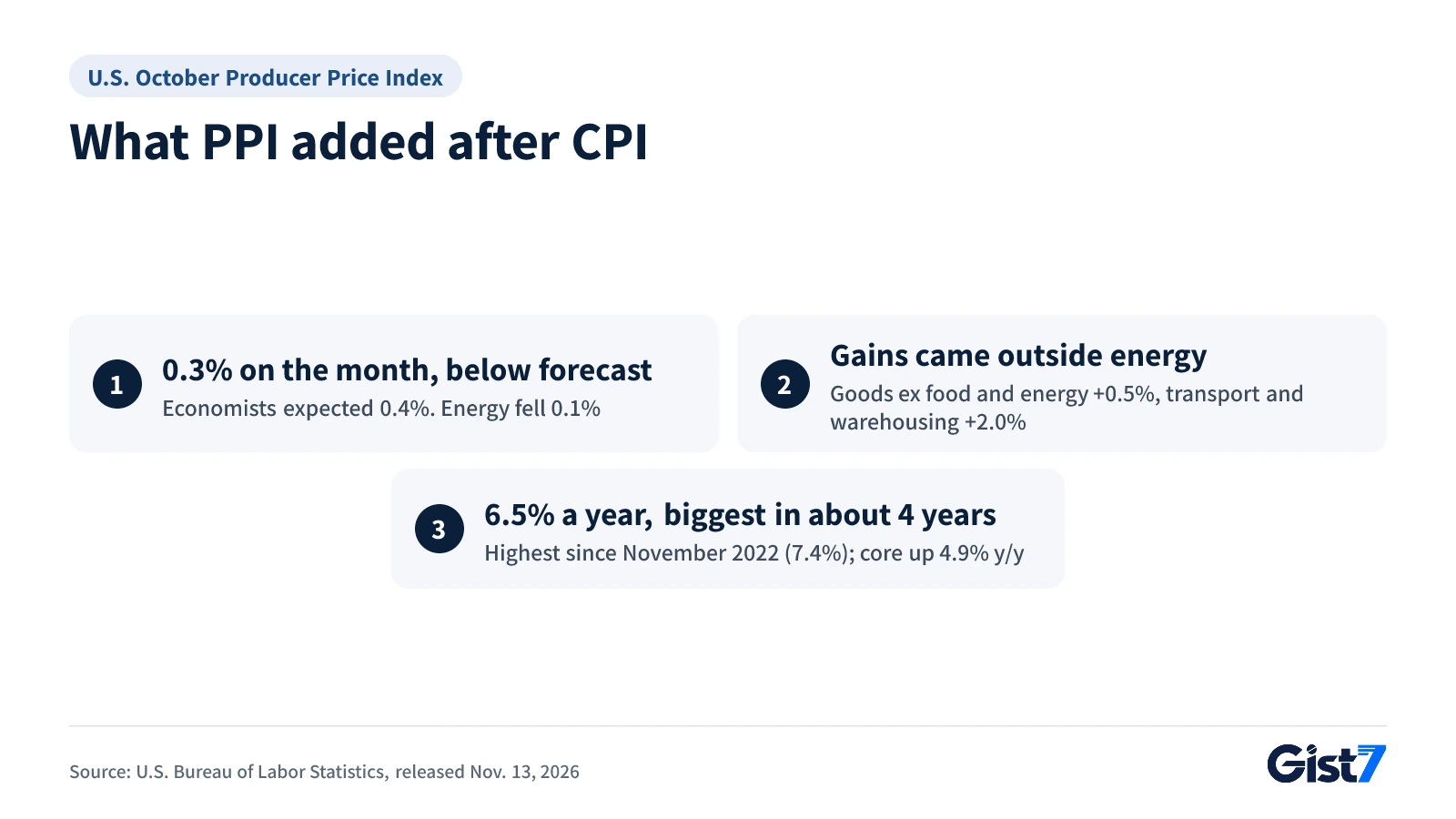
The Producer Price Index (PPI) measures the prices businesses receive for the goods and services they sell, and it often moves ahead of consumer prices. According to the Bureau of Labor Statistics (BLS), final demand prices rose 0.3% in October, below the 0.4% economists expected, as reported by Yahoo Finance. Over 12 months, though, they were up 6.5%, the largest annual increase since November 2022 (7.4%).
Break the numbers down and the picture changes. Energy prices edged down 0.1%, yet goods excluding food and energy rose 0.5%, food rose 1.3% and transportation and warehousing services jumped 2.0%. Core PPI, which excludes food, energy and trade services, rose 0.5% on the month and 4.9% from a year earlier. In other words, it was not fuel that pushed prices higher.
| October PPI component (BLS) | Month over month | Year over year |
|---|---|---|
| Final demand | +0.3% | +6.5% |
| Excluding food, energy and trade services | +0.5% | +4.9% |
| Goods | +0.5% | +10.2% |
| Goods excluding food and energy | +0.5% | - |
| Energy | -0.1% | - |
| Transportation and warehousing | +2.0% | - |
Source: BLS October PPI news release, published Nov. 13, 2026
If the 0.4% October CPI that pushed the 10-year toward 5% cemented expectations for a December hike, this PPI report added evidence that price pressure is spreading beyond energy. Fed Governor Michelle Bowman said earlier in the week that inflation pressures have shown recent signs of broadening (Yahoo Finance). Based on CME FedWatch, as reported by CNBC, traders priced a 100% chance of a hike at the Dec. 9 meeting, with about 87% odds of a quarter-point move and about 13% for a half point. That is little changed from right after CPI. Gist 7's read: PPI did not change the size of the December hike so much as the market's math on how long hikes may last.
Weekly recap: where U.S. stocks stand after the week
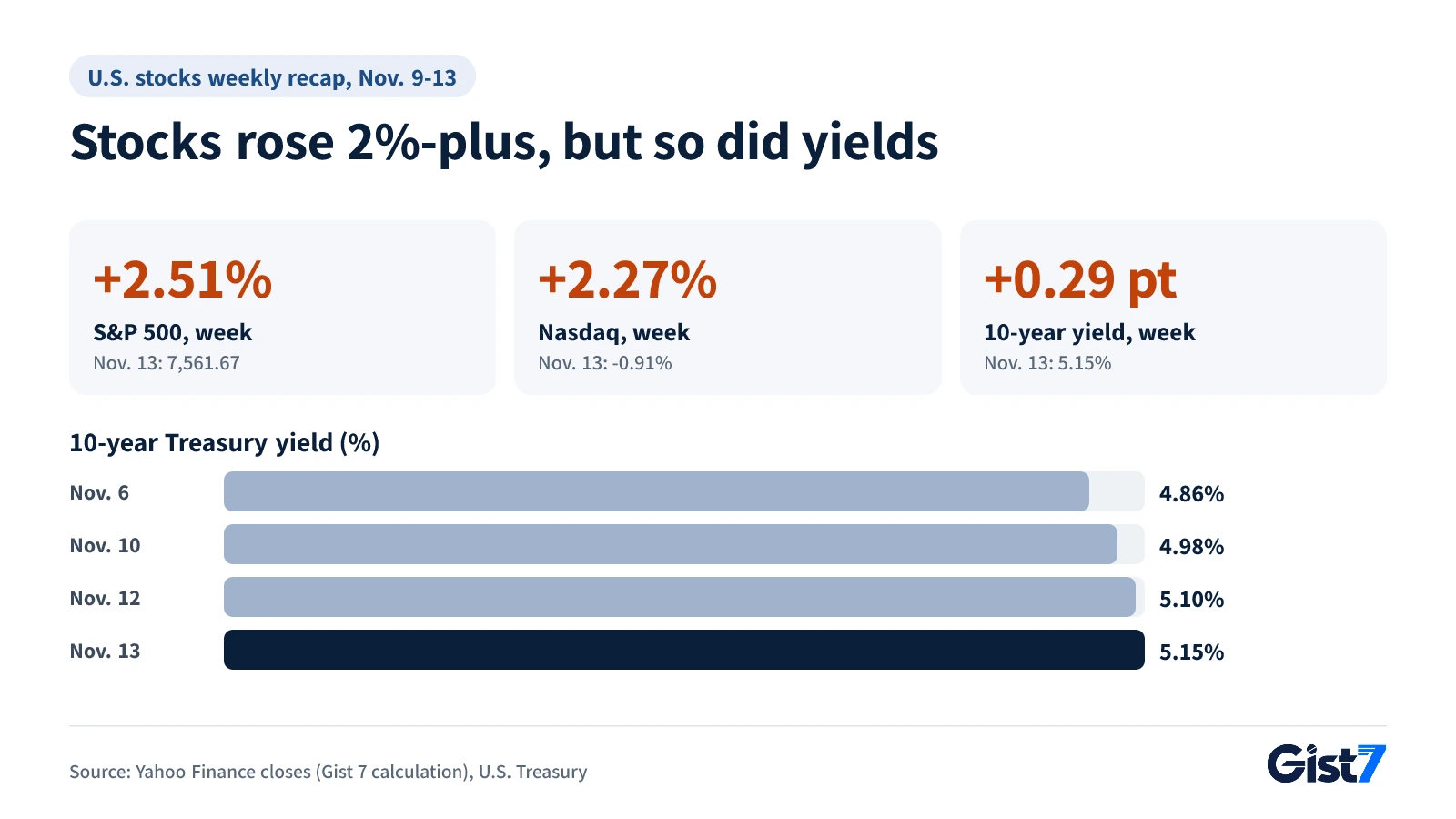
Taken as a whole, it was a rebound week for U.S. stocks. But most of the gain came on Monday, and the remaining four sessions swung with rates and Nvidia headlines. On Wednesday, CoreWeave (Nasdaq: CRWV) earnings briefly revived enthusiasm for AI chips. Measured against the Nov. 6 close, the S&P 500 rose 2.51%, the Nasdaq 2.27% and the Dow 2.07% (Yahoo Finance closes, Gist 7 calculation).
| Date (ET) | S&P 500 | Nasdaq Composite | 10-year yield | Driver |
|---|---|---|---|---|
| Fri., Nov. 6 | 7,376.86 | 24,579.43 | 4.86% | Prior week's close |
| Mon., Nov. 9 | 7,549.94 (+2.35%) | 25,253.14 (+2.74%) | 4.88% | Oil slump, dip-buying in chips |
| Tue., Nov. 10 | 7,520.93 (-0.38%) | 25,065.88 (-0.74%) | 4.98% | October CPI +0.4% m/m |
| Wed., Nov. 11 | 7,619.38 (+1.31%) | 25,466.19 (+1.60%) | Bond market closed | CoreWeave earnings |
| Thu., Nov. 12 | 7,592.40 (-0.35%) | 25,366.09 (-0.39%) | 5.10% | Jensen Huang resigns |
| Fri., Nov. 13 | 7,561.67 (-0.40%) | 25,136.27 (-0.91%) | 5.15% | October PPI +6.5% y/y, chip selloff |
Source: index closes from Yahoo Finance; 10-year yields from Treasury Department par yield data
Of the S&P 500's 184.81-point weekly gain, 173.08 points came on Monday. From Wednesday's high, the Nasdaq gave back 1.30% in two sessions. Over the week, the 10-year yield climbed 0.29 point from 4.86% to 5.15%, and the 2-year rose 0.37 point from 4.51% to 4.88% (Treasury).
Gist 7's view is that the yield level matters more this week than the index gains. With the 10-year above 5%, stocks need proof that earnings are growing fast enough to justify the higher discount rate. The first big test is Nvidia's report next Tuesday.
Market impact map
The table reflects moves on Nov. 13 (ET) only.
| Asset / indicator | Direction | Strength | Why |
|---|---|---|---|
| 10-year Treasury | ↑ | Strong | PPI fed worries about sticky inflation, 5.10% → 5.15% (Treasury) |
| Nasdaq | ↓ | Medium | Chip selling plus a higher discount rate, -0.91% |
| Semiconductors | ↓ | Strong | AMD (about -9%) and Broadcom (about -6%) reversed Thursday's gains; Nvidia downgraded (intraday, Yahoo Finance) |
| Bitcoin | ↓ | Medium | Risk-off mood amid hike expectations; below $70,000 for the first time in about three months |
| KOSPI (Korea's benchmark index) | ↓ | Medium | Weak U.S. chips could weigh on Samsung Electronics (KOSPI: 005930) and SK Hynix (KOSPI: 000660) when Seoul opens Monday, Nov. 16. For the Nov. 13 close of 5,290.53, see our KOSPI intraday reversal story |
Little direct impact: 2-year Treasury (+0.02 point to 4.88%), S&P 500 (-0.40%), dollar index, won/dollar, gold (flat near $3,880 an ounce), oil (WTI flat near $88.82 a barrel), VIX (19.06). Quotes from Yahoo Finance and the Treasury for Nov. 13; Friday U.S.-session figures for the dollar index and won/dollar could not be confirmed
- Borrowing costs: The 10-year anchors U.S. mortgage and corporate bond rates, so a stay above 5% keeps borrowing expensive and can push up market rates elsewhere, including in Korea.
- Overseas investors: Bigger swings in U.S. chip stocks, combined with currency moves, can magnify returns measured in local currency in either direction.
Market reactions can vary with other factors, and this table is not a basis for investment decisions.
What to watch next
| Date (ET) | Indicator / event | Previous | Why it matters here | If it comes in... |
|---|---|---|---|---|
| Tue., Nov. 17, after the close (call 5:00 p.m.) | Nvidia Q3 fiscal 2027 earnings | Q2 revenue $96.2 billion; Q3 outlook $108.0 billion ±2% (Nvidia) | Whether profits can hold up with yields above 5% | Beating the outlook could support a chip rebound; a miss tends to extend Friday's selling |
| Wed., Nov. 25, 8:30 a.m. | October PCE prices and Q3 GDP second estimate (BEA) | Sept. PCE +3.6% y/y, core +3.1% (BEA) | Whether PPI's goods and transport costs reached the Fed's preferred gauge | Hotter readings tend to lift yields and the dollar and weigh on growth stocks |
| Fri., Dec. 4, 8:30 a.m. | November jobs report (BLS) | Oct. payrolls +165,000, unemployment 4.1% (BLS) | How hot the labor market is after the hike | Strong hiring tends to raise bets on further hikes |
| Wed., Dec. 9, 2:00 p.m. | FOMC rate decision and projections (Dec. 8-9 meeting) | Target range 3.75%-4.00% (October decision) | Where this week's rise in yields leads | A half-point hike would tend to lift the 2-year and the dollar and weigh on tech |
Frequently asked questions
Why did the Nasdaq fall on Nov. 13, 2026?
The direct cause was a chip-stock selloff. AMD fell about 9% and Broadcom about 6% intraday after rallying the day before, and HSBC downgraded Nvidia. October PPI up 6.5% from a year earlier also pushed the 10-year yield to 5.15%, adding pressure on tech.
Was the October PPI hotter or cooler than expected?
It rose 0.3% on the month, below the 0.4% forecast. But the 6.5% annual rise was the biggest since November 2022, and goods excluding food and energy (+0.5%) and transportation and warehousing (+2.0%) rose even as energy fell, supporting the view that price pressure is broadening.
What is the difference between PPI and CPI?
CPI tracks prices consumers pay, while PPI tracks prices businesses receive for what they sell. When PPI rises first, the increase can pass through to consumer prices with a lag. Some PPI components also feed into the PCE price index the Fed targets.
Did U.S. stocks rise for the week?
Yes. Versus the Nov. 6 close, the S&P 500 rose 2.51%, the Nasdaq 2.27% and the Dow 2.07% (Yahoo Finance closes, Gist 7 calculation). Most of the S&P 500's gain came on Monday, and the index swung with rising yields from Tuesday on.
How much will the Fed raise rates in December?
Based on CME FedWatch, as reported by CNBC, traders priced a 100% chance of a hike on Dec. 9, with about 87% odds of a quarter point and about 13% for a half point. The decision comes at 2 p.m. ET on Dec. 9, and October PCE and the November jobs report will shape the size.
When does Nvidia report earnings?
Nvidia reports fiscal third-quarter 2027 results after the market close on Tuesday, Nov. 17, with a conference call at 2 p.m. PT (5 p.m. ET). In August the company guided third-quarter revenue to $108.0 billion, plus or minus 2%.
References
- Producer Price Index News Release, October 2026 — U.S. Bureau of Labor Statistics
- Daily Treasury Par Yield Curve Rates (November 2026) — U.S. Department of the Treasury
- Stock market today: Dow rises, S&P 500 and Nasdaq slip to cap volatile week, Nvidia stock plunge deepens — Yahoo Finance
- Stock market news for Nov. 13, 2026 — CNBC
- NVIDIA Sets Conference Call for Third-Quarter Financial Results — NVIDIA