Stock market plunge: Nvidia probe sinks Nasdaq 5%, chips 10%
Key summary
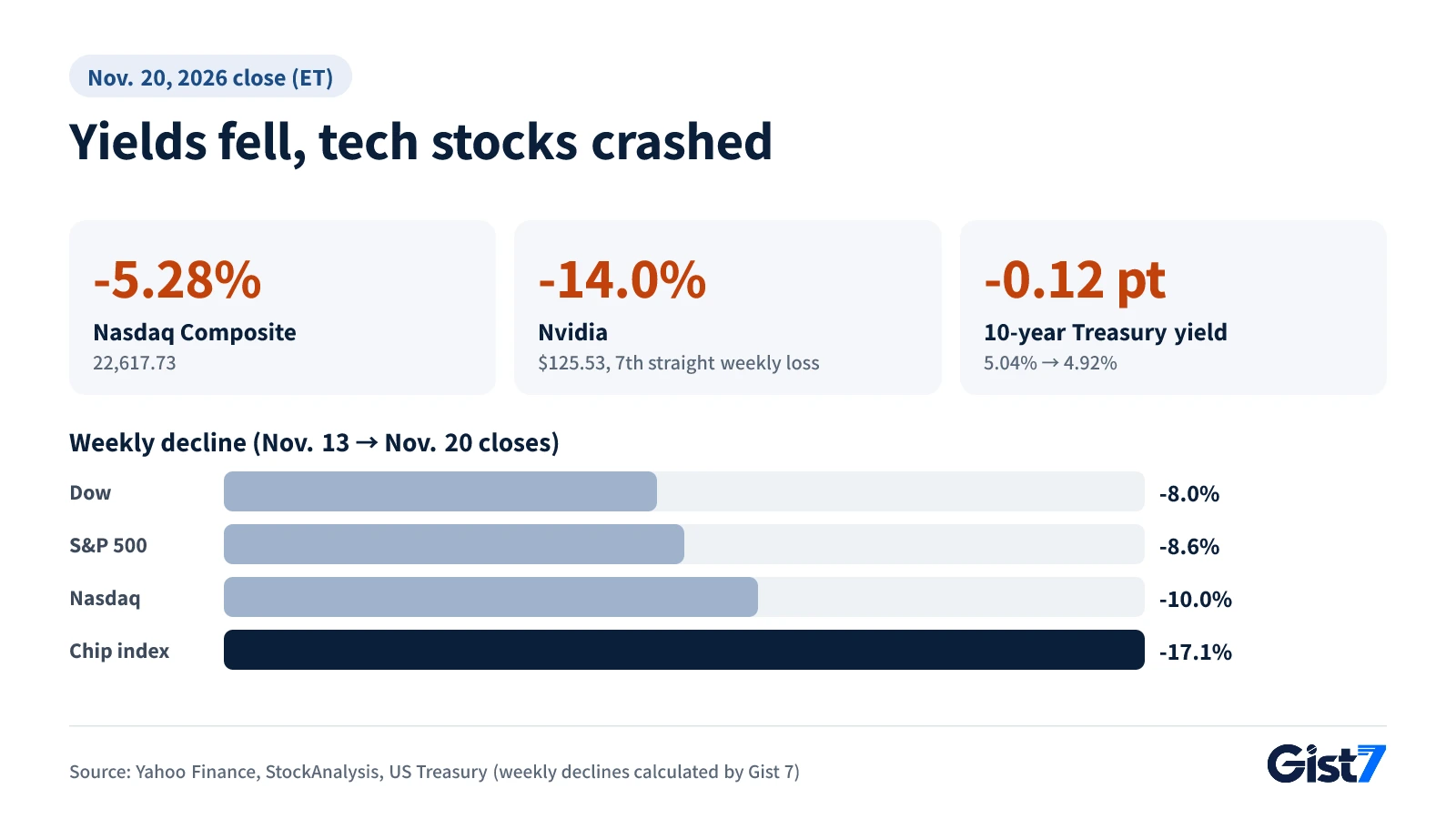
The US stock market plunge on Nov. 20, 2026, cut the Nasdaq 5.28% and Nvidia 14.0%, its seventh weekly loss in a row. The 10-year yield fell to 4.92%, but on safe-haven demand, not Fed cut hopes. Nvidia probe reports and AI spending fears outweighed lower rates.
- Nov. 20 closes: Nasdaq 22,617.73 (-5.28%), S&P 500 6,910.39 (-3.70%), Dow 48,147.33 (-1.93%) (Yahoo Finance)
- Philadelphia Semiconductor Index fell 10.73%; Nvidia lost 14.01% and AMD and Micron about 13% each, while staples and pharma rose
- The 10-year yield fell to 4.92%, yet the Fed is still expected to hike in December; lower yields reflected a flight to safety
- For the week: S&P 500 -8.6%, Nasdaq -10.0%, Nvidia -22.9% (Gist 7 calculation)
- Checkpoints: the Nasdaq-100's 20% line on a closing basis, the Nvidia investigations, and the 2-year yield's gap over the policy rate
The US stock market plunge on Friday, November 20, 2026, took the Nasdaq Composite down 1,261.47 points, or 5.28%, to 22,617.73. The S&P 500 fell 3.70% to 6,910.39 and the Dow Jones Industrial Average lost 949.73 points (1.93%) to 48,147.33, according to Yahoo Finance closing data. On the same day the 10-year Treasury yield slipped from 5.04% to 4.92%, a drop of 0.12 percentage point (US Treasury). The usual rule that lower yields cushion tech stocks did not hold. Reports of investigations into Nvidia (Nasdaq: NVDA) and worries about slowing AI spending overwhelmed any relief from lower rates.
Stock market plunge: what got sold hardest on Friday
Selling was concentrated in AI chipmakers, and the Nvidia stock drop sat at the center of it. The Philadelphia Semiconductor Index fell 10.73% in a single session, roughly three times the S&P 500's decline, and the Nasdaq ended 2.7% below its 2025 year-end close of 23,241.99, wiping out its gains for the year (Yahoo Finance). Defensive names moved the other way: according to CNBC, large consumer staples and pharmaceutical stocks rose about 1%. Money did not leave the market entirely. It rotated into defensive sectors.
| Stock / index | Nov. 20 close | Daily change |
|---|---|---|
| Nasdaq-100 | 25,028.98 | -5.61% |
| Philadelphia Semiconductor Index | 8,408.59 | -10.73% |
| Nvidia | $125.53 | -14.01% |
| Micron | $594.51 | -13.89% |
| AMD | $424.39 | -13.25% |
| Anthropic | $88.91 | -8.50% |
Index data and Anthropic from Yahoo Finance; other stock prices are StockAnalysis closing prices (4 p.m. ET).
Investigation headlines fueled the Nvidia selling. CNBC reported that selling intensified after Reuters said the Securities and Exchange Commission (SEC) was exploring possible accounting issues at the company. The previous evening, California Attorney General Rob Bonta sent Nvidia an investigative subpoena. Bonta said his office is examining whether actions by Nvidia or former CEO Jensen Huang allowed China to obtain advanced chips (CNBC). Earlier, on November 17, The Wall Street Journal reported a civil SEC investigation into whether Nvidia's disclosures misled investors (InvestmentNews). The source reports carry no official confirmation from the SEC or Nvidia.
Company snapshot
| Item | Details |
|---|---|
| Legal name | NVIDIA Corporation |
| Ticker / exchange | NVDA, Nasdaq (listed January 1999) |
| Industry | Semiconductors (GPUs and AI accelerators) |
| Revenue mix | Q3 fiscal 2027 (ended Oct. 25) revenue of $115.8 billion, of which Data Center was $107.6 billion, about 93% |
| Leadership | Jensen Huang resigned as CEO on Nov. 12; CFO Colette Kress serves as interim CEO |
| Market value | About $3.03 trillion (Nov. 20 close, StockAnalysis) |
Company details are based on Nvidia's SEC filings: the earnings release (Nov. 17) and the CEO transition 8-K (Nov. 12). For background on the resignation, see Jensen Huang's resignation and Nvidia's slide.
Micron Technology (Nasdaq: MU) and Advanced Micro Devices (Nasdaq: AMD) each fell more than 13%. AMD extended Thursday's 7%-plus drop, which followed a short-seller report. The hit that allegation delivered to Korean stocks is covered in our analysis of the KOSPI's 5.2% plunge. Anthropic (Nasdaq: ANT) fell 8.50% on its second trading day, though its close was still 7.1% above the $83 IPO price (Yahoo Finance).
Why the Nasdaq plunged even as Treasury yields fell
The Nasdaq plunged because lower yields gave tech stocks no real support. Yields fell because investors were nervous about stocks, not because they expected the Federal Reserve to ease. Expectations of a December rate hike were unchanged, and what dragged tech down was concern about earnings and risk, not the discount rate. Three threads explain the move.
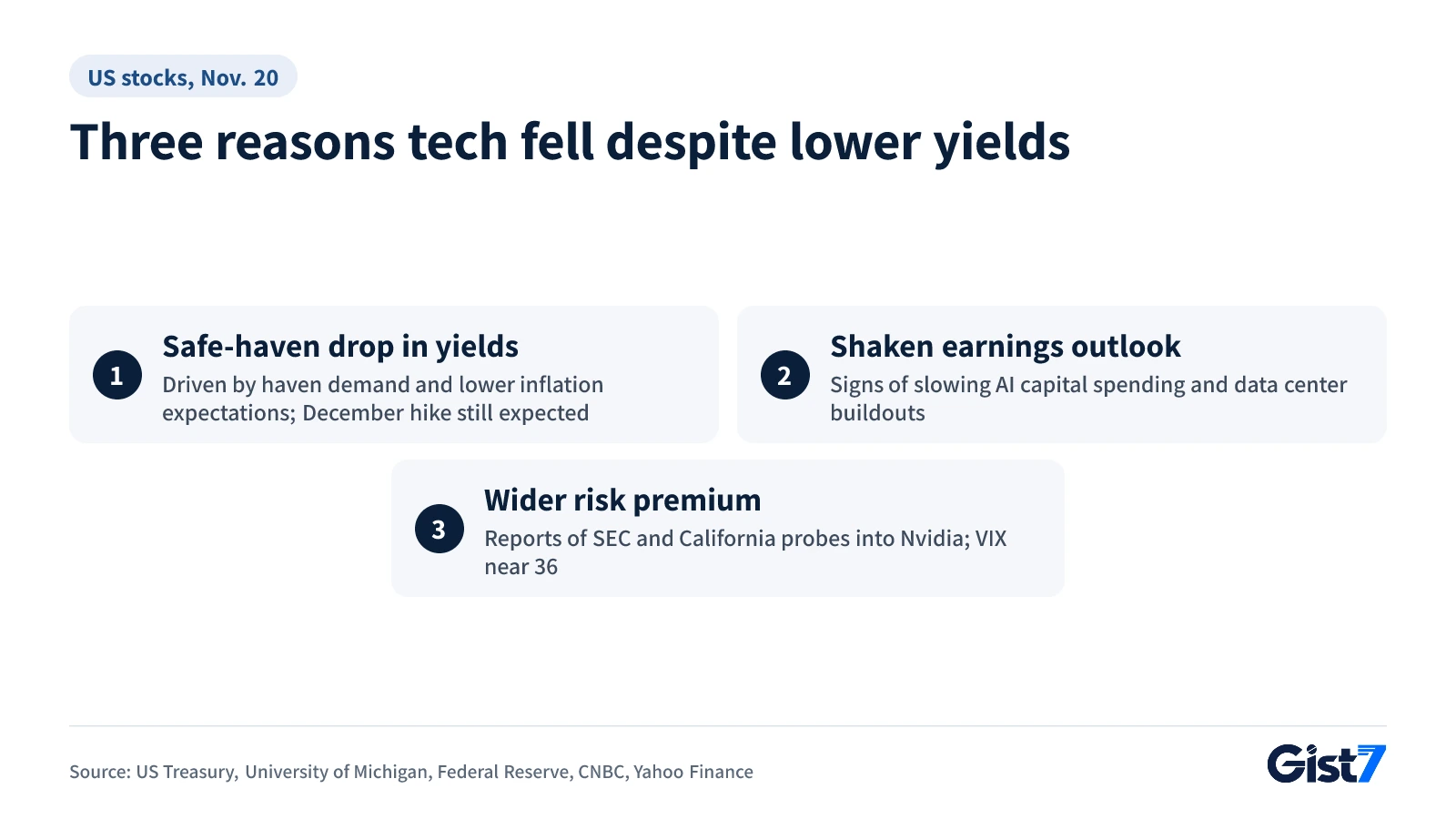
First, the drop in yields was a flight to safety. On November 20 the 10-year yield fell 0.12 point and the 2-year yield fell 0.13 point to 4.63% (US Treasury). According to the University of Michigan's final November survey, consumers' expected inflation one year ahead fell from 4.7% to 3.7%, and long-run inflation expectations eased from 3.5% to 3.3%. Inflation expectations measure how fast people think prices will rise. That decline, together with safe-haven money leaving stocks, pushed Treasury prices higher.
The Fed's stance did not change. At its October meeting the Fed held the federal funds target range at 3.75% to 4.00%, but Governor Lisa Cook and Cleveland Fed President Beth Hammack dissented in favor of a quarter-point hike (Fed statement). The minutes released on November 18 said "almost all participants" judged that further increases would likely be appropriate. Speaking in Chile on November 20, Cook warned that waiting longer to raise rates risks falling behind the curve, and CNBC said markets strongly expect a quarter-point hike at the December 8-9 meeting.
Second, the earnings outlook wobbled. A stock price is the present value of future earnings, so a slightly lower discount rate cannot hold prices up once investors start doubting the earnings themselves. CNBC cited signs of slowing AI capital spending as a driver of the selloff, and Richard Saperstein of Treasury Partners pointed to slower data center buildouts. According to CNBC, President Trump also said on Friday he wants to stop US companies from building data centers abroad and warned of severe penalties, adding to worries that overseas data center projects could stall. The basic link between rates and stock prices is explained in why stocks fall when interest rates rise.
Third, the risk premium widened. The risk premium is the extra return investors demand for holding an uncertain asset. It rises when a risk is hard to quantify, such as the outcome of a regulatory investigation. The Cboe Volatility Index (VIX) hit 40.03 intraday and closed at 35.89, 26.2% above the previous close of 28.44 (Yahoo Finance, Cboe).
Gold and bitcoin also fell. December gold futures fell more than 4% to the $3,520s an ounce, and bitcoin traded in the $58,000s, about 6% lower than a day earlier (Yahoo Finance). Lower yields usually help gold, so its decline may reflect investors raising cash by selling whatever they could to cover losses or cut risk. That is Gist 7's interpretation, not something confirmed by fund-flow data.
How the week unfolded for US stocks
The S&P 500 fell on all five days this week, while the Nasdaq rose only on Wednesday before collapsing on Friday. The S&P 500 has now declined for seven straight sessions since November 12. For the week it lost 8.6%, the Nasdaq 10.0% and the Dow 8.0% (Gist 7 calculation from Yahoo Finance closes). According to CNBC, it was the Dow's worst week since March 2020 and the S&P 500's worst since April 2025.
| Date (ET) | S&P 500 | Nasdaq Composite | What moved the market |
|---|---|---|---|
| Nov. 16 (Mon) | 7,416.59 (-1.92%) | 24,509.76 (-2.49%) | Philadelphia Semiconductor Index fell 5.28% |
| Nov. 17 (Tue) | 7,340.53 (-1.03%) | 24,328.38 (-0.74%) | Nvidia reported Q3 revenue of $115.8 billion after the close |
| Nov. 18 (Wed) | 7,323.63 (-0.23%) | 24,429.88 (+0.42%) | October FOMC minutes showed broad support for more hikes |
| Nov. 19 (Thu) | 7,175.83 (-2.02%) | 23,879.20 (-2.25%) | Anthropic IPO, short-seller report on AMD |
| Nov. 20 (Fri) | 6,910.39 (-3.70%) | 22,617.73 (-5.28%) | Nvidia investigation reports, chip stock rout |
The strangest day in the table is Wednesday, the day after earnings. Nvidia had posted strong numbers after Tuesday's close, including a fourth-quarter revenue outlook of $130 billion (SEC filing). Yet the stock fell 2.89% to $150.96 on Wednesday, November 18 (Yahoo Finance), and slid 22.9% for the week, from $162.85 on November 13 to $125.53 on November 20 (Gist 7 calculation from Yahoo Finance closes). Reports compiled by StockAnalysis say that marks a seventh straight weekly loss, the longest losing streak since 2008. Management uncertainty, investigation risk and doubts about when AI spending will peak are setting the price more than earnings are.
How far can the AI selloff go? Three checkpoints
No one can know in advance where the AI selloff will stop. But three checkpoints over the next two to three weeks will help define what kind of selloff this is.
- The Nasdaq-100's 20% line: The Nasdaq-100 closed 19.8% below its October 6 peak of 31,224.47 (Yahoo Finance). By market convention, a drop of 10% or more from a peak is a correction and 20% or more is a bear market. CNBC reported that the Nasdaq-100 crossed the 20% mark intraday, entering a bear market on that basis. Whether it closes beyond that line is the first thing to watch.
- What the Nvidia investigations actually involve: Whether the SEC probe concerns disclosures or accounting, and whether California's inquiry leads to action, will shape the risk premium on Nvidia shares. InvestmentNews reported on November 17 that Treasury Secretary Scott Bessent asked Nvidia's board for answers within 10 days.
- The gap between the 2-year yield and the policy rate: At 4.63%, the 2-year yield sits 0.63 point above the 4.00% top of the Fed's target range, a sign that markets are pricing in further hikes. If that gap narrows, expectations for a December hike are fading.
Views are divided. According to CNBC, Capital Economics expects the S&P 500 to fall to 6,500 by the end of next year, while ARK's Brett Winton described AI software as a $40 trillion market. Next week US markets close on Thursday, November 26, for Thanksgiving and close early at 1 p.m. ET on Friday, November 27 (NYSE), so trading may be thin.
Market impact map
| Asset / indicator | Direction | Strength | Link (why) |
|---|---|---|---|
| Nasdaq | ↓ | Strong | Nvidia probe reports and AI capex worries triggered heavy selling in chip and AI megacaps (-5.28%) |
| S&P 500 | ↓ | Strong | Plunge in heavyweight tech stocks dragged the index lower, seventh straight decline (-3.70%) |
| Philadelphia Semiconductor Index | ↓ | Strong | Memory and AI chips sold together, 36% below its Oct. 6 level of 13,217.82 (-10.73%) |
| VIX | ↑ | Strong | Regulatory and investigation risk lifted demand for downside protection, closed at 35.89, intraday high 40.03 (Yahoo Finance) |
| 10-year Treasury yield | ↓ | Medium | Safe-haven demand and lower inflation expectations, 4.92% (-0.12 pt, US Treasury) |
| 2-year Treasury yield | ↓ | Medium | Same drivers, 4.63% (-0.13 pt), though December hike expectations remain |
| Gold | ↓ | Medium | Likely cash-raising sales despite lower yields, December futures in the $3,520s (down more than 4%) |
| Bitcoin | ↓ | Medium | Sold with other risk assets, below $60,000, in the $58,000s (about -6%) |
| KOSPI | ↓ short term | Medium | The US chip rout may weigh on Korea's Monday (Nov. 23) session; KOSPI already fell 5.21% on Nov. 20 |
| USD/KRW | ↑ short term | Medium | Risk aversion and foreign selling of Korean stocks, from 1,330.40 won on Nov. 19 to around 1,346 won on Nov. 20 (Yahoo Finance) |
Little direct impact: US dollar index, crude oil (WTI) (December contract up 0.93% at $83.98, CNBC)
- Everyday impact: Investors holding US stocks or ETFs in another currency should note that a stronger dollar only partly offsets the much larger loss in dollar terms.
- Everyday impact: Lower long-term Treasury yields do not translate directly into cheaper loans. Whether the Fed hikes in December matters more for borrowing costs.
- Everyday impact: A weaker won makes travel money and overseas online purchases more expensive for Korean consumers.
Market reactions can vary with other factors, and this table is not a basis for investment decisions.
What to watch next
| Date (ET) | Indicator / event | Previous | Why it matters here | If it comes in like this |
|---|---|---|---|---|
| Nov. 25 (Wed) 8:30 a.m. | US October PCE prices and Q3 GDP second estimate | September PCE +3.6% y/y; Q3 GDP advance estimate 3.4% annualized (BEA) | Tests whether hike expectations and the drop in yields will last | Hotter inflation tends to lift yields and the dollar and weigh on tech |
| Dec. 4 (Fri) 8:30 a.m. | US November jobs report | October payrolls +165,000, unemployment 4.1% (BLS) | Shows whether a slowing economy is behind lower yields | Weak hiring tends to push yields down; stocks may react mixed on growth worries |
| Dec. 9 (Wed) 2:00 p.m. | December FOMC decision and projections (Dec. 8-9 meeting) | Held at 3.75%-4.00% in October, two dissents for a hike (Fed) | Whether the expected quarter-point hike happens | A hike plus signals of more tends to weigh on the Nasdaq |
| Dec. 10 (Thu) 8:30 a.m. | US November consumer price index (CPI) | October +0.4% m/m, core +0.3% (BLS) | Checks the inflation trend around the hike | A hotter print raises odds of further hikes, a headwind for growth stocks |
Frequently asked questions
Why did the US stock market plunge on November 20, 2026?
Selling in AI chipmakers was the core driver. According to CNBC, selling intensified after Reuters reported that the SEC was exploring possible accounting issues at Nvidia, on top of worries about slowing AI spending and expectations of a December Fed rate hike. The Philadelphia Semiconductor Index fell 10.73% in one day.
Don't lower interest rates usually lift tech stocks?
It depends on why rates fall. On November 20, Treasury yields fell because of safe-haven demand and lower inflation expectations, not because investors expected Fed cuts. When worries about earnings and risk grow, a slightly lower discount rate cannot hold stock prices up.
Why has Nvidia stock fallen for seven straight weeks?
The slide followed CEO Jensen Huang's resignation on November 12, reports of SEC and California attorney general investigations, and worries about slowing AI investment. Nvidia's third-quarter revenue of $115.8 billion, reported November 17, was strong, yet the stock still fell 22.9% that week.
Is the Nasdaq in a bear market?
CNBC reported that the Nasdaq-100 fell more than 20% from its high during trading on November 20, crossing the bear market threshold intraday. On a closing basis it was 19.8% below its October 6 peak of 31,224.47, so whether it closes beyond 20% is the next checkpoint. The 20% threshold is a market convention, not an official rule.
What should investors watch in US stocks next week?
First comes the October personal consumption expenditures (PCE) price index and the second estimate of third-quarter GDP at 8:30 a.m. ET on Wednesday, November 25. US markets are closed on Thursday, November 26, for Thanksgiving and close early at 1 p.m. ET on Friday, November 27. The Fed decision on December 9 is the next big event.
How does the US selloff affect Korean stocks?
Friday's US session came after Korea's market had closed, so the chip rout may weigh on large Korean chipmakers such as Samsung Electronics and SK Hynix on Monday, November 23. The KOSPI had already fallen 5.21% on November 20, and the dollar rose to around 1,346 won (Yahoo Finance).
References
- Stock market today: Dow, S&P 500, Nasdaq (Nov. 20, 2026 live updates) — CNBC
- S&P 500 (^GSPC) Historical Data — Yahoo Finance
- NASDAQ Composite (^IXIC) Historical Data — Yahoo Finance
- PHLX Semiconductor (^SOX) Historical Data — Yahoo Finance
- NASDAQ 100 (^NDX) Historical Data — Yahoo Finance
- Anthropic, PBC (ANT) Historical Data — Yahoo Finance
- CBOE Volatility Index (^VIX) Historical Data — Yahoo Finance
- Gold Dec 26 (GC=F) Historical Data — Yahoo Finance
- Bitcoin USD (BTC-USD) Historical Data — Yahoo Finance
- USD/KRW (KRW=X) Historical Data — Yahoo Finance
- Daily Treasury Par Yield Curve Rates (2026년 11월) — 미 재무부
- NVIDIA (NVDA) Stock Price — StockAnalysis
- NVIDIA Announces Financial Results for Third Quarter Fiscal 2027 — SEC EDGAR
- NVIDIA Announces CEO Transition (Form 8-K, 2026-11-12) — SEC EDGAR
- Embattled Nvidia faces SEC probe as California attorney general eyes action — InvestmentNews
- Surveys of Consumers (2026년 11월 확정치) — 미시간대
- Federal Reserve issues FOMC statement (2026-10-28) — 연준
- Minutes of the Federal Open Market Committee, October 27-28, 2026 — 연준
- Release Schedule — 미 경제분석국
- Holidays and Trading Hours — 뉴욕증권거래소