CoreWeave Earnings: 16% Bond Yields and the AI Debt Test
Key summary
CoreWeave earnings will show whether markets keep funding debt-built AI infrastructure. Results come after the Nov. 10, 2026 U.S. close; the call is at 5 p.m. ET. With its 2032 bond yielding over 16% and the stock down 47.5% in a month, watch interest costs, backlog and funding.
- CoreWeave reports Q3 results after the U.S. close on Nov. 10; the conference call is at 5 p.m. ET
- Its 2032 bond yielded more than 16% on Nov. 6, and the stock fell 47.5% in a month (24/7 Wall St.)
- Q2 interest expense of $640 million was five times adjusted operating income of $128 million
- Numbers to check: Q3 revenue of $3.45 billion to $3.6 billion, interest expense of $860 million to $940 million, backlog, and funding for $35 billion to $39 billion of 2026 capex
- October CPI comes out the same day; CME FedWatch showed 78% odds of a December hike (Nov. 8)
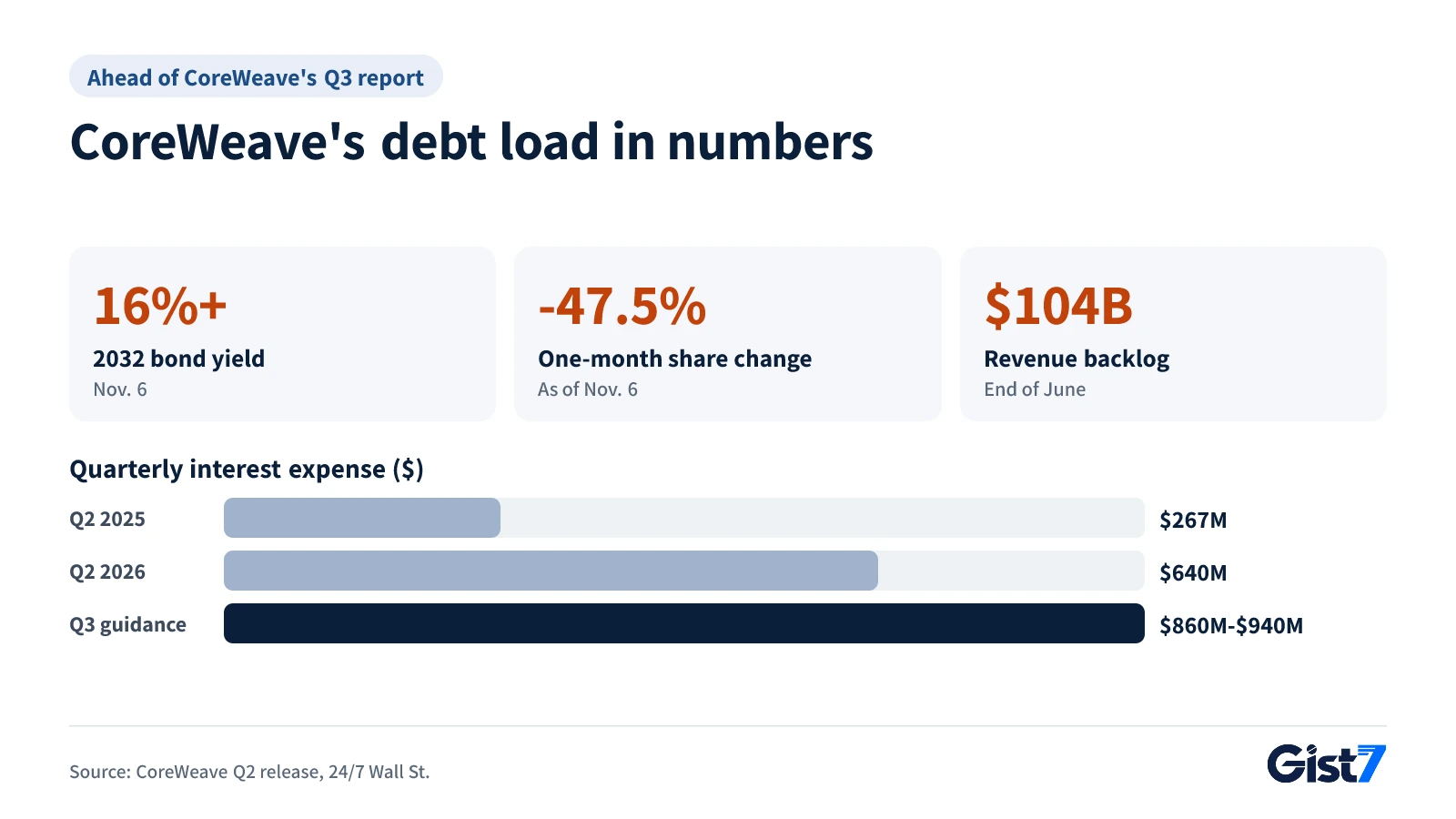
CoreWeave (Nasdaq: CRWV), the AI data-center operator, reports third-quarter results after the U.S. market close on Nov. 10, 2026, and holds its conference call at 5 p.m. ET. These CoreWeave earnings have become a test of more than one company: they will show whether markets are still willing to finance AI infrastructure built largely on borrowed money. According to 24/7 Wall St., the yield on CoreWeave's 2032 bond topped 16% on Nov. 6, and the stock had fallen 47.5% in a month.
Why have CoreWeave earnings become a gauge for all AI stocks?
Because AI demand, chip orders and debt financing all meet inside one company. CoreWeave buys Nvidia graphics processing units (GPUs) in bulk and rents the computing power to large customers such as Microsoft, a business often called a "neocloud." It pays for most of that equipment with debt. So CoreWeave's numbers capture three links of the AI investment chain at once: customer demand (backlog), orders flowing to Nvidia (capital spending) and the patience of the bond investors who fund it (interest expense and bond yields).
In its Nov. 8 week-ahead piece, CNBC quoted Jim Cramer calling CoreWeave "insanely important." CNBC said it has been watching CoreWeave's bonds and stock as a gauge of investor appetite for AI names. Last week's trading shows why. According to CNBC, the Nasdaq Composite fell 5.5% on Nov. 5, then rose 1.09% on Nov. 6 to close at 24,579.42, but still lost 3.4% for the week. This week's first big AI report will help decide whether Friday's bounce was the start of a recovery or just a pause. We covered the causes of the selloff in why the Nasdaq dropped 5.5% after the Democrats' midterm sweep.
What does a 16% bond yield mean?
A 16% yield means bond investors are demanding an unusually high reward for the risk of lending to CoreWeave. According to 24/7 Wall St., the 2032 bond, which carries a 9.625% coupon, yielded more than 16% on Nov. 6. Put simply, its price has dropped sharply.
Credit default swaps (CDS), contracts that work like insurance against a borrower failing to repay, point the same way. The same article said CoreWeave's five-year CDS rose above 1,289 basis points on Nov. 5 (roughly a 12.9% annual premium) before easing to about 1,155 basis points on Nov. 6. Nvidia's CDS, at about 139 basis points, was up 76% in a month. The hidden question in this report is whether stress at one company spreads to borrowing costs across the AI supply chain.
The strain shows up in the income statement too. CoreWeave's second-quarter release (Aug. 11) reported net interest expense of $640 million, more than double the $267 million a year earlier. Adjusted operating income in the same quarter was $128 million, so interest costs were five times what the business earned from operations. 24/7 Wall St. reported third-quarter interest expense guidance of $860 million to $940 million.
CoreWeave earnings: the numbers to check
The first thing to check in CoreWeave's earnings is the flow of money, not revenue. Even if revenue lands within guidance, a bigger-than-expected interest bill or a vague funding plan could hit the bond market first. Guidance is the company's own forecast of upcoming results.
| Number to check | Guidance / prior figure | What it tells you |
|---|---|---|
| Q3 revenue | $3.45 billion to $3.6 billion (Q2 actual: $2.575 billion) | Within range confirms demand; the top end means growth is holding up |
| 2026 capital spending | $35 billion to $39 billion | A cut would worry Nvidia and equipment suppliers; holding it shifts the focus to funding |
| Q3 interest expense | $860 million to $940 million (per 24/7 Wall St.; Q2: $640 million) | Coming in above range would show higher borrowing costs feeding into results |
| Revenue backlog | About $104 billion at end of June, excluding more than $25 billion of new early-Q3 commitments | Whether the new contracts actually show up in backlog |
| Funding plan | Q2: $3.1 billion term loan, more than $10 billion of unsecured notes and convertibles | Whether a concrete source of money for the capex plan is laid out |
Backlog is contracted business that has not yet been booked as revenue. CoreWeave said its backlog was about $104 billion at the end of June, and that more than $25 billion of new customer commitments signed in early Q3 were not included. 24/7 Wall St. said investors will look for those commitments in the new backlog figure. Customer concentration is another variable: according to the same article, Microsoft accounted for about 67% of 2025 revenue.
Gist 7's take: the market has moved past asking how fast revenue grows and is now asking how long the debt can be carried. One strong number may not be enough. If the explanation of capex funding and interest costs falls short, the stock and the bonds could move in different directions. As with Google's earnings shock, bigger investment plans can be read as a burden rather than a strength.
Same day: October CPI, with 78% odds of a December hike
The October consumer price index (CPI) also comes out on Nov. 10, the day CoreWeave reports. According to the U.S. Bureau of Labor Statistics (BLS), the release is at 8:30 a.m. ET; September CPI was up 3.7% from a year earlier and core CPI 2.6%. According to CNBC, CME FedWatch put the odds of a quarter-point rate hike in December at 78% as of Nov. 8. A hot reading would add rate pressure, a double squeeze for heavily indebted AI infrastructure companies. Dates and scenarios are in our Nov. 10 CPI calendar.
Market impact map
Directions read "if CoreWeave's results and funding plan add to worries / ease them." The table maps links, not forecasts.
| Asset / indicator | Direction | Strength | Link (why) |
|---|---|---|---|
| Nasdaq | ↓ / ↑ | Strong | Expectations for continued AI infrastructure spending feed directly into big-tech valuations |
| S&P 500 | ↓ / ↑ | Medium | Transmitted through the weight of AI-linked megacaps |
| KOSPI | ↓ / ↑ | Medium | Large weight of memory chips, power equipment and other AI data-center suppliers |
| Semiconductor stocks | ↓ / ↑ | Strong | CoreWeave's capex turns into GPU and memory orders |
| High-yield spreads | ↑ / ↓ | Medium | Risk premiums on AI infrastructure bonds could spill over to lower-rated debt |
| VIX (volatility index) | ↑ / ↓ | Medium | After last week's selloff, results are a key input for risk appetite |
Little direct impact: 2-year Treasury, 10-year Treasury, dollar index, USD/KRW, gold, oil (WTI), bitcoin (the same-day CPI is likely to move these more)
- Retirement accounts and funds: products heavy in U.S. tech or chip stocks may see bigger swings this week.
- Jobs and exports: slower AI data-center spending could weigh on expectations for South Korea's memory-chip exports.
Market reactions can vary with other factors, and this table is not a basis for investment decisions.
What to watch next
| Date (ET) | Event | Prior | Why it matters here | If it comes in... |
|---|---|---|---|---|
| Nov. 10 (Tue) 8:30 a.m. | U.S. October CPI (BLS) | Sept.: 3.7% y/y, core 2.6% (BLS) | Rate pressure adds to AI infrastructure borrowing costs | Hot: yields tend to rise, pressure on growth stocks and high-risk bonds |
| Nov. 10 (Tue) 5 p.m. | CoreWeave Q3 earnings call (company notice, Oct. 27) | Q2 revenue $2.575 billion, net loss $626 million (company) | The main event of this article | Vague funding plan: bond yields tend to rise, pressure on AI stocks |
| Nov. 12 (Thu), before the open | Nebius earnings | n/a | Demand and funding at another neocloud | Same direction as CoreWeave could be read as a sector signal |
| Nov. 12 (Thu), after the close | Cisco and Applied Materials earnings | n/a | Checks AI spending on networking and chip equipment | Solid orders tend to ease worries about chip stocks |
| Nov. 17 (Tue) 5 p.m. | Nvidia fiscal 2027 Q3 earnings call (company notice, Oct. 28) | n/a | Where CoreWeave's capex ends up | Strong data-center sales tend to support expectations of continued AI spending |
Frequently asked questions
When does CoreWeave report earnings?
CoreWeave reports third-quarter 2026 results after the U.S. market close on Tuesday, Nov. 10. The conference call starts at 5 p.m. ET and is webcast on the company's investor relations site.
What does CoreWeave's 16% bond yield mean?
It means bond investors see enough risk in lending to CoreWeave to demand more than 16% a year. According to 24/7 Wall St., the 2032 bond with a 9.625% coupon yielded more than 16% on Nov. 6, which reflects a sharp fall in its price.
Why do CoreWeave earnings affect Nvidia and other AI stocks?
CoreWeave borrows to buy Nvidia GPUs and rents computing power to customers such as Microsoft, so demand, chip orders and financing all sit in one company. That is why investors treat its bonds and stock as a gauge of sentiment toward AI.
What is the most important number in CoreWeave's report?
Interest expense and the funding plan, more than revenue. Company guidance cited by 24/7 Wall St. puts Q3 interest expense at $860 million to $940 million, and the bond market wants to know how the $35 billion to $39 billion of 2026 capex will be paid for. Whether more than $25 billion of new early-Q3 commitments shows up in backlog is also key.
Should I buy CoreWeave stock before earnings?
This article does not recommend buying or selling. CoreWeave posted a $626 million net loss in Q2 and relies heavily on debt, so the stock tends to swing widely around earnings. Any decision should weigh risks such as interest costs and funding needs.
References
- CoreWeave Reports Strong Second Quarter 2026 Results — CoreWeave
- CoreWeave's Bonds Now Yield More Than 16%, Days Before Earnings — 24/7 Wall St.
- Here are the 2 big things we're watching in the stock market in the week ahead — CNBC
- Stock market today (Nov. 5~6, 2026) — CNBC
- Consumer Price Index – September 2026 — U.S. Bureau of Labor Statistics
- CoreWeave Announces Date of Third Quarter 2026 Financial Results and Conference Call — CoreWeave
- NVIDIA Sets Conference Call for Third-Quarter Financial Results — NVIDIA