Bank of Korea Rate Hike Outlook: 3.25% in November?
Key summary
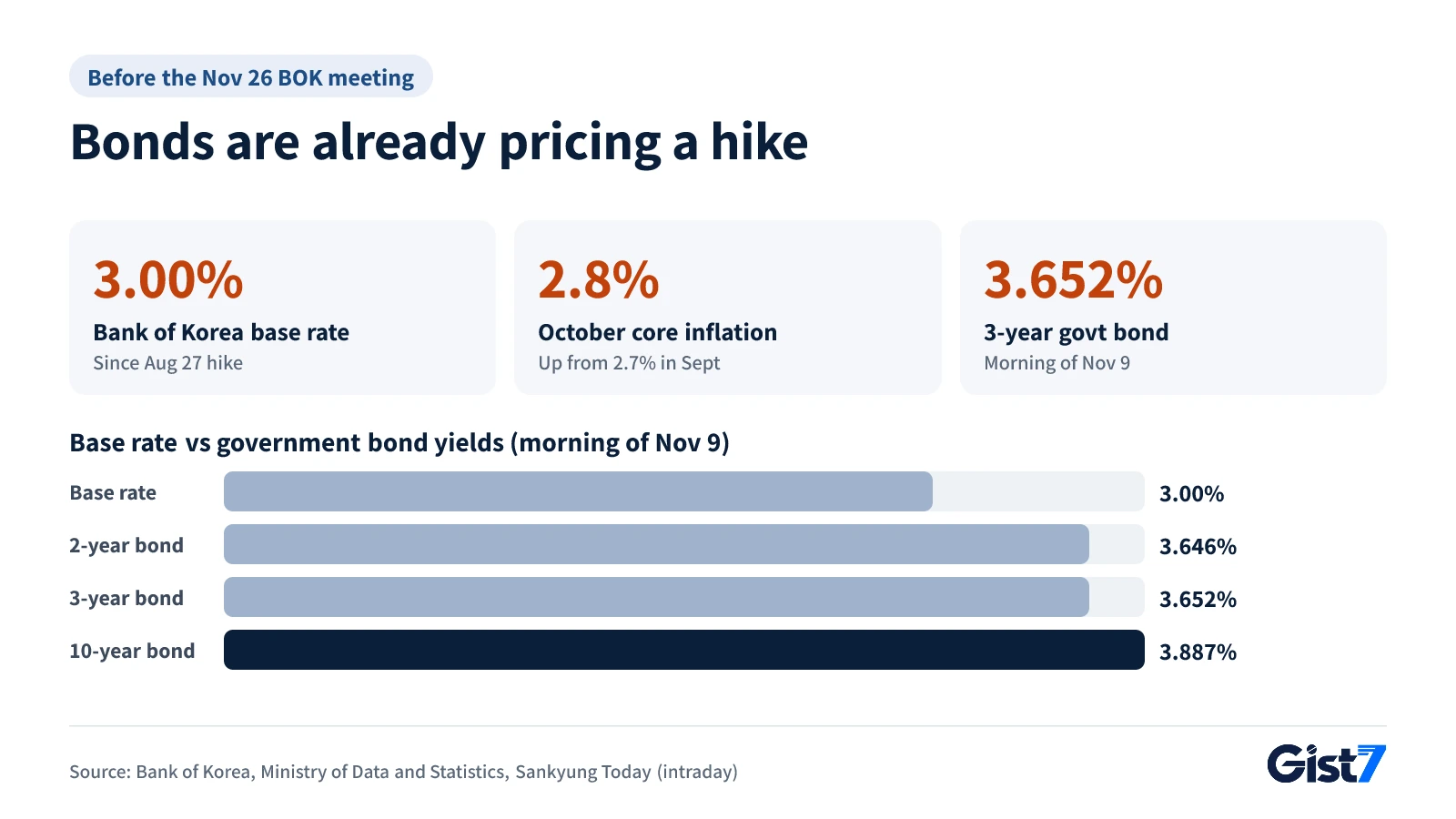
Korea's three-year bond yield hit 3.652% on the morning of November 9, 2026, about 0.65 point above the 3.00% base rate. NH Investment & Securities still expects a Bank of Korea rate hike to 3.25% on November 26, citing low financial stress and the Fed's 2018 case. Core inflation and growth agree.
- The Bank of Korea's base rate has been 3.00% since August 27, 2026; the next rate meeting is November 26.
- NH Investment & Securities kept its call for a 0.25-point hike in November, citing the financial stress index and the Fed's 2018 experience (report dated November 9).
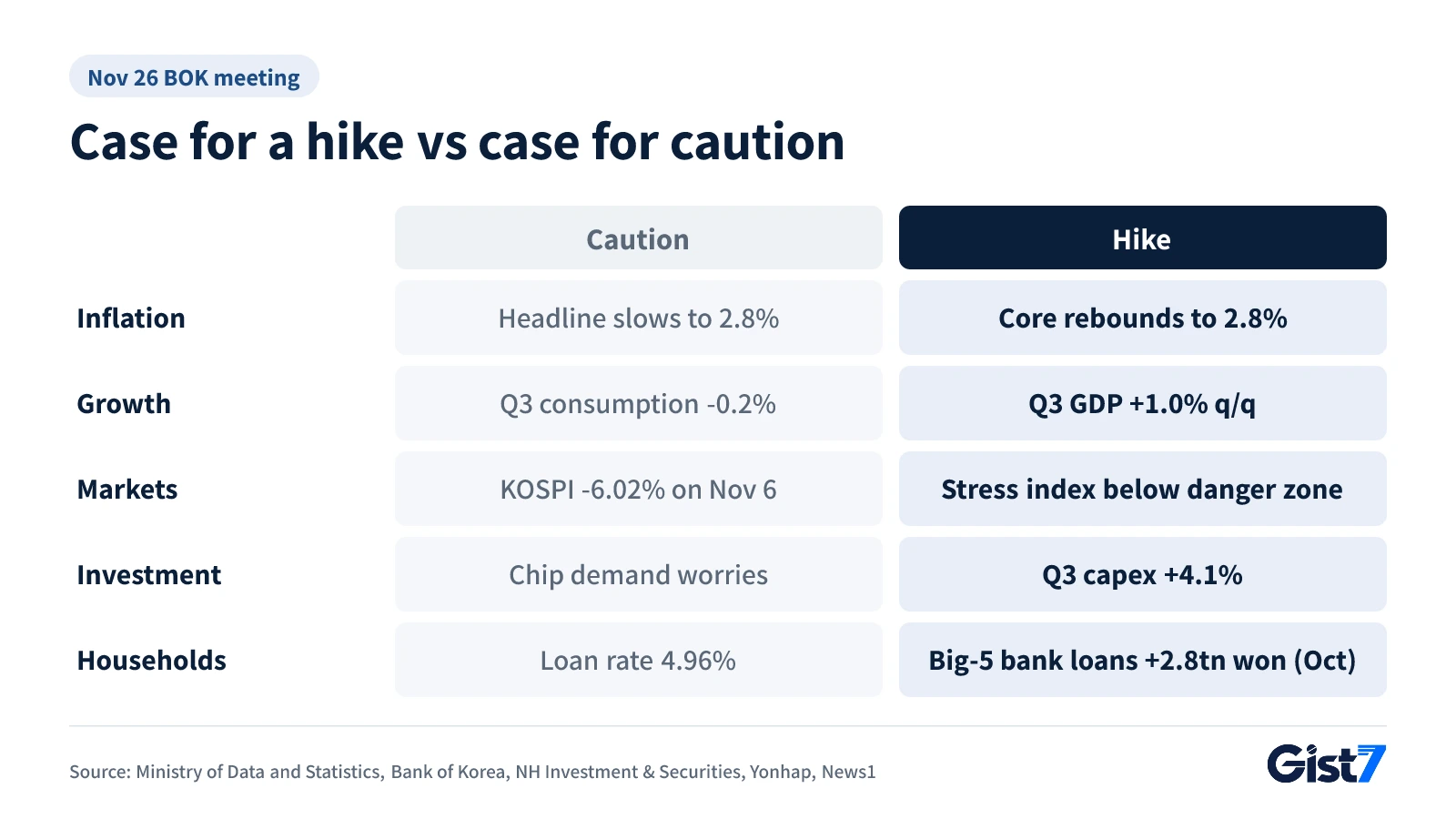
- Core inflation rebounding to 2.8%, third-quarter GDP growth of 1.0% quarter on quarter and renewed growth in household loans are cited as reasons to hike.
- The case for caution: the KOSPI's 6.02% one-day plunge, worries about chip demand and a 0.2% drop in private consumption.
- The three-year government bond yield was 3.652% (+3.9 bp) on the morning of the 9th, about 0.65 point above the base rate.
On the morning of November 9, 2026, South Korea's two-year government bond yield jumped 4.5 basis points to 3.646%, as the market leaned toward a Bank of Korea rate hike at the Monetary Policy Board meeting on November 26. That bet holds even after the KOSPI, Korea's benchmark stock index, lost more than 6% in one day last week. In a report released the same day, NH Investment & Securities (KOSPI: 005940) kept its call that the central bank will raise its base rate by 0.25 percentage point this month, from 3.00% to 3.25%.
Bank of Korea rate hike: will November bring 3.25%?
The NH forecast and Monday's bond market moves both point to a quarter-point hike on November 26. According to the Bank of Korea's base rate history, the rate rose twice in a row in 2026: from 2.50% to 2.75% on July 16, then to 3.00% on August 27. At the October 22 meeting the board held at 3.00% to gauge the effect of those two moves.
The pause did not read as the end of the cycle. According to the Seoul Shinmun, the October decision was unanimous among the seven board members, and Governor Shin Hyun-song told reporters the bank would decide policy "after checking third-quarter GDP and October inflation." He added that the bank would keep responding until it was confident inflation was converging steadily toward its target, and said growth this year and next would come in considerably above the August projections of 3.3% and 2.9%.
Both data points the governor flagged have since been released, and both are cited as arguments for a hike. According to Newspim, NH Investment & Securities expects another 0.25-point increase on the 26th. The open question is whether the stock market rout is a big enough shock to break that path.
What is the case for raising rates?
The case rests on two points: underlying inflation is picking up again, and growth is running stronger than expected. Korea's Ministry of Data and Statistics reported on November 3 that consumer prices rose 2.8% in October from a year earlier, slower than September's 2.9%. But core inflation, which strips out farm products and petroleum, rose to 2.8%, up from the September reading of 2.7% released on October 2. Core inflation excludes items that swing with the weather or oil prices, and central banks use it to judge the underlying trend.
| Indicator | Latest | Period and source | Signal for rates |
|---|---|---|---|
| Consumer price inflation | 2.8% (Sept 2.9%) | October 2026, Ministry of Data and Statistics | Still above the 2% target |
| Core inflation (ex farm products and petroleum) | 2.8% (Sept 2.7%) | October and September 2026, Ministry of Data and Statistics | Underlying inflation rebounding, points to a hike |
| Real GDP growth | 1.0% q/q, 3.4% y/y | Q3 2026 advance estimate, Bank of Korea | Overheating risk, points to a hike |
| Private consumption | -0.2% q/q | Q3 2026 advance estimate, Bank of Korea | Weak domestic demand, points to caution |
| Household loans at the five largest banks | Up 2.7717 trillion won in October | News1 report | Lending growing again, points to a hike |
| Household loan rate (new loans) | 4.96% | September 2026, Bank of Korea | Borrowing costs already high |
The growth numbers are even clearer. According to a Ministry of Finance and Economy release on the government's Korea.kr portal, based on the Bank of Korea's advance estimate, real GDP grew 1.0% quarter on quarter in the third quarter, and facilities investment rose 4.1%, led by chipmaking equipment. The ministry said the result raised the chance of growth in the mid-3% range this year. When growth runs well above its potential rate, price pressure tends to follow. Add a report that household loans at the five largest banks grew by 2.7717 trillion won in October, and some argue that financial stability offers little reason to stop tightening.
Why the hike call survives the sell-off, and the case against it
NH Investment & Securities analyst Kang Seung-won argues that falling stock prices alone do not make central banks change course. In his report "Stocks and central banks: the 2018 case," as described by Newspim, he notes that the S&P 500 fell about 15% from October to December 2018, yet the Federal Reserve still raised rates in December. The Fed turned cautious only in January 2019, after the slide spread into corporate bond and leveraged loan markets and tightened financial conditions across the board. The report says the Bank of Korea's financial stress index for September was well below the danger zone and its financial vulnerability index for the second quarter was near its long-run average, leaving room to absorb shocks.
The counterarguments carry real weight.
- Size of the equity shock: According to Yonhap's Korean Center, the KOSPI closed at 5,059.69 on November 6, down 6.02% on the day, as foreign investors sold a net of about 2.8 trillion won of shares on the main board. The won weakened by 14.5 won to 1,356.6 per dollar at 3:30 p.m. Seoul time that day.
- Chip demand worries: The same report said concerns about regulation of AI data centers after the US midterm elections spilled over into fears about semiconductor demand. We covered the background in Why the Nasdaq fell 5.5% after the Democratic sweep. Exports have driven Korea's growth, so a demand slowdown would weaken the case for a hike.
- Strain on household spending: Private consumption fell 0.2% in the third quarter, and household loan rates are already close to 5%. Another hike could weigh further on spending through higher interest costs.
In Gist 7's view, the deciding factor is the credit market, not stock prices. If NH's reasoning holds, the Bank of Korea's calculation changes when corporate bond and leveraged loan markets start to wobble or banks sharply tighten lending standards. Without such signals by the 26th, the hike scenario looks likely to stay in place. That is a forecast, not a decision.
How much is already priced into bonds and loan rates?
The bond market has already priced in much of a hike. According to Sankyung Today, the three-year government bond yield stood at 3.652% in morning trading on the 9th, up 3.9 basis points from the previous session and roughly 0.65 percentage point above the 3.00% base rate. A three-year yield reflects expected policy rates over the next three years plus a term premium for holding longer-dated debt. So not all of that gap is hike expectations, but it does signal that the market is pricing in further tightening.
| Maturity | Yield, morning of Nov 9 | Change from previous session |
|---|---|---|
| 2-year government bond | 3.646% | +4.5 bp |
| 3-year government bond | 3.652% | +3.9 bp |
| 5-year government bond | 3.752% | +3.5 bp |
| 10-year government bond | 3.887% | +3.4 bp |
| 30-year government bond | 3.991% | +2.0 bp |
Short-dated yields rose the most, a sign that the upcoming rate decision, rather than long-term growth expectations, is pushing yields higher. These are intraday figures and may differ from closing levels.
Loan rates have moved too. According to CEO Score Daily, citing the Bank of Korea's September data on weighted average interest rates at financial institutions, the average rate on new household loans was 4.96%, up 0.20 percentage point in a month. Mortgage rates were 4.88% (+0.22 point) and unsecured personal loans 6.49% (+0.16 point). The rate on new bank savings deposits rose 0.24 point to 3.45% in the same month. Korean bank lending rates follow market rates such as government and bank bond yields more closely than the base rate itself, so if a hike materializes, upward pressure would remain, mainly on floating-rate loans.
Market impact map
| Asset / indicator | Direction | Strength | Link (why) |
|---|---|---|---|
| Korea 3-year government bond | ↑ | Strong | November hike expectations feed straight into short-term yields (+3.9 bp on the morning of Nov 9, Sankyung Today) |
| Korean yield curve (10-year minus 3-year) | ↓ | Medium | Flattening as short-dated yields rise more than long-dated ones |
| USD/KRW (won per dollar) | ↑↓ | Weak | A narrower Korea-US rate gap after a hike supports the won (rate ↓); foreign selling of Korean stocks weakens it (rate ↑) |
| KOSPI (Korea's benchmark index) | ↓ | Weak | Higher discount rates weigh on stocks, though the recent drop owes more to US AI stocks |
| REITs and construction | ↓ | Medium | Higher borrowing costs and real estate financing strain |
| Banks | ↑↓ | Weak | Higher lending rates lift margins; rising delinquencies are a risk |
Little direct impact: 2-year Treasury, 10-year Treasury, Dollar Index, gold, oil (WTI), bitcoin, S&P 500, Nasdaq
- Loans: In Korea, floating-rate mortgages and personal loans can rise further as they track CD and bank bond yields.
- Deposits: Deposit rates tend to follow market rates higher, so rates on short-term deposits are worth watching.
- Currency exchange: For Koreans buying dollars, a won supported by a narrower rate gap would ease the cost, though continued stock market jitters could push the won the other way.
Market reactions can vary with other factors, and this table is not a basis for investment decisions.
What to watch next
| Date (KST / ET) | Indicator / event | Previous | Why it matters | If it comes in... |
|---|---|---|---|---|
| Nov 10 (Tue) 22:30 KST / 8:30 a.m. ET | US October consumer price index (CPI) | Sept 3.7%, core 2.6% (Bureau of Labor Statistics) | US rate path and the Korea-US rate gap | Hotter than expected: stronger dollar, pressure on the won, a stronger case for a Bank of Korea hike |
| Nov 11 (Wed), scheduled | Korea October household lending (Bank of Korea, financial regulators) | Reference: five largest banks +2.7717 trillion won in October (News1) | Key input for financial stability | A large increase strengthens the case for a hike |
| Nov 11 (Wed), scheduled | Korea October employment report (Ministry of Data and Statistics) | September employment +113,000 year on year (Ministry of Data and Statistics) | Gauge of domestic demand and economic strain | Slower job growth strengthens the case for caution |
| Nov 26 (Thu) | Bank of Korea monetary policy decision | 3.00% (Bank of Korea) | The conclusion of this article | A hike: loan and deposit rates rise further. A hold: short-term bond yields may retrace |
The two November 11 release dates come from News1's weekly economic calendar (November 8) and may change. The US CPI and other releases that week are in our economic calendar for the week ahead.
Frequently asked questions
What is the Bank of Korea's base rate now?
As of November 9, 2026, it is 3.00%. The Bank of Korea raised it from 2.50% to 2.75% on July 16 and to 3.00% on August 27, then held it at the October 22 meeting.
When is the November rate meeting?
Thursday, November 26. Brokerage analysts are discussing a 0.25-point hike to 3.25%. The decision is announced on the day of the meeting.
Why do analysts expect a hike after the stock market plunge?
Because, in their analysis, inflation, growth and overall financial stress matter more for rate decisions than share prices. NH Investment & Securities noted that the Bank of Korea's September financial stress index was well below the danger level. On that reasoning, the hike outlook could hold until market turmoil spreads into credit markets such as corporate bonds.
If the base rate rises, will Korean loan rates rise right away?
Floating-rate loans follow market rates such as CD and bank bond yields, so they can rise with a lag. Market rates tend to price in hike expectations early: the average rate on new household loans had already reached 4.96% in September, up 0.20 point in a month. Borrowers should discuss their own situation with their lender.
Will deposit rates rise too?
Deposit rates tend to follow market rates higher. In the Bank of Korea's September data, the rate on new bank savings deposits rose 0.24 point to 3.45%. Actual rates differ by bank, and they could fall back if no hike is decided.
References
- Base rate history (Bank of Korea)
- Base rate held at 3.0%; a third hike next month? (Seoul Shinmun)
- October 2026 consumer price trends (Korea.kr, Ministry of Data and Statistics)
- September 2026 consumer price trends (Korea.kr, Ministry of Data and Statistics)
- Q3 growth at 1.0%; mid-3% growth more likely this year (Korea.kr)
- Bank of Korea hike still expected despite stock plunge; 0.25-point rise this month (Newspim)
- Government bond yields rise across the curve; short end jumps (Sankyung Today)
- This week in the economy: October household lending and job data (News1)
- September mortgage rates hit another high at 4.88% (CEO Score Daily)
- 'Blue wave shock' sends won to 1,360 range (Yonhap Korean Center)
- September employment up 113,000; youth employment down for 47th month (iNews24)