Why AI stocks fell after the Democrats' midterm sweep
Key summary
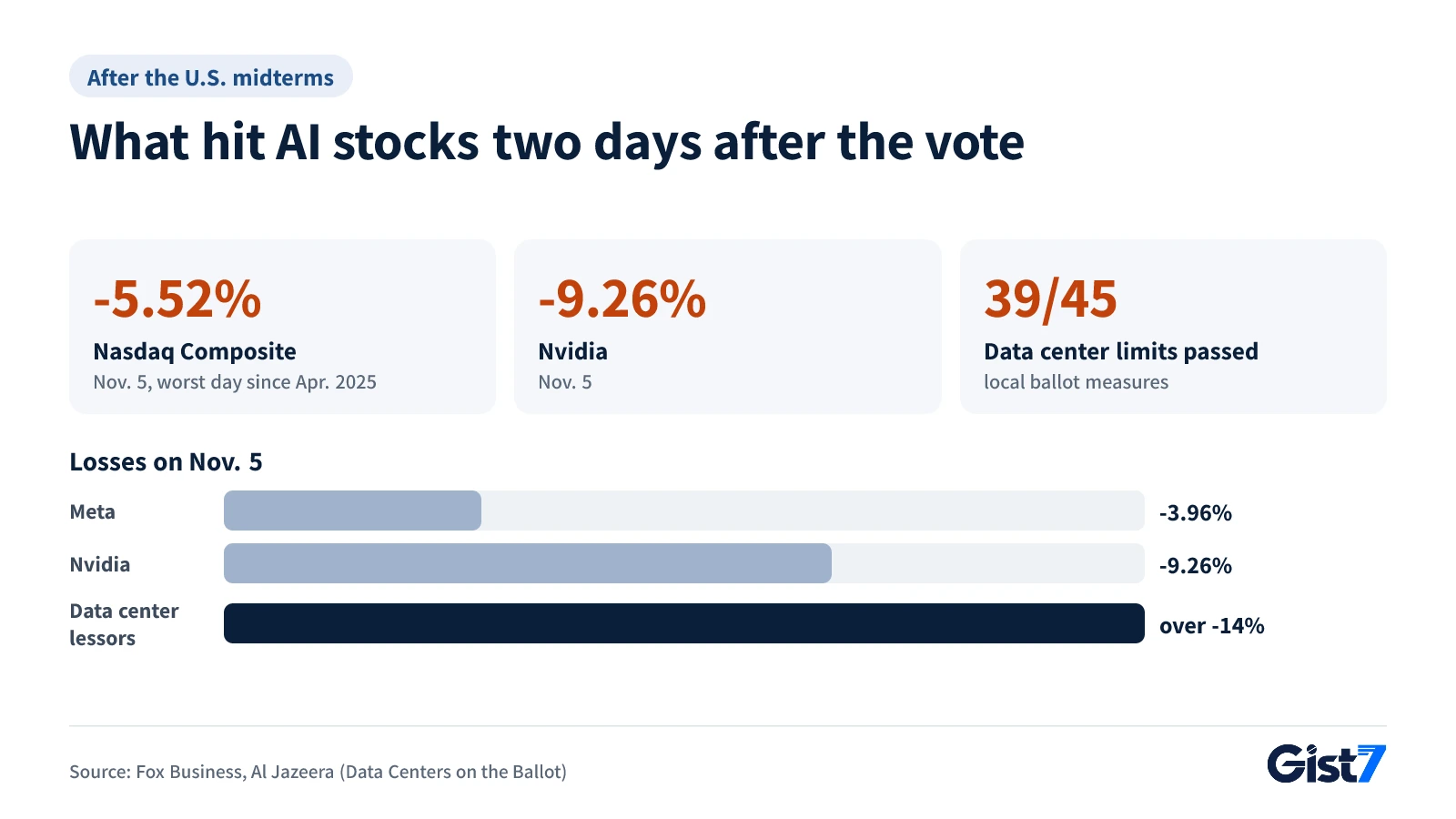
AI stocks fell because markets read the Democrats' Nov. 3, 2026 midterm sweep as a sign that AI data centers will get harder and costlier to build. On Nov. 5 the Nasdaq dropped 5.52% and Nvidia 9.26%, as 39 of 45 local data center ballot measures passed (as of Nov. 7, 2026).
- The Nasdaq Composite fell 5.52% on Nov. 5, its worst day since April 2025, and slipped into correction territory
- 39 of 45 local ballot measures limiting data centers passed; UBS says about 30% of planned 2028 U.S. data center additions are at risk
- Democrats won the governorships of Texas and Georgia, which account for about a third of AI data center spending
- Doubts about AI returns predated the vote: Goldman Sachs' AI basket fell 15% in October
- Other markets moved too: gold hit $4,134 intraday while bitcoin fell 6%, and the won weakened to 1,356.6 per dollar
On Nov. 3, 2026, Democrats won both chambers of Congress in the U.S. midterm elections. Two days later, the Nasdaq Composite fell 5.52% in a single session, its steepest drop since the April 2025 tariff shock. The short answer to why AI stocks fell: investors read the result as a sign that building AI data centers in America is about to get slower and more expensive. According to Fox Business, Nvidia lost 9.26% that day and the Philadelphia Semiconductor Index sank more than 12%.
How big was the Democrats' midterm win?
Democrats secured majorities in both the Senate and the House. According to Investing.com (via Yahoo Finance), they also won in traditionally Republican-leaning states such as Texas and Kansas. CBS News projected on Nov. 7 that Democrats would control the House, with estimates suggesting their seat count could climb from 214 before the election to around 255.
The presidential veto still stands, though. To pass laws on their own, Democrats need President Trump's signature or enough votes to override a veto. That makes a sweeping federal AI law unlikely any time soon. So why did AI stocks react so sharply? The answer lies elsewhere.
Why did the post-election rally reverse within a day?
Stocks rose on Wednesday, Nov. 4, as results came in. Al Jazeera reported that President Trump's statement that he would accept the outcome helped ease uncertainty. By the next day, however, investors had started to recalculate the political risk the election left hanging over AI infrastructure. Michael Monaghan of the Founders 100 ETF said the broad selling across chipmakers and hyperscalers reflected exactly that concern.
Jakub Rochlitz of eToro told Fox Business that the market was "pricing in the midterm results." The view spreading across trading desks was simple: the AI buildout will be slower and costlier than expected.
| Thu., Nov. 5 | Fri., Nov. 6 | |
|---|---|---|
| Nasdaq Composite | -5.52% | +1.09% (24,579.42) |
| S&P 500 | -4.36% | +0.31% (7,376.86) |
| Dow Jones | -1,833 points (-3.44%) | -237 points (-0.46%) |
| Nvidia | -9.26% | +2.78% |
| Philadelphia Semiconductor Index | more than -12% | +4.2% |
(Closing figures as reported by Fox Business on Nov. 5 and 6, 2026)
Why AI stocks fell, reason 1: data centers were on the ballot
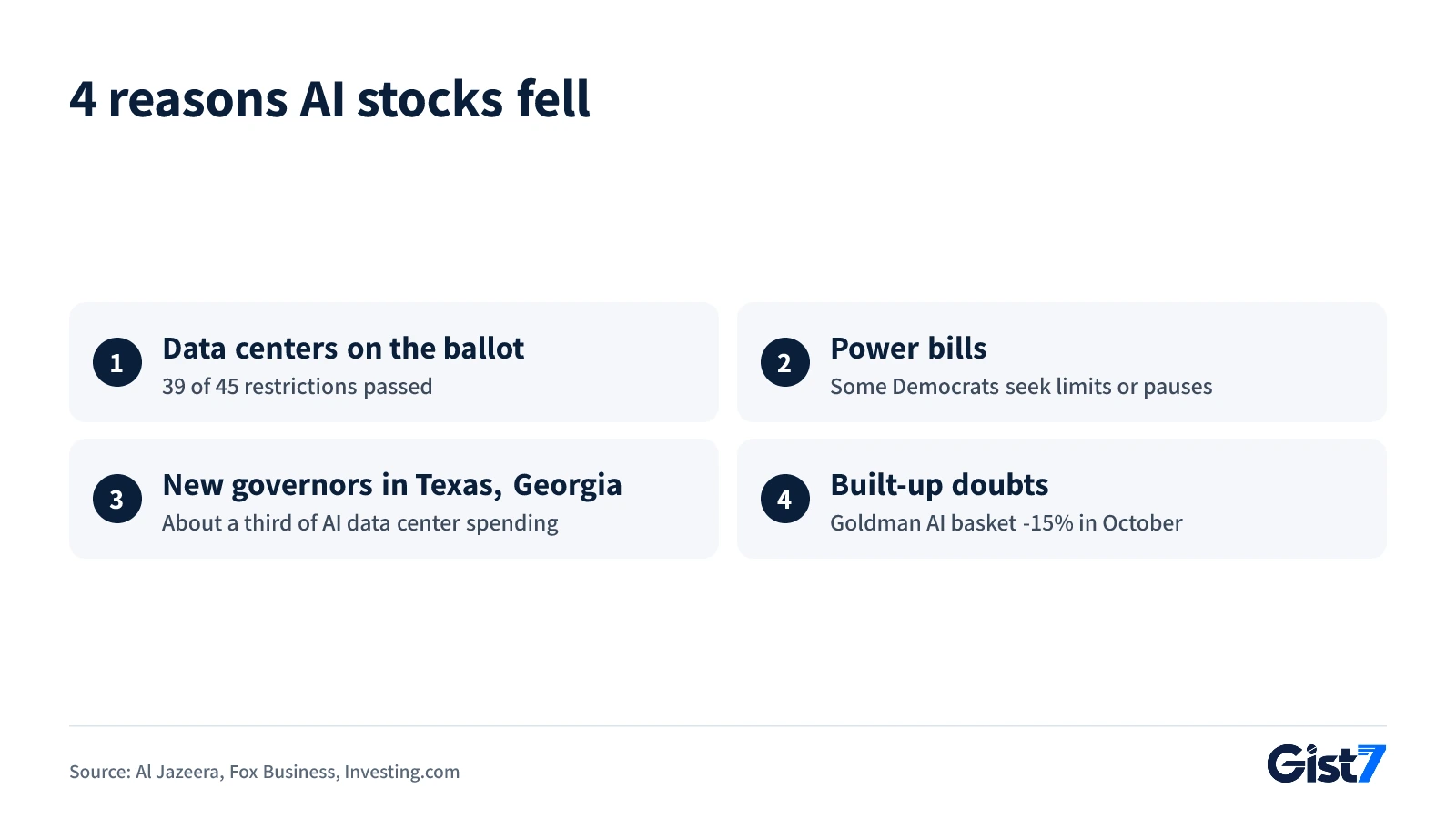
Most local ballot measures to restrict data center construction passed on Election Day. A data center is a large facility housing tens of thousands of servers that train and run AI models. Citing a tally by Data Centers on the Ballot, Al Jazeera reported that 39 of 45 local initiatives restricting AI facilities were approved.
Investors care about that number because AI demand ultimately comes down to where, and how fast, new capacity can be built. UBS estimated that if construction pauses spread, roughly 30% of the U.S. data center capacity additions planned for 2028 could be at risk. According to Investing.com, Data Center Watch counted at least 45 projects worth about $68 billion that were blocked or delayed by local opposition in the second quarter of 2026 alone.
Why AI stocks fell, reason 2: power bills and governor races
Rising electricity prices turned data centers into a campaign issue. Fox Business reported that as power costs climbed, data center growth became political, and some Democrats called for restrictions or pauses on new projects. Power-related names such as GE Vernova and Constellation Energy also fell on Nov. 5.
The governor races mattered too. According to Investing.com, Democrats won the governorships of Texas and Georgia, two states that together account for about a third of U.S. AI data center spending and projects. Several governors-elect have spoken in favor of more AI oversight. In Congress, talk of tighter oversight, rollbacks of tech tax incentives and more antitrust scrutiny could return.
AI stocks were already shaky before the vote
The election was the trigger, not the whole story. Doubts about AI spending had been building for weeks. According to Investing.com, Goldman Sachs' broad AI basket fell 15% in October and stood more than 24% below its peak right after the election. Oracle's recent $20 billion stock and debt offering also showed how much money AI infrastructure requires. The slide in Alphabet shares after its late-October earnings fits the same pattern.
Amit Daryanani of Evercore ISI said the first reaction would be to sell AI names, but the bigger question is how much the election actually changes companies' fundamentals. Ipek Ozkardeskaya of Swissquote Bank described money rotating out of tech into other sectors, and out of the U.S. into other markets. Tesla (-10.77%) and SpaceX (-9.05%) also fell sharply after Texas candidates Elon Musk had spent heavily to defeat won their races. Analyst Dan Ives said a SpaceX-Tesla merger now faces a tougher regulatory path in 2027.
Gist 7's take: local votes scared investors more than Washington
The losses by company show what the market was really worried about. On Nov. 5, Meta slipped just 3.96%, while IREN, Applied Digital and Nebius, companies that build and lease out data centers, each dropped more than 14%. A federal AI law can be stalled by a veto. Securing land and power, though, can be blocked right away by a state or local vote. The market priced that in first.
That makes this selloff less "the AI bubble popped" and more "AI growth now carries a political cost." Even if demand holds, slower construction pushes revenue further out and makes existing debt heavier. Whether the Nov. 6 chip rebound lasts will depend on hard numbers about that pace. Asian markets felt it too: Fox Business reported that Japan's Nikkei and South Korea's Kospi, both up more than 20% this year, fell after the Wall Street rout.
Policy questions ahead
- AI and data center bills after the new Congress convenes in January 2027, and the White House response
- Data center permitting and power-price policies from new governors in Texas, Georgia and elsewhere
- Whether Big Tech trims or keeps its 2027 capital spending plans in the next earnings season
- How quickly the Nasdaq climbs out of correction territory (a drop of 10% or more from its peak)
Market impact map: yields and the dollar rose, oil and bitcoin slid
The shock did not stay inside AI stocks. The election result and a strong U.S. jobs report on Nov. 6 landed in the same week, lifting yields and the dollar while oil and bitcoin fell hard. The table below maps how this event connects to each asset, based on moves from Nov. 4 to 6, 2026.
| Asset / indicator | Direction | Strength | Link (why) |
|---|---|---|---|
| 2-year Treasury | ↑ | Medium | Strong hiring raised the odds of a December rate hike (jobs mattered more than the vote) |
| Dollar index | ↑ | Medium | Safe-haven demand during the selloff plus a strong jobs report |
| KRW/USD (won per dollar) | ↑ (weaker won) | Strong | Foreign investors sold Korean chip stocks and converted the proceeds to dollars |
| Gold | ↑ then ↓ | Medium | Haven buying on the crash day, profit-taking the next day as hike bets rose |
| Oil (WTI) | ↓ | Strong | The Democratic win raised hopes of an earlier end to the Iran war |
| Bitcoin | ↓ | Strong | Sold alongside tech stocks, with leveraged positions liquidated en masse |
| S&P 500 | ↓ | Strong | Heavyweight AI megacaps dragged the index lower |
| Nasdaq | ↓ | Strong | An AI- and chip-heavy index, the most exposed to data center rules |
| KOSPI | ↓ | Strong | South Korea's main index is chip-heavy and tied to U.S. AI spending |
| Philadelphia Semiconductor Index | ↓ | Strong | Slower data center builds could delay AI chip orders |
| Power and energy equipment stocks | ↓ | Medium | A lower power-demand outlook for data centers, plus falling oil |
| Ether | ↓ | Strong | The same risk-off selling as bitcoin, with a deeper drop |
| VIX (volatility index) | ↑ | Strong | The crash raised anxiety about future swings |
Little direct impact: 10-year Treasury (up just 0.02 percentage point on Nov. 6)
- Travel and shopping abroad: a stronger dollar makes dollar-priced goods more expensive for anyone paid in other currencies.
- Gas prices: if the drop in crude holds, pump prices could follow with a lag.
- Loan and savings rates: rising odds of a Fed hike can push market lending rates higher.
- Retirement and regular investing: funds heavy in U.S. and Korean tech stocks may see bigger short-term swings.
Market reactions can vary with other factors, and this table is not a basis for investment decisions.
Yields and the dollar: the jobs report moved them more than the vote
According to 24/7 Wall St., the Fed's target range stands at 3.75% to 4.00%, and CME FedWatch odds of a December hike rose from 66.9% a week earlier to 76.8% on Nov. 6. October payrolls grew by 165,000, about 2.5 times the forecast. The 2-year Treasury yield rose 0.05 percentage point that day, from 4.46% to 4.51%, while the 10-year edged up 0.02 point to 4.86%. FinanceFeeds reported that the dollar index, which tracks the dollar against six major currencies, rose 0.72% to 102.28 on Nov. 6.
For AI companies, rates are a second burden. Data centers are often built with borrowed money, so a company raising $20 billion like Oracle pays more interest as rates climb. If construction slows and borrowing costs rise at the same time, the pressure doubles.
Inflation and oil: power bills link the vote to prices
U.S. inflation is still above the Fed's 2% target. According to Kiplinger, the consumer price index (CPI) rose 3.7% year over year in September, and core CPI, which excludes food and energy, rose 2.6%. Gasoline jumped 9.1% from the prior month and accounted for more than half of the monthly increase. As energy costs climbed, power-hungry data centers were blamed for higher local electric bills, which fed into the restrictive ballot measures.
Oil moved the other way after the vote. According to OilPrice.com, as of 1 p.m. ET on Nov. 4, WTI was down 8.3% at $88.08 a barrel and Brent was down 8.6% at $94.66, as traders bet a Democratic Congress could hasten the end of the Iran war. Cheaper oil could ease price pressure over time, but the Fed is likely to look first at the October CPI due Nov. 10.
Gold: up on a political shock, down on a rate shock
According to Al Jazeera, spot gold rose more than 1% to $4,115 an ounce on Nov. 5, a two-week high, and FinanceFeeds put that day's intraday peak at $4,134.83. On Nov. 6, however, the same outlet reported that gold closed down 1.02% at $4,045 as the jobs report boosted hike bets. Gold pays no interest, so it tends to lose appeal when rates rise. For the week it was still about 4.4% above its Oct. 30 level of $3,875.
The won and the KOSPI: the shock reached South Korea
KRW/USD is the number of South Korean won per U.S. dollar, so a higher figure means a weaker won. According to Seoul Shinmun, a Korean daily, the rate closed up 14.5 won at 1,356.6 on Nov. 6 after touching 1,362.2 intraday, the highest since Oct. 2. The KOSPI, South Korea's benchmark index, fell 6.02% to 5,059.69 the same day. Foreign investors sold a net 3 trillion won or more on Nov. 5 and about 2.8 trillion won on Nov. 6, their sixth straight day of net selling. Whether that selling stops is likely to set the won's next move.
Bitcoin: moving opposite to gold
According to The Block, bitcoin climbed back above $80,000 on Nov. 4, then fell about 6% to $75,700 on Nov. 5, while ether dropped more than 7% to $2,247. CoinGlass data showed roughly $1.1 billion in positions forcibly liquidated over 24 hours. A liquidation happens when an exchange automatically closes a leveraged position after losses pass a set threshold. With gold up and bitcoin down on the same day, bitcoin again traded more like a tech stock than "digital gold."
What to watch next
| Date (ET) | Indicator / event | Previous | Why it matters here | If it comes in... |
|---|---|---|---|---|
| Tue., Nov. 10, 8:30 a.m. | U.S. October consumer price index (CPI), Bureau of Labor Statistics | September: 3.7% y/y, core 2.6% (Kiplinger) | First test for a December rate hike | Hotter than expected: yields and the dollar ↑, gold and growth stocks ↓ tend to follow |
| Tue., Nov. 17, 5 p.m. | Nvidia fiscal 2027 third-quarter results | Nov. 6 close: $186.64 (Fox Business) | Shows whether AI data center demand holds up after the vote | Strong data center sales and guidance tend to ease pressure on chip and AI infrastructure stocks |
| Dec. 8-9 (press conference Dec. 9, 2:30 p.m.) | Federal Open Market Committee (FOMC) rate decision | 3.75%-4.00% (24/7 Wall St.) | A hike would raise the cost of financing AI buildouts | A hike or hawkish signal: the dollar ↑, gold, bitcoin and growth stocks ↓ tend to follow |
| Thu., Dec. 10, 8:30 a.m. | U.S. November CPI, Bureau of Labor Statistics | October reading (due Nov. 10) | Shows whether the oil slump starts to show up in prices | Cooler inflation tends to lower hike odds and ease pressure on growth stocks |
Frequently asked questions
Why do AI stocks fall when Democrats win?
Investors saw the Democratic win as raising the odds of data center restrictions, power-price measures and smaller tech tax breaks. Concern grew after 39 of 45 local ballot measures limiting data centers passed, which could slow AI infrastructure buildout.
What are data center ballot measures?
They are local votes in which residents decide directly whether to ban, cap or pause data center construction. Many were held alongside the 2026 midterms, and most ended in favor of restrictions.
What does it mean that the Nasdaq entered a correction?
A correction means an index has fallen 10% or more from a recent peak. According to Fox Business, the Nasdaq's Nov. 5 close was more than 10% below its Oct. 6 record.
Will new federal AI regulation happen right away?
Not soon. A bill needs President Trump's signature, and overriding a veto requires two-thirds of both chambers. State and local permitting rules, however, can take effect much faster.
How did the AI selloff affect gold, bitcoin, currencies and oil?
Gold rose to $4,115 an ounce on Nov. 5, a two-week high, while bitcoin fell about 6% to $75,700. On Nov. 6 the South Korean won weakened by 14.5 to 1,356.6 per dollar as foreign investors sold Korean stocks, and WTI crude had already dropped 8.3% on Nov. 4 on hopes of an end to the Iran war.
Did the selloff affect markets outside the U.S.?
Yes. Fox Business reported that Japan's Nikkei and South Korea's Kospi fell after the Wall Street rout. South Korea's KOSPI fell 6.02% on Nov. 6 as foreign investors sold for a sixth straight day. Chip-heavy markets like Korea's are especially sensitive to the outlook for U.S. AI spending.
References
- AI stocks plunge after US election, driving down markets — Al Jazeera
- Nasdaq tumbles 5%, Dow plunges more than 1,800 points — Fox Business
- Nasdaq rises as AI and chip stocks recover after post-midterm sell-off — Fox Business
- AI data center stocks drop as Democrats sweep U.S. midterms — Investing.com(Yahoo Finance)
- 2026 House midterm election results — CBS News
- Bitcoin erases post-election gains as Wall Street selloff triggers over $1 billion in crypto liquidations — The Block
- Odds of a December Rate Hike Jump to 77% After a Blowout Jobs Report — 24/7 Wall St.
- Gold Price Today: $4,045 After Jobs Beat, CPI Next — FinanceFeeds
- September CPI Report Shows Inflation Remains Red-Hot — Kiplinger
- '블루웨이브 여파' 원달러 환율 14.5원↑…한 달 만에 1360원대 터치 — 서울신문
- Oil Crashes 9% as Trump and Vance Blame Iran War for Midterm Rout — OilPrice.com
- Schedule of Releases for the Consumer Price Index — U.S. Bureau of Labor Statistics
- December 2026 Events — Federal Reserve Board
- NVIDIA Sets Conference Call for Third-Quarter Financial Results — NVIDIA