Bank of Korea Rate Hike to 3.25%: Dot Plot Points to 3.50%
Key summary
The Bank of Korea rate hike on November 26, 2026 took the base rate to 3.25%, the third this year, citing chip-led growth and sticky inflation. The vote was 5-2, and the reported dot plot median of 3.50% leaves room for another hike.
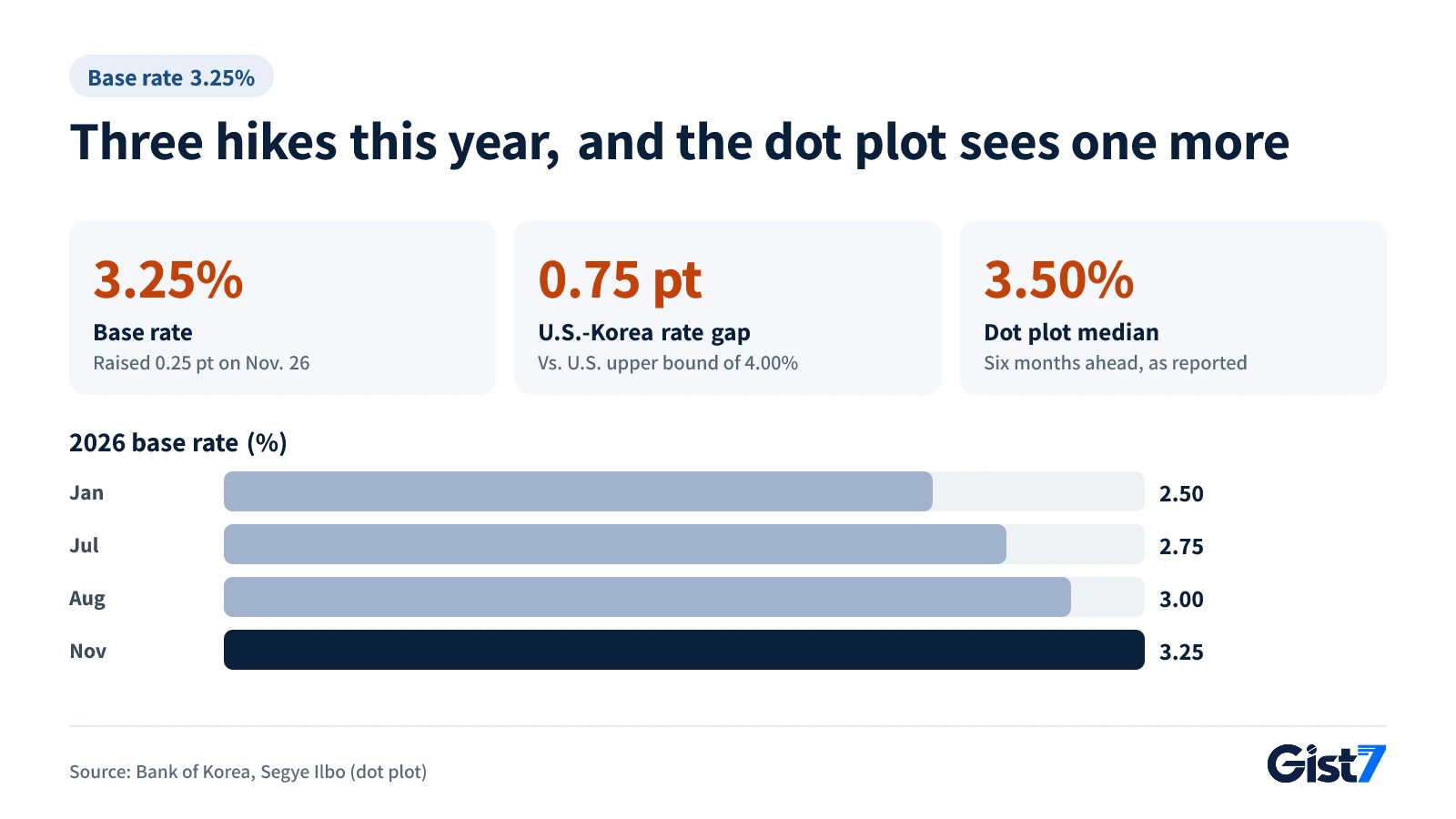
- Base rate up from 3.00% to 3.25%, the third hike of 2026 and the highest level since November 2024 (Bank of Korea, Nov. 26, 2026)
- Growth forecasts raised to 3.9% for 2026 and 4.1% for 2027; October inflation at 2.8%, above the 2% target
- Five of seven board members voted to hike; Hwang Gun-il and Lee Su-hyeong preferred to hold at 3.00%
- Reported six-month dot plot median at 3.50%, with seven dots at 3.75%
- KOSPI gave back most of a 2.6% intraday gain to close up 0.29%; won steady at 1,342.7 per dollar
The Bank of Korea's Monetary Policy Board raised its base rate by 0.25 percentage point, from 3.00% to 3.25%, on November 26, 2026. This Bank of Korea rate hike was the third this year after July and August, and it puts the base rate at its highest level since November 2024. The central bank said growth led by semiconductors is stronger than expected and that inflation is likely to stay above its 2% target for an extended period.
Why the Bank of Korea rate hike took the base rate to 3.25%
According to the Bank of Korea's background note, the board judged a 0.25-point hike appropriate because growth has strengthened further, inflation is expected to run above target for a considerable period, and financial stability risks persist.
| Decision date | Base rate | Change |
|---|---|---|
| May 29, 2025 | 2.50% | 0.25 pt cut |
| July 16, 2026 | 2.75% | 0.25 pt hike |
| August 27, 2026 | 3.00% | 0.25 pt hike |
| October 22, 2026 | 3.00% | Hold |
| November 26, 2026 | 3.25% | 0.25 pt hike |
Source: Bank of Korea base rate history (checked November 26)
The growth outlook moved up sharply from August. The Bank of Korea now expects 3.9% growth this year, up from 3.3%, and 4.1% in 2027, up from 2.9%. Its reasoning is that AI infrastructure spending keeps lifting chip exports and capital investment, and that the gains gradually spread to household income and consumption.
| Item | August forecast | November forecast |
|---|---|---|
| 2026 GDP growth | 3.3% | 3.9% |
| 2027 GDP growth | 2.9% | 4.1% |
| 2026 consumer prices | 2.7% | 2.7% |
| 2027 consumer prices | 2.3% | 2.4% |
| 2026 and 2027 core inflation | 2.5% | 2.6% |
Source: Bank of Korea monetary policy background note (November 26, 2026)
Headline consumer prices and core inflation (excluding food and energy) both rose 2.8% year over year in October. With oil prices staying high and the economy running hot, the Bank of Korea sees a risk that inflation stays above target for longer.
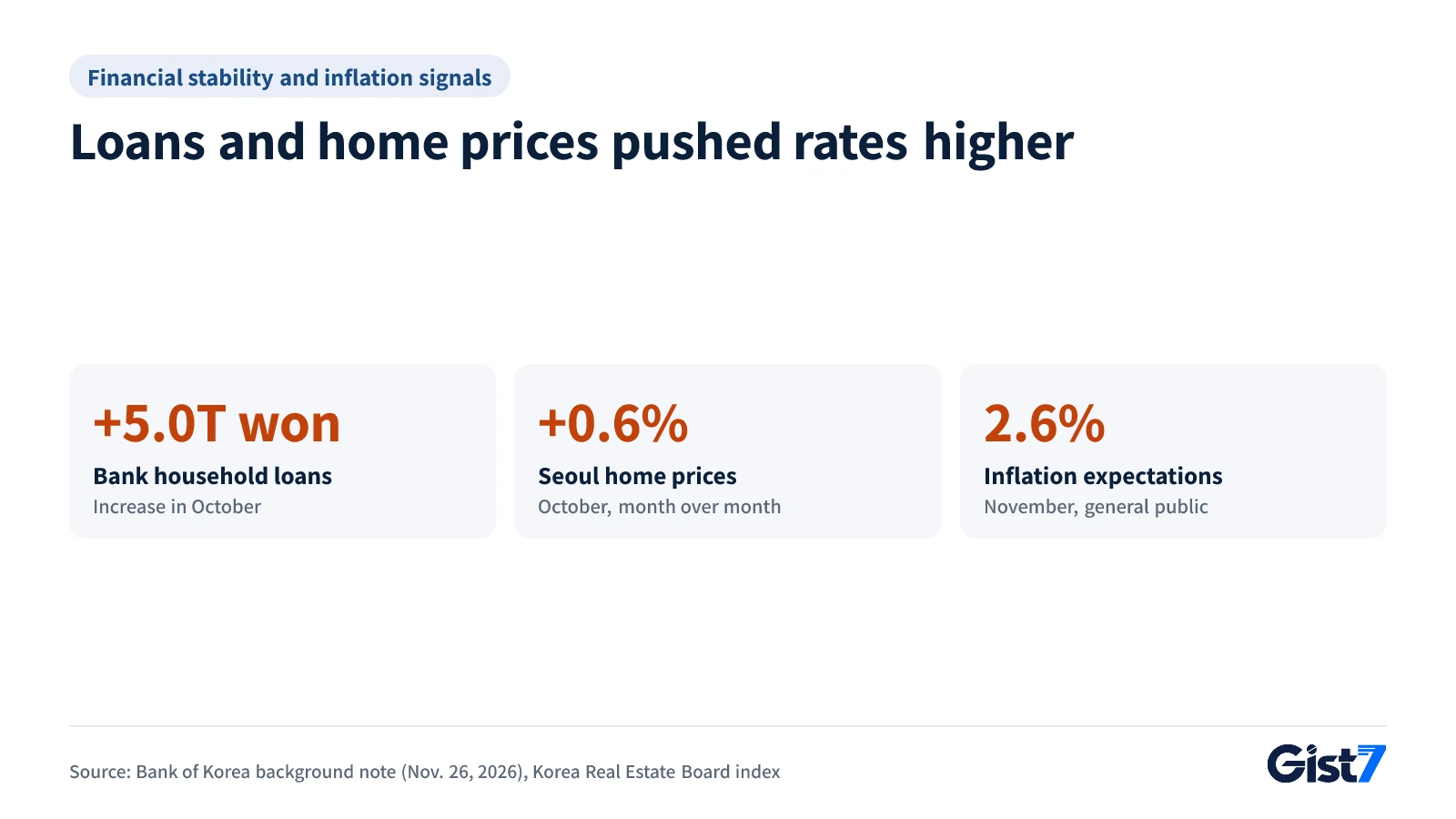
Household lending at banks grew by 5.0 trillion won in October alone. Seoul home prices rose 0.6% that month, and expectations of further gains remain high (Bank of Korea background note, Korea Real Estate Board index). On the same day, the central bank also lifted the rate on its Financial Intermediation Support Facility, a cheap lending program for smaller firms, from 1.25% to 1.50% (Newspim).
Governor Shin Hyun-song explained the growth and inflation outlook and the reasons for the hike at a press conference right after the decision.
Two dissents, but the Bank of Korea dot plot points to 3.50%
The decision was not unanimous. Five of the seven board members backed the hike, while Hwang Gun-il and Lee Su-hyeong preferred to keep the rate at 3.00%, the Bank of Korea said. Their dissent can be read as a wish to see more of the effect of the two earlier hikes first. The detailed arguments will come with the minutes, due on December 15.
The dot plot gave a clearer view of what comes next. It is a conditional outlook in which board members mark the base rate they see as appropriate six months ahead. According to Segye Ilbo, each member places three dots, for 21 in total, and the distribution shifted like this:
| Base rate in six months | August dot plot | November dot plot |
|---|---|---|
| 3.00% | 5 dots | None |
| 3.25% | 10 dots | 6 dots |
| 3.50% | 6 dots | 8 dots |
| 3.75% | None | 7 dots |
Lined up in order, the middle (11th) of the 21 dots sits at 3.50%. That means many members see room for one more hike by around May 2027, and seven dots are already at 3.75%. The Bank of Korea wrote that it will decide "the timing of further hikes" going forward. There was no talk of stopping.
As Gist 7 sees it, three factors will set the pace of the next move: whether the chip cycle lasts as long as the Bank of Korea expects, whether oil-driven price pressure spreads into services, and whether household borrowing keeps growing despite higher rates. The scenarios markets weighed before the meeting are laid out in our preview of a possible November Bank of Korea hike.
Why did the KOSPI give back most of its intraday gain?
Korea's benchmark KOSPI rose as much as 2.6% to 4,817.77 on November 26 before closing at 4,711.21, up 0.29%. The fade lines up with the point at which foreign investors turned net sellers after the rate decision was announced.
| KOSPI on Nov. 26 | Figure |
|---|---|
| Open / intraday high / close | 4,745.10 / 4,817.77 / 4,711.21 |
| Change | +0.29% (previous day -6.16%) |
| Foreign investors | Net buy of 230.5 billion won in the morning → net sell of 109.5 billion won at the close |
| Individuals | Net sell of 1.0441 trillion won |
| Institutions | Net buy of 750.9 billion won |
Source: Financial News market close report (November 26). News1 put foreign net selling at 113.7 billion won.
Samsung Electronics (KOSPI: 005930) had climbed close to 3% and SK Hynix (KOSPI: 000660) more than 5% during the session, but they finished up 0.35% and 2.23%. The KOSDAQ rose 0.78% to 655.71.
The morning rally was rebound buying after the index fell more than 6% the day before, according to Kang Jin-hyuk, a senior analyst at Shinhan Securities (Financial News). News1 reported that the afternoon pullback coincided with heavier foreign selling after the hike. Higher rates raise the discount rate used to value future earnings, which tends to weigh on stock prices (why stocks fall when interest rates rise).
What it means for overseas investors: the won and the U.S.-Korea rate gap
The hike narrows the gap between the U.S. and Korea base rate levels (upper bound) from 1.00 point to 0.75 point. The Federal Reserve's target range is 3.75% to 4.00%. A smaller gap means investors give up less yield by holding won assets, which is supportive for the currency. For the Fed side, see our take on October PCE inflation and the Fed's December meeting.
The Korean won closed at 1,342.7 per dollar, 0.5 won stronger on the day, News1 reported. The Bank of Korea said the currency has stayed broadly stable despite foreign equity outflows, thanks to a large current account surplus. Its domestic financial indicators table (month-to-date basis) shows foreign investors sold a net 18.1 trillion won of Korean stocks from November 1 to 25.
Because the won barely moved, the KOSPI's return in dollar terms was close to its return in won terms. The hike works less as a trigger for foreign buying and more as a cushion against won weakness.
Market impact map
| Asset / indicator | Direction | Strength | Link (why) |
|---|---|---|---|
| Korea 3-year government bond yield | ↑ | Weak | The higher base rate and signals of more hikes support short-term yields. The yield stood at 3.58% the day before the decision, down from 3.72% at the end of October (Bank of Korea background note) |
| USD/KRW | ↓ | Weak | A narrower U.S.-Korea rate gap favors a stronger won. 1,342.7 on Nov. 26, down 0.5 won (News1) |
| KOSPI | ↕ | Weak | Intraday +2.6% → close +0.29% on Nov. 26, with foreigners turning net sellers after the decision. A higher discount rate weighs on stocks |
| Bank stocks | ↑ | Weak | General tendency: higher lending rates widen interest margins, though delinquency risk rises too |
| REITs and builders | ↓ | Weak | General tendency: higher funding costs and concern about slower housing demand |
Little direct impact: U.S. 2-year Treasury yield, U.S. 10-year Treasury yield, Dollar Index, gold, oil (WTI), bitcoin, S&P 500, Nasdaq
- Everyday impact in Korea: the rate hike lifts interest burdens first on floating-rate loans, which follow benchmarks such as COFIX (banks' cost of funds index) with a lag.
- Deposit and savings rates have room to rise. Fixed-rate loans keep their contracted rate.
- Currency exchange and overseas shopping: the won barely moved on the day, so there is little immediate change.
Market reactions can vary with other factors, and this table is not a basis for investment decisions.
What to watch next
| Date (KST) | Indicator / event | Previous | Why it matters here | If it comes in... |
|---|---|---|---|---|
| Early December | Korea November trade data (Ministry of Trade and Industry) | October exports +93.9% y/y (customs basis, Bank of Korea background note) | Whether the chip-led growth behind the hike continues | Strong exports tend to lift expectations of more hikes and bond yields |
| Early December | Korea November consumer prices (Ministry of Data and Statistics) | October 2.8%, core 2.8% (Bank of Korea) | Confirms whether inflation stays above target | A reading near 3% could pull the next hike forward |
| Dec. 10 (Thu) 04:00 KST (Dec. 9, 14:00 ET) | U.S. FOMC rate decision | 3.75% to 4.00% (Federal Reserve) | U.S.-Korea rate gap and the won | A Fed hike would widen the gap again and tends to pressure the won |
| Dec. 15 (Tue) | Minutes of the November Bank of Korea meeting | 5 for a hike, 2 for a hold | The dissenters' reasoning and the pace of hikes | Strong arguments for holding could slow further hikes |
| Mid-December | November COFIX (Korea Federation of Banks) | October new-loan COFIX 3.62% (Korea Federation of Banks, iNews24) | How fast the hike passes through to loan rates | A rise tends to push up floating mortgage rates |
Schedule sources: Federal Reserve FOMC calendar, Bank of Korea meeting schedule (minutes are posted on the first Tuesday after two weeks). Exact dates for the trade, inflation and COFIX releases could not be confirmed on official calendars, so periods are given. The next Bank of Korea rate meeting is on January 14, 2027 (Thursday), according to the 2027 schedule announced on October 29 (SBS Biz).
Frequently asked questions
What is the Bank of Korea's base rate now?
It is 3.25% as of the November 26, 2026 decision. The Monetary Policy Board raised it by 0.25 point from 3.00%, and it will stay there until the next policy decision.
How many times has the Bank of Korea raised rates in 2026?
Three times: to 2.75% on July 16, to 3.00% on August 27 and to 3.25% on November 26. It held on October 22 (Bank of Korea base rate history).
Will Korean loan rates rise right away?
Floating-rate loans adjust with a lag, as benchmarks such as COFIX change and each loan's reset date comes around. Fixed-rate loans keep their contracted rate. Borrowers should check their loan contract and bank disclosures for the exact change.
Will the Bank of Korea hike again at its next meeting?
Nothing is decided. The next meeting is on January 14, 2027. The Bank of Korea says it will set the timing of further hikes after reviewing inflation, growth and financial stability, and the reported dot plot median of 3.50% suggests many members see one more hike within six months.
How wide is the U.S.-Korea interest rate gap?
The gap between the U.S. upper bound of 4.00% and Korea's 3.25% is 0.75 point. It narrowed from 1.00 point before this hike.
References
- 한국은행 기준금리 추이 — 한국은행
- 2026년 11월 26일 통화정책방향 관련 참고자료: 한국은행 기준금리를 상향 조정하게 된 배경 — 한국은행
- 한은 기준금리 3.25%로 상향…고성장·고물가에 유동성 고삐 죘다 — 세계일보
- '4800' 찍고 '4700' 마감…반등 코스피, 금리 인상에 뒷심 부족 — 파이낸셜뉴스
- '매수 주체 실종' 코스피 4700선 턱걸이…개인 1조원 매도 — 뉴스1
- 달러·원 환율 1342.7원 '소폭 하락'…한은 금리 인상·수출업체 네고 — 뉴스1
- 신규 코픽스 2년 8개월 만에 최고⋯주담대 금리 또 오른다 — 아이뉴스24
- 신현송 "금리 인상, 선제 대응이자 가시화된 물가 압력 대응" — 뉴스핌
- 한은, 2027년 통화정책방향 결정회의 일정 발표 — SBS Biz