How the Fed Controls Interest Rates: IORB and Reverse Repos
Key summary
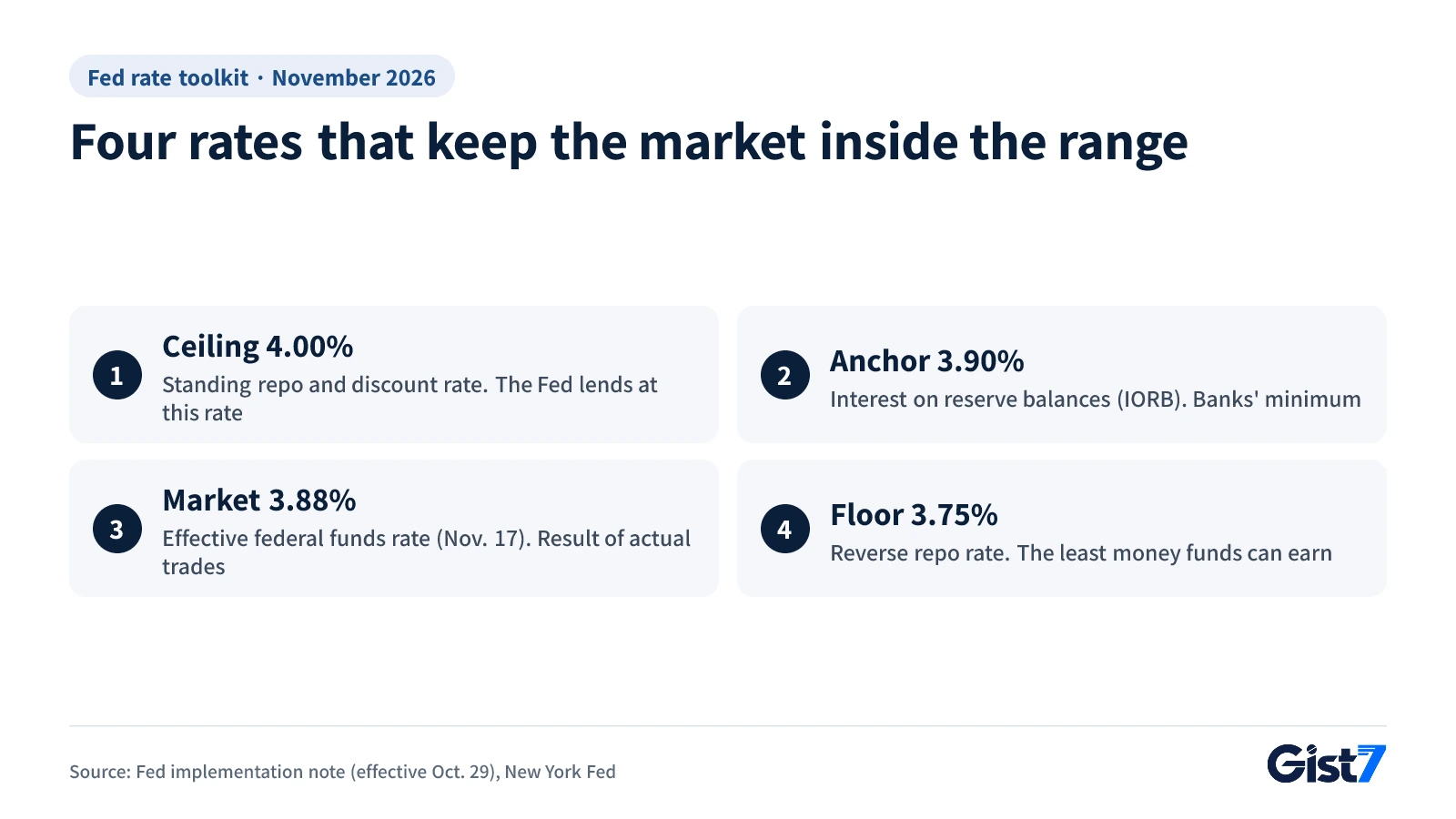
The Fed controls interest rates by setting a target range for the federal funds rate and using interest on reserve balances (IORB) and the reverse repo rate to keep market rates inside it. As of November 2026: range 3.75%–4.00%, IORB 3.90%, reverse repo 3.75%, effective rate 3.88% (Nov. 17).
- The Fed sets the federal funds rate as a 0.25-point target range, not a single number (3.75%–4.00% as of November 2026)
- IORB (3.90%) anchors the system, the reverse repo rate (3.75%) is the floor, and the standing repo and discount rates (4.00%) form the ceiling
- In all four changes since September 2025, the effective federal funds rate moved by exactly 0.25 point on the effective date
- Open market operations now mainly keep reserves ample rather than moving rates directly
- Market rates price in expectations before the decision (2-year Treasury at 4.80% on Nov. 18, US Treasury)
How the Fed controls interest rates: set a range, then fence the market inside it
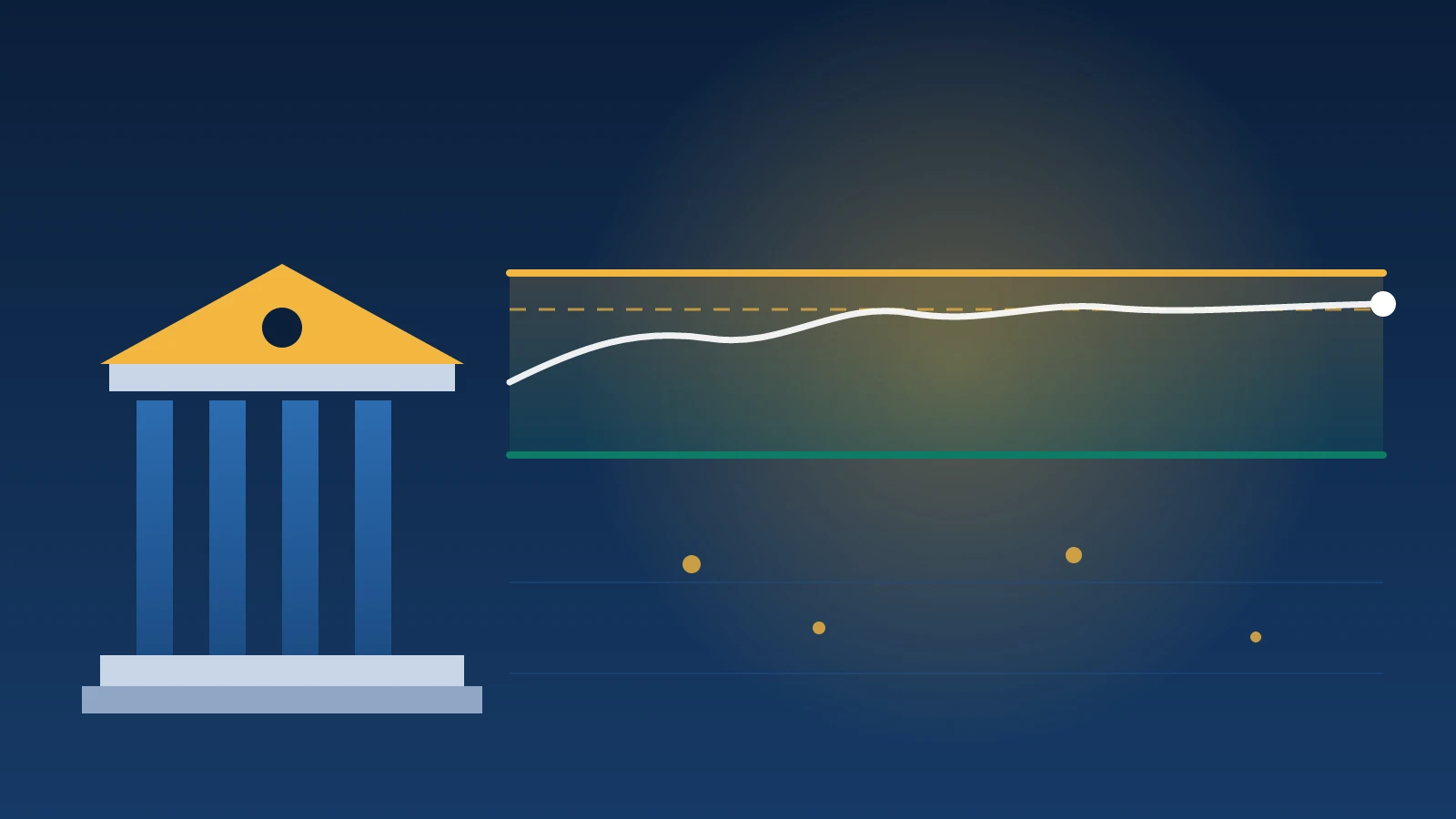
The Fed controls interest rates by having the Federal Open Market Committee (FOMC) set a target range for the federal funds rate, then using a handful of rates it administers itself to keep market rates inside that range. As of November 2026, the two workhorses are interest on reserve balances (IORB), paid on banks' deposits at the Fed, and the overnight reverse repo (ON RRP) rate, which the Fed offers to non-bank institutions. When the range moves, these rates move with it the next day, and the overnight interbank rate follows.
The federal funds rate is what US banks charge one another to borrow reserves held at the Fed overnight. The Fed announces it not as a single number but as a range 0.25 percentage point wide.
The Fed's rate toolkit (as of November 2026)
| Tool | What it is | Rate |
|---|---|---|
| Federal funds target range | Policy rate range set by the FOMC | 3.75%–4.00% |
| Standing repo facility (SRF) and discount rate | What the Fed charges to lend against Treasuries, or directly to banks | 4.00% |
| Interest on reserve balances (IORB) | Interest paid on reserves banks keep at the Fed | 3.90% |
| Effective federal funds rate (EFFR) | Volume-weighted median of actual overnight trades | 3.88% (Nov. 17) |
| Overnight reverse repo (ON RRP) | Rate the Fed pays to take in cash from money market funds and others overnight | 3.75% |
Sources: Fed implementation note of Oct. 28 (effective Oct. 29), New York Fed
Who sets Fed interest rates, and when?
The FOMC sets Fed interest rates by vote at eight regularly scheduled meetings a year. According to the Fed, the committee has 12 voting members: the seven members of the Board of Governors, the president of the New York Fed, and four of the remaining 11 Reserve Bank presidents, who rotate in for one-year terms. Decisions come out at 2 p.m. ET on the second day of each two-day meeting, in a policy statement and an implementation note. At the March, June, September and December meetings, the Fed also publishes its Summary of Economic Projections (SEP), which includes the "dot plot" of participants' rate projections.
Why does interest on reserve balances (IORB) pull market rates toward it?
IORB pulls market rates toward it because it works as the minimum a bank will accept for lending cash overnight. A bank that earns 3.90% simply by leaving money in its Fed account has little reason to lend it to anyone else for less. If market rates drift well below IORB, an arbitrage opens up: borrow cheaply, park the cash at the Fed, and pocket the difference. That trade pushes rates back toward IORB.
The system only works when reserves are plentiful. According to the Fed's H.4.1 release of Nov. 12, reserve balances averaged about $2.97 trillion in the week ended Nov. 11. Before 2008, when reserves were scarce, the Fed had to buy and sell Treasuries to fine-tune the quantity of reserves to move rates. The Fed began paying interest on reserves in October 2008, and today its main lever is changing the administered rates while keeping reserves ample.
The result is tight. According to the New York Fed, the EFFR was 3.88% on Nov. 17, 0.02 percentage point below IORB. Excluding the bottom and top 1% of trades, every trade printed between 3.85% and 3.90%. Volume was $95 billion that day.
What do open market operations do now?
Open market operations are the Fed's purchases and sales of Treasuries and other securities to manage the quantity of reserves. Today they are not the tool that pushes rates up or down; their job is to keep reserves ample. According to the October implementation note, the Fed rolls over maturing Treasuries at auction, reinvests principal from agency debt and agency mortgage-backed securities into Treasury bills, and buys bills when needed to maintain ample reserves. The minutes show reserve management purchases (RMPs) were set at zero for the current period, with the pace decided monthly.
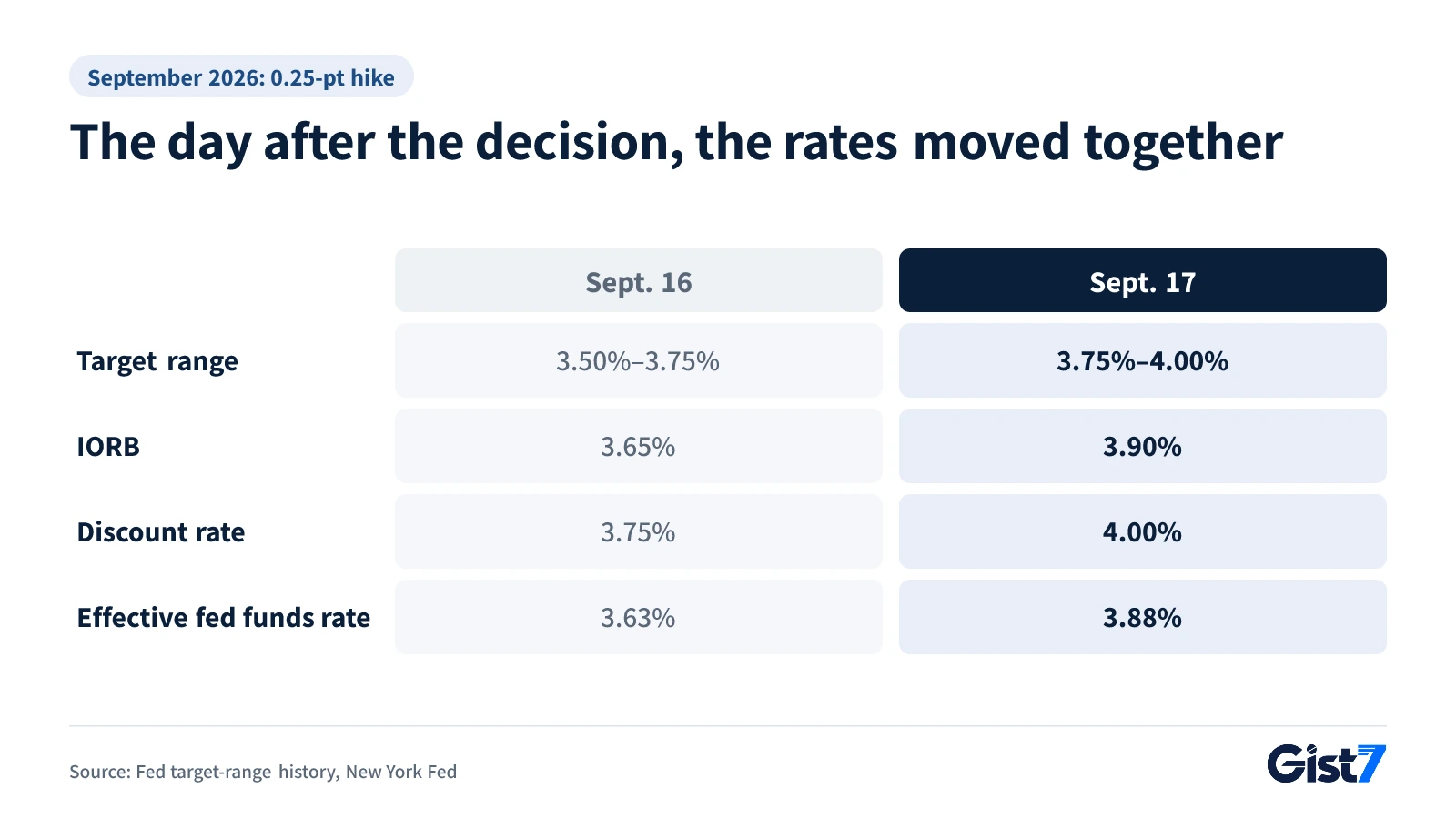
The numbers on rate-change days show the machinery at work. In each of the last four changes, IORB and the EFFR moved together by exactly 0.25 percentage point on the effective date.
| Effective date | Decision | Target range | IORB | EFFR (prior business day → effective date) |
|---|---|---|---|---|
| Sept. 18, 2025 | 0.25-pt cut | 4.00%–4.25% | 4.40% → 4.15% | 4.33% → 4.08% |
| Oct. 30, 2025 | 0.25-pt cut | 3.75%–4.00% | 4.15% → 3.90% | 4.12% → 3.87% |
| Dec. 11, 2025 | 0.25-pt cut | 3.50%–3.75% | 3.90% → 3.65% | 3.89% → 3.64% |
| Sept. 17, 2026 | 0.25-pt hike | 3.75%–4.00% | 3.65% → 3.90% | 3.63% → 3.88% |
Sources: Fed target-range history, New York Fed (EFFR). Period: September 2025 to November 2026
How do the reverse repo and standing repo facilities set a floor and a ceiling?
The reverse repo facility sets a floor by fixing the lowest rate that institutions such as money market funds can earn, while the standing repo facility sets a ceiling by fixing the rate at which the Fed will lend. In a reverse repo, the Fed sells a Treasury security to one of these institutions and buys it back the next day. Many of them cannot earn IORB, so without this facility they might lend below the range. An institution that can park cash at the Fed at 3.75% has little reason to lend overnight to anyone else for less.
As of November 2026, the ON RRP rate is 3.75%, equal to the bottom of the range, with a limit of $160 billion per counterparty per day. Actual usage on Nov. 18 was just $331 million, according to the New York Fed. That signals market rates sit comfortably above the floor, so few institutions need the Fed.
The ceiling comes from the standing repo facility and the discount rate. Because the Fed will lend overnight at 4.00% against Treasuries, market rates have a hard time spiking far above the top of the range.
Why do Treasury yields move before the Fed changes rates?
Treasury yields move first because they price in where policy rates are expected to go. A three-month bill yield is close to the expected average of overnight rates over the next three months. According to the US Treasury, the three-month yield was 4.34% and the two-year yield 4.80% on Nov. 18, both above the current top of the range (4.00%). That suggests markets have already priced in much of the expected tightening.
So what moves markets on FOMC day is less the decision itself than the gap between the decision and expectations, along with the path signaled in the statement and projections. The minutes of the October meeting, released on Nov. 18, 2026, said "almost all participants" judged that further increases would likely be appropriate. "A couple of participants" noted that a hike larger than 0.25 percentage point could warrant consideration at the next meeting if inflation data were unfavorable (minutes). A sentence like that is enough to move the two-year yield. We covered how policy rates feed into stock valuations in Why stocks fall when interest rates rise, and the latest inflation picture in our analysis of October CPI and the 10-year near 5%.
Gist 7's take: Beyond whether the Fed hikes, watch the gap between the EFFR and IORB. A gap of around 0.02 percentage point, as now, means reserves are plentiful. If the EFFR presses up against IORB or rises above it, that would be an early sign reserves are getting tight. The minutes' note that the RMP pace is set month by month fits the same logic.
Market impact map: when the Fed raises the range or hike expectations build
| Asset / indicator | Direction | Strength | Why |
|---|---|---|---|
| 2-year Treasury yield | ↑ | Strong | Most directly reflects the expected policy path (4.80% on Nov. 18, US Treasury) |
| 10-year Treasury yield | ↑ (conditional) | Medium | Tends to follow the short-rate path, but can fall if hikes stoke growth worries |
| Yield curve (10-year minus 2-year) | ↓ flattens | Medium | The 2-year reacts more than the 10-year (0.27 pt on Nov. 18, US Treasury) |
| SOFR (secured overnight rate) | ↑ | Strong | Standing repo and reverse repo rates lift the repo market's ceiling and floor together (3.92% on Nov. 17, New York Fed) |
| US T-bill and money market fund yields | ↑ | Strong | Reverse repo and IORB rates raise the floor for overnight cash returns |
| Dollar index | ↑ | Medium | Higher yields on dollar deposits and short-term Treasuries |
| USD/KRW (won per dollar) | ↑ | Medium | A wider US-Korea rate gap puts pressure on the Korean won |
| Gold | ↓ | Medium | Higher opportunity cost of holding a non-yielding asset |
| S&P 500 | ↓ | Medium | Higher discount rates and rising corporate interest costs |
| Nasdaq | ↓ | Medium | Growth stocks whose profits lie far in the future are most sensitive to discount rates |
Little direct impact: WTI crude, bitcoin, KOSPI (Korea's benchmark index, affected indirectly through the exchange rate and foreign investor flows)
- Everyday impact: US adjustable-rate loans and credit card rates often move with the policy rate
- Yields on dollar deposits and US money market funds tend to rise; when the won weakens, exchanging currency and buying from overseas get pricier for Korean consumers
- In Korea, loan rates are set directly by the Bank of Korea's decisions; the Fed matters indirectly through bond yields and the exchange rate (see our Bank of Korea rate hike outlook)
Market reactions can vary with other factors, and this table is not a basis for investment decisions.
What to watch next
| Date (ET) | Indicator / event | Previous | Why it matters here | If it comes in like this |
|---|---|---|---|---|
| Every business day, around 9:00 a.m. | New York Fed publishes the EFFR (prior business day) | 3.88% (Nov. 17, New York Fed) | Shows whether the toolkit keeps rates inside the range | A move up to or above IORB's 3.90% would signal tighter reserves |
| Nov. 25 (Wed) 8:30 a.m. | US October PCE price index | September up 3.6% year over year (BEA) | The inflation gauge the Fed targets | A hot reading tends to lift hike expectations and the 2-year yield |
| Dec. 4 (Fri) 8:30 a.m. | US November jobs report | October payrolls +165,000, unemployment 4.1% (BLS) | Last jobs data before the December meeting | Strong hiring supports a hike; a sharp slowdown argues for a slower pace |
| Dec. 9 (Wed) 2:00 p.m. | FOMC decision and implementation note (Dec. 8–9 meeting) | Target range 3.75%–4.00%, IORB 3.90% (Fed) | A higher range means IORB and the reverse repo rate move too | After a 0.25-pt hike, the EFFR should settle around 4.1% the next day if the system works normally |
| Dec. 10 (Thu) 8:30 a.m. | US November CPI | October +0.4% month over month, core +0.3% (BLS) | First inflation data after the FOMC | Core readings of 0.3% or more would lift expectations for further hikes |
Frequently asked questions
Why is the Fed's policy rate a range instead of a single number?
With ample reserves, it is hard to pin a market rate to one exact point. The Fed announces a target range 0.25 percentage point wide and uses IORB and the reverse repo rate to keep the actual rate inside it. As of November 2026, the range is 3.75%–4.00%.
What is the difference between IORB and the federal funds rate?
IORB is the interest the Fed pays directly on banks' reserves, while the federal funds rate is the market rate banks charge each other to borrow reserves overnight. The Fed sets IORB, and the market rate forms around it. On Nov. 17, IORB was 3.90% and the effective federal funds rate was 3.88%.
What does low reverse repo usage mean?
It means overnight rates available in the market are comfortably above the reverse repo rate, so institutions have little reason to park cash at the Fed. Usage was $331 million on Nov. 18 (New York Fed). The facility props up the floor of the range, so it does its job even when little used.
If the Fed raises rates, do Korean loan rates rise right away?
Not immediately. Korean loan rates are set directly by the Bank of Korea's base rate and domestic bond yields. A Fed hike can still influence Korean rates and the Bank of Korea's thinking through US Treasury yields and the won-dollar exchange rate.
Where can I check the effective federal funds rate?
The New York Fed publishes the prior business day's rate on its website at around 9 a.m. ET each business day. That is around 11 p.m. in Korea during the winter. FRED also charts the same series.
References
- Implementation Note issued October 28, 2026 — Federal Reserve
- Minutes of the Federal Open Market Committee, October 27-28, 2026 — Federal Reserve
- Federal Open Market Committee (About the FOMC) — Federal Reserve
- Effective Federal Funds Rate — Federal Reserve Bank of New York
- Open Market Operations (target range history) — Federal Reserve
- Factors Affecting Reserve Balances (H.4.1), November 12, 2026 — Federal Reserve
- Daily Treasury Par Yield Curve Rates, November 2026 — U.S. Department of the Treasury