How Is the Won-Dollar Exchange Rate Set? 3 Key Drivers
Key summary
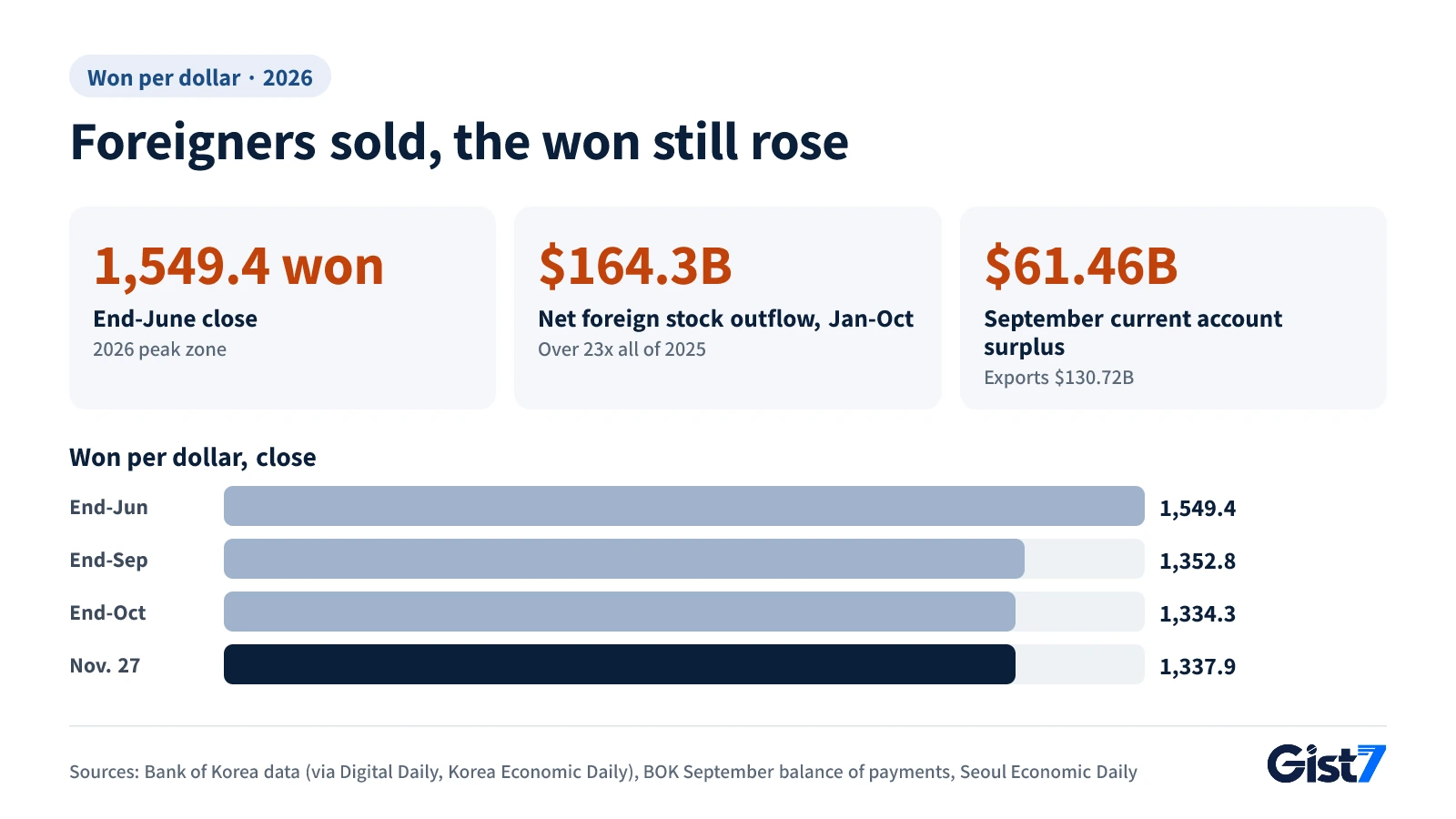
The won-dollar exchange rate is set by dollar flows in Seoul's interbank market: exports, stock and bond money, and the Korea-US rate gap. As of November 2026, export dollars outweighed foreign stock outflows, and the rate fell from 1,549.4 won in late June to 1,337.9 won on Nov. 27.
- The Korean government does not set the won-dollar rate. It is the price where buy and sell orders for dollars meet in the interbank market
- Korea's September 2026 current account surplus of $61.46 billion was twice the $30.44 billion of outflow pressure from portfolio investment that month
- Korea's policy rate is 3.25% and the Fed's target range is 3.75-4.00%, a 0.75-point gap at the upper bound that tilts the direction of capital flows
- Won-dollar trading has run 24 hours on weekdays since July 6, 2026, but the official close is still 3:30 p.m. Seoul time, and the bank reference rate is set to switch to a TWAP method in January 2027
- Korea's FX authorities were net dollar sellers for six straight quarters from Q1 2025 through Q2 2026, and the National Pension Service's $65 billion FX swap line expires at the end of 2026
On Nov. 27, 2026, the won-dollar exchange rate closed Seoul's daytime session at 1,337.9 won per dollar, down 4.8 won from the previous day (Seoul Economic Daily). The same day, foreign investors bought a net 1.1298 trillion won of stocks on the main KOSPI board, and exporters sold dollars as the month drew to an end. Almost every driver of the won-dollar rate showed up in that single day. The price is set where dollar buyers and sellers meet in the interbank market, and behind those orders sit trade flows (the current account), stock and bond money, and the interest rate gap between Korea and the United States.
Who sets the won-dollar rate? Dollar supply and demand in the interbank market
The won-dollar rate is not a number the government or the Bank of Korea decides and announces. It is the price at which banks trade dollars with one another in the interbank FX market. Orders from exporters, foreign investors, individuals and pension funds investing abroad, and importers flow into this market through their banks. When buy orders for dollars dominate, the rate rises (a weaker won); when sell orders dominate, it falls (a stronger won). Ask why the rate is rising, and the answer usually comes back to who wanted more dollars.
2026 put this mechanism on full display. According to Bank of Korea data reported by Digital Daily, the rate climbed to 1,549.4 won at the end of June, after foreign investors pulled $110.21 billion out of Korean stocks in January-June. In the second half, the flow reversed. The Bank of Korea attributed the drop to 1,334.3 won by the end of October to more dollar selling by exporters ("International Finance and FX Market Developments since October 2026"), and Korea Economic Daily reported that semiconductor exporters led that selling. On Nov. 26, the day the Bank of Korea raised its policy rate from 3.00% to 3.25%, the rate closed at 1,342.7 won.
| Date (2026) | Won per dollar (close) | What moved the market |
|---|---|---|
| End of May | 1,507.9 | Continued net selling of Korean stocks by foreigners |
| End of June | 1,549.4 | $32.37 billion net foreign outflow from stocks in June alone |
| End of September | 1,352.8 | $61.46 billion current account surplus in September; $14.16 billion net foreign outflow from stocks |
| End of October | 1,334.3 | More dollar selling by exporters (led by chipmakers, Korea Economic Daily); fell despite a $19.31 billion net foreign outflow from stocks |
| Nov. 26 | 1,342.7 | Bank of Korea raised its policy rate to 3.25% |
| Nov. 27 | 1,337.9 | Foreigners bought a net 1.1298 trillion won of KOSPI stocks (most since Sept. 7); month-end export dollar sales |
Sources: Bank of Korea data (as reported by Digital Daily and Korea Economic Daily), Bank of Korea September balance of payments, Bank of Korea policy rate history, Seoul Economic Daily. The Nov. 26 value is derived from the Nov. 27 close and its daily change.
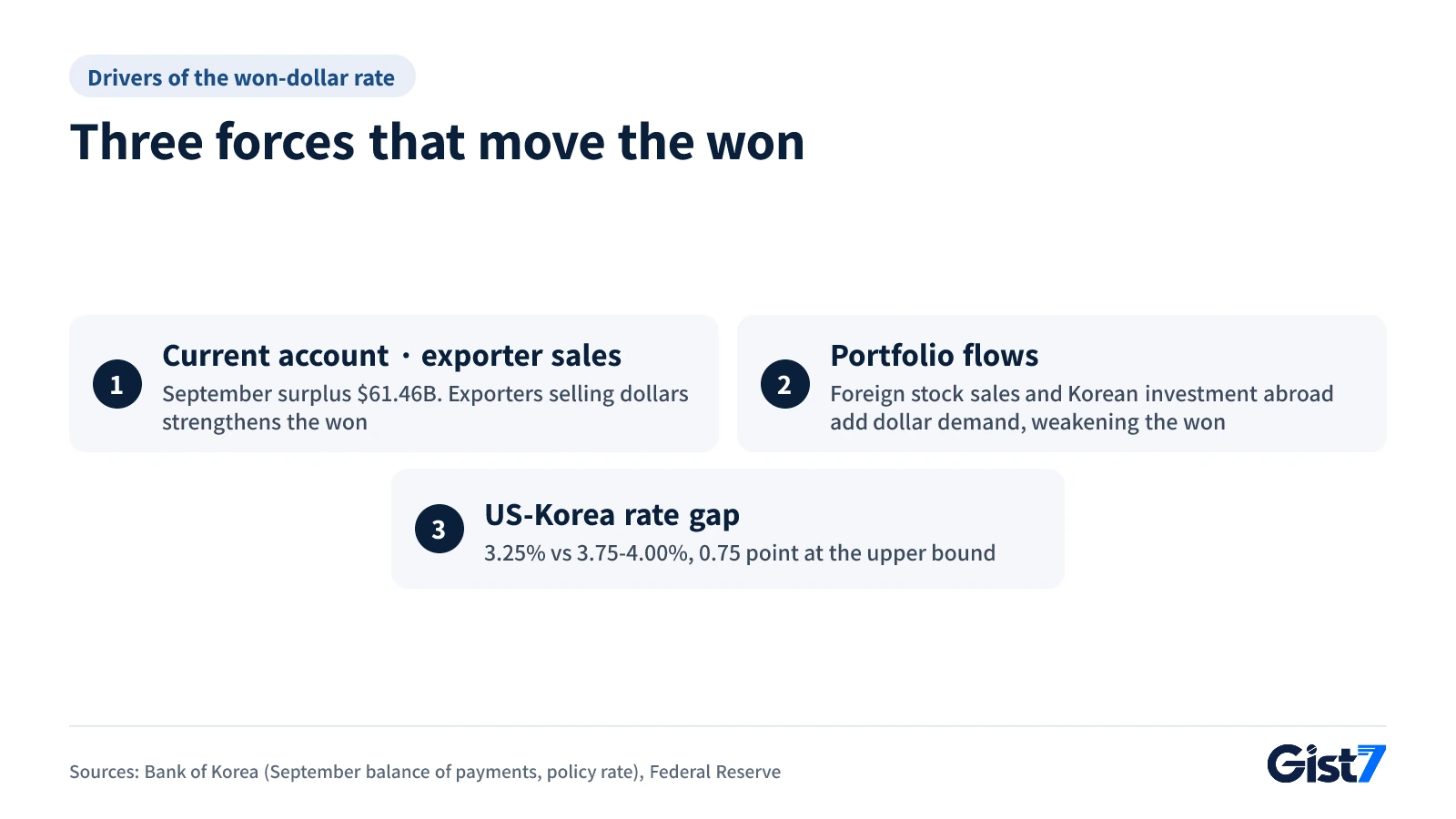
Three drivers of the exchange rate: current account, portfolio flows and the rate gap
The forces behind the won-dollar rate fall into three groups: dollars that flow in and out through trade (the current account), dollars that move with stock and bond investment (portfolio flows), and the direction of capital set by the rate gap between the two countries. The first two are actual volumes of dollars; the rate gap works more like a slope that tilts which way those volumes flow.
The Bank of Korea's September balance of payments (preliminary), released Nov. 5, shows all three forces colliding within a single month.
| Dollar flows, September 2026 | Size | Pressure on the won |
|---|---|---|
| Current account | $61.46 billion surplus | Stronger won (export proceeds come in) |
| Goods exports | $130.72 billion, up 92.4% from a year earlier | Stronger won |
| Korean investment in foreign securities | Up $16.63 billion | Weaker won (dollars bought to buy foreign stocks) |
| Foreign investment in Korean securities | Down $13.81 billion | Weaker won (sale proceeds converted to dollars and sent out) |
| Korean direct investment abroad | Up $11.43 billion | Weaker won |
Source: Bank of Korea, September 2026 balance of payments (preliminary), published via the KDI Economic Information and Education Center
Portfolio investment alone created $30.44 billion ($16.63 billion + $13.81 billion) of outflow pressure, but the current account surplus was twice that. Note that the foreign stock flow figures in this article (such as the $164.3 billion for January-October) follow the Bank of Korea's "International Finance and FX Market Developments" (stocks only), while the portfolio investment figures in the table above follow the balance of payments (stocks plus bonds), so the numbers differ.
Current account and exporter dollar sales. When exporters sell the dollars they earn to get won, Korean traders call it "nego" supply. A large surplus does not strengthen the won right away, because dollars that companies park in foreign currency deposits never reach the market. That was cited, along with foreign stock selling, as a reason the won stayed weak in July 2026 despite a record surplus (Digital Daily).
Portfolio flows. When foreigners sell Korean stocks, they convert the won they receive into dollars and take them out, pushing the rate up. By Bank of Korea data, net foreign outflows from Korean stocks reached $164.3 billion in January-October, more than 23 times the full-year 2025 figure of $7.07 billion. Dollar demand also arises when Koreans buy foreign stocks or when companies pay dividends to overseas shareholders. Seoul Economic Daily reported that on Nov. 27, demand from foreign investors repatriating dividends from Samsung Electronics (KOSPI: 005930) supported the rate, but month-end exporter selling outweighed it.
The US-Korea rate gap. After the Nov. 26 hike, Korea's policy rate is 3.25% and the Fed's target range is 3.75-4.00%, a gap of 0.75 percentage point at the upper bound, with the US higher. Money tends to flow toward higher-yielding currencies, so a narrower gap means less interest is given up by holding won. The Fed held rates on Oct. 28, but two officials argued for a quarter-point hike. The background to the Korean decision is covered in our analysis of the Bank of Korea's hike to 3.25%.
One outside force sits on top of these three: global dollar strength. The Bank of Korea cited a rise in the dollar index as a factor that limited the won's gains in October. But the dollar index does not include the won, so the won-dollar rate is best read as the global dollar trend plus Korea's own supply and demand.
In Gist 7's view, the order shown by the 2026 numbers is clear. The rate gap tilts the direction, but what moved the actual level was the volume of dollars. Foreigners sold $164.3 billion of Korean stocks in January-October, yet the won ended up stronger than at the end of June, which reads as export proceeds reaching the market on an even larger scale. Conversely, if chip exports turn down, the same selling could push the rate up much harder.
How Seoul's FX market works: 24-hour trading and the reference rate
Won-dollar trading in Seoul has been open 24 hours on weekdays since July 6, 2026. Even so, the value the news calls the "close" is still the 3:30 p.m. daytime close (1:30 a.m. ET), and the reference rate behind bank exchange rates keeps its current method for now. Here is a summary of the code-of-conduct revision approved by the Seoul Foreign Exchange Market Committee on May 29 (reported by Herald Economy) and the Ministry of Economy and Finance's administrative notice.
| Item | Details |
|---|---|
| Won-dollar trading hours | 7 a.m. Monday to 7 a.m. Saturday Seoul time (6 a.m. during US daylight saving time); open on Korean public holidays; closed weekends and Jan. 1 |
| Before the change | 9 a.m. to 2 a.m. the next day |
| Won against other currencies | Won-yuan and others stay at 9 a.m. to 3:30 p.m. |
| Closing rate | 3:30 p.m. daytime close retained |
| Time-weighted average rate (TWAP) | Provided by brokers on the hour, every hour |
| Reference rate | Currently the market average rate (MAR); set to switch to TWAP from Jan. 1, 2027 (Ministry of Economy and Finance administrative notice, June 18, 2026) |
The reference rate is the benchmark banks use to post exchange and remittance rates. The market average rate is the volume-weighted average of spot trades executed through FX brokers on the previous business day. Banks add or subtract a margin from it to set the rates for buying cash or sending money abroad, which is why a bank counter rate differs from the closing rate in the news on the same day. A time-weighted average rate averages the rate over a set period by time, a benchmark suited to a market that now trades around the clock.
KBS reported from the market on the first day of 24-hour trading and on the government's goals.
What FX smoothing and the National Pension Service swap do
Korea's FX authorities (the Ministry of Economy and Finance and the Bank of Korea) do not set the level of the exchange rate. When it lurches in one direction, they sell or buy dollars to slow the move, a practice known as smoothing operations. The Bank of Korea discloses the net amount, dollars bought minus dollars sold, every quarter.
| Quarter | Net FX authority trades | What it means |
|---|---|---|
| Q4 2025 | -$22.467 billion | Largest quarterly net dollar sale on record |
| Q1 2026 | -$13.628 billion | Net dollar sales amid a weak won |
| Q2 2026 | -$9.612 billion | The period when the rate rose to 1,549.4 won by end-June |
Source: Bank of Korea disclosure (SBS Biz, Sept. 30, 2026). Negative figures are net dollar sales
All six quarters from Q1 2025 through Q2 2026 were net sales. What the authorities did in the third quarter, when the won strengthened, will be known when the Q3 figure is released at the end of December.
Another tool is the National Pension Service FX swap. Instead of buying dollars in the market for overseas investment, the pension fund deposits won and borrows dollars from the Bank of Korea's reserves. This keeps large dollar purchases from hitting the market all at once and eases pressure on the won; the dollars are returned at maturity, so the drop in reserves is temporary. According to Financial News, the National Pension Fund Management Committee on Dec. 15, 2025, extended the $65 billion swap line by a year to the end of 2026, and also extended through 2026 a temporary strategic hedge under which it sells dollar assets when the rate rises above a set level.
Market impact map: tendencies when forces favor a stronger won
These are the usual tendencies when exporter dollar sales and foreign stock buying combine to increase the supply of dollars.
| Asset / indicator | Direction | Strength | Link (why) |
|---|---|---|---|
| Won per dollar (USD/KRW, Korea's main exchange rate) | ↓ | Strong | More dollars reach the market. 1,337.9 won on Nov. 27, down 4.8 won (Seoul Economic Daily) |
| KOSPI (Korea's main stock index) | ↑ | Medium | Foreign net buying creates won demand, so stocks and the won tend to rise together. Up 4.34% at the Nov. 27 regular-session close from the previous trading day (Seoul Economic Daily) |
| Won-yen cross rate | ↓ | Weak | If dollar-yen holds steady, won-yen falls as much as won-dollar does |
| Exporters (chips, autos) | ↓ | Weak | The same dollar revenue converts into less won profit (general tendency) |
| Airlines and travel | ↑ | Weak | Dollar-denominated fuel and aircraft lease costs and overseas travel costs fall (general tendency) |
Little direct impact: 2-year Treasury, 10-year Treasury, dollar index, gold, oil (WTI), bitcoin, S&P 500, Nasdaq
Of these, Treasury yields and the dollar index are outside forces that move the won-dollar rate rather than things the won moves. Higher Treasury yields widen the US-Korea rate gap, and a stronger dollar index tends to lift the won-dollar rate too. In the opposite case, when foreign stock selling or more Korean investment abroad raises dollar demand, the same links work in reverse: the won-dollar rate tends to rise (a weaker won), weighing on the KOSPI and airlines while adding to exporters' won-converted profits. The first half, when the rate climbed to 1,549.4 won by the end of June, was such a case.
- Daily life: a stronger won lowers the cost of currency exchange for travel abroad, overseas online shopping and tuition sent abroad.
- Import prices: even if oil prices stay the same, fuel and imported raw materials cost less in won.
- Investors in foreign stocks: returns on dollar assets shrink when converted into won.
- Bank exchange: once the reference rate method changes in January 2027, the timing that bank posted rates are based on may also change.
Market reactions can vary with other factors, and this table is not a basis for investment decisions.
What to watch next
| Date (Korea time) | Indicator / event | Previous | Why it matters here | If it comes in like this |
|---|---|---|---|---|
| Dec. 1 (Tue.), expected | November trade data (Ministry of Trade, Industry and Resources) | October exports $115.28 billion, up 93.7% from a year earlier (Ministry of Trade, Industry and Resources) | Export proceeds, the source of exporter dollar sales | Strong exports tend to add dollar supply and favor a stronger won |
| Dec. 8 (Tue.) 8:00 a.m. KST / Dec. 7, 6:00 p.m. ET | October balance of payments, preliminary (Bank of Korea) | September current account surplus of $61.46 billion | Compares the current account with portfolio flows | A surplus larger than portfolio outflows tends to keep pressure toward a stronger won |
| Dec. 10 (Thu.) 4:00 a.m. KST / Dec. 9, 2:00 p.m. ET | FOMC rate decision (Dec. 8-9 meeting) | Held at 3.75-4.00% in October, two officials favored a hike | US-Korea rate gap, now 0.75 point at the upper bound | A Fed hike would widen the gap to 1.00 point, tending to push the won-dollar rate up |
| Mid-December, expected | International Finance and FX Market Developments since November (Bank of Korea) | October foreign portfolio flows (stocks plus bonds) $13.7 billion net outflow, of which stocks $19.31 billion net outflow | The net result of November foreign selling and the Nov. 27 buying | Smaller outflows lean toward a stronger won, larger ones toward a weaker won |
| End of December | Q3 FX authority net trades released; National Pension Service FX swap expires (Dec. 31) | Q2 net dollar sales of $9.612 billion; swap line $65 billion | How the authorities and the pension fund respond | An extension keeps the setup in which the fund's dollar buying reaches the market less |
Schedule sources: Bank of Korea SDDS release calendar (balance of payments), minutes of the Fed's October FOMC meeting (next meeting Dec. 8-9). The trade data date is expected based on the practice of releasing on the 1st of each month (October data came out Nov. 1). The International Finance and FX Market Developments report (previous releases Sept. 17, Oct. 16 and Nov. 12) and the FX authority net trades (previous releases June 30 and Sept. 30) are given as periods because official dates could not be confirmed. Korea is 14 hours ahead of US Eastern time in December.
Frequently asked questions
Does the Korean government or the Bank of Korea set the won-dollar rate?
No. The won-dollar rate is set where orders to buy and sell dollars meet in Seoul's interbank FX market. The authorities only smooth the pace when the rate moves too fast in one direction, buying or selling dollars, and the Bank of Korea discloses the net amount every quarter.
Why can the won weaken even when Korea runs a current account surplus?
If more dollars leave than exporters bring in, the rate can rise despite a surplus. In the first half of 2026, foreign investors pulled $110.21 billion out of Korean stocks, and companies also tended to hold dollars in foreign currency deposits, so the rate climbed to 1,549.4 won by the end of June.
What is the bank reference rate, and why does it differ from the rate at a bank counter?
The reference rate (maemae gijunyul) is the benchmark banks use to post exchange and remittance rates. It is currently the market average rate (MAR), a volume-weighted average of spot trades made through brokers on the previous business day. Banks add or subtract a margin to set cash and transfer rates, so these differ from the closing rate in the news. Under an administrative notice from Korea's Ministry of Economy and Finance, the method is set to change to a time-weighted average rate (TWAP) on Jan. 1, 2027.
If the FX market is open 24 hours, which time is the closing rate based on?
Won-dollar trading has been open 24 hours on weekdays since July 6, 2026, but the Seoul Foreign Exchange Market Committee decided to keep using the 3:30 p.m. daytime close for now. The 'closing rate' in Korean news is usually that 3:30 p.m. value. Because trading no longer stops, moves made in overnight trading become the starting point for the next day's daytime session.
Does a narrower US-Korea rate gap push the won-dollar rate down?
A narrower gap means less interest is given up by holding won, which supports the currency, but it does not set the rate on its own. As of November 2026 the gap was 0.75 percentage point at the upper bound, and the actual rate moved more with the volume of dollars hitting the market, such as export proceeds and foreign stock trades.
How does the National Pension Service FX swap affect the exchange rate?
It lets Korea's National Pension Service borrow dollars for overseas investment from the Bank of Korea's reserves instead of buying them in the market, so large dollar purchases do not hit the market all at once. The line is $65 billion and expires at the end of 2026, so whether it is extended decides whether this brake on won weakness stays in place.
References
- 원·달러 환율, 4.8원 내린 1337.9원…일주일 만에 1340원 하회 (2026.11.27) — 서울경제
- 한국은행 기준금리 추이 — 한국은행
- 2026년 9월 국제수지(잠정) (2026.11.5) — 한국은행, KDI 경제교육·정보센터 게재
- "외국인 놀이터 됐다"…한국 주식 산 개미들 분통 터진 이유 (한국은행 「2026년 10월 이후 국제금융·외환시장 동향」 인용, 2026.11.12) — 한국경제
- 사상 최대 경상흑자에도 원화 약세…외국인 주식 1102억달러 순매도 (2026.7.14) — 디지털데일리
- 원/달러 거래, 주 5일 24시간 체제로…7월 6일 시행 (2026.5.30) — 헤럴드경제
- 외국환거래규정 일부개정안 행정예고 (2026.6.18) — 재정경제부, 국민참여입법센터
- 한은, 올해 2분기 환율 방어에 96.1억 달러 투입 (2026.9.30) — SBS Biz
- 국민연금이 '고환율 소방수'로.. 650억불 스와프·환헤지 연장 (2025.12.15) — 파이낸셜뉴스
- SDDS 대상통계 공표일정 — 한국은행
- 2026년 10월 수출입 동향 (2026.11.1) — 산업통상부
- Minutes of the Federal Open Market Committee, October 27-28, 2026 (2026.11.18 공개) — Federal Reserve