KOSDAQ Surge of 8.13%: Why Did It Double the KOSPI's Gain?
Key summary
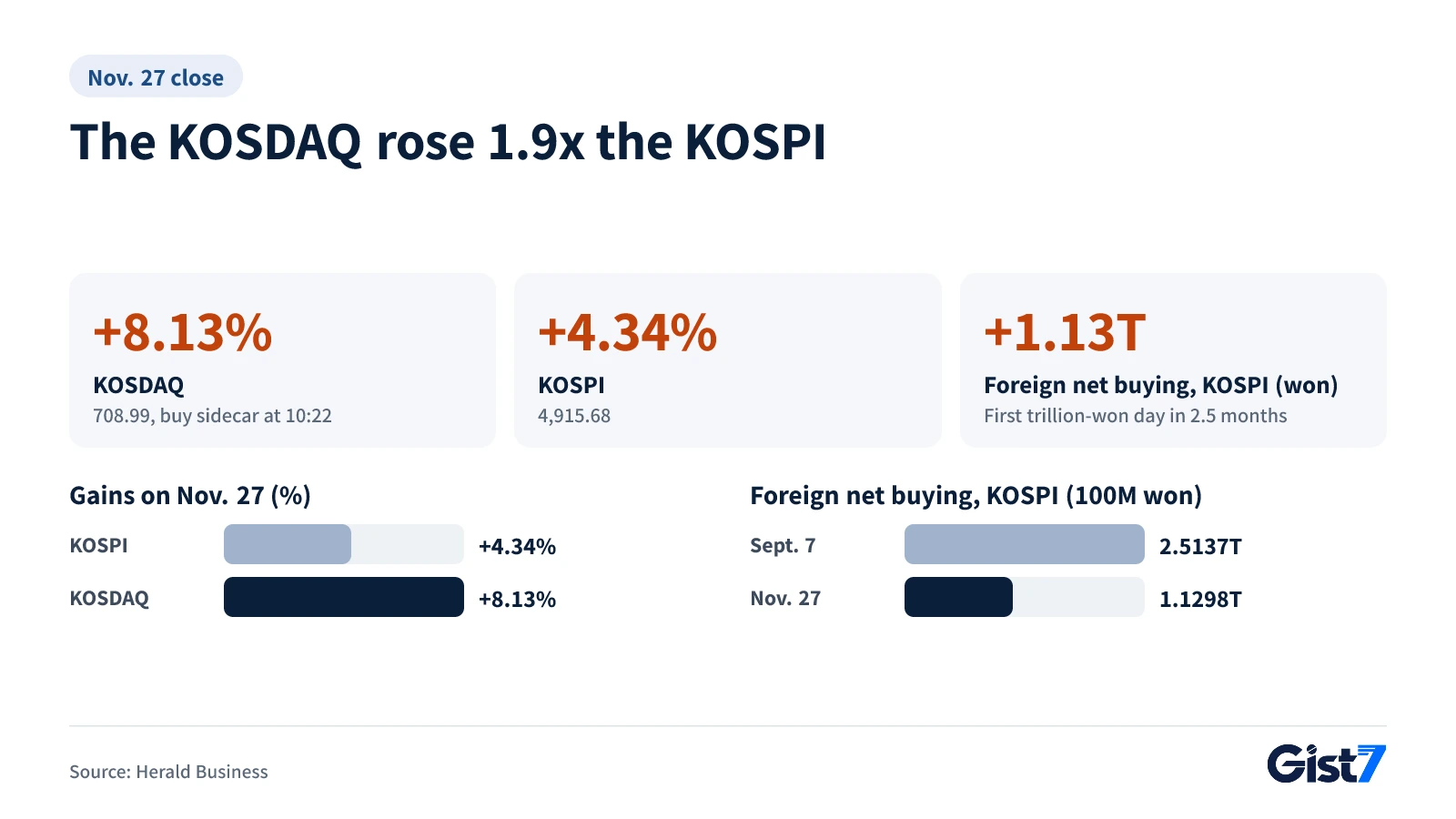
The KOSDAQ surge of 8.13% to 708.99 on November 27, 2026 was driven by hopes that Korea will activate its stock market stabilization fund; the KOSPI rose 4.34%. Foreign investors bought a net 1.1298 trillion won of KOSPI shares. The fund has not spent any money yet.
- KOSDAQ +8.13% (708.99), KOSPI +4.34% (4,915.68) at the Nov. 27 close; KOSDAQ buy-side sidecar at 10:22 a.m. Seoul time
- Foreigners bought a net 1.1298 trillion won of KOSPI shares, the first trillion-won day since Sept. 7 (2.5137 trillion won)
- The stabilization fund (10.76 trillion won committed) has not deployed yet; in 2020 the market rebounded about 26% in three weeks without any purchases
- KOSDAQ margin loans were 41.7% below January, leaving less selling pressure in the rebound than on the KOSPI
- Won 4.8 stronger at 1,337.9 per dollar; dollar-based gains of about 4.7% for the KOSPI and 8.5% for the KOSDAQ
South Korea's KOSDAQ surged 8.13% on November 27, 2026. The tech-heavy index jumped 53.28 points to close at 708.99, roughly 1.9 times the gain in the benchmark KOSPI, which rose 4.34% to 4,915.68, according to Korea Exchange data reported by Financial News. The rebound came after a rough week: the KOSPI fell 6.16% on November 25, and on November 26, when the Bank of Korea raised its policy rate to 3.25%, both indexes rose less than 1%. On the third day, the mood turned on one phrase, the government's stock market stabilization fund, which officials say could be activated soon. Foreign investors added fuel, buying more than 1 trillion won of KOSPI shares.
KOSDAQ surge of 8.13%: why did it rise almost twice as much as the KOSPI?
Three things lined up for the KOSDAQ, Korea's market for smaller growth and tech companies. Investors expected that if the stabilization fund starts buying, it could buy index products such as the KOSDAQ 150. Margin loans, stocks bought with borrowed money, had shrunk sharply, so there was less forced or break-even selling into the rally. And the biotech, robotics and battery stocks that had fallen the most bounced together.
The KOSDAQ moved first. At 10:22:21 a.m. Seoul time (8:22 p.m. ET on November 26), Korea Exchange triggered a buy-side "sidecar" on the KOSDAQ. A sidecar pauses program trading orders for five minutes when futures prices swing sharply; on the KOSDAQ it kicks in when KOSDAQ 150 futures are up 6% or more and the KOSDAQ 150 index is up 3% or more for one minute. KOSDAQ 150 futures were up 6.06% at 1,162.20 when it was triggered, the first sidecar in three trading days after November 24. That brought this year's total across the KOSPI and KOSDAQ to 103 (Maeil Shinmun, Financial News).
Robotics, biotech and battery stocks mostly rose by double digits. Based on regular-session closing prices, ABL Bio (KOSDAQ: 298380) rose 26.52%, EcoPro (KOSDAQ: 086520) 13.91%, Rainbow Robotics (KOSDAQ: 277810) 13.70% and EcoPro BM (KOSDAQ: 247540) 13.44% (Digital Daily). Two leveraged exchange-traded funds (ETFs) that track twice the daily move of the KOSDAQ 150 gained 20% or more. Analyst Kang Jin-hyuk of Shinhan Securities attributed the robotics rally to humanoid-related events and expectations for CES (Newsworks).
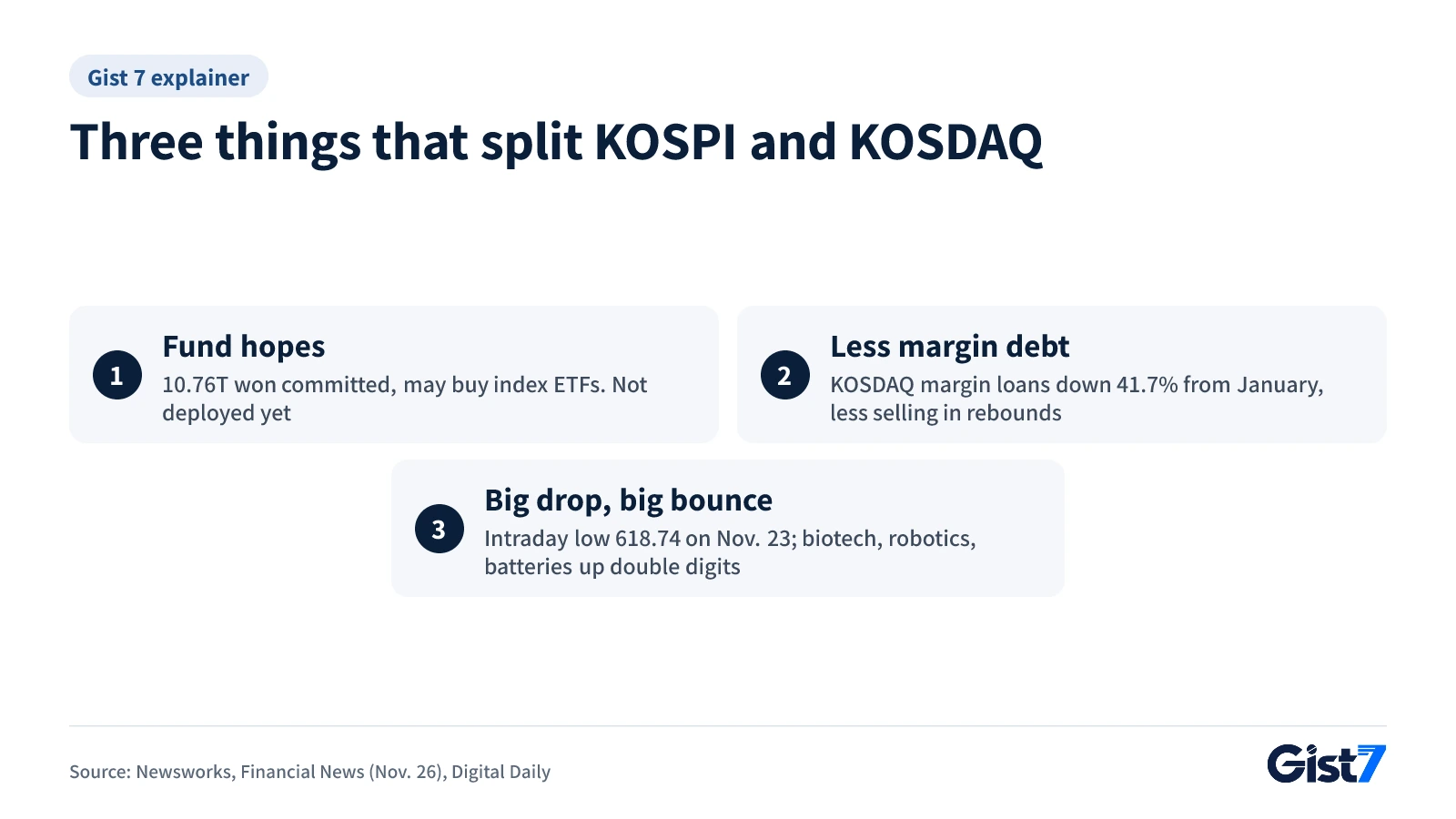
Margin-loan data show how the two markets differ. According to Financial News (November 26), the KOSDAQ's average daily margin-loan balance from November 1 to 24 was 6.0676 trillion won, down 41.7% from January (10.4089 trillion won), while the KOSPI balance rose 13.9% over the same period. When fewer shares are held on borrowed money, fewer investors rush to sell as prices recover. The KOSDAQ had also fallen to an intraday 618.74 on November 23, its lowest since April 2020, which left more room to bounce.
| Index | Nov. 24 close | Nov. 26 close (rate hike day) | Nov. 27 close | Nov. 27 change | vs. Nov. 24 |
|---|---|---|---|---|---|
| KOSPI | 5,006.03 | 4,711.21 | 4,915.68 | +4.34% | -1.8% |
| KOSDAQ | 665.88 | 655.71 | 708.99 | +8.13% | +6.5% |
Source: Korea Exchange index data (Naver Pay Securities daily prices); change vs. Nov. 24 calculated by Gist 7
The KOSDAQ is now 6.5% above its November 24 close, the day chip stocks rallied. It was the KOSDAQ's first close above 700 since November 11 (705.10) and its highest close since November 4 (714.95). The KOSPI has not fully recovered from the chip-concentrated plunge of 6.16% on November 25 and remains 1.8% below its November 24 level. This was a day led by KOSDAQ small and mid caps, not by the big chipmakers.
Yonhap News TV reported after the close on the joint surge in both indexes and the hopes for the stabilization fund.
What is Korea's stabilization fund, and has it actually bought anything?
Korea's stock market stabilization fund is a pool set up jointly by financial companies and securities-related institutions to buy stocks or ETFs when the market crashes. As of the close on November 27, the government had not announced whether or when it would actually put money in (Newsworks). The rally was driven by expectations of buying, not by buying itself.
The fund has 10.76 trillion won in committed capital and was created in 2020 during the COVID-19 shock. It does not hold the money in advance; it uses a "capital call" structure, asking contributors to pay in when needed. At an emergency market meeting on November 22 chaired by Lee Hyung-il, deputy prime minister and minister of finance and economy, the government decided to start preparations so the fund can be deployed immediately depending on market conditions. A joint market review meeting held again at 7:40 a.m. on November 27 found that links between the chip cycle and financial markets have strengthened, and saw no unusual activity in short selling. The Financial Services Commission is reportedly set to meet the chairs of the five major financial groups and others on November 30 to discuss expanding the fund and the timing of any deployment.
Sources: Newsworks, Financial News (Nov. 22), Financial Services Commission briefing (Nov. 27), Digital Times (Nov. 26)
| Period | Trigger | Did it buy stocks? | What followed |
|---|---|---|---|
| 2008 | Global financial crisis | Yes, through redemption and liquidation | Last actual deployment |
| March 2020 | COVID-19, KOSPI at 1,457.64 (March 19) | Deployment approved, purchases put on hold | 1,836.21 on April 9, a rebound of about 26% in about three weeks |
| November 2026 | AI worries and foreign selling, KOSDAQ at 618.74 (Nov. 23 intraday) | Not yet (preparing) | Financial-sector meeting planned for Nov. 30 (reported) |
Sources: Financial News (Nov. 25, News1 article), Digital Times (Nov. 26)
In 2020 the index rose nearly 26% in three weeks even though the fund never bought a share. The fund's limits are just as clear. The Korea Capital Market Institute noted that its committed capital equals only about 0.27% of the KOSPI's market value, too small to stop a long selling wave, and argued that its role should be to restore market functioning rather than prop up the index (Newsworks). If the fund does buy, index ETFs are seen as a likely target (Lee Sang-heon of iM Securities, Financial News, Nov. 26). Gist 7's reading is that the rally priced in a simple calculation: the same amount of money weighs more in the smaller KOSDAQ.
A reversal the day after a rate hike: what changed?
Interest rates did not change overnight. What changed was the policy outlook and the mood around U.S. tech stocks. The Bank of Korea raised its benchmark rate from 3.00% to 3.25% on November 26, and the KOSPI that day climbed as high as 4,817.77 early on before closing up just 0.29% at 4,711.21. Financial News summed it up as a market that "ran out of steam after the rate hike." The reasons for the hike and the likely path ahead are covered in our analysis of the 3.25% rate hike.
On November 27, worries from the U.S. eased somewhat. Nasdaq 100 futures were firm on November 26 even while U.S. stock markets were closed for Thanksgiving (Digital Daily), and gains of 2.1% in Germany and 1.6% in France the previous day also helped sentiment (Korea Economic Daily). The shape of the session was different too. On many recent days the market rose early and then slipped in the afternoon as foreign investors sold into every rebound. On November 27 the KOSPI dipped to an intraday 4,682.43 and then widened its gain to more than 4% in the afternoon (Herald Business; intraday low from Naver Pay Securities).
The rate burden has not gone away, though. Brokerage views cited by Financial News (November 26) held that a full recovery needs the liquidity drained by successive rate hikes to return, and that the market may stabilize around the first quarter of 2027. Even on a big up day, financial groups fell: KB Financial Group (KOSPI: 105560) -0.21%, Shinhan Financial Group (KOSPI: 055550) -0.94% and Hana Financial Group (KOSPI: 086790) -0.84% (Financial News). No reason for the decline was reported.
What it means for foreign investors: where did the 1.1 trillion won go, and will the buying last?
Foreign investors bought a net 1.1298 trillion won of KOSPI shares and 307.4 billion won of KOSDAQ shares on November 27, based on the end-of-day tally reported by Herald Business. It was their first trillion-won net purchase on the KOSPI in two and a half months, since September 7 (2.5137 trillion won). Figures differ by outlet because they were compiled at different times; Etoday, in an article posted at 3:47 p.m. Seoul time, put the total at 1.439 trillion won. This article uses the Herald Business figure, whose institutional and individual numbers are nearly identical to Newspim's and Digital Daily's; the final Korea Exchange tally may differ. Institutions bought 238.8 billion won on the KOSPI and 586.6 billion won on the KOSDAQ, while individuals sold about 2.6588 trillion won across both markets.
Foreign money went mainly into the big chipmakers. The two largest foreign net purchases were Samsung Electronics (KOSPI: 005930, 442.4 billion won) and SK hynix (KOSPI: 000660, 378.3 billion won), together about 73% of foreign net buying on the KOSPI (M Economy News; share calculated by Gist 7). Samsung closed the regular session at 179,100 won (+4.55%) and SK hynix at 1,110,000 won (+5.41%) (Newspim). The index rally was led by KOSDAQ small caps, but foreign money still went mostly into semiconductors.
The won strengthened as well. The won closed at 1,337.9 per dollar at 3:30 p.m. in Seoul, 4.8 won stronger than the previous session (Asia Business Daily, Seoul Finance). Etoday pointed to month-end dollar selling by exporters and the stock rally. In dollar terms, the KOSPI gained about 4.7% and the KOSDAQ about 8.5%, roughly 0.4 percentage point more than in won (Gist 7 calculation based on the closing exchange rate). For investors who measure returns in dollars, stocks and the currency both worked in their favor.
It is too early to say whether foreign buying will last. Foreign investors also turned net buyers on November 24 for the first time in eight sessions, yet the KOSPI fell 6.16% the next day (KOSPI's 6.3% surge and the return of foreign buyers). Lee Kyung-min, an analyst at Daishin Securities, told Herald Business that a sustained uptrend would require a recovery in AI investment sentiment, stable U.S. Treasury yields and continued foreign buying in both cash stocks and futures. The same article said next week's U.S. congressional hearing for Nvidia (Nasdaq: NVDA) CEO Jensen Huang and U.S. jobs data could be turning points. How the dollar affects emerging-market stocks is covered in strong dollar vs. emerging-market stocks: a 13-year scorecard.
Market impact map
| Asset / indicator | Direction | Strength | Link (why) |
|---|---|---|---|
| KOSDAQ | ↑ | Strong | Hopes the stabilization fund buys index ETFs + smaller margin-loan overhang → 8.13% surge |
| KOSPI | ↑ | Medium | Foreign net buying of over 1 trillion won concentrated in Samsung Electronics (+4.55%) and SK hynix (+5.41%); still below the Nov. 24 close |
| Won per dollar | ↓ | Weak | Foreign stock buying and month-end dollar selling by exporters → 1,337.9 (4.8 won stronger) |
| Biotech, robotics, batteries | ↑ | Strong | KOSDAQ's hardest-hit sectors; ABL Bio +26.52%, EcoPro +13.91% |
Little direct impact: 2-year Treasury, 10-year Treasury, dollar index, gold, oil (WTI), bitcoin, S&P 500, Nasdaq (U.S. stocks were closed for Thanksgiving on Nov. 26; this rally was driven mainly by Korean policy expectations)
- Everyday impact: Korean equity funds and retirement accounts with KOSDAQ exposure recovered a lot of value in one day, but leveraged ETFs also move twice as much on the way down.
- Everyday impact: With the won back in the 1,330s per dollar, overseas payments and currency exchange became slightly cheaper for Koreans.
- Everyday impact: The rate hike still stands, so interest costs on variable-rate loans remain regardless of the rally.
Market reactions can vary with other factors, and this table is not a basis for investment decisions.
What to watch next
| Date (Seoul time / ET) | Indicator / event | Previous | Why it matters here | If it comes in... |
|---|---|---|---|---|
| Nov. 30 (Mon), Seoul | Emergency meeting of the Financial Services Commission with heads of the five major financial groups (reported*) | Preparations started Nov. 22; 10.76 trillion won committed (not yet deployed) | Size and timing of any fund deployment | If deployment or expansion becomes concrete, hopes for index-ETF buying tend to hold; if it stays vague, the rally could fade |
| Dec. 1 (Tue), Seoul, expected | Korea's November trade data (Ministry of Trade, Industry and Resources) | October chip exports $56.44 billion, +259.4% year on year (ministry) | Export results that give foreigners a reason to buy Korean stocks | Strong chip exports support foreign buying; a sharp slowdown tends to sap the rebound |
| Dec. 4 (Fri) 22:30 Seoul / 8:30 a.m. ET | U.S. November jobs report | October nonfarm payrolls +165,000, unemployment 4.1% (BLS) | A turning point cited by brokers | Strong hiring tends to lift U.S. yields and the dollar, weighing on flows into emerging-market stocks |
| Dec. 10 (Thu) 04:00 Seoul / Dec. 9, 2:00 p.m. ET | FOMC rate decision (Dec. 8-9 meeting) | Held at 3.75%-4.00%, two dissents in favor of a hike (October, Fed) | Whether Treasury yields stabilize | A hike or signals of more hikes tend to weaken the won and add foreign selling pressure |
| Dec. 10 (Thu) 22:30 Seoul / 8:30 a.m. ET | U.S. November CPI | October +0.4% month on month, core +0.3% (BLS) | Fed path and discount rates for tech stocks | A hotter reading tends to lift yields and weigh on growth stocks and the KOSDAQ |
Schedule sources: BLS December release schedule, Federal Reserve FOMC calendar. The trade data date follows the usual practice of publishing on the first of the month. *The November 30 meeting was confirmed through a Digital Times report, not an official calendar, and the date of Jensen Huang's hearing could not be confirmed.
Frequently asked questions
Why did the KOSDAQ jump 8% on November 27?
The biggest factor was the expectation that Korea's stock market stabilization fund will soon be activated and could buy index products such as the KOSDAQ 150. Margin-loan balances were 41.7% lower than in January, so there was less selling into the rally, and beaten-down biotech, robotics and battery stocks rose by double digits together. The KOSDAQ closed up 8.13% at 708.99 on November 27, 2026.
Has the stabilization fund actually bought stocks?
No. As of the November 27 close, no money from the fund had been deployed. The government began preparations on November 22, and the Financial Services Commission is reported to meet heads of financial groups on November 30 to discuss expanding the fund and the timing of any deployment.
How big is the fund and how does it work?
It has 10.76 trillion won in committed capital, set up in 2020 during COVID-19 by financial companies and securities-related institutions. It uses a capital-call structure, asking contributors to pay in only when needed. The Korea Capital Market Institute says the amount equals about 0.27% of the KOSPI's market value, too small to stop a prolonged sell-off.
Why do reports give different figures for foreign net buying?
Outlets compiled their numbers at different times. Most reported foreign net buying on the KOSPI of around 1.1 trillion won on November 27, but an Etoday article posted at 3:47 p.m. Seoul time put it at 1.439 trillion won. This article uses the Herald Business tally of 1.1298 trillion won; the final Korea Exchange figure may differ.
Will foreign buying continue?
That cannot be said with certainty. Brokers cite a recovery in AI investment sentiment, stable U.S. Treasury yields and continued foreign buying in both stocks and futures as conditions. The November 30 meeting, the U.S. jobs report on December 4 and the FOMC decision on December 9 (ET) are the key tests.
Why did stocks rise the day after a rate hike?
Rates did not change; the policy outlook and the mood around U.S. tech did. The KOSPI rose only 0.29% on November 26, when the Bank of Korea lifted its rate to 3.25%, but on November 27 stabilization-fund hopes and firm Nasdaq 100 futures came together. The squeeze on liquidity from rate hikes is still there.
References
- 코스닥 8% 급등해 700선 탈환…외국인 1조 매수에 코스피도 4900선 [fn마감시황] — 파이낸셜뉴스
- '코스피 폭풍 쇼핑' 대체 얼마만…돌아온 외인, 전약후강 패턴 깼다 — 헤럴드경제
- 긴 악몽 끝나나…코스피 4.3%·코스닥 8%대 폭등 — 디지털데일리
- 금융시장 동향 및 증시안정조치 진행상황 점검 (2026-11-27) — 금융위원회
- 시장상황 따라 증안펀드 바로 가동 준비 착수 (2026-11-22) — 파이낸셜뉴스
- 코스피 5천 회복에도 10.7조 증안펀드 준비 계속…투입 여부 F4가 결정 — 파이낸셜뉴스
- '역사적 저점' 코스닥…증안펀드 가동 땐 코스피보다 더 웃는다 — 파이낸셜뉴스
- 금융위, 30일 금융권 긴급 점검회의…10조원대 증안펀드 가동 논의 — 디지털타임스
- [종합] 코스닥 5%대 급등…증안펀드 기대에 3거래일 만에 매수 사이드카 — 뉴스웍스
- 코스닥 5% 넘게 폭등…3거래일 만에 '매수 사이드카' 발동 — 매일신문
- [속보] 코스닥 5%대 급등에 매수 사이드카 발동 — 파이낸셜뉴스
- 10조원 풀지도 않았는데…외국인 돌변에 코스닥 5%대 급등 — 한국경제
- 원·달러 환율, 4.8원 내린 1337.9원(오후 3시30분) — 아시아경제
- [외환] 원·달러 환율 1337.9원 마감···4.8원↓ — 서울파이낸스
- [환율마감] 원·달러 일주일만 1340원 하회, 월말 네고+증시 랠리 — 이투데이(네이트 뉴스)
- '4800' 찍고 '4700' 마감…반등 코스피, 금리 인상에 뒷심 부족 (2026-11-26) — 파이낸셜뉴스
- 증안펀드 기대감에 외국인 귀환…코스피 4.34%·코스닥 8.13% 급등 — 이투데이
- 코스피 4.34% 급등해 4,900선 회복...코스닥 8.13% 상승 — M이코노미뉴스
- [마감시황] 코스피, 4%대 상승에 4900선 회복…코스닥도 8% 급등 — 뉴스핌
- 코스닥 지수 일별 시세 — 네이버페이 증권
- 2026년 10월 수출입 동향 — 산업통상부
- December 2026 Release Schedule — 미 노동통계국
- The Employment Situation — October 2026 — 미 노동통계국
- Consumer Price Index — October 2026 — 미 노동통계국
- Federal Reserve issues FOMC statement (2026-10-28) — 연준
- Meeting calendars and information — 연준