KOSDAQ surge of 5.62%: what two straight buy sidecars signal
Key summary
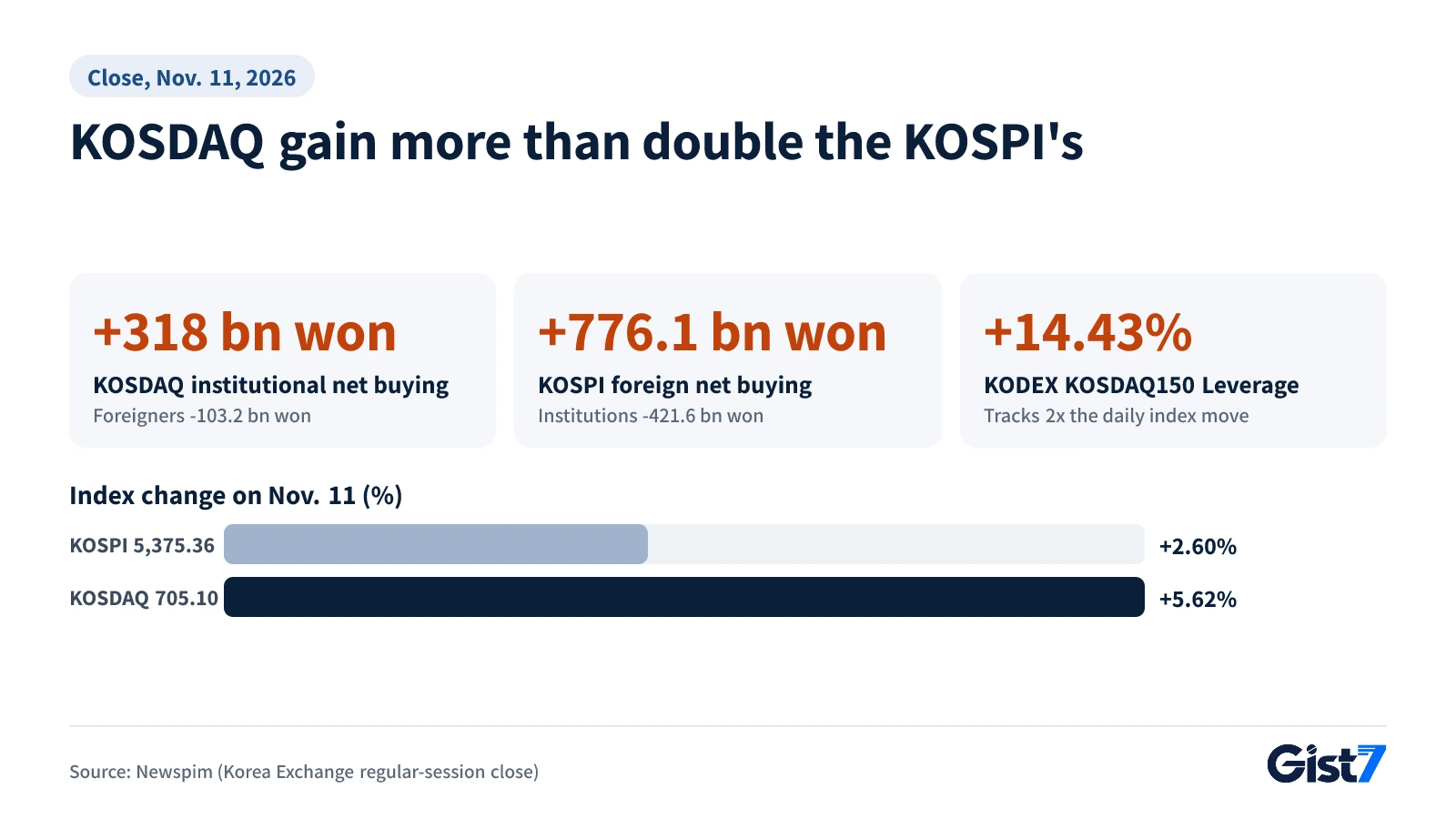
The KOSDAQ surge on Nov. 11, 2026 lifted the index 5.62% to 705.10, more than double the KOSPI's 2.60%. Institutions net bought 318 billion won of KOSDAQ stocks while foreigners bought the KOSPI. With 38 KOSDAQ sidecars already this year, two in a row say little about direction.
- Nov. 11 close: KOSDAQ 705.10 (+5.62%), KOSPI 5,375.36 (+2.60%); the KOSDAQ is back above 700 for the first time since Nov. 5
- Different buyers: foreigners net bought 776.1 billion won of KOSPI stocks, institutions 318 billion won of KOSDAQ stocks
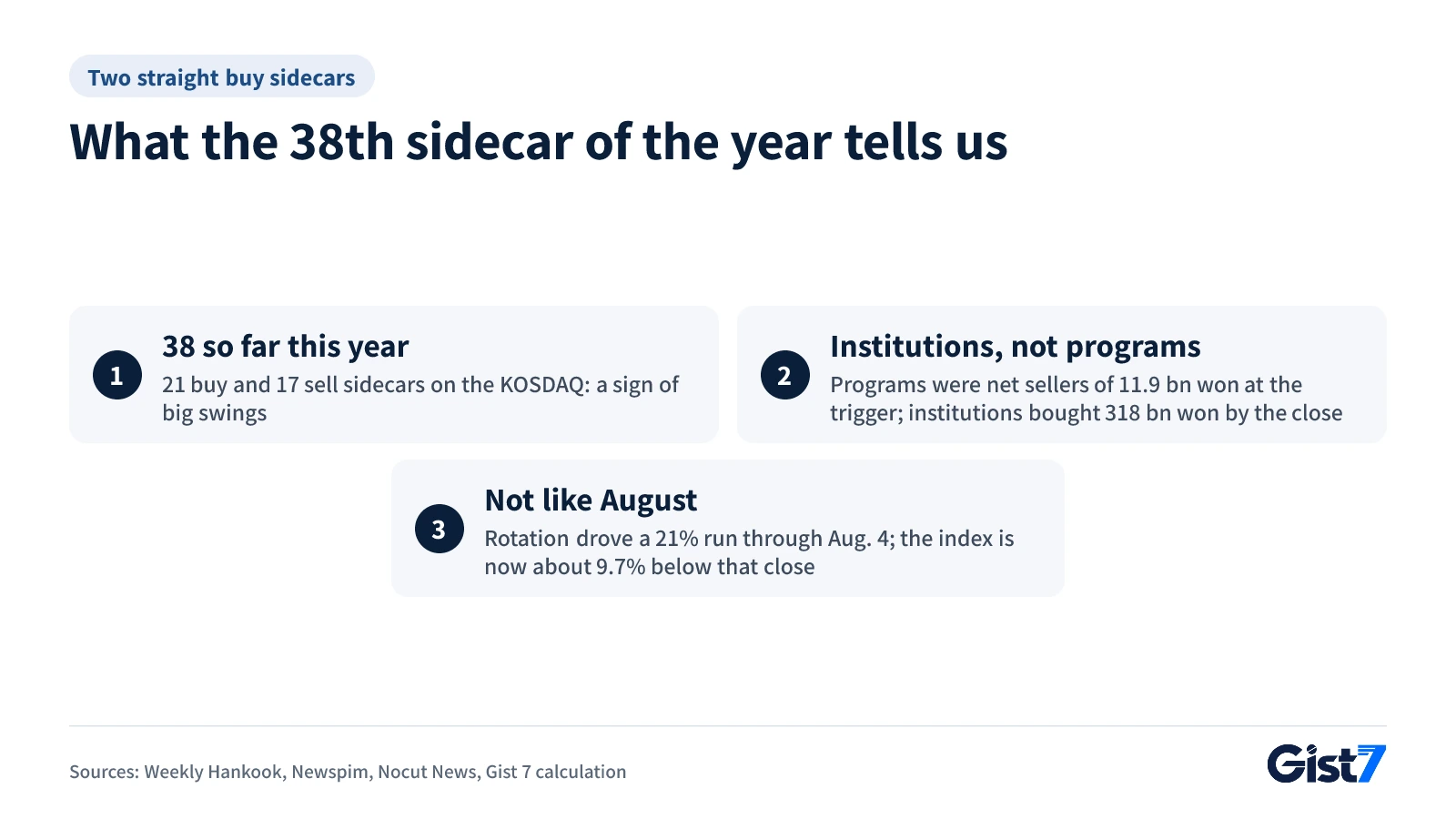
- A KOSDAQ buy sidecar fired at 11:28:44 a.m. KST, the second day in a row and the market's 38th sidecar of 2026
- KODEX KOSDAQ150 Leverage (KRX: 233740) jumped 14.43%, but its 2x target resets daily, so multi-day returns can differ from twice the index
- The won firmed to 1,333.6 per dollar (down 3.9 won) despite the hot U.S. October CPI
The KOSDAQ surge on Nov. 11, 2026 took the index to 705.10, up 37.49 points or 5.62%, according to closing data from the Korea Exchange reported by Newspim. According to News1, the index crossed 700 intraday for the first time since Nov. 5, and it held above that level at the close. The KOSPI rose 136.23 points, or 2.60%, to 5,375.36, so the KOSDAQ surge was more than twice as large. A KOSDAQ buy sidecar was triggered at 11:28:44 a.m. Korea time, a day after the previous one. The won closed daytime trading at 1,333.6 per dollar, 3.9 won stronger.
Wall Street had a weak session the night before after the U.S. October consumer price index (CPI) came in hotter than expected (News1). Korean stocks rose for a second day anyway. The inflation data itself is covered in our piece on the October CPI and a possible December Fed hike.
Why did the KOSDAQ surge twice as much as the KOSPI?
On Nov. 11, foreign investors net bought 776.1 billion won (about $582 million) of KOSPI stocks, while institutions net bought 318 billion won (about $238 million) of KOSDAQ stocks. Each market had a different buyer. The KOSDAQ also holds many battery and chip-equipment stocks that had fallen hard in recent weeks, which made for a bigger rebound.
| Net buying on Nov. 11 (at the close) | KOSPI | KOSDAQ |
|---|---|---|
| Foreign investors | +776.1 bn won | -103.2 bn won |
| Institutions | -421.6 bn won | +318.0 bn won |
| Individuals | -893.1 bn won | -225.4 bn won |
| Index change | +2.60% (5,375.36) | +5.62% (705.10) |
Source: Newspim market close. Net buying is the value bought minus the value sold. Dollar figures use the day's closing rate of 1,333.6 won (Gist 7 calculation).
According to Newspim, among the largest KOSDAQ stocks Jusung Engineering (KOSDAQ: 036930) rose 17.14%, Simmtech (KOSDAQ: 222800) 14.07%, EcoPro BM (KOSDAQ: 247540) 11.39% and EcoPro (KOSDAQ: 086520) 10.03%. Lee Kyung-min, an analyst at Daishin Securities (KOSPI: 003540), pointed to a recovery in AI investment sentiment and bargain hunting in the KOSDAQ (Newspim). News1 reported that results from AI infrastructure company CoreWeave (Nasdaq: CRWV) eased worries about AI spending.
Policy hopes also played a part. Traders cited the KOSDAQ tiering system that the government and the Korea Exchange are preparing, which would group stronger companies into a separate segment. In the afternoon a rumor spread that the Financial Supervisory Service (FSS) would hold a meeting on KOSDAQ support measures, but an FSS official told News1 it was "not true at all." To the extent the rumor drove buying, that part of the rally had no basis.
On the KOSPI side, SK hynix (KOSPI: 000660) gained around 5% and Samsung Electronics (KOSPI: 005930) rose about 3%, while Samsung Biologics (KOSPI: 207940) fell 2.59% (Newspim). Hyundai Motor (KOSPI: 005380) also slipped 0.91%, so a few large caps trimmed the KOSPI's gain.
What is a buy sidecar, and why did it fire twice?
A buy sidecar is a circuit-style tool that suspends program buy orders for five minutes when futures prices surge. Program trading means computer-driven orders that buy or sell a basket of stocks at once under preset conditions. According to the Korea Exchange, the KOSDAQ sidecar is triggered when KOSDAQ150 futures rise 6% or more above the base price and the KOSDAQ150 index rises 3% or more from the previous close, and it applies only in the regular session. Under the exchange's rules, both conditions must hold for one minute.
| Item | KOSDAQ buy sidecar, Nov. 11 |
|---|---|
| Trigger time | 11:28:44 a.m. KST |
| KOSDAQ150 futures | 1,158.60 (+6.06%) |
| KOSDAQ150 index | 1,156.27 (+6.19%) |
| Program trading at the trigger | Net selling of 11.9 bn won |
| KOSDAQ sidecars in 2026 | 38th (21 buy, 17 sell) |
Sources: Korea Exchange, Newspim, Weekly Hankook.
According to Weekly Hankook, program trading was a net seller of 11.9 billion won at the moment of the trigger. Program buying was not what pushed the index up, so pausing program buy orders for five minutes had little room to matter. The KOSDAQ in fact extended its gains in the afternoon. Gist 7 reads the rally as driven by institutions buying shares directly in the cash market rather than by program buying, with 318 billion won of institutional net buying at the close as the evidence. On Nov. 10 the sidecar fired in both the KOSPI and the KOSDAQ; that session is covered in our KOSPI 4.39% rebound piece.
The 38th sidecar of 2026: how is this different from August?
In August, money rotating out of the KOSPI pushed the KOSDAQ up 21% in three days; this two-day rebound of about 10.4% was bought by institutions while foreigners sold KOSDAQ stocks. According to Nocut News, the KOSDAQ closed at 780.72 on Aug. 4, 2026 after buy sidecars on three straight trading days, and Yuanta Securities Korea (KOSPI: 003470) described it as rotation from chips into pharma, biotech and robotics.
This time the pattern is different. The KOSDAQ rose 4.48% on Nov. 10 and 5.62% on Nov. 11, about 10.4% over two days (Gist 7 calculation). On Nov. 11 institutions net bought 318 billion won, while foreigners sold 103.2 billion won and individuals sold 225.4 billion won. The rebound rests on one group of buyers.
Sidecars are not rare this year. The KOSDAQ has seen 38 of them in 2026, and 17 were sell sidecars triggered by sharp drops (Weekly Hankook). Daily moves of around 6% in either direction have been common. Compared with the Aug. 4 close, today's 705.10 is still about 9.7% lower (Gist 7 calculation), which shows the index fell sharply again after that run of sidecars. Gist 7 therefore gives more weight to whether institutional buying lasts a few more days, and whether foreigners turn into buyers of KOSDAQ stocks as well, than to the sidecar count.
Leveraged ETFs jumped 14%: daily and cumulative returns are not the same
A leveraged ETF is an exchange-traded fund that tracks twice the index's daily move. According to Newspim's ETF wrap, KODEX KOSDAQ150 Leverage (KRX: 233740) rose 14.43% on Nov. 11.
| ETF | Change on Nov. 11 |
|---|---|
| KODEX Semiconductor Leverage (KRX: 494310) | +17.52% |
| TIGER KOSDAQ150 Leverage (KRX: 233160) | +14.59% |
| KODEX KOSDAQ150 Leverage (KRX: 233740) | +14.43% |
| KODEX KOSDAQ150 Futures Inverse (KRX: 251340) | -7.32% |
Source: Newspim ETF market wrap.
The 2x applies to a single day. If an index falls 10% one day and rises 10% the next, it ends 1% lower, but a 2x product drops 20% and then gains 20%, ending 4% lower (Gist 7 calculation). When prices swing back and forth, leveraged products tend to do worse than twice the index's return. In a year with 38 sidecars in both directions, that gap can widen.
Market impact map
| Asset / indicator | Direction | Strength | Link (why) |
|---|---|---|---|
| KOSDAQ | ↑ | Strong | Institutions net bought 318 bn won; rebound in battery and chip-equipment stocks that had fallen hard (+5.62% on Nov. 11) |
| KOSPI | ↑ | Medium | Foreigners net bought 776.1 bn won; large chip stocks rose (+2.60% on Nov. 11) |
| Won/dollar | ↓ (stronger won) | Weak | Foreign buying of KOSPI stocks adds demand for won (daytime close 1,333.6, down 3.9 won) |
| Semiconductor sector | ↑ | Strong | AI infrastructure spending worries eased after CoreWeave results (KODEX Semiconductor Leverage +17.52%) |
| Battery sector | ↑ | Medium | Bargain hunting after steep losses (EcoPro BM +11.39%, EcoPro +10.03%) |
| Large-cap biotech | ↓ | Weak | Weaker on a day when buying concentrated in chips and batteries (Samsung Biologics -2.59%) |
Market reactions can vary with other factors, and this table is not a basis for investment decisions.
Little direct impact: 2-year Treasury yield, 10-year Treasury yield, dollar index, gold, oil (WTI), bitcoin, S&P 500, Nasdaq
- Currency exchange and overseas payments: with the won near 1,330 per dollar, buying dollars got slightly cheaper. Renewed foreign selling could reverse that.
- Leveraged products: because they reset daily, repeated swings can produce losses larger than the index's. The "daily return" wording in the prospectus is the first thing to check.
- Korean equity funds and pensions: on the same day, products heavy in KOSDAQ stocks and those centered on KOSPI large caps saw very different results.
What to watch next
| Date (Korea time) | Indicator / event | Previous | Why it matters here | If it comes in... |
|---|---|---|---|---|
| Nov. 13 (Fri) 10:30 p.m. KST (8:30 a.m. ET) | U.S. October producer price index (PPI) | September +1.3% m/m, +6.3% y/y (BLS) | Whether U.S. tightening worries grow after the CPI | Hotter than expected: yields and dollar tend to rise, pressure on KOSDAQ growth stocks |
| Nov. 18 (Wed) 7:00 a.m. KST (Nov. 17, 5 p.m. ET) | Nvidia (Nasdaq: NVDA) fiscal 2027 Q3 earnings call | n/a | AI spending sentiment that moved KOSDAQ chip-equipment stocks | Strong data-center demand tends to support chip suppliers; a miss tends to do the opposite |
| Nov. 26 (Thu) | Bank of Korea rate decision | Base rate 3.00% (Bank of Korea) | The won and foreign capital flows | A hike narrows the Korea-U.S. rate gap and supports the won; a hold leaves more weight on external factors |
| Dec. 10 (Thu) 4:00 a.m. KST (Dec. 9, 2 p.m. ET) | FOMC decision (Dec. 8-9 meeting) | 3.75-4.00% (Fed, Oct. 28) | The answer to the U.S. tightening worries this rebound has to withstand | A larger hike weighs on risk assets; a smaller one tends to help growth-stock sentiment |
Dates come from the BLS release schedule, Nvidia's investor notice, the Bank of Korea's monetary policy meeting calendar and the Fed's FOMC calendar.
Frequently asked questions
Why did the KOSDAQ jump more than 5% today?
On Nov. 11, 2026 the KOSDAQ rose 5.62% as institutions net bought 318 billion won and bargain hunters moved into battery and chip-equipment stocks that had fallen hard. CoreWeave's results eased AI spending worries, and hopes for the planned KOSDAQ tiering system were also cited. A rumor of an FSS meeting on support measures was denied by the FSS.
What does it mean when KOSDAQ sidecars fire often?
It means daily swings of around 6% have been frequent, not that the market is pointing in a particular direction. The KOSDAQ has had 38 sidecars in 2026 (21 buy, 17 sell), and after buy sidecars on three straight days through Aug. 4 the index is now about 9.7% below that day's close. Whether institutional and foreign buying continues says more about direction.
How is a buy sidecar different from a circuit breaker?
A buy sidecar only suspends program buy orders for five minutes, and regular trading continues. A circuit breaker halts all trading in the market when the index falls sharply, so its scope is much broader.
What triggers a KOSDAQ sidecar?
According to the Korea Exchange, a buy sidecar fires when KOSDAQ150 futures rise 6% or more above the base price and the KOSDAQ150 index rises 3% or more from the previous close; under its rules, both conditions must last one minute. On Nov. 11 it fired with futures up 6.06% and the index up 6.19%.
Does a 2x leveraged ETF earn double when the index doubles its gain?
It tracks twice the index only on a daily basis. If an index falls 10% and then rises 10%, it is down 1%, while a 2x product is down 4%, so repeated swings can leave cumulative returns worse than twice the index.
References
- [마감시황] 코스피 2.6%·코스닥 5.6%↑…코스닥 연속 매수 사이드카 — 뉴스핌
- "낙폭 지나치다" 코스닥 4%대↑ '또 사이드카'…부양책 기대 — 뉴스1
- 코스닥 매수 사이드카 발동…올해 38번째 — 주간한국
- [ETF 시황] 코스닥 700선 회복에 관련 ETF 급등…반도체 상품도 강세 — 뉴스핌
- 힘 받는 코스닥 사흘간 21%↑…매수사이드카 세 번 연속 울렸다 — 노컷뉴스
- Sidecar (KOSDAQ market) — Korea Exchange
- Producer Price Index News Release (September 2026) — U.S. Bureau of Labor Statistics
- Meeting calendars and information — Federal Reserve
- Federal Reserve issues FOMC statement (2026-10-28) — Federal Reserve
- NVIDIA Sets Conference Call for Third-Quarter Financial Results — NVIDIA
- 통화정책방향 결정회의 일정 — 한국은행