Korea's October Jobs Report: Hiring Up, Youth Employment Down
Key summary
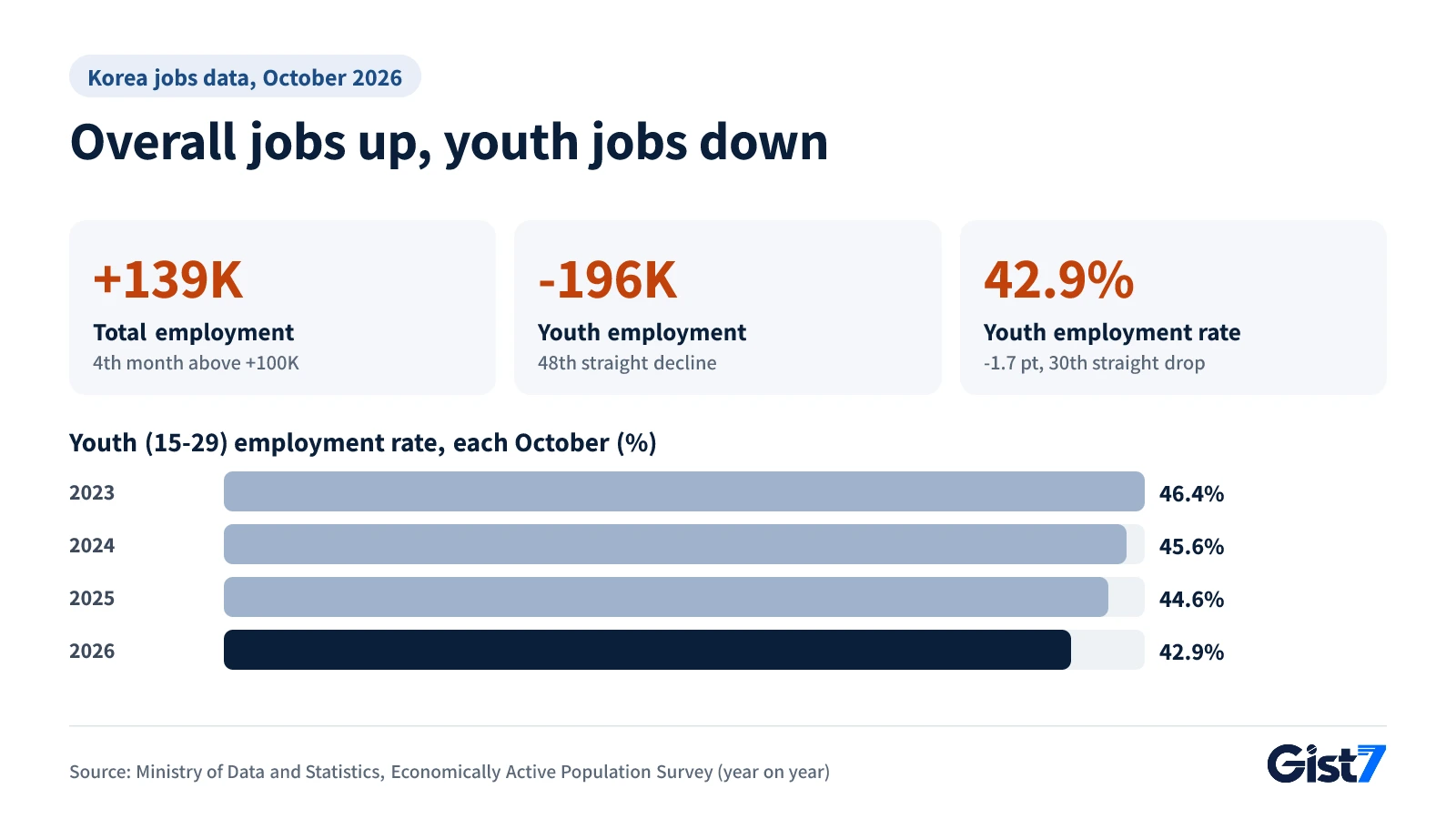
Korea's October jobs report for 2026 showed 139,000 more people employed, yet youth jobs fell by 196,000 and the youth employment rate slid to 42.9%, a 30th straight drop. With unemployment at a record October low of 2.0%, it does little to derail a November BOK hike, though domestic demand is weak.
- October 2026 employment reached 29.179 million, up 139,000 from a year earlier (fourth month above +100,000)
- Youth (15-29) employment fell by 196,000, the 48th straight decline; the youth employment rate fell to 42.9% for a 30th straight month
- Workers aged 65 and older rose by 255,000, more than the total gain; older workers and care jobs are carrying the numbers
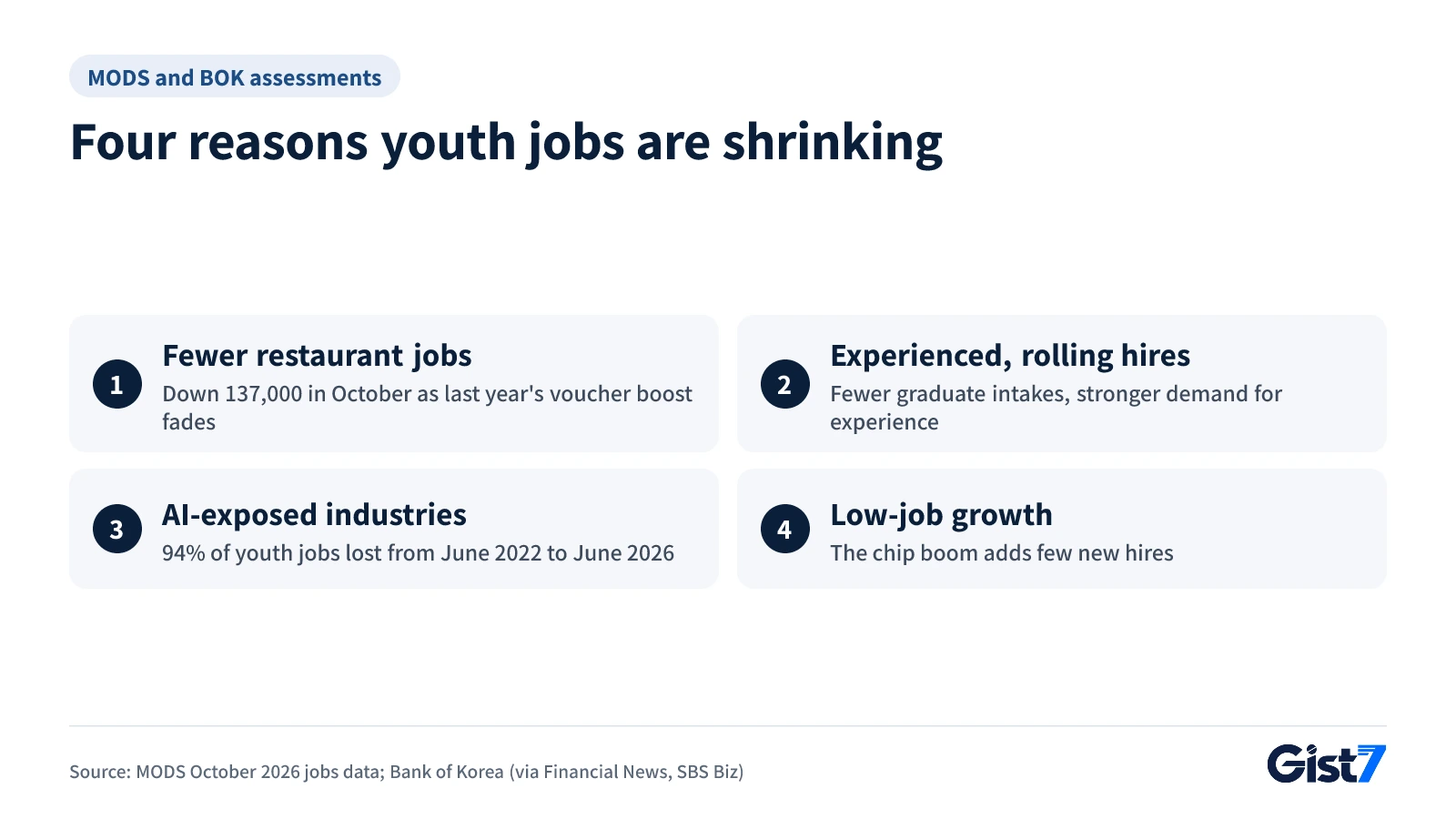
- Causes cited: 137,000 fewer restaurant and lodging jobs, a shift to experienced and rolling hires, and fewer entry-level tasks in AI-exposed industries (MODS, BOK)
- A record-low October jobless rate of 2.0% keeps the case for a Nov. 26 BOK hike intact, but weak consumption weighs on domestic demand
South Korea added 139,000 jobs from a year earlier in October 2026, bringing total employment to 29.179 million, according to the Korea October jobs report released on Nov. 11 by the Ministry of Data and Statistics (MODS), the country's statistics agency. It was the fourth straight month of gains above 100,000. Young people told a different story: employment among 15- to 29-year-olds fell by 196,000, and the youth employment rate dropped 1.7 percentage points to 42.9%, its 30th consecutive monthly decline. The jobless rate of 2.0% was the lowest for any October since records began in 1999. The headline looks solid, but the people holding the jobs are changing.
What Korea's October jobs report shows for young workers
Overall job growth came from people aged 60 and over and from workers in their 30s, while employment among people in their 20s fell by 203,000, the steepest drop of any age group. According to MODS data reported by the Korean daily Financial News, employment among those 65 and older alone rose by 255,000, more than the total increase. By simple arithmetic, employment excluding the 65-plus group actually shrank.
| Indicator | October 2026 | Change from a year earlier | Note |
|---|---|---|---|
| Employed persons | 29.179 million | +139,000 | Fourth straight month above +100,000 |
| Unemployment rate | 2.0% | -0.2 pt | Lowest October reading since 1999 |
| Employment rate, ages 15-64 | 70.4% | +0.3 pt | Highest October reading on record |
| Employed youth (15-29) | 3.325 million | -196,000 | 48th consecutive monthly decline |
| Youth employment rate | 42.9% | -1.7 pt | 30th straight decline, lowest October since 2020 |
| Youth labor force participation | 45.2% | -1.9 pt | Share of young people working or looking for work |
| Youth unemployment rate | 5.2% | -0.1 pt | Young people who stop searching drop out of the count |
Source: MODS, October 2026 Economically Active Population Survey; Financial News.
The employment rate is the share of a population that has a job. Because Korea's youth population is shrinking, the number of young workers can fall even if their odds of finding work stay the same, so the rate is the better gauge. In October the youth population fell by 141,000, but youth employment fell by 196,000. Demographics explain only part of the decline.
That is also why the youth unemployment rate edged down. The unemployment rate counts only people actively looking for work, so anyone who gives up the search or goes back to school or a training course is no longer counted. The number of young people outside the labor force rose by 72,000 in October, and across all ages, people in school or training made up the largest part of the increase in the economically inactive population, at 131,000.
Why are fewer young Koreans finding jobs?
Officials and the Bank of Korea (BOK) point to four forces. Restaurant and lodging jobs, where many young people work, are disappearing. Employers have shifted toward hiring experienced workers rather than new graduates. Entry-level tasks are shrinking in industries highly exposed to AI. And growth led by semiconductors creates relatively few jobs.
According to Financial News, Bin Hyun-jun, director general for social statistics at MODS, said the drop in accommodation and food services, combined with companies' preference for experienced hires and a shift to rolling, year-round recruitment instead of annual graduate intakes, weighed on youth employment. Employment in accommodation and food services fell by 137,000, the largest decline since February 2021. The agency attributed it mainly to a base effect: consumption vouchers that lifted spending in the second half of last year are no longer in place. An official at the Ministry of Finance and Economy added that lower alcohol consumption and a shakeout among small business owners are spilling over into jobs. Within the youth group, employment also fell in information and communications and in health and social work.
The central bank does not see this as a passing dip. In an Oct. 26 report titled "Weak Youth Employment and Policy Tasks," as reported by Financial News, the BOK said the deterioration is becoming structural, driven by an industrial shift toward IT and AI, sluggish growth in services and a rigid labor market. It also noted that the chip boom, despite record output, has a low job-creation effect and is not translating into new hiring.
How much of this is AI remains open to debate. According to SBS Biz, a BOK issue note published on Aug. 18 found that 285,000 jobs held by young people disappeared between June 2022 and June 2026, and 268,000 of them (94%) were in industries highly exposed to AI. The BOK cautioned, however, that this is not purely an AI effect; AI appears to have accelerated changes already underway, such as the move toward experienced hires.
Where did the new jobs go?
The jobs that pushed up the total were not the kind young people can easily walk into. By industry, health and social work added 249,000 positions and led the gains. Manufacturing lost 7,000 jobs, slipping back one month after September's first increase in 27 months. Construction shed 42,000, its 30th straight monthly decline.
By employment status, permanent employees rose by 287,000, while temporary workers fell by 107,000 and daily workers by 53,000. On the surface, job quality improved. But the BOK report found that the share of temporary and daily jobs among employed people has been rising quickly, and that as hiring in the primary labor market (stable, well-paid jobs at large firms and the public sector) shrinks, more young people settle for lesser jobs and get stuck there. The national average and the experience of young workers are moving apart.
In Gist 7's view, what stands out is not the speed of the decline but how long it has lasted: 48 months of falling youth employment and 30 months of a falling youth employment rate. The BOK has warned of hysteresis, meaning that the longer young people miss out on work experience, the slower employment recovers even after the economy improves. That risk is growing.
What does the jobs report signal for the BOK's November rate decision?
The October data give little reason for the BOK to back away from a rate hike in November. Its Monetary Policy Board meets on Nov. 26. The base rate rose to 3.00% on Aug. 27 and was held in October, and some in the market expect another hike this month (BOK rate hike outlook and Korean bond yields). The overall jobless rate and employment rate are the standard measures of labor market heat, and a record-low October unemployment rate alongside a record-high employment rate for ages 15-64 is hard to read as a cooling economy.
Growth points the same way. According to the BOK's advance estimate, published on the government's Korea.kr policy briefing site, real gross domestic product (GDP) grew 1.0% in the third quarter from the previous quarter and 3.4% from a year earlier. Private consumption, however, fell 0.2% quarter on quarter. The government called that temporary and expects a rebound in the fourth quarter, but job losses in restaurants and lodging and the drop in temporary and daily work are consistent with weak domestic services demand.
Monetary policy is also a poor tool for fixing youth unemployment, since the BOK itself traces the causes to industrial structure and hiring practices. Lower rates would not give companies a reason to hire graduates instead of experienced staff. Higher rates, on the other hand, would raise interest costs and add pressure on already weak consumption and small-business jobs. Hot U.S. inflation, which has raised the odds of a Federal Reserve hike in December, further limits the BOK's room to wait.
Gist 7's read: overall employment is no argument against a November hike, but with domestic demand and youth employment this weak, the pace of any further hikes after that could slow. How much weight the BOK gives to consumption and jobs on Nov. 26 will be the clue.
Market impact map
| Asset / indicator | Direction | Strength | Why |
|---|---|---|---|
| Korean 3-year government bond yield | ↑ pressure | Weak | Record-low unemployment and job growth keep the case for a November hike intact |
| Domestic consumer stocks (retail, restaurants) | ↓ | Weak | Restaurant and lodging jobs down 137,000; Q3 private consumption -0.2% |
| Construction | ↓ | Weak | Weak business conditions confirmed by a 30th straight monthly drop in construction jobs |
Little direct impact: U.S. 2-year Treasury, U.S. 10-year Treasury, dollar index, won/dollar, gold, oil (WTI), bitcoin, S&P 500, Nasdaq, KOSPI
- Loans in Korea: if this data does not change expectations for a November hike, variable mortgage and credit rates may stay high.
- Job seekers: with more rolling and experienced-hire recruitment, the search for a first job may take longer.
- Small businesses: restaurants and lodging face weak hiring and weak sales at the same time.
Market reactions can vary with other factors, and this table is not a basis for investment decisions.
What to watch next
| Date (Korea time) | Release / event | Previous | Why it matters here | If it comes in... |
|---|---|---|---|---|
| Nov. 26 (Thu) | BOK monetary policy decision | 3.00% (BOK) | Solid overall employment supports the case for a hike | A hike paired with concern about consumption and jobs would hint at a slower pace afterward |
| Nov. 30 (Mon) | October industrial activity (MODS) | Reference: Q3 private consumption -0.2% q/q (BOK advance estimate) | Retail sales and services output test domestic demand | Weak retail sales would suggest a slower recovery in restaurant and lodging jobs |
| Dec. 2 (Wed) | November consumer prices (MODS) | October 2.8%; core (excluding agricultural products and petroleum) 2.8% (MODS) | Inflation, not jobs, drives the rate path | A further rise in core inflation would strengthen talk of more hikes |
| Dec. 16 (Wed) | November employment (MODS) | Jobs +139,000; youth employment rate 42.9% (October) | Will the youth rate fall for a 31st month? | A deeper youth decline would add to concerns about domestic demand; a smaller one would start talk of a bottom |
Dates follow the MODS 2026 statistics release calendar and the BOK monetary policy meeting schedule and may change. Korea time (KST) is 14 hours ahead of U.S. Eastern Time.
Frequently asked questions
How many jobs did South Korea add in October 2026?
Employment rose by 139,000 (0.5%) from a year earlier to 29.179 million, according to the Ministry of Data and Statistics. It was the fourth straight month of gains above 100,000, and the 2.0% unemployment rate was the lowest for any October since 1999.
Why did the youth unemployment rate fall while the youth employment rate dropped?
The unemployment rate only counts people actively looking for work, so young people who stop searching or return to school drop out of the calculation. Youth labor force participation fell 1.9 points to 45.2% in October, and the number of young people outside the labor force rose by 72,000.
Is the fall in youth employment just a result of a shrinking population?
Only partly. The youth population fell by 141,000 in October, but youth employment fell by 196,000, more than the population decline, which is why the employment rate dropped 1.7 points.
Is AI causing the drop in jobs for young people in Korea?
The Bank of Korea sees AI as one factor. Its August issue note found that 94% of the 285,000 youth jobs lost between June 2022 and June 2026 were in highly AI-exposed industries, but the BOK said AI mostly accelerated existing trends such as the shift to experienced hires.
Will the jobs report affect the Bank of Korea's November rate decision?
Overall employment is strong enough that it gives little reason to drop a hike at the Nov. 26 meeting. Weak youth employment and the 0.2% fall in third-quarter consumption, however, make the BOK's comments on domestic demand an important clue to the pace of any later hikes.