Recoverynomics: Why Young Koreans Pick Saunas Over Soju

Key summary
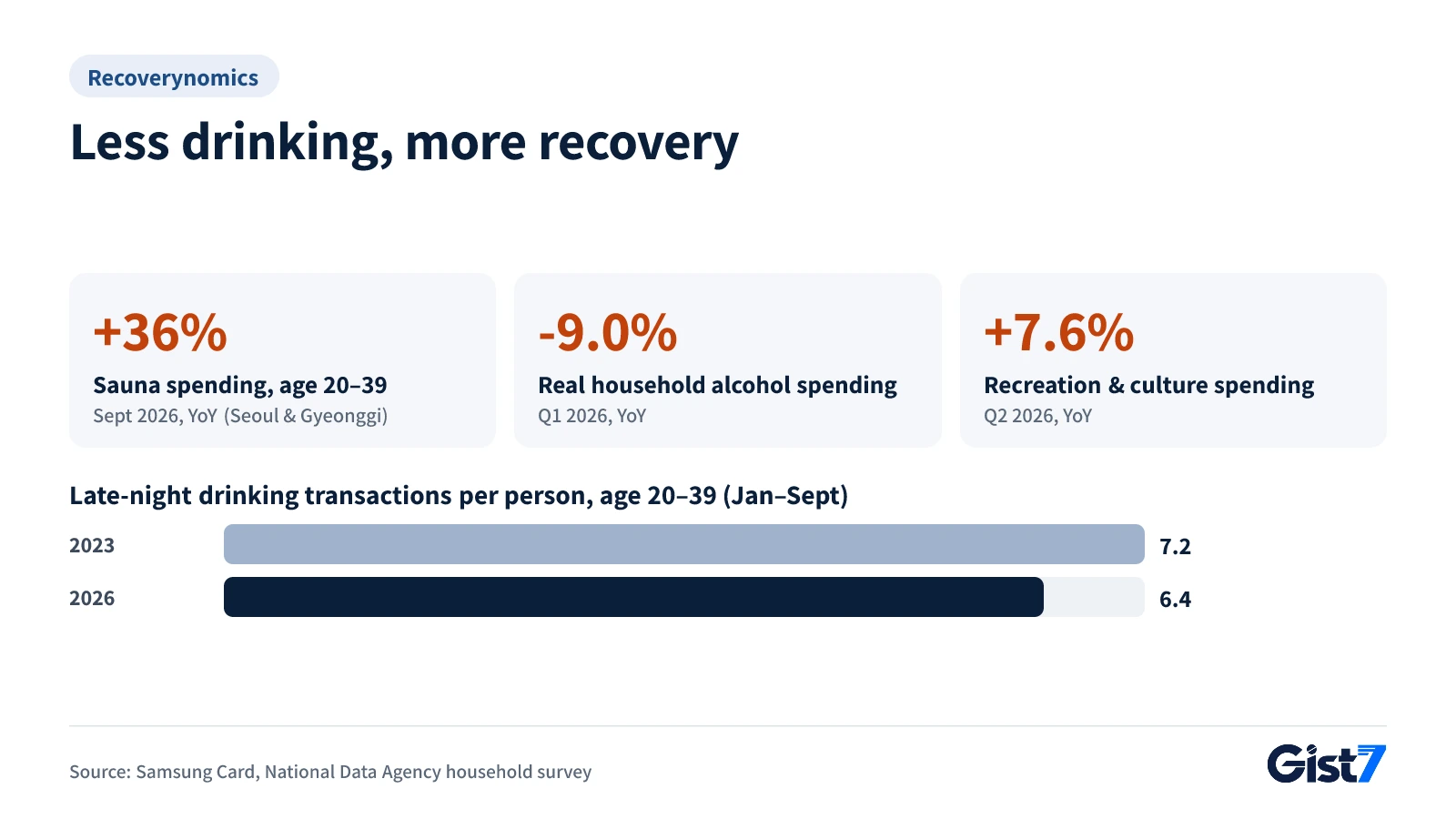
Recoverynomics is a shift in which Koreans in their 20s and 30s spend on saunas, exercise and healthy food instead of drinking. Samsung Card data shows their sauna spending rose 36% year on year in September 2026, while late-night drinking transactions fell from 7.2 to 6.4 per person since 2023.
- Sauna spending by 20–39s up 36% in September, third straight month in the 30% range (Samsung Card)
- Late-night drinking transactions per person: 7.2 (2023) → 6.4 (2026)
- Real household alcohol spending down 9.0% in Q1 2026, the 10th straight quarterly decline (National Data Agency data)
- Retail sales fell 0.4% year on year in September: the mix of spending is changing more than the total
- Gist 7 reads the 30-month slide in the youth (15–29) employment rate as a possible driver
Recoverynomics, Samsung Card's term for young Koreans who spend less on drinking and more on recovery, shows up clearly in the data. In September 2026, card spending on saunas by people in their 20s and 30s in Seoul and Gyeonggi Province rose 36% from a year earlier. According to an analysis of Samsung Card (KOSPI: 029780) data reported by Korea JoongAng Daily, the same age group's late-night drinking transactions (10 p.m. to 3 a.m.) fell from 7.2 per person in 2023 to 6.4 in 2026.
What is recoverynomics, and where is young Korean spending going?
Recoverynomics, a blend of "recovery" and "economics," describes a spending pattern in which younger consumers put money not only into diet and exercise but also into rest and mental and physical recovery. The figures come from Samsung Card's analysis of transactions by its customers (12.23 million as of the end of September) from January 2023 through September 2026, and they put numbers on how consumers in their 20s and 30s are changing habits.
Set side by side with customers aged 40 and older, the data shows where the generational gap actually opens up.
| Item (Samsung Card transactions) | Age 40+ | Age 20–39 |
|---|---|---|
| Sauna spending growth, Seoul & Gyeonggi (Sept 2026, YoY) | 32% | 36% |
| Enzyme-bath and mugwort-moxibustion visits (Sept vs. Jan 2025) | 1.1x | 2.6x |
| Share shopping at sports businesses (Jan–Sept 2026) | 14.3% | 19.7% |
| Purchases at Namdaemun Market household-goods shops (Sept vs. Jan 2025) | 3.2x | 14.8x |
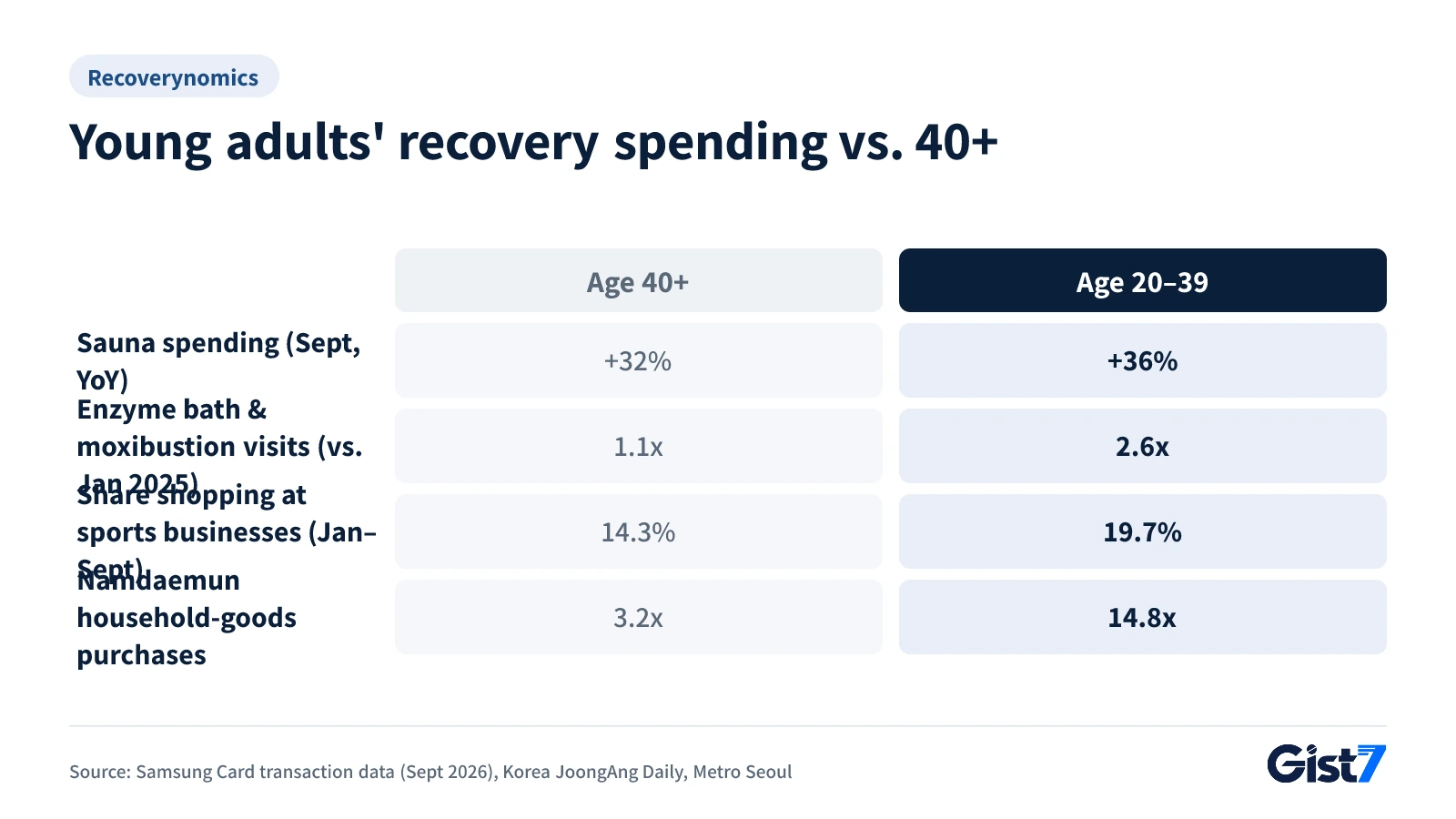
Saunas themselves are popular across age groups. Growth among 20- and 30-somethings ran at 33% in July, 34% in August and 36% in September, three straight months in the 30% range, but that is only 4 percentage points above the 40-plus group (32%). The real gaps show up in enzyme baths and moxibustion (2.6x versus 1.1x) and in the share of customers shopping at sports businesses (19.7% versus 14.3%). Purchases by younger shoppers at household-goods stores in Namdaemun Market, Seoul's largest traditional market, jumped 14.8-fold, pointing to a parallel shift toward practical, low-cost goods. Healthy food follows the same pattern. In September, people in their 20s and 30s were 22% more likely than those 40 and older to eat at salad and poke restaurants, and 87% more likely to use online stores selling chicken breast and other high-protein foods. The share shopping at specialty running stores rose 2.36-fold over three years.
Are young Koreans really drinking less? What official data says
One card company's data cannot speak for the whole country, so we checked it against the household income and expenditure survey from Statistics Korea's successor agency, the National Data Agency. According to a Kookmin Ilbo analysis of the agency's data, real monthly household spending on alcohol in the first quarter of 2026 was about 13,000 won (roughly $9), down 9.0% from a year earlier. That was the steepest drop since the survey was revised in 2019 and the tenth consecutive quarterly decline, a streak that began in the fourth quarter of 2023.
The second quarter told the same story. In the National Data Agency's survey for April–June 2026, household consumption spending rose 3.4% to 2.932 million won a month, while spending on alcohol and tobacco fell 2.2%. Spending on recreation and culture, by contrast, climbed 7.6%. The total isn't shrinking as much as the destination of the money is changing.
Why are people in their 20s and 30s choosing saunas over soju?
No single cause explains it, but three hypotheses stand out when the trend is read against the data.
The first is money. Korea's employment rate for young people aged 15 to 29 fell to 42.9% in October 2026, its 30th straight monthly decline. We covered that in detail in why Korea's youth employment rate keeps falling. Note that the measure excludes people in their 30s. When income feels uncertain, a predictable recovery expense is easier to justify than a night out that can cost a lot in one go.
The second is the search for small, reliable pleasures. Much like the lipstick effect, in which consumers trade big purchases for small indulgences during downturns, a sauna session or a healthy meal costs little and delivers dependable satisfaction.
The third is a change in drinking culture and in attitudes toward health. According to a February 2026 report by the Korea Economic Daily (Hankyung), "sauna runs," in which participants recruited on social media run 3 to 5 kilometers together and finish in a sauna, have spread among people in their 20s and 30s. This is an observed trend, though; no study has yet established cause and effect.
Overall consumer spending has not recovered
Recoverynomics is not a sign of a broad consumer rebound. In the National Data Agency's September industrial activity report, retail sales rose 3.6% from August but fell 0.4% from a year earlier, and they declined 1.0% for the third quarter as a whole versus the second. The overall wallet is flat or thinner; young consumers are reallocating within it, and falling alcohol consumption is part of that reshuffle. For the interest-rate backdrop, see the Bank of Korea's November rate-hike outlook.
Market impact map
| Asset / indicator | Direction | Strength | Link (why) |
|---|---|---|---|
| Liquor makers: HiteJinro (KOSPI: 000080), Lotte Chilsung Beverage (KOSPI: 005300) and others | ↓ | Medium | Real household alcohol spending down for 10 straight quarters, plus fewer nights out among young adults |
| Late-night restaurants and bars (small businesses) | ↓ | Medium | Fewer per-person transactions by 20- and 30-somethings between 10 p.m. and 3 a.m. hit sales directly |
| Sports and running gear | ↑ | Medium | Share of 20–39s shopping at sports businesses is more than 5 points above the 40+ group |
| Healthy and high-protein foods, convenience stores: BGF Retail (KOSPI: 282330) and others | ↑ | Medium | Demand for low-sugar and high-protein products is spreading to convenience stores and online shops |
| Saunas, bathhouses and wellness services | ↑ | Low | Spending has grown in the 30% range for three months, but few such businesses are listed |
Little direct impact: 2-year Treasury, 10-year Treasury, dollar index, won/dollar exchange rate (the price of one U.S. dollar in South Korean won), gold, oil (WTI), bitcoin, S&P 500, Nasdaq, KOSPI (Korea's benchmark stock index)
- Fewer office dinners could slow the sales recovery of late-night small businesses such as bars and karaoke rooms.
- Neighborhood saunas and bathhouses, and shops near parks where running crews gather, may pick up new customers.
- Grocery shopping is changing too, with convenience stores giving more shelf space to low-sugar and high-protein products.
Market reactions can vary with other factors, and this table is not a basis for investment decisions.
What to watch next
| Date (Korea time) | Indicator / event | Previous | Why it matters here | If it comes in like this |
|---|---|---|---|---|
| Late November (expected) | Q3 2026 household income and expenditure survey (National Data Agency) | Q2: alcohol & tobacco -2.2%, recreation & culture +7.6% (National Data Agency) | Shows whether the shift from drinking to recovery spending appears in official data | Continued declines in alcohol and gains in recreation would point to a structural change |
| Nov. 26 (Thu) | Bank of Korea monetary policy decision | 3.00% (Bank of Korea) | Higher rates squeeze young people's disposable income | A hike could push consumers further from big outlays toward small recovery-type spending |
| Nov. 30 (Mon) | October industrial activity (National Data Agency) | Sept retail sales +3.6% MoM, -0.4% YoY (National Data Agency) | Tests whether total consumption is growing | Another fall in retail sales would support the view that totals are flat and only the mix is shifting |
| Dec. 16 (Wed) | November employment report (National Data Agency) | Youth employment rate 42.9% (October) | The financial footing of young consumers | Better youth employment could bring back some drinking and dining-out demand |
Dates follow the National Data Agency's release calendar and the Bank of Korea's policy meeting schedule and may change. Korea time is 14 hours ahead of U.S. Eastern Time. We could not find a confirmed release date for the Q3 household survey, so it is listed as late November.
Passing fad or lasting change?
Gist 7 sees this as closer to a structural shift than a fad, for two reasons: real alcohol spending has fallen for 10 straight quarters, and the cumulative January–September gap in sports spending participation exceeds 5 percentage points. There are counterarguments. The card data covers one company's customers, and sauna growth among young adults is not far ahead of older customers. The test is whether year-on-year sauna growth stays in the 30% range through the winter months of December and January, and whether drinking comes back once youth employment recovers.
Frequently asked questions
What does recoverynomics mean?
Recoverynomics combines "recovery" and "economics" and describes spending on rest, exercise and healthy food to restore body and mind. Samsung Card used the term in 2026 when analyzing card transactions by Koreans in their 20s and 30s.
Are young Koreans really drinking less?
Both card data and official statistics point to a decline. Samsung Card says late-night drinking transactions per person among 20- and 30-somethings fell from 7.2 in 2023 to 6.4 in 2026, and real household alcohol spending fell 9.0% in Q1 2026, the 10th straight quarterly drop, according to National Data Agency figures.
Why are young Koreans going to saunas?
Saunas offer a predictable cost and reliable satisfaction, and "sauna runs" organized on social media have spread. The youth (15–29) employment rate, which has fallen for 30 straight months, may also play a role, but that is Gist 7's interpretation and no causal link has been proven.
Does recoverynomics mean Korean consumption is recovering?
Not really. Retail sales fell 0.4% year on year in September 2026 and declined for the third quarter overall. Total spending is flat while younger consumers change where they spend.
How can we tell whether the trend will last?
Watch whether the Q3 household survey, expected in late November, shows continued declines in alcohol spending and gains in recreation, and whether year-on-year sauna growth stays in the 30% range through winter. Whether drinking returns as youth employment recovers is another key test.
References
- Off the sauce, in the sauna: Young Koreans shift spending toward well-being, health — Korea JoongAng Daily
- Card data reveals young Koreans' surprising new trend (in Korean) — Metro Seoul
- Household Income and Expenditure Survey, Q2 2026 (in Korean) — National Data Agency via KDI
- Industrial Activity, September 2026 (in Korean) — National Data Agency via KDI
- Alcohol and tobacco spending hits 11-year low (in Korean) — Kookmin Ilbo
- Sauna runs popular with people in their 20s and 30s (in Korean) — Korea Economic Daily