Oil Price Drop Enters Week 3: Mideast Attacks and OPEC+ Nov. 29
Key summary
The oil price drop reached a third week: January Brent settled at $92.57 on Nov. 20, 2026, down $20.86 (18.4%) from Oct. 30. Returning Gulf exports and rising U.S. stockpiles drove it. After weekend Mideast attacks, the next test is the Nov. 29 OPEC+ meeting on 2027 quotas.
- January Brent fell for three straight weeks, from $113.43 on Oct. 30 to $92.57 on Nov. 20 (Newsquawk settlements).
- According to the EIA, Brent spot averaged $124 in October and slipped below $100 on Nov. 4.
- OPEC output rose 1.38 million barrels a day in October, and U.S. crude stocks grew 3.4 million barrels in the week to Nov. 13.
- OPEC+ ministers meet Nov. 29 to set 2027 output policy based on a review of members' production capacity.
- Korean pump prices follow world crude with a lag of two to three weeks; petroleum products were up 14.9% in Korea's October CPI.
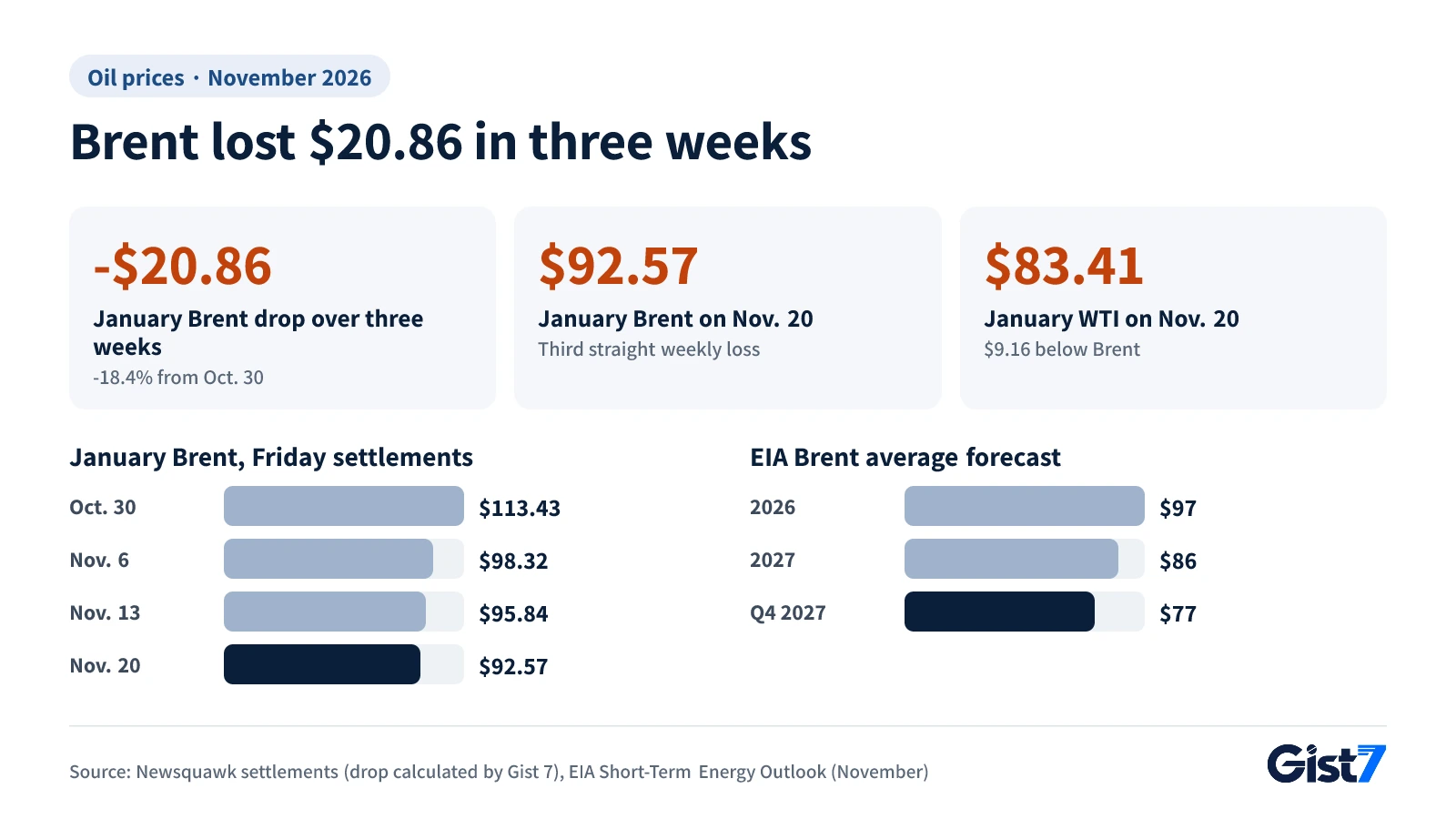
January Brent crude settled at $92.57 a barrel on Nov. 20, 2026, extending the oil price drop to a third straight week. The Brent crude price is now $20.86, or 18.4%, below the Oct. 30 settlement of $113.43. West Texas Intermediate (WTI), the U.S. benchmark, fell too, with the WTI price for January settling at $83.41, according to Newsquawk settlement data. For last week alone, Brent lost 3.4% and U.S. crude 5.2% (CNBC).
The market's worry has flipped. Gulf crude that had been bottled up by the U.S.-Israeli war with Iran, which began in late February (the Iran war), is moving by sea again, and U.S. inventories are building. Traders now see a supply glut as the bigger risk than a shortage. The next turning point is the Nov. 29 (Sunday) meeting of OPEC+, the alliance of the Organization of the Petroleum Exporting Countries and non-member producers such as Russia. It will be the first meeting since the group reviewed members' production capacity, the basis for 2027 quotas.
Tensions rose again over the weekend. The Saudi-led coalition said it intercepted a ballistic missile that Yemen's Houthis fired on Saturday, Nov. 21, toward western Saudi Arabia, home to refining and export facilities, and Bahrain said an Iranian attack set an industrial facility on fire. The UK Maritime Trade Operations (UKMTO) reported that two tankers near Oman were hit by unidentified projectiles the same day. Iranian Foreign Minister Abbas Araghchi said the Islamabad memorandum of understanding was no longer valid but left the door open to a broader deal with Washington (CNBC, as of the morning of Nov. 22 ET). Because oil futures were closed for the weekend, this news may show up in prices in the first session of the week.
Oil price drop over three weeks: how far has Brent fallen?
January Brent lost $20.86 (18.4%) over three weeks, and about three-quarters of that, $15.11, came in the first week. That was the week hopes grew for progress in Qatar-mediated talks to end the U.S.-Iran war (The Nation, Nov. 2). According to the EIA, the Brent spot price fell below $100 on Nov. 4. The next two weeks brought further declines of about 2.5% and 3.4%.
| Week (Friday settlement) | January Brent | Weekly change | What happened that week |
|---|---|---|---|
| Oct. 30 | $113.43 | - | Starting point of the slide; that day crude closed higher on fears of renewed U.S. strikes on Iran |
| Nov. 6 | $98.32 | -$15.11 (-13.3%) | Hopes for Qatar-mediated U.S.-Iran talks |
| Nov. 13 | $95.84 | -$2.48 (-2.5%) | Peace-talk hopes drained more of the war risk premium |
| Nov. 20 | $92.57 | -$3.27 (-3.4%) | Surprise U.S. inventory build, sharp drop in tanker rates |
Source: Friday settlements from Newsquawk; weekly changes and percentages calculated by Gist 7.
On Nov. 20 alone, Brent gained 59 cents. The Houthis threatened Saudi Red Sea ports, and Newsquawk cited a CBS report that the U.S. and Israel were weighing new strikes on Iran. Still, that was not enough to reverse the weekly loss. The Nov. 20 settlement matched the Nov. 9 close of $92.57. Reuters reported that after settling on Nov. 9, Brent slid intraday to its lowest level since late August. Prices remain high compared with before the war: Brent was about $73 before the conflict began in late February (CNBC).
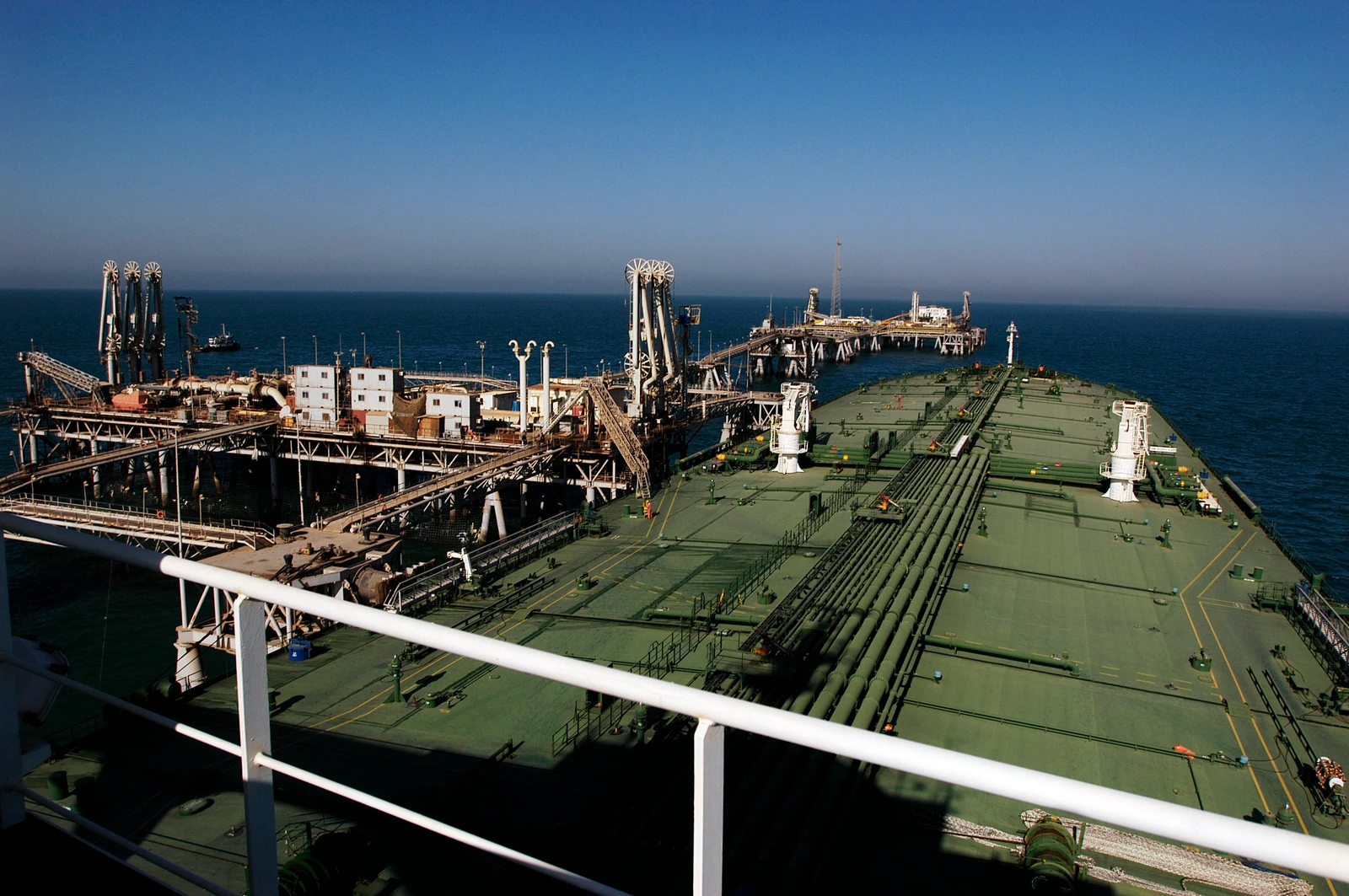
Why oil prices fell: supply is back and stockpiles are building
Oil fell because Gulf crude that the Iran war had blocked is reaching the market again, while rising U.S. crude and gasoline inventories sent a signal of weaker demand. Supply and demand pointed in the same direction.
Supply: Gulf barrels return, OPEC+ increases stayed on paper
The first force is recovering supply. OPEC produced 22.87 million barrels a day in October, up 1.38 million from a month earlier, according to a Reuters survey of OPEC output. Reuters also reported that JPMorgan Chase (NYSE: JPM) estimated the global crude surplus at about 1.4 million barrels a day in October.
The cost of risk at sea has come down as well. By Newsquawk's count, supertanker rates from the Gulf of Oman to China on Nov. 18 were about 64% below their Oct. 8 record. Lower freight rates mean many shippers see less danger in sending vessels out. The strait is not fully back to normal. Iran has proposed reopening the Strait of Hormuz only after the U.S. ends hostilities and lifts oil sanctions and its naval blockade (Newsquawk, Nov. 18). The EIA's November Short-Term Energy Outlook (STEO) also assumes Iranian exports stay constrained through the forecast period.
OPEC+ has been raising quotas, but actual output has not kept up. Seven core members, including Saudi Arabia and Russia, pumped about 25 million barrels a day in August, roughly 5 million below February, before the war (CNBC, Oct. 4). Gulf exports ran at 60% to 80% of normal in recent months, and most of this year's agreed increases stayed on paper. About 2 million barrels a day of cuts covering most members also remain in place.
Demand: U.S. inventories and the EIA outlook point to a surplus
On the demand side, U.S. inventories sent the first signal. According to the EIA's Weekly Petroleum Status Report released Nov. 18, U.S. commercial crude stocks rose 3.4 million barrels to 417.8 million in the week to Nov. 13. Gasoline stocks climbed 5.2 million barrels to 215.9 million (Reuters). Gasoline demand over the past four weeks was lower than a year earlier. The direction of travel, with stocks starting to rise, mattered more to prices than the level itself.
The EIA's November oil price outlook starts from the view that inventories will rebuild quickly next year. High prices cut world oil consumption by 2 million barrels a day this year, and stocks are projected to build by 3.5 million barrels a day in the first half of 2027.
| EIA November outlook | 2026 | 2027 |
|---|---|---|
| Brent average (per barrel) | $97 | $86 ($77 in Q4) |
| World oil consumption (per day) | 102.4 million barrels | 104.4 million barrels |
| World oil production (per day) | 101.7 million barrels | 108.4 million barrels |
Source: EIA Short-Term Energy Outlook (released Nov. 10, data through Nov. 5).
That outlook put Brent at around $100 on average in November and December, yet prices were in the low $90s within 10 days of its release. A stock market sell-off also made a rebound harder. In the same week, a report on a probe into Nvidia helped push the Nasdaq down more than 5% on Nov. 20 alone and about 10% for the week, as money left risk assets across the board. Gist 7's view is that the idea "a weaker economy means less fuel use" was added on top of oil prices. Within commodities, gold's slide to its lowest level in more than a year was driven by rising real interest rates, a different cause from this supply-led drop in oil.
Can the Nov. 29 OPEC+ meeting stop the slide?
Gist 7's reading is that one meeting is unlikely to halt the decline on its own. Most members already produce below their quotas, so even if the numbers change, actual supply will depend more on how fast Gulf output recovers. The core issue at this meeting is 2027 production policy. OPEC said that Saudi Arabia, Russia, Iraq, Kuwait, Kazakhstan, Algeria and Oman agreed at a Nov. 1 video conference to keep December required production at September levels and set the next meeting for Nov. 29. OPEC reviewed each member's maximum sustainable production capacity on Nov. 16, and those figures will underpin 2027 quotas (Reuters). Reuters reported that the review was originally due by the end of September but was delayed after the war disrupted expansion projects across the Middle East.
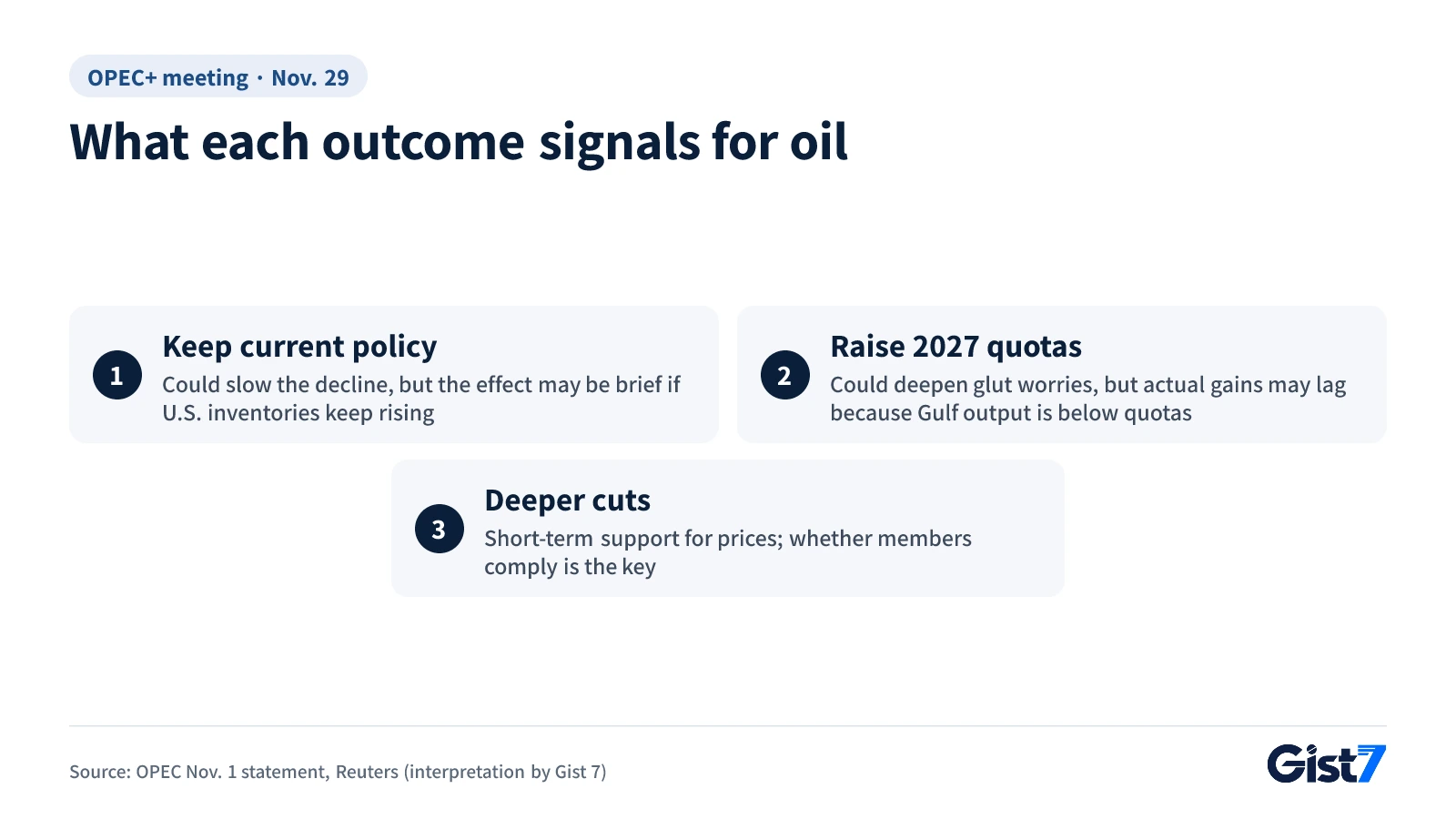
The outcome can be sorted into roughly three paths. How markets react will also depend on Gulf exports and U.S. inventories.
| Nov. 29 outcome | Signal for oil prices | What to watch alongside |
|---|---|---|
| Keep current policy | Could slow the decline, but the effect may be short-lived if inventories keep rising | EIA weekly crude inventories |
| Raise 2027 quotas | May be read as a sign of more supply ahead and deepen glut worries; but because Gulf output is still below current quotas, actual supply gains may come later | Whether Gulf producers' actual output catches up with quotas |
| Deeper cuts | A short-term support for prices; compliance is the key | Member-by-member compliance |
Gist 7's reading: a decision to raise quotas is likely to hit prices first as a signal about future supply rather than through actual barrels. On the other hand, if talks over the Strait of Hormuz collapse, upside risk will grow again regardless of the meeting. The weekend's missile interception and tanker strikes show that risk has not gone away.
When do Korean gasoline prices follow world oil lower?
It usually takes two to three weeks for a drop in world crude prices to reach Korean gas stations (Yonhap). In the second week of November (Nov. 8-12), the national average gasoline price was 1,855.1 won per liter, down 0.4 won from the previous week, according to Opinet, the state-run price tracker. That was the 26th straight weekly decline, but with weekly moves under 1 won, prices were essentially flat. In the same week, Dubai crude, the main benchmark for Korea's imports, fell $10.50 to $89.00 a barrel. The gap with Brent's weekly drop of about 2.5% comes from different measuring periods: the Dubai figure is a weekly average (Nov. 8-12), while Brent compares Friday settlements. Whether that decline reaches the pump between late November and early December is the first thing to check. On Nov. 13 the government set its 12th oil price cap at 1,784 won per liter for gasoline, effective for four weeks from Nov. 14. The cap applies to the price refiners charge gas stations, not to retail pump prices (Money Today, reporting when the system began in March), so it is a different measure from the 1,855.1-won average retail price.
Inflation is linked too. Korea's consumer prices rose 2.8% from a year earlier in October, and petroleum products jumped 14.9%, adding 0.56 percentage point to headline inflation (Ministry of Data and Statistics data via SBS Biz). If oil stays around current levels, the contribution from petroleum products could shrink and pull inflation lower.
Market impact map
The starting point is the oil price drop driven by recovering Gulf supply and rising U.S. inventories.
| Asset / indicator | Direction | Strength | Link (why) |
|---|---|---|---|
| Oil (WTI) | ↓ (short-term ↑ if weekend Mideast attacks are priced in) | Strong | Rising U.S. crude and gasoline stocks feed directly into the U.S. benchmark (January contract at $83.41 on Nov. 20) |
| Brent crude | ↓ (short-term ↑ if weekend attacks are priced in or OPEC+ deepens cuts) | Strong | The Nov. 29 OPEC+ outcome and the pace of Gulf export recovery set the direction |
| Dubai crude | ↓ | Strong | Benchmark for Korea's crude imports; feeds into local fuel prices with a two- to three-week lag |
| Korean refiners | ↓ | Medium | Tends to raise valuation losses on crude bought at higher prices |
| Airlines | ↑ | Medium | Tends to ease fuel costs |
| Tanker operators | ↓ (short-term ↑ if attacks add a risk premium) | Medium | Supertanker rates about 64% below the October peak tend to cut freight income |
Little direct impact: 2-year Treasury, 10-year Treasury, dollar index, won-dollar rate, gold, bitcoin, S&P 500, Nasdaq, KOSPI (this week, U.S. inflation data and the Bank of Korea's rate decision matter more; lower oil can weigh slightly on the 10-year yield and the won-dollar rate through inflation expectations and smaller crude import bills)
- Fuel prices: Once lower crude feeds through, gasoline and diesel prices in Korea may have room to fall from late November, though the price cap and fuel taxes also play a part.
- Inflation: Slower increases in petroleum product prices may be felt first in transportation costs rather than grocery bills.
- Travel: Airline fuel surcharges reflect jet fuel prices with a lag, so they may have room to come down.
Market reactions can vary with other factors, and this table is not a basis for investment decisions.
What to watch next
U.S. markets close on Thursday, Nov. 26, for Thanksgiving and have a shortened session on Nov. 27, so trading will be thin. The OPEC+ meeting falls on the weekend in between. The full week's calendar is in our preview of PCE inflation and the Bank of Korea meeting.
| Date (ET) | Indicator / event | Previous | Why it matters here | If it comes in... |
|---|---|---|---|---|
| Nov. 25 (Wed) 10:30 a.m. | EIA weekly crude inventories (week to Nov. 20) | 417.8 million barrels, +3.4 million (EIA) | Shows whether weak U.S. demand persists | If builds continue, the glut view hardens and oil tends to fall; a draw would support a rebound |
| Nov. 25 (Wed) evening (Nov. 26 morning, Korea time) | Bank of Korea rate decision | 3.00% (Bank of Korea) | Whether lower oil trims the BOK's inflation outlook | A lower oil assumption in the revised outlook tends to soften next year's inflation forecast and talk of further hikes |
| Nov. 29 (Sun) | OPEC+ meeting (2027 output policy) | December required output kept at September level (OPEC, Nov. 1) | The supply-side factor that could end the three-week slide | Keep current policy: slower decline; raise 2027 quotas: oil tends to fall; deeper cuts: short-term rise |
| When fourth-week November data is released | Opinet weekly average gasoline price | 1,855.1 won per liter (second week of November, Opinet) | Whether the drop in crude reaches pumps after a two- to three-week lag | A weekly drop well above 1 won would signal the pass-through has started |
| Early December (scheduled by Ministry of Data and Statistics) | Korea November consumer prices | October 2.8%, petroleum products 14.9% (Ministry of Data and Statistics) | Whether lower oil feeds into Korean inflation | Slower petroleum product inflation tends to cool headline inflation |
Frequently asked questions
Why have oil prices fallen for three weeks in a row?
Supply came back and demand signals weakened. A Reuters survey showed OPEC output up 1.38 million barrels a day in October, and tanker rates from the Gulf of Oman to China fell about 64% from their October peak. U.S. crude stocks rose 3.4 million barrels in the week to Nov. 13 (EIA).
What will OPEC+ decide at its Nov. 29 meeting?
It will set 2027 production policy. Seven members including Saudi Arabia and Russia kept December output at September levels on Nov. 1 and scheduled the next meeting for Nov. 29 (OPEC). A review of each member's maximum sustainable capacity, examined on Nov. 16, will underpin 2027 quotas (Reuters).
What is the difference between Brent and WTI?
Brent is North Sea crude and the benchmark for European and Asian oil prices; WTI is crude produced in Texas and other U.S. regions and the U.S. benchmark. On Nov. 20, January Brent settled at $92.57 and January WTI at $83.41, a gap of about $9.16 (Newsquawk settlements, Gist 7 calculation). WTI tends to react more to U.S. inventories, Brent to Middle East and OPEC+ supply. Korea's import prices are tracked against Dubai crude.
When do Korean gasoline prices fall after world oil drops?
Usually two to three weeks later. In the second week of November, Dubai crude fell $10.50, but the national average gasoline price slipped only 0.4 won to 1,855.1 won per liter (Opinet, Yonhap). The government's oil price cap applies to refiners' supply prices, not pump prices, and fuel taxes also play a role.
Could oil climb back above $100?
It remains possible. If talks over the Strait of Hormuz break down or OPEC+ cuts output further, supply worries could return. Using data through Nov. 5, the EIA forecast Brent to average $97 in 2026 and $77 in the fourth quarter of 2027. The direction of prices cannot be predicted with certainty, and forecasts differ by institution.
References
- Short-Term Energy Outlook: Global Oil Markets, November 2026 (U.S. Energy Information Administration)
- Weekly Petroleum Status Report, November 18, 2026 (U.S. Energy Information Administration)
- US crude stocks, gasoline and distillate inventories rise, EIA says (Reuters, BOE Report, 18 Nov 2026)
- Saudi Arabia, Russia, Iraq, Kuwait, Kazakhstan, Algeria, and Oman reaffirm commitment to market stability, 1 November 2026 (OPEC)
- Saudi Arabia, Bahrain report Iran-linked attacks; Tehran open to talks, 22 Nov 2026 (CNBC)
- OPEC+ agrees to keep November oil output targets steady (CNBC)
- OPEC officials meet to discuss oil production capacity review (Reuters, BOE Report)
- OPEC delays oil capacity review after Iran war disrupts expansion plans, sources say (Reuters, ZAWYA)
- CRUDE WRAP: Brent (F7) settles at USD 113.43/bbl, 30 Oct 2026 (Newsquawk)
- CRUDE WRAP: Brent (F7) settles at USD 98.32/bbl, 6 Nov 2026 (Newsquawk)
- CRUDE WRAP: Brent (F7) settles at USD 95.84/bbl, 13 Nov 2026 (Newsquawk)
- CRUDE WRAP, 18 Nov 2026: supertanker freight rates and Iran's conditions for reopening Hormuz (Newsquawk)
- CRUDE WRAP: WTI (F7) settles at USD 83.41/bbl; Brent (F7) at USD 92.57/bbl, 20 Nov 2026 (Newsquawk)
- Oil falls over US$7 as Trump signals restraint on Iran (Reuters, New Straits Times)
- Oil falls over 7% on November 2 amid Iran peace hopes (The Nation)
- 주유소 기름값 26주째 내렸지만…두 달간 사실상 제자리 (연합뉴스, 코리안센터 게재)
- 13일부터 휘발유 공급가 1724원 상한…주유소 판매가에는 미적용 (머니투데이)
- 10월 소비자물가 2.8% 올라…석유류 14.9% 급등 (SBS Biz)
- 한국은행 기준금리 추이 (한국은행)