Korea Winter Heating Bill: ₩128,000 a Month and the LNG Risk

Key summary
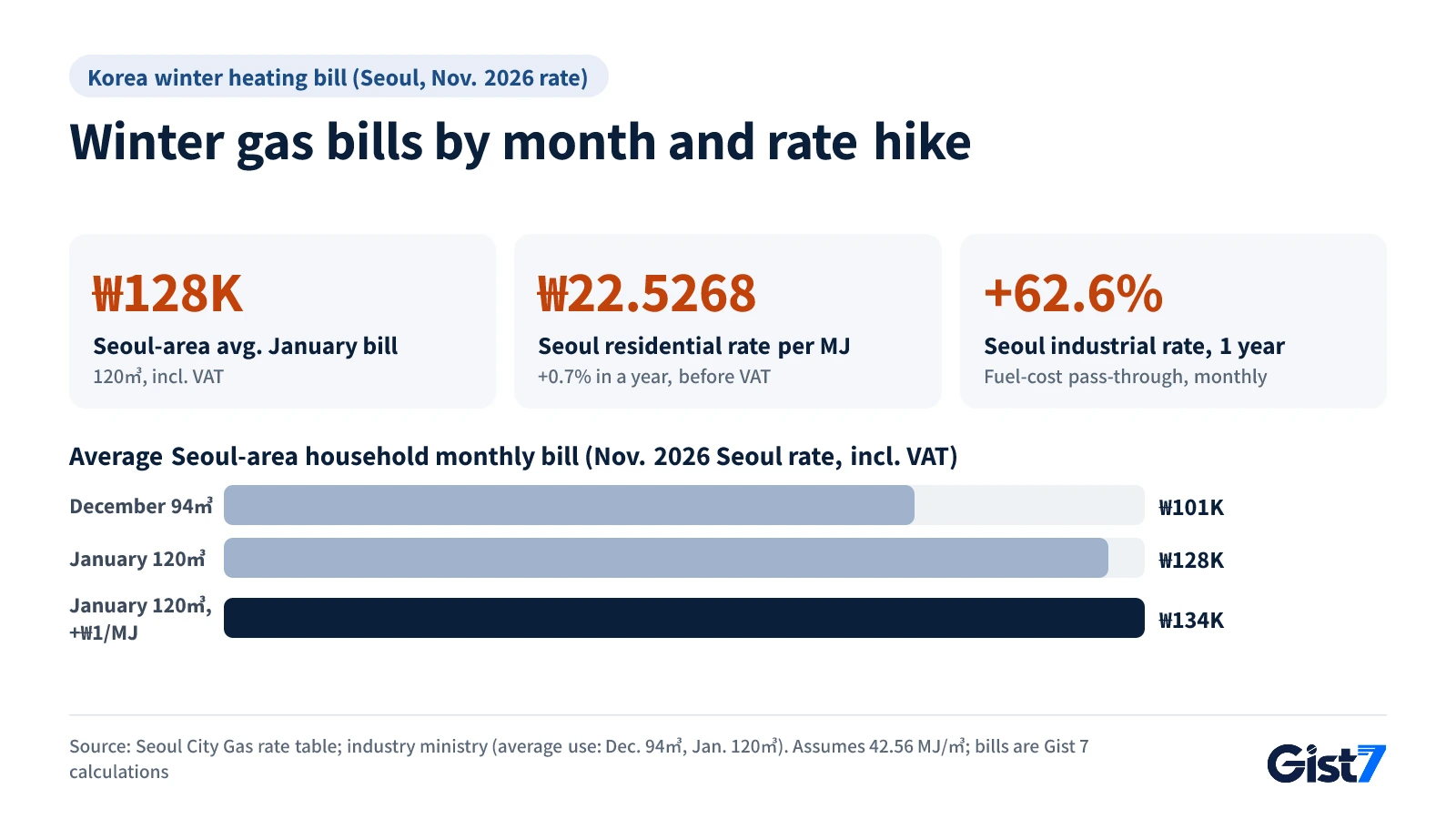
A Korea winter heating bill for a gas-heated Seoul-area home is about ₩128,000 in January (120㎥ at about ₩22.5/MJ, Nov. 2026; Gist 7 calculation). Asian spot LNG (JKM) nearly tripled in a year, from about $11 to around $30, but the household rate rose 0.7%. The gap piles up as KOGAS receivables.
- Seoul's residential city gas rate is about ₩22.5 per MJ before VAT, plus a ₩1,250 monthly basic charge (effective Nov. 1, 2026, Seoul City Gas)
- Using 120㎥ in January (the Seoul-area average) costs about ₩127,900; a 40㎥ studio costs about ₩43,600, both including VAT (Gist 7 calculation)
- Rates jumped 38.4% in a year during Korea's 2023 'heating bill shock,' and the November 2026 rate is 58.4% above January 2022
- Over the same year Seoul's industrial gas rate rose 62.6% while the residential rate rose 0.7%; the deferred increases build up as KOGAS receivables
- Electric heaters cost 2.6 to 3.8 times as much as city gas for the same heat (winter tiers 2 and 3 of Korea's progressive power tariff)
A Korea winter heating bill for a home heated by city gas in the Seoul metropolitan area runs about ₩120,000 to ₩130,000 for January. Korea's industry ministry put average use for a Seoul-area household at 120㎥ (estimate for January 2025). Plug that into Seoul's November 2026 residential rate (₩22.5268 per megajoule, before VAT) and the bill comes to about ₩127,900 including VAT, or roughly $96 at ₩1,337.9 per dollar (Gist 7 calculation). A studio apartment using around 40㎥ pays in the ₩40,000 range. Asian spot LNG prices have nearly tripled in a year, but the government has put off adjusting household rates, so Seoul's residential rate is up just 0.7%.
Korea winter heating bill: how much per month?
The math is simple. According to the rate table of Seoul City Gas (KOSPI: 017390), the residential rate has been ₩22.5268 per MJ (before VAT) since Nov. 1, 2026, with a basic charge of ₩1,250 a month.
- Monthly bill = (basic charge ₩1,250 + energy used in MJ × ₩22.5268) × 1.1 (10% VAT)
- Energy used (MJ) = meter reading in ㎥ × correction factor × average calorific value (MJ/㎥)
A megajoule (MJ) is a unit of heat. Korean gas bills convert the volume you burn into heat content and charge for that. The calorific value is measured at the supply point and shifts slightly from month to month. The table below assumes 42.56 MJ per ㎥ and a correction factor of 1.
| January use (assumed) | Heat content | Monthly bill incl. VAT | Typical home |
|---|---|---|---|
| 40㎥ | about 1,702 MJ | about ₩43,600 | Studio, single occupant out during the day |
| 80㎥ | about 3,405 MJ | about ₩85,700 | Small apartment or villa |
| 120㎥ | about 5,107 MJ | about ₩127,900 | Seoul-area household average (January 2025 estimate, industry ministry) |
| 160㎥ | about 6,810 MJ | about ₩170,100 | Larger home, heated all day |
Source: Seoul City Gas rate table (effective Nov. 1, 2026); Ministry of Trade, Industry and Energy explanatory note (Feb. 27, 2025). Heat content is assumed; bills are Gist 7 calculations.
The estimate lines up with real bills. The ministry said the average January 2025 city gas heating bill was ₩126,000, an estimate by Korea Gas Corporation (KOGAS · KOSPI: 036460), and ₩140,000 for an 85㎡ apartment on district heating. Running the same method with that month's rate gives ₩126,600. December use is lower: the Seoul-area average in December 2024 was 94㎥, which works out to about ₩100,500 at the November 2026 rate.
Rates outside Seoul differ a little. KOGAS sells gas at one wholesale price nationwide, but the retail rate consumers pay is approved by each city or provincial governor, so it varies by region.
Company snapshot
| Item | Korea Gas Corporation |
|---|---|
| Official name | Korea Gas Corporation (KOGAS) |
| Listing | KOSPI 036460 (listed Dec. 15, 1999) |
| Headquarters | Dong-gu, Daegu |
| Founded | Aug. 18, 1983 |
| Industry | Natural gas import and sales |
| Core business | Imports LNG and supplies power plants and city gas companies through a national pipeline network and tank trucks |
| Market cap | about ₩3.29 trillion (closing price ₩35,600 on Nov. 27, 2026 × 92.313 million shares, Gist 7 calculation) |
Source: KOGAS 2025 annual report (DART, filed March 23, 2026); listing and founding dates from the Korea Exchange KIND company overview. Closing price is the Korea Exchange regular-session close on Nov. 27, 2026 (Korea Investment & Securities daily data).
How much have gas rates risen since Korea's 2023 "heating bill shock"?
Seoul's residential city gas rate went from ₩14.2243 per MJ in January 2022 to ₩19.6910 in January 2023, a 38.4% jump in one year. The increase landed all at once on midwinter bills, when use peaks, and Korean media dubbed January 2023 the "heating bill bomb." Rates rose several more times after that, including in May 2023 and August 2024, and the November 2026 rate is 58.4% higher than in January 2022.
| Month (rate in effect) | Seoul residential (₩/MJ, before VAT) | Change from a year earlier | Monthly bill at 120㎥ |
|---|---|---|---|
| January 2022 | 14.2243 | - | about ₩81,000 |
| January 2023 | 19.6910 | +38.4% | about ₩111,700 |
| January 2024 | 20.7354 | +5.3% | about ₩117,900 |
| January 2025 | 22.2954 | +7.5% | about ₩126,600 |
| November 2026 | 22.5268 | +0.7% (vs. November 2025) | about ₩127,900 |
Source: Seoul City Gas rate table. Monthly bills include the basic charge (₩1,000 through June 2023, ₩1,250 from July) and VAT at 42.56 MJ/㎥; Gist 7 calculation.
The only change to Seoul's residential rate in 2026 came on Aug. 1 (₩0.1651 per MJ, 0.7%), so the 2026-27 winter starts at essentially the same rate as the 2025-26 winter.
How Korean gas rates are set: fuel cost is 85%
Most of a Korean gas bill pays for imported LNG (liquefied natural gas). Korea brings in nearly all of its gas by ship as liquid chilled to minus 162°C. According to KOGAS, of the ₩20.8495 per MJ residential wholesale rate as of Dec. 1, 2026, the fuel cost is ₩17.7120 (85.0%) and KOGAS's supply cost is ₩3.1375 (15.0%). City gas distributors add their own supply cost on top, which brings Seoul's retail rate to ₩22.5268.
KOGAS explains that its fuel cost is linked to international oil prices and the exchange rate, so "changes in oil prices and exchange rates are the key to the rate level." On Nov. 27, it signed natural gas sales contracts with 10 city gas companies in the Seoul and Chungcheong regions, including Seoul City Gas and Samchully (KOSPI: 004690), to supply 170 million tonnes over 15 years through 2041.

LNG prices soared, so why are household gas rates flat?
Because the government is holding back household rate adjustments. In a Nov. 10 explanatory note, the industry ministry said industrial rates are adjusted monthly under a fuel-cost pass-through system, while rates for households and small businesses are on hold "in consideration of people's livelihoods and inflation conditions." Costs that are not recovered pile up as receivables at KOGAS and are recouped later through household rates. These receivables are, in effect, the amount KOGAS booked as money to collect later because it sold gas below cost.
JKM (Japan Korea Marker, in dollars per million BTU), the spot price benchmark for LNG delivered to Korea and Japan, was around $30 for December delivery on Nov. 13, 2026 (Global LNG Hub weekly report). A year earlier, on Nov. 14, 2025, it was about $11 (just under $11, per Global LNG Hub's Nov. 10-14, 2025 report), so the price has nearly tripled. Tension in the Middle East persisted after the Iran war that began in late February, and low gas storage in Europe set up a contest with Asia for winter cargoes, which kept prices high. According to the industry ministry's trade data, Korea's energy imports in October were $16.49 billion, up 63.1% from a year earlier.
The 70% in the video reflects prices at the time of the report; JKM, as shown above, has nearly tripled over a year.
The gap shows up in the rate tables. As of Dec. 1, the fuel cost component is ₩25.6990 per MJ for industrial users and ₩17.7120 for households, so the residential fuel cost sits 31% below the industrial one, which tracks actual LNG costs.
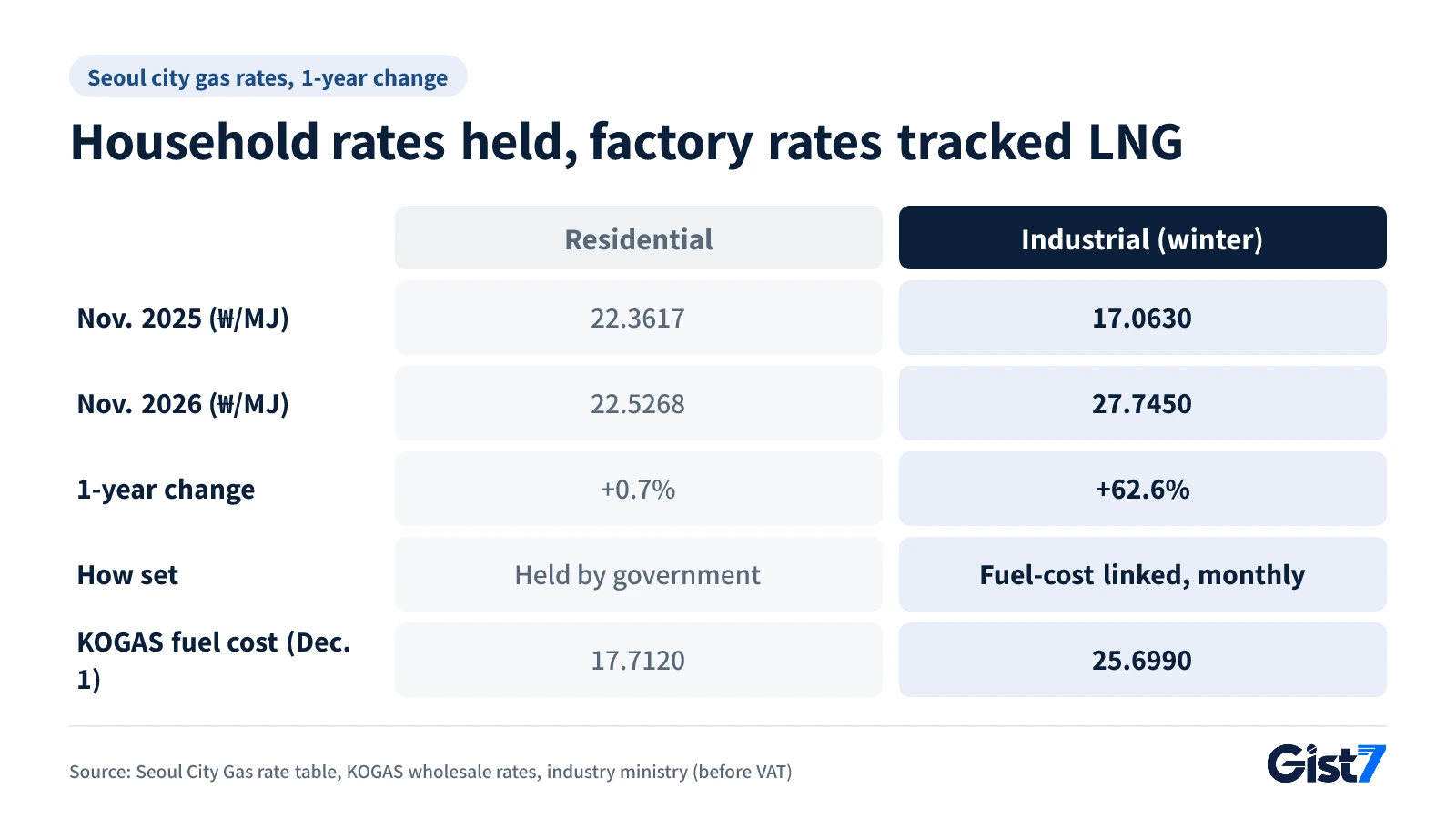
The chart draws on the Seoul City Gas rate table, KOGAS wholesale rates and the industry ministry's Nov. 10, 2026 note. A year ago industrial gas was cheaper than residential gas; in November 2026 it is 23% more expensive. According to the Ministry of Data and Statistics (formerly Statistics Korea), consumer prices rose 2.8% in October from a year earlier, but electricity, gas and water rose just 0.4%.
Will gas bills rise in the 2026-27 winter? Receivables, oil and the won
KOGAS left its Dec. 1 residential wholesale rate unchanged, so December use will also be billed at the November 2026 rate. After that, it depends on the government.
At a Nov. 18 press briefing, KOGAS CEO Hong Eui-rak called a rate hike "the most important thing" and said receivables could reach ₩14 trillion to ₩15 trillion by the end of 2026 and, if oil prices hold their current trend, ₩17 trillion in 2027 (ZDNet Korea). He also estimated that raising household rates by ₩1 per MJ would bring in about ₩500 billion a year. A ₩1 increase would add about ₩5,600 to the January bill of a home using 120㎥ (including VAT, Gist 7 calculation). On Nov. 10 the government said only that it "will review reasonable gas rate adjustment plans, comprehensively considering the rate burden on the public and businesses and KOGAS's financial condition."
Some factors ease the pressure. The won-dollar rate fell 13.7%, from ₩1,549.4 on June 30 to ₩1,337.9 on Nov. 27 (Seoul FX market daytime close, as reported by Money Today and Seoul Economic Daily); a lower number means a stronger won. We explain what moves the rate in how the won-dollar exchange rate is determined. Brent crude also fell about 18% on a January-contract settlement basis, from $113.43 a barrel on Oct. 30 to the $92 range on Nov. 20. Because KOGAS's fuel cost is linked to oil prices and the exchange rate, a drop in oil feeds into fuel costs with a lag. Our three-week oil price slide and the OPEC+ meeting covers the oil side.
Household gas rates move less with global prices than with when the government decides to fold the receivables into bills. A one-shot hike like 2023's would make midwinter bills a shock again, while lower oil prices and a stronger won as of November 2026 leave room for a smaller increase (Gist 7 analysis).
Electric heaters and maintenance fee bills: what foreign tenants should check
For the same amount of heat, city gas is cheaper than electricity. Residential low-voltage power rates from Korea Electric Power Corp. (KEPCO · KOSPI: 015760) have not changed since May 16, 2023, and in winter (December to February) they use a progressive structure in which the unit price climbs as you use more. Since 1 kWh equals 3.6 MJ, 1 kWh worth of heat from Seoul city gas costs about ₩81. Dollar figures use ₩1,337.9 per dollar (Nov. 27).
| Winter heating energy (Seoul, unit price only) | Per 1 kWh of heat | In dollars | vs. city gas |
|---|---|---|---|
| Residential city gas | about ₩81 | about 6.1 cents | 1x |
| Electricity, up to 200 kWh | ₩120.0 | about 9.0 cents | 1.5x |
| Electricity, 201-400 kWh | ₩214.6 | about 16.0 cents | 2.6x |
| Electricity, over 400 kWh | ₩307.3 | about 23.0 cents | 3.8x |
| Electricity, over 1,000 kWh (Dec.-Feb.) | ₩736.2 | about 55.0 cents | 9.1x |
Source: Seoul City Gas rate table; KEPCO residential power rate table (low voltage). Unit prices only, excluding basic charges, VAT and climate and environment charges, and not adjusted for boiler efficiency; Gist 7 calculation.
Running an electric heater or electric blanket for long hours can easily push you into the second or third tier. On a city gas bill, start with four terms (Seoul City Gas guide to reading your bill):
- 당월 사용량 (monthly usage, ㎥): this month's meter reading minus last month's
- 보정계수 (correction factor): adjusts the volume for temperature and pressure
- 사용열량 (energy used, MJ): usage × average calorific value; this is what you are charged for
- 기본요금 (basic charge): ₩1,250 a month for Seoul households
Bills also depend on how the home is heated.
- Individual heating: each unit has its own gas boiler, and the gas bill comes separately or appears in the maintenance fee as a gas charge. The formula above applies directly.
- District or central heating: the complex buys heat and splits it on the maintenance fee bill into a heating fee (난방비) and a hot water fee (급탕비).
- Studios and officetels: check your lease to see whether gas and electricity are included in the maintenance fee.
You can pay by bank or card auto-debit, by transfer to the dedicated deposit account printed on the bill, or with the barcode at a convenience store. When moving, call the local customer center before moving out and before moving in to settle the bill and book disconnection or hookup of the gas range; at the new home, gas is supplied only after you sign a supply contract (Seoul City Gas move-in and move-out service, checked Nov. 29, 2026). We work through rents and maintenance fees in Seoul rent prices for foreign tenants.
Low-income households can get an energy voucher (1.44 million households in 2026, budget ₩504.2 billion, Ministry of Climate, Energy and Environment). It covers basic livelihood recipient households that include an older person, an infant or a person with a disability, among others. The press release does not address eligibility for foreign households, so ask at your local community service center. Vulnerable groups such as basic livelihood recipients will not have their gas cut off for unpaid bills from October 2026 through May 2027.
Market impact map
| Asset / indicator | Direction | Strength | Link (why) |
|---|---|---|---|
| KOGAS receivables | ↑ | Strong | Residential fuel cost is 31% below industrial, so they grow as winter sales rise |
| Industrial and commercial gas rates | ↑ | Strong | Adjusted monthly under fuel-cost pass-through; Seoul industrial rate +62.6% in a year |
| Asian spot LNG (JKM) | ↑ | Medium | Northeast Asian winter demand and Middle East risk; nearly tripled in a year, from about $11 to around $30 |
| Oil (Brent) | ↓ eases rate pressure | Medium | January contract settled $113.43 on Oct. 30 → $92 range on Nov. 20 (about -18%); fuel cost is linked to oil, so it falls with a lag |
| Won-dollar rate | ↓ eases rate pressure | Medium | Fuel cost is linked to the exchange rate; the Nov. 27 rate was 13.7% below June 30 |
Little direct impact: 2-year Treasury, 10-year Treasury, dollar index, gold, bitcoin, S&P 500, Nasdaq, KOSPI
- Cost of living: the average Seoul-area January city gas bill is about ₩128,000, and a 40㎥ studio pays in the ₩40,000 range. A ₩1 per MJ rise in household rates adds about ₩5,600 to an average January bill (Gist 7 calculation).
- Inflation: electricity, gas and water prices rose 0.4% year over year in October. A household rate hike would move this figure first.
Market reactions can vary with other factors, and this table is not a basis for investment decisions.
What to watch next
| Date (Korea time) | Indicator / event | Previous | Why it matters here | If it comes in... |
|---|---|---|---|---|
| Nov. 29 (Sun.) | OPEC+ ministerial meeting | December required production kept at September level (Nov. 1, OPEC) | Direction of oil prices, to which KOGAS fuel costs are linked | A signal of higher output tends to lower oil and, with a lag, fuel costs |
| Dec. 1 (Tue.) | November trade data (industry ministry) | October energy imports $16.49 billion, +63.1% y/y | How much pricier LNG shows up in import bills | Continued growth in energy imports would signal fuel costs are still heavy |
| Dec. 2 (Wed.) | November consumer prices (Ministry of Data and Statistics) | October 2.8%; electricity, gas and water 0.4% | How frozen utility rates are holding down inflation | Hot inflation could push back the timing of a rate hike |
| Jan. 1, 2027 (Fri.) | KOGAS January wholesale rate notice (whether household rates change) | Residential wholesale ₩20.8495/MJ, industrial fuel cost ₩25.6990 (Dec. 1) | First number to show whether household rates move | A residential increase would hit January bills; no change means receivables keep growing |
Frequently asked questions
How much is a winter heating bill in Korea per month?
A gas-heated home in the Seoul area pays about ₩128,000 in January on average. That is a Gist 7 calculation using the industry ministry's Seoul-area average of 120㎥ and Seoul's November 2026 residential rate (₩22.5268 per MJ) plus the basic charge and VAT. An 85㎡ apartment on district heating paid ₩140,000 in January 2025.
How much is the gas bill for a studio in Korea in winter?
Using 40㎥ in January costs about ₩43,600 including VAT, and 80㎥ costs about ₩85,700 (Seoul rates, Gist 7 calculation). How long the heating runs and how well the home is insulated matter more than its size.
How is a Korean city gas bill calculated?
Multiply the meter reading (㎥) by the correction factor and the average calorific value (MJ/㎥, shown on the bill) to get energy used in MJ, then multiply by the per-MJ rate. Add the ₩1,250 monthly basic charge and 10% VAT to get the amount due (Seoul residential rate).
Will Korean gas rates rise in the 2026-27 winter?
December use will also be billed at the November 2026 rate, because KOGAS left its Dec. 1 residential wholesale rate unchanged. After that it is up to the government. The KOGAS CEO says a hike is needed, while the government has said only that it will review adjustment plans. A ₩1 per MJ increase would add about ₩5,600 to an average January bill.
Is an electric heater or a gas boiler cheaper in Korea?
For the same heat, city gas is cheaper. 1 kWh worth of heat from Seoul city gas costs about ₩81, while winter residential electricity costs ₩214.6 per kWh in the 201-400 kWh tier and ₩307.3 above 400 kWh, or 2.6 to 3.8 times as much. Power rates are progressive, so the unit price rises as you use more.
What is the difference between district heating and individual heating?
With individual heating, each home runs its own gas boiler and pays city gas by usage. With district heating, hot water from a plant is piped to the complex and billed on the maintenance fee as heating and hot water fees. District heating for an 85㎡ apartment cost ₩140,000 in January 2025 (industry ministry).
References
- 가스요금표 (서울, 2026년 11월 1일 시행) — 서울도시가스
- 도시가스용 천연가스 도매요금 (2026년 12월 1일 기준) — 한국가스공사
- (설명자료) 산업용 가스요금은 LNG 도입원가를 반영하여 조정되며, 정부가 기업에 가격 상승 부담을 전가하는 것은 아님 (2026.11.10) — 산업통상부
- (설명자료) 정부는 취약계층 보호와 에너지 절약을 통한 난방비 부담 완화에 최선의 노력을 기울이고 있음 (2025.2.27) — 산업통상자원부
- 2026년 10월 수출입 동향 (2026.11.1) — 산업통상부
- 주택용 전기요금표 (저압·고압) — 한국전력
- 올겨울, 먼저 찾아가는 에너지바우처로 따뜻한 겨울나기를 지원합니다 (2026.11.10) — 기후에너지환경부, 대한민국 정책브리핑
- 2026년 10월 소비자물가동향 (2026.11.3) — 국가데이터처
- 홍의락 가스공사 사장 "가스는 전기…미수금 내년 17조, 가스요금 올려야" (2026.11.18) — 지디넷코리아
- Natural gas prices weekly update – JKM, TTF and Henry Hub (16 November 2026) — Global LNG Hub