KOSPI 5,000 barely holds as battery rout erases a 2% rally
Key summary
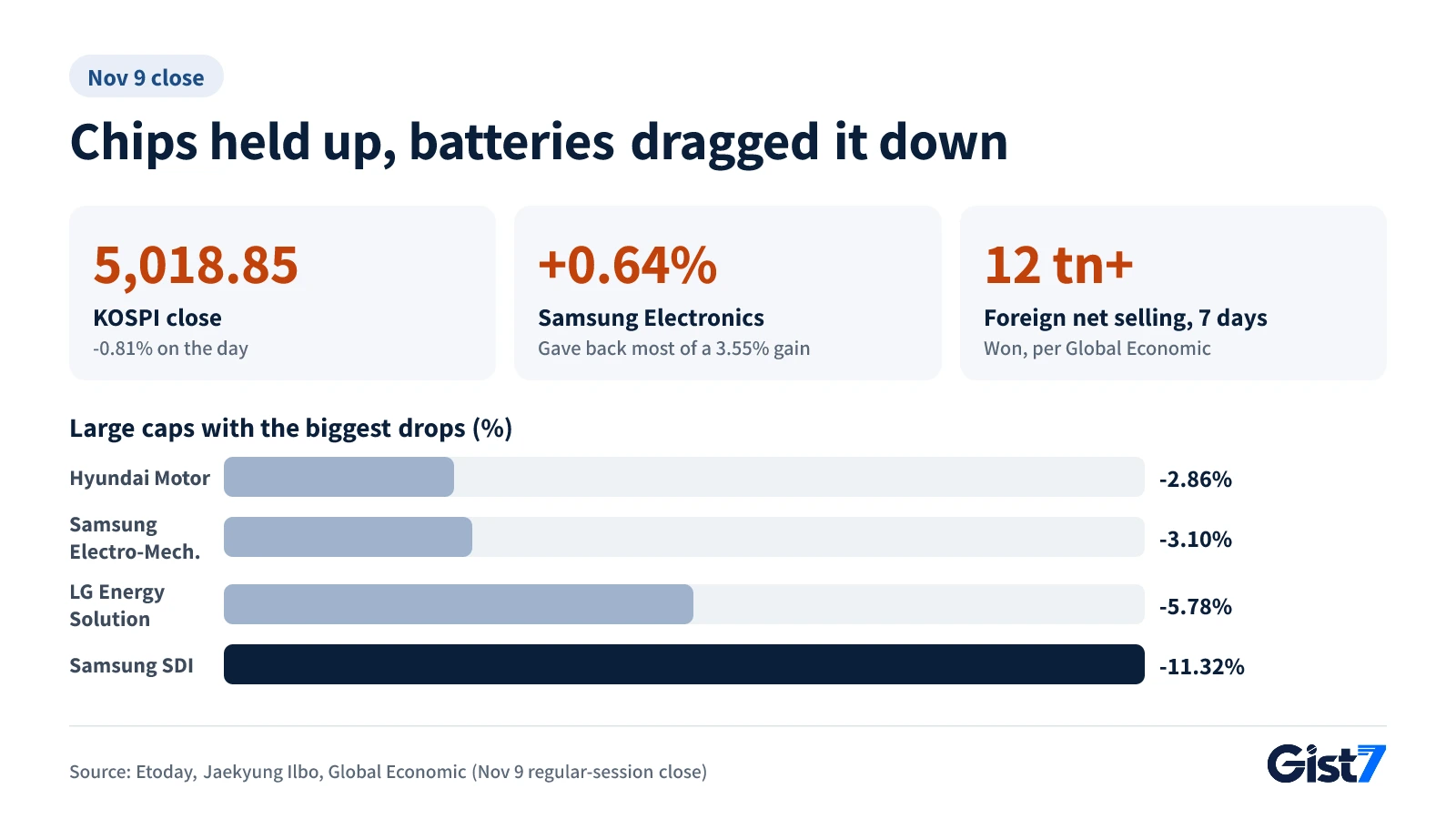
The KOSPI 5,000 line barely held on Nov 9, 2026: close 5,018.85 (-0.81%) after a 2.24% intraday gain. Batteries fell 5-11% on profit-taking and foreigners sold for a 7th day; institutional buying of about 720 billion won (~$530 million) cushioned the drop.
- The KOSPI rose as much as 2.24% to 5,172.94 on Nov 9, then closed at 5,018.85 (-0.81%), its lowest close since Feb 2
- Foreigners net sold about 658-693 billion won, a seventh straight day (over 12 trillion won in total); institutions net bought about 720 billion won
- Samsung Electronics (+0.64%) and SK hynix (+0.35%) gave back most intraday gains; battery heavyweights fell 5-11%
- The battery drop looks like profit-taking after a Nov 4 policy-driven surge; no negative company filings were found
- The won strengthened 9.5 won to 1,347.1 per dollar, moving against the foreign selling
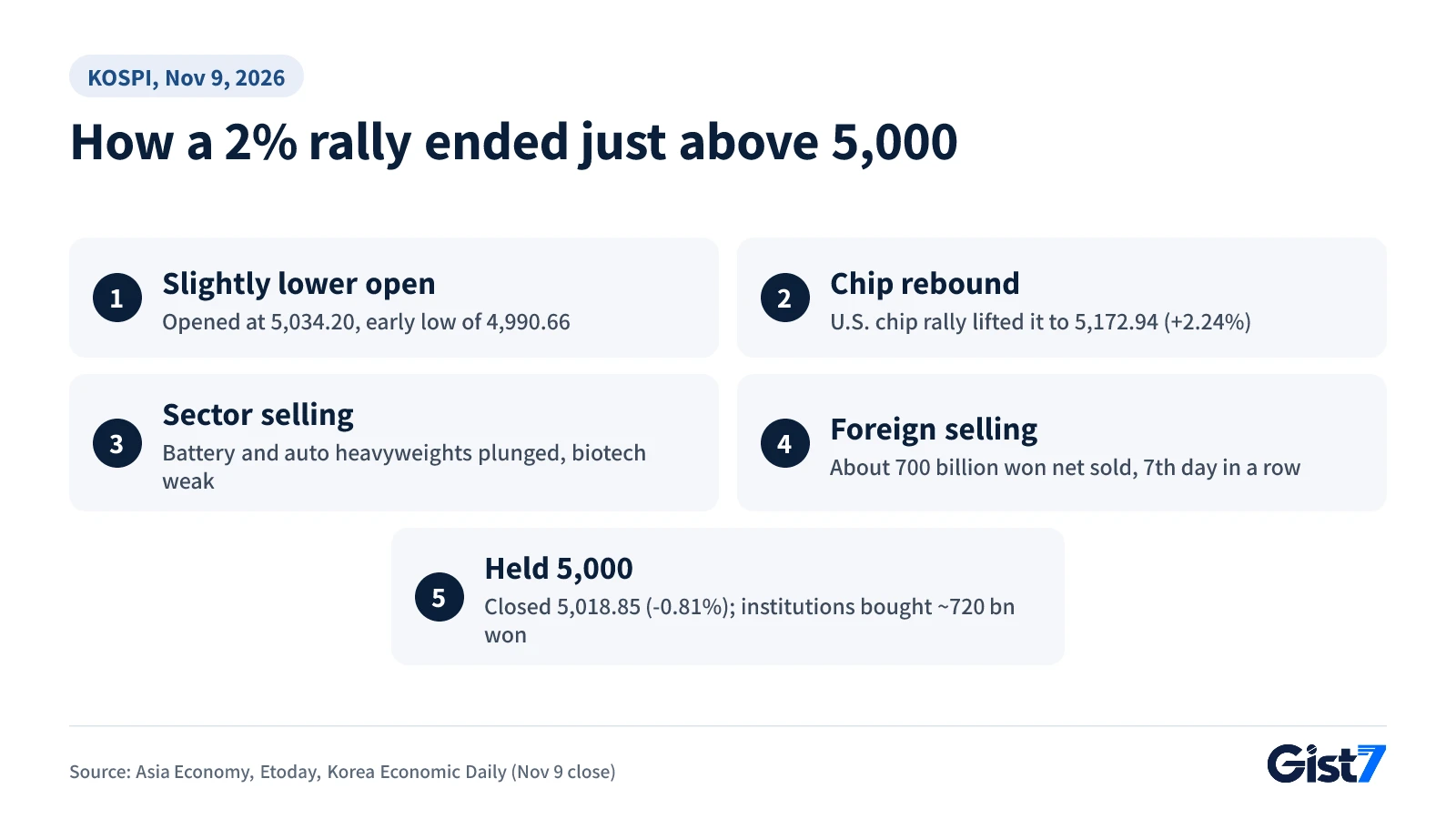
On November 9, 2026, South Korea's benchmark KOSPI climbed as much as 2.24% to 5,172.94 during the session, then reversed to close down 40.84 points (0.81%) at 5,018.85. The index held the KOSPI 5,000 line on a closing basis, but according to Etoday it was the lowest close since February 2 (4,949.67). News1 reported that the KOSPI first closed above 6,000 on February 25, so Monday's close sits roughly 980 points below that mark. Chipmakers edged higher while battery and auto heavyweights sold off, and foreign investors extended their net selling to a seventh straight session.
How did the KOSPI 5,000 line survive on November 9?
The KOSPI opened slightly lower, rallied more than 2% at one point on a chip rebound, and then gave back the entire gain to finish in the red. According to Asia Economy, the index opened at 5,034.20 and touched an intraday low of 4,990.66, briefly slipping below 5,000. Etoday counted 340 gainers and 530 decliners. The KOSDAQ, Korea's second board, also fell 0.82% to 638.97.
Institutions and foreigners traded in opposite directions. Net selling means an investor group sold more shares than it bought. Outlets compiled the figures at different times, so the numbers differ slightly; both sets are shown below.
| Investor (KOSPI market) | Korea Economic Daily / Newspim | Etoday / Global Economic |
|---|---|---|
| Foreigners | Net sold ~658 billion won | Net sold ~693 billion won |
| Institutions | Net bought ~719 billion won | Net bought ~720.4 billion won |
| Individuals | Net sold ~511 billion won | Net sold ~488.7 billion won |
Either way, foreigners sold roughly 700 billion won, or about $520 million at the day's rate of 1,347.1 won per dollar. Institutional buying of about 720 billion won almost fully offset that, so it is fair to say institutions did much of the work of keeping the index just above 5,000.
Chips rebounded, so why did the KOSPI fall?
The KOSPI fell because chipmakers gave back most of their early gains while battery, auto and biotech heavyweights dropped sharply. According to Etoday, the Philadelphia Semiconductor Index rose 4.20% in the previous U.S. session on November 6, and bargain hunters piled into Korean chip stocks at the open.
Samsung Electronics (KOSPI: 005930) rose as much as 3.55% before closing up 0.64% at 189,900 won. SK hynix (KOSPI: 000660) climbed as much as 5.39% and closed up 0.35% at 1,136,000 won. Etoday noted that the two stocks had fallen 13.44% and 18.91%, respectively, over November 5 and 6.
| Stock | Change at Nov 9 close | Reported background |
|---|---|---|
| Samsung SDI (KOSPI: 006400) | -11.32% (415,000 won) | Profit-taking after Nov 4 surge; no negative company filing |
| LG Energy Solution (KOSPI: 373220) | -5.78% | Same battery pullback |
| EcoPro BM (KOSDAQ: 247540) | -8.66% | Same battery pullback |
| Samsung Electro-Mechanics (KOSPI: 009150) | -3.10% | No company-specific cause reported |
| Hyundai Motor (KOSPI: 005380) | -2.86% | No company-specific cause reported |
| Alteogen (KOSDAQ: 196170) | -16.01% | U.S.-related earnings worries (Korea Economic Daily) |
Sources: closing reports from Etoday, Newspim and Jaekyung Ilbo (Korea Exchange regular-session close, November 9, 2026)
The battery selloff looks more like a reversal of a sharp run-up than a reaction to fresh bad news. According to Aju Business Daily, Samsung SDI jumped 11.57% and LG Energy Solution 5.03% on November 4 on hopes that the Democratic Party's midterm win in the U.S. would bring more support for clean energy. The same report said that on November 9 profit-taking met doubts about whether that policy would turn into actual earnings. Jaekyung Ilbo reported that Samsung SDI had made no disclosure and faced no negative news in the past week that would explain the drop. Sector flows, not company fundamentals, moved the stock.
Lee Kyung-min, an analyst at Daishin Securities (KOSPI: 003540), told Newspim the market was "differentiated by sector," with chips rebounding on bargain buying while other groups stayed weak. Asia Economy data showed the securities sector down 3.99%, one of the steepest declines.
Why have foreigners sold for seven straight sessions?
Foreign net selling began on October 30 and swelled on November 5 and 6 as worries spread about tighter AI data center regulation after the U.S. midterm elections. According to Global Economic, foreigners sold more than 12 trillion won (roughly $8.9 billion) of KOSPI shares over the seven sessions through November 9.
Investors read the election result as a sign that building data centers in the U.S. would become harder and more expensive, which fed concerns about chip demand. We covered that background in why the Nasdaq fell 5.5% after the Democrats' sweep. According to Yonhap, foreign net selling has continued since October 30; daily figures are in the table below.
| Date | KOSPI close | Foreign net selling (KOSPI market) | Source |
|---|---|---|---|
| Nov 5 | 5,383.80 (-5.28%) | Over 3 trillion won (3.8316 trillion per Financial News) | Yonhap, Financial News |
| Nov 6 | 5,059.69 (-6.02%) | Nearly 2.8 trillion won | Yonhap |
| Nov 9 | 5,018.85 (-0.81%) | About 658-693 billion won | Korea Economic Daily, Etoday |
Gist 7's take: what matters in this table is the intensity of the selling, not its direction. Foreigners are still selling, but the daily amount has shrunk to about a quarter of the November 6 level. Han Ji-young of Kiwoom Securities (KOSPI: 039490) told Global Economic that a repeat of last week's plunge is unlikely unless new macro or AI shocks emerge. Still, foreigners sold even on a day when chips rose, which suggests they are using rebounds to cut exposure rather than to buy back in. We looked separately at how much debt AI companies have taken on in the bond market ahead of CoreWeave's earnings.
Regulators also moved to calm the market. According to Yonhap, at a joint market meeting on November 6 authorities decided to waive brokers' obligation to maintain a 140% collateral ratio on margin loans for three months starting November 9, citing the need to ease volatility. Margin loans let investors buy stocks with money borrowed from a broker. The report did not mention forced liquidations, but a looser collateral rule can be expected to reduce pressure on brokers to sell pledged shares when prices plunge.
The won moved in the opposite direction from foreign equity flows. According to the Korea Economic Daily and Newspim, the won-dollar rate fell 9.5 won to 1,347.1 per dollar as of 3:30 p.m. Seoul time on November 9, meaning the won strengthened. Yonhap reported that the rate had jumped 14.5 won to 1,356.6 on November 6. We found no report directly explaining Monday's move. It may be a partial reversal of last week's spike, but one day is not enough to call a trend. How the currency spike factors into the Bank of Korea's November rate decision is covered in our Bank of Korea rate-hike outlook.
Market impact map
| Asset / indicator | Direction | Strength | Link (why) |
|---|---|---|---|
| KOSPI | ↓ | Medium | Seven days of foreign selling; institutional buying cushions the fall |
| USD/KRW | ↓ (stronger won) | Weak | Likely a partial reversal of last week's spike (1,347.1 on Nov 9, -9.5 won) |
| Battery stocks | ↓ | Strong | Profit-taking after a policy-driven surge |
| Semiconductor stocks | ↑↓ | Medium | Bargain buying after U.S. chip rebound; AI regulation worries cap gains |
| Brokerage stocks | ↓ | Medium | Higher market volatility (sector -3.99% on Nov 9, Asia Economy) |
| KOSDAQ | ↓ | Medium | Weakness in batteries and biotech (-0.82% on Nov 9) |
Little direct impact: 2-year Treasury, 10-year Treasury, dollar index, gold, oil (WTI), bitcoin, S&P 500, Nasdaq
- Currency exchange and overseas payments: the won firmed slightly on November 9, but renewed foreign selling could push the won-dollar rate higher again.
- Retirement accounts and funds: products heavy in KOSPI stocks may see wide gaps in returns across sectors.
- Exporters: if the won-dollar rate returns to where it was before last week's spike, exporters' dollar revenue will be worth fewer won.
Market reactions can vary with other factors, and this table is not a basis for investment decisions.
What to watch next
| Date (ET / KST) | Indicator / event | Previous | Why it matters here | If it comes in... |
|---|---|---|---|---|
| Nov 10, 8:30 a.m. ET (10:30 p.m. KST) | U.S. October Consumer Price Index (CPI) | September 3.7% y/y, core 2.6% (BLS) | U.S. rates and risk appetite | Hotter than expected tends to lift the dollar and add to foreign selling pressure |
| Nov 10, 5 p.m. ET (Nov 11, 7 a.m. KST) | CoreWeave (Nasdaq: CRWV) Q3 earnings call | n/a | Sentiment on AI data center spending | Cuts to spending plans weigh on chips; steady plans tend to ease worries |
| Around Nov 11 KST (date not confirmed) | Korea Customs Service exports for Nov 1-10 | Oct 1-10 exports $26.1 billion, +102.0% y/y; chips +170.9% (Korea Customs Service; growth rates can be inflated by holiday differences) | Whether demand for Korean chips is actually slowing | Continued strong chip exports tend to ease AI-demand worries |
| Nov 17, 5 p.m. ET (Nov 18, 7 a.m. KST) | Nvidia (Nasdaq: NVDA) fiscal 2027 Q3 earnings call | n/a | Demand outlook for Samsung Electronics and SK hynix | Strong data center revenue could ease foreign selling of Korean chips |
Dates come from official announcements by the U.S. Bureau of Labor Statistics, CoreWeave and Nvidia. Korea Customs usually publishes 10-day export data around the 11th of each month (October's came out on October 12), and the date may change.
Frequently asked questions
Why did the KOSPI rise and then fall on November 9?
The Philadelphia Semiconductor Index rose 4.20% in the prior U.S. session, so bargain hunters bought Korean chip stocks early and lifted the KOSPI as much as 2.24%. Chipmakers then gave back most of those gains, and battery, auto and biotech heavyweights dropped, leaving the index down 0.81% at 5,018.85.
Why do foreign investors keep selling Korean stocks?
Foreign net selling has run since October 30, and reports said worries about AI data center regulation after the U.S. midterms, which spread into concerns about chip demand, enlarged the selling on November 5 and 6. Foreigners sold more than 12 trillion won over seven sessions through November 9, but daily selling fell from nearly 2.8 trillion won on November 6 to about 700 billion won.
Why did Korean battery stocks plunge on November 9?
Aju Business Daily attributed the drop to profit-taking after battery stocks surged on November 4 on hopes of more U.S. clean-energy support following the Democrats' win. Samsung SDI fell 11.32%, and no company filing or negative news in the prior week explained the move.
Why do reported foreign selling figures differ between outlets?
The gap appears to come from outlets compiling data at different times, such as right after the close versus later final tallies. For November 9, the Korea Economic Daily and Newspim reported about 658 billion won of foreign net selling, while Etoday and Global Economic reported about 693 billion won.
Why did the won strengthen while foreigners sold stocks?
The won-dollar rate fell 9.5 won to 1,347.1 on November 9, but no report directly explained the move. A partial reversal of the 14.5-won jump on November 6 and smaller foreign selling may both have played a part, though one day is too short to call a trend.
References
- AI 데이터 센터 규제 우려 지속…코스피, 5000선 겨우 사수 — 한국경제
- 코스피, 2%대 상승분 모두 반납…5000선 턱걸이 마감 — 이투데이
- 코스피, 개인·외인 동반 '팔자'에 하락…5000선 턱걸이 — 글로벌이코노믹
- [마감시황] 코스피 5018선 후퇴…반도체 반등 속 2차전지·바이오 부진 — 뉴스핌
- 힘 잃고 주저앉은 코스피…0.81% 하락한 5018 마감 — 아시아경제
- [특징주] 급등 뒤 차익실현 매물…삼성SDI 6%대 급락 등 2차전지株 약세 — 아주경제
- [마감분석] 삼성SDI, 11%대 급락하며 41만5000원에 거래 마감 — 재경일보
- '블루웨이브 쇼크' 원/달러 환율 한 달 만에 1,360원대 터치 — 연합뉴스 한민족센터
- 코스피 5.28% 급락 5400선 붕괴·코스닥 5%대 하락 [fn오늘의 시황] — 파이낸셜뉴스(네이트 뉴스)
- 2026년 10월 1일 ~ 10월 10일 수출입 현황 [잠정치] — 관세청(KDI 경제정보센터)
- Consumer Price Index – September 2026 — U.S. Bureau of Labor Statistics
- CoreWeave Announces Date of Third Quarter 2026 Financial Results and Conference Call — CoreWeave
- NVIDIA Sets Conference Call for Third-Quarter Financial Results — NVIDIA
- 코스피, 사상 최초 6000선 마감 '개미군단의 힘' — 뉴스1