KOSPI Surges 6.3% as Foreign Buyers Return: Will It Last?
Key summary
South Korea's KOSPI surged 6.32% to 5,006.03 on November 24, 2026, as foreign investors turned net buyers for the first time in eight sessions after Jensen Huang returned to Nvidia. It recovered only about 69% of its two-day loss; foreign buying and rate events will decide whether it lasts.
- KOSPI 5,006.03 (+6.32%), KOSDAQ 665.88 (+4.79%); buy-side sidecars triggered early in both markets
- Foreigners bought a net 739.2 billion won and institutions 869.2 billion won; foreigners turned buyers after seven straight selling sessions
- Trigger: Nvidia reinstated CEO Jensen Huang on Nov. 23 (ET); Philadelphia Semiconductor Index +14.03%
- Foreigners bought Samsung Electronics but sold SK hynix; equipment maker HPSP rose 10.75% on a 100 billion won buyback
- Eleventh 6%-plus daily gain in the past year; after 4 of the previous 10, the index was lower 10 sessions later
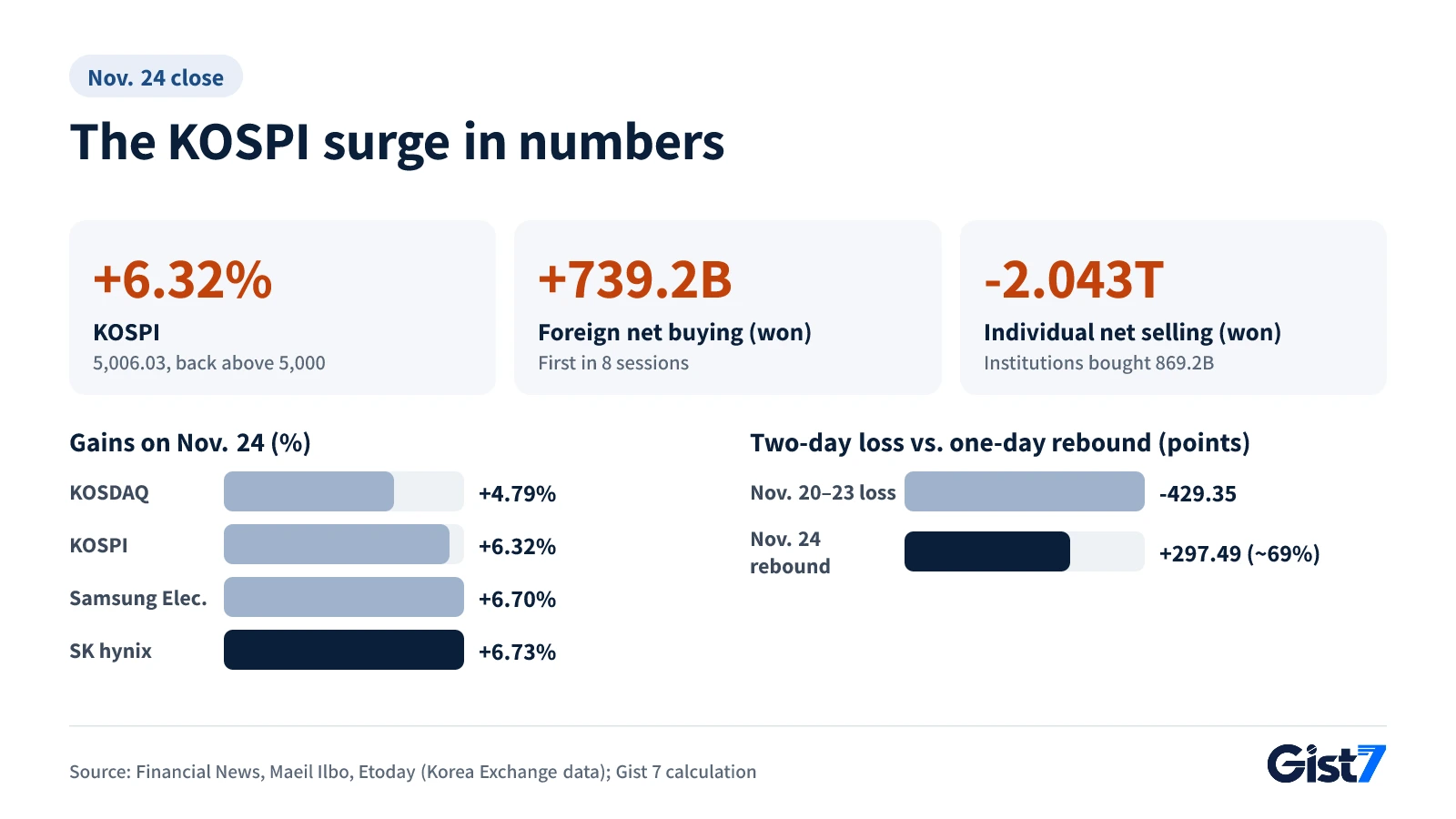
South Korea's KOSPI surged 297.49 points, or 6.32%, to close at 5,006.03 on Tuesday, November 24, 2026, back above the 5,000 mark for the first time in three sessions (Korea Exchange data via Financial News). What changed in this KOSPI surge was the direction of money. Foreign investors, who had been net sellers of KOSPI stocks for seven straight sessions since November 13, turned net buyers for the first time in eight trading days, and domestic institutions bought alongside them. The secondary KOSDAQ index rose 4.79% to 665.88, and 797 KOSPI stocks advanced while only 94 declined. Still, the index won back only about 69% of the 429.35 points it lost on November 20 and 23.
Why did the KOSPI surge? The worry Jensen Huang's return erased
The KOSPI jumped more than 6% in a day mainly because Nvidia (Nasdaq: NVDA) said on November 23 (U.S. Eastern time) that its board had reinstated Jensen Huang as CEO, easing fears that AI investment plans and supply contracts could stall. According to Newspim, the Philadelphia Semiconductor Index rose 14.03% that day and Micron Technology (Nasdaq: MU) gained 19.04%. We covered Nvidia's side of the story and the investigations still under way in our analysis of Huang's return and the Nasdaq rebound.
Han Ji-young, an analyst at Kiwoom Securities, told Newspim that Huang's return did more than remove a management risk: it eased "anxiety over the continuity of the AI ecosystem." Last week the KOSPI was dragged down by Nvidia's leadership vacuum and by the AMD export-control allegations. Once one of those two weights lifted, Korea's chip-heavy market reacted first.
The day looked different from the opening bell. The KOSPI opened 3.64% higher at 4,880.16, and a buy-side "sidecar" was triggered at 9:06 a.m. Seoul time (Financial News). A sidecar is a Korea Exchange circuit breaker that halts program-trading orders for five minutes when KOSPI 200 futures move 5% or more for over a minute. The KOSDAQ market got the same measure at 9:28 a.m. The KOSPI hit an intraday high of 5,065.74 (+7.59%) before giving back part of the gain. According to Maeil Ilbo, sidecars have now been triggered 101 times this year across the KOSPI and KOSDAQ combined, the most since 2002.
What happened after past 6% days? 11 surges in the past year
A one-day jump of more than 6% does not guarantee a lasting rebound. Gist 7 calculated from Yahoo Finance daily closes that the KOSPI has gained more than 6% in a single day 11 times over the past year, including this one. Of the previous 10, the index was higher 10 trading days later in six cases and lower in four.
| Surge day (2026) | Daily gain | Close on surge day | Change 10 trading days later vs. surge-day close |
|---|---|---|---|
| Feb. 3 | +6.84% | 5,288.08 | +9.8% |
| Mar. 5 | +9.63% | 5,583.90 | +3.2% |
| Apr. 1 | +8.44% | 5,478.70 | +11.2% |
| Apr. 8 | +6.87% | 5,872.34 | +9.3% |
| May 6 | +6.45% | 7,384.56 | -2.4% |
| May 21 | +8.42% | 7,815.59 | -4.2% |
| Jun. 9 | +8.18% | 8,096.93 | +1.3% |
| Jul. 15 | +6.24% | 7,284.41 | -23.2% |
| Jul. 31 | +17.91% | 6,595.45 | +5.8% |
| Oct. 28 | +6.63% | 6,012.44 | -10.6% |
| Nov. 24 | +6.32% | 5,006.03 | Not yet known |
According to Segye Ilbo, the 17.91% gain on July 31 is the largest one-day rise in KOSPI history. Split the table and a pattern appears. All four surges from February to April were followed by a higher index 10 trading days later, but two of the three in May and June were followed by a lower one. Of the three surges after the June 22 closing peak (9,114.55), July 15 and October 28 were followed by a lower index, and only July 31 by a higher one. The most recent, October 28, lifted the index to 6,012.44, but it slid to 5,018.85 by November 9. The KOSPI now sits about 45% below its June peak. The table is a record of the past, not a forecast.
Lee Kyung-min, an analyst at Daishin Securities, told Maeil Ilbo that the rebound was strong enough to trigger sidecars, but it was too early to call a trend reversal and investors should watch whether foreign buying continues. Gist 7's view is that three things need to line up for this rally to last beyond a single day.
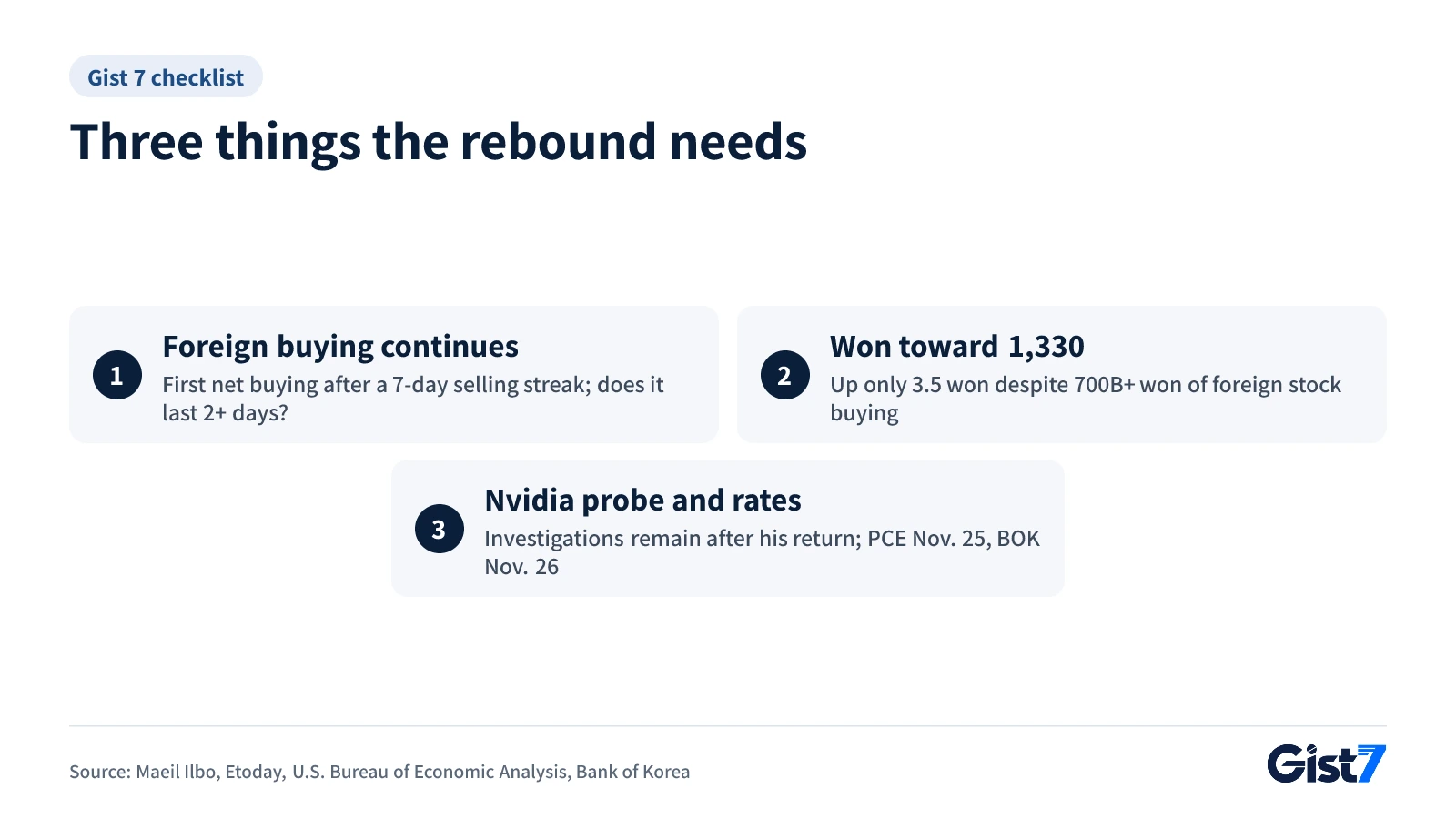
First, foreign net buying needs to continue for a second and third day. Second, the won needs to strengthen toward the 1,330 per dollar range; it gained only 3.5 won even though foreigners bought more than 700 billion won of stocks. Third, there is the Nvidia investigation that remains open after Huang's return, along with the rate outlook that U.S. personal consumption expenditures (PCE) inflation on November 25 (8:30 a.m. ET) and the Bank of Korea's Monetary Policy Board on November 26 will shape. This week's schedule is in our calendar of PCE inflation and the Bank of Korea decision.
Foreigners bought Samsung but sold SK hynix: who drove the rebound?
Foreign investors and domestic institutions drove the rebound, and foreign buying was concentrated in Samsung Electronics. For the market as a whole, foreigners were net buyers of 739.2 billion won and institutions of 869.2 billion won, while individual investors were net sellers of 2.043 trillion won (Maeil Ilbo and Etoday; another tally put foreign buying at 725.6 billion won). In KB Securities' 3:30 p.m. tally, foreigners bought a net 421.3 billion won of Samsung Electronics (KOSPI: 005930) but sold a net 144.0 billion won of SK hynix (KOSPI: 000660) (Financial News). Samsung closed up 6.70% at 189,400 won and SK hynix up 6.73% at 1,158,000 won.
Company snapshot
| Item | Samsung Electronics | SK hynix |
|---|---|---|
| Legal name | Samsung Electronics Co., Ltd. | SK hynix Inc. |
| Ticker and exchange | 005930 · KOSPI (preferred 005935) | 000660 · KOSPI |
| Headquarters | Suwon, Gyeonggi Province | Icheon, Gyeonggi Province |
| Founded | 1969 | Entity founded 1949; entered chips in 1983 as Hyundai Electronics |
| Industry | Electronics and semiconductors | Memory chips |
| Main businesses | Smartphones, TVs, appliances (DX); memory and foundry (DS) | DRAM, NAND flash, high-bandwidth memory (HBM) for AI servers |
| Revenue | 333.6059 trillion won in 2025; DS division 39.0% | 97.1467 trillion won in 2025; all from chips |
| Market cap | Over 1,100 trillion won (common shares) | Over 800 trillion won |
Founding, business and revenue data come from each company's 2025 annual report (DART); market capitalization is based on November 24 closing prices from Naver Pay Securities. The two stocks are worth more than 1,900 trillion won combined, so a 6% move in both shakes the whole KOSPI.
Gains were even bigger outside the chip sector. According to Financial News, the transport equipment and parts index rose 9.41%, machinery and equipment 7.88%, and electrical and electronics 7.14%. Hyundai Motor (KOSPI: 005380) gained 11.11%, Samsung SDI (KOSPI: 006400) 13.64% and Samsung Electro-Mechanics (KOSPI: 009150) 10.28%. Chip equipment makers also outran the large caps. HPSP (KOSDAQ: 403870) closed up 10.75% at 41,200 won on the same day it disclosed a 100 billion won share buyback. The planned purchase is 2,688,172 shares, based on the November 23 close of 37,200 won. According to the DART filing, the buyback runs from November 25, 2026 to February 24, 2027, and the company in principle plans to cancel the repurchased shares. Hanmi Semiconductor (KOSPI: 042700) closed up 8.49% at 163,600 won and Wonik IPS (KOSDAQ: 240810) up 9.15% at 71,600 won (Yahoo Finance closing prices).
What it means for overseas investors: +6.6% in dollars, so why did the won move only 3.5 won?
Measured in dollars, the KOSPI rose about 6.6%, roughly 0.3 percentage point more than its 6.32% gain in won. Overseas investors had already reacted before Seoul opened. The iShares MSCI South Korea ETF (NYSE Arca: EWY), the U.S.-listed exchange-traded fund that tracks Korean stocks, closed up 10.11% at $135.72 on November 23 (U.S. Eastern time), pricing in the KOSPI rebound ahead of time (Yahoo Finance). EWY is the main vehicle overseas investors use to buy or sell Korean stocks as a basket. Foreigners also turned net buyers on the KOSDAQ for the first time in 14 trading days, at 118.6 billion won (Etoday).
Even though foreigners bought more than 700 billion won of KOSPI stocks, the won closed at 1,342.4 per dollar, only 3.5 won stronger than the previous session's daytime close (Etoday, Seoul foreign exchange market). Inflows into stocks came with offsetting dollar demand, which kept the move small. According to Etoday, exporters' dollar sales capped the rate near 1,350 won, but dollar futures selling and custody-related dollar buying tied to foreign stock trades pulled in both directions, and global dollar strength limited the won's gain. One currency dealer expected a range of 1,335 to 1,355 won through the end of the month and early December.
Market impact map
| Asset / indicator | Direction | Strength | Link (why) |
|---|---|---|---|
| KOSPI and KOSDAQ | ↑ | Strong | Nvidia's leadership vacuum resolved → fear of an AI spending halt eases → foreigners and institutions buy together, starting with the index heavyweights |
| Big chip stocks and chip equipment | ↑ | Strong | Concern over demand for AI server memory (HBM) eases → buying in the two largest stocks by market value; HPSP's buyback disclosure added to equipment gains |
| KOSPI 200 futures and program trading | ↑ | Strong | Futures jump right after the open → buy-side sidecar at 9:06 a.m., program buy orders halted for five minutes |
| Won per dollar | ↓ | Weak | Foreign net buying comes in, but dollar futures, custody dollar buying and global dollar strength limit the move (1,342.4) |
| EWY | ↑ priced in early | Strong | Reflected Nvidia's surge in New York on Nov. 23 while Seoul was closed |
Little direct impact: 2-year Treasury, 10-year Treasury, dollar index (104.29 at 3:40 p.m. Seoul time, Etoday), gold, oil (WTI), bitcoin, S&P 500, Nasdaq (the Nasdaq and S&P 500 were the cause of this rally, not something the KOSPI rebound moves in return)
- Everyday impact: The value of Korean equity funds and retirement accounts with stock holdings recovered about 70% of the two-day loss but is still below the November 19 level.
- Everyday impact: With the won still around 1,340 per dollar, the cost of overseas card payments and currency exchange is almost unchanged.
Market reactions can vary with other factors, and this table is not a basis for investment decisions.
What to watch next
| Date (Korea time) | Indicator / event | Previous | Why it matters here | If it comes in… |
|---|---|---|---|---|
| Nov. 25 (Wed) 22:30 (8:30 a.m. ET) | U.S. October PCE inflation and Q3 GDP second estimate | September PCE 3.6% y/y, core 3.1% (Bureau of Economic Analysis) | Whether the chip rebound can continue without rate pressure | Higher than expected: U.S. yields tend to rise, weighing on tech and the KOSPI |
| Nov. 26 (Thu) morning | Bank of Korea Monetary Policy Board rate decision (BOK schedule) | 3.00% (raised Aug. 27, Bank of Korea) | Korea digests it alone while U.S. markets close for Thanksgiving | A hike with signals of more: won tends to strengthen, growth stocks under pressure. A hold: less rate pressure but a tendency toward a weaker won |
| Dec. 1 (Tue), scheduled | Korea November trade data (Ministry of Trade, Industry and Resources) | October chip exports $56.44 billion, +259.4% y/y (the ministry) | Whether hopes for chip earnings show up in export numbers | Chip export growth stays high: supports earnings hopes. Sharp slowdown: rebound tends to lose momentum |
| Dec. 4 (Fri) 22:30 (8:30 a.m. ET) | U.S. November jobs report | October nonfarm payrolls +165,000, unemployment 4.1% (Bureau of Labor Statistics) | Last jobs data before the Fed's December decision | Strong hiring: dollar tends to rise, pressuring flows into emerging-market stocks |
| Dec. 10 (Thu) 04:00 (Dec. 9, 2 p.m. ET) | FOMC rate decision (Dec. 8–9 meeting) | 3.75–4.00% held, two dissents favoring a hike (October, Federal Reserve) | Whether conditions favor continued foreign buying | A large hike or signals of more: won tends to weaken, adding foreign selling pressure |
We looked at how much weight chips carry in Korea's exports in Korea's $1 trillion in exports and the 49% chip share.
Frequently asked questions
Why did the KOSPI jump more than 6% on November 24, 2026?
Nvidia's board reinstated Jensen Huang as CEO on November 23 (U.S. Eastern time), easing fears that AI investment and supply contracts could stall. After the Philadelphia Semiconductor Index jumped 14.03%, foreign investors turned net buyers for the first time in eight sessions, Samsung Electronics and SK hynix rose about 6.7% each, and the KOSPI closed up 6.32% at 5,006.03.
How much did foreign investors buy on the KOSPI that day?
By closing tallies, foreigners were net buyers of about 739.2 billion won, ending a seven-session selling streak that began on November 13 and turning buyers for the first time in eight sessions. Institutions bought 869.2 billion won and individuals sold 2.043 trillion won. One tally put foreign buying at 725.6 billion won.
Will this KOSPI rebound last?
No one can say for sure. Of the 10 earlier days in the past year when the KOSPI rose more than 6%, the index was lower 10 trading days later in four cases; after the October 28 surge during the downtrend, it was 10.6% lower 10 sessions later. Watch for continued foreign buying, a stronger won, U.S. PCE data on November 25 and the Bank of Korea decision on November 26.
Does a buy-side sidecar stop all trading in Korea?
No. A sidecar halts only program-trading orders for five minutes when KOSPI 200 futures move 5% or more for over a minute; regular orders keep executing. On November 24, buy-side sidecars were triggered at 9:06 a.m. on the KOSPI and 9:28 a.m. on the KOSDAQ, Seoul time.
Why did the won barely strengthen even though foreigners bought stocks?
The won closed at 1,342.4 per dollar, just 3.5 won stronger. According to Etoday, dollar futures selling and custody-related dollar buying tied to foreign stock trades pulled in both directions, and global dollar strength limited the won's gain. One currency dealer expected a 1,335 to 1,355 won range through early December.
What is EWY and why did it rise before the KOSPI?
EWY is the U.S.-listed iShares MSCI South Korea ETF, the main vehicle overseas investors use to trade Korean stocks as a basket. It rose 10.11% in New York on November 23, after Seoul had closed, reacting to Nvidia's surge and pricing in the KOSPI rebound a day early.
References
- 코스피, 젠슨 황 복귀에 6.32% 급등…5000선 회복 [fn마감시황] — 파이낸셜뉴스
- 젠슨 황과 함께 돌아온 외국인... 코스피 5000선 회복 [마감시황] — 매일일보
- [마감시황] 코스피, 297.49포인트(+6.32%) 오른 5006.03 마감 — 라이센스뉴스
- [환율마감] 원·달러 사흘만 하락, 상하단 막힌 박스권 — 이투데이
- [특징주] 젠슨 황 복귀에 반도체 소부장株 일제히 '급등' — 뉴스핌
- HPSP 주요사항보고서(자기주식취득결정), 2026-11-24 — 금융감독원 DART
- 삼성전자 사업보고서(2025년) — 금융감독원 DART
- SK하이닉스 사업보고서(2025년) — 금융감독원 DART
- 삼성전자 시세·시가총액 — 네이버페이 증권
- SK하이닉스 시세·시가총액 — 네이버페이 증권
- KOSPI Composite Index (^KS11) Historical Data — Yahoo Finance
- iShares MSCI South Korea ETF (EWY) Historical Data — Yahoo Finance
- 코스피, 사상 최대 상승률 17.91% (2026-07-31) — 세계일보
- 통화정책방향 결정회의 일정 — 한국은행
- 한국은행 기준금리 추이 — 한국은행
- Release Schedule — 미 경제분석국
- Personal Income and Outlays, September 2026 — 미 경제분석국
- December 2026 Release Schedule — 미 노동통계국
- The Employment Situation — October 2026 — 미 노동통계국
- Federal Reserve issues FOMC statement (2026-10-28) — 연준
- Meeting calendars and information — 연준
- HPSP (403870.KQ) Historical Data — Yahoo Finance
- Hanmi Semiconductor (042700.KS) Historical Data — Yahoo Finance
- Wonik IPS (240810.KQ) Historical Data — Yahoo Finance
- 2026년 10월 수출입 동향 (2026-11-01) — 산업통상부