KOSPI plunge: why a 6% rally reversed in one day
Key summary
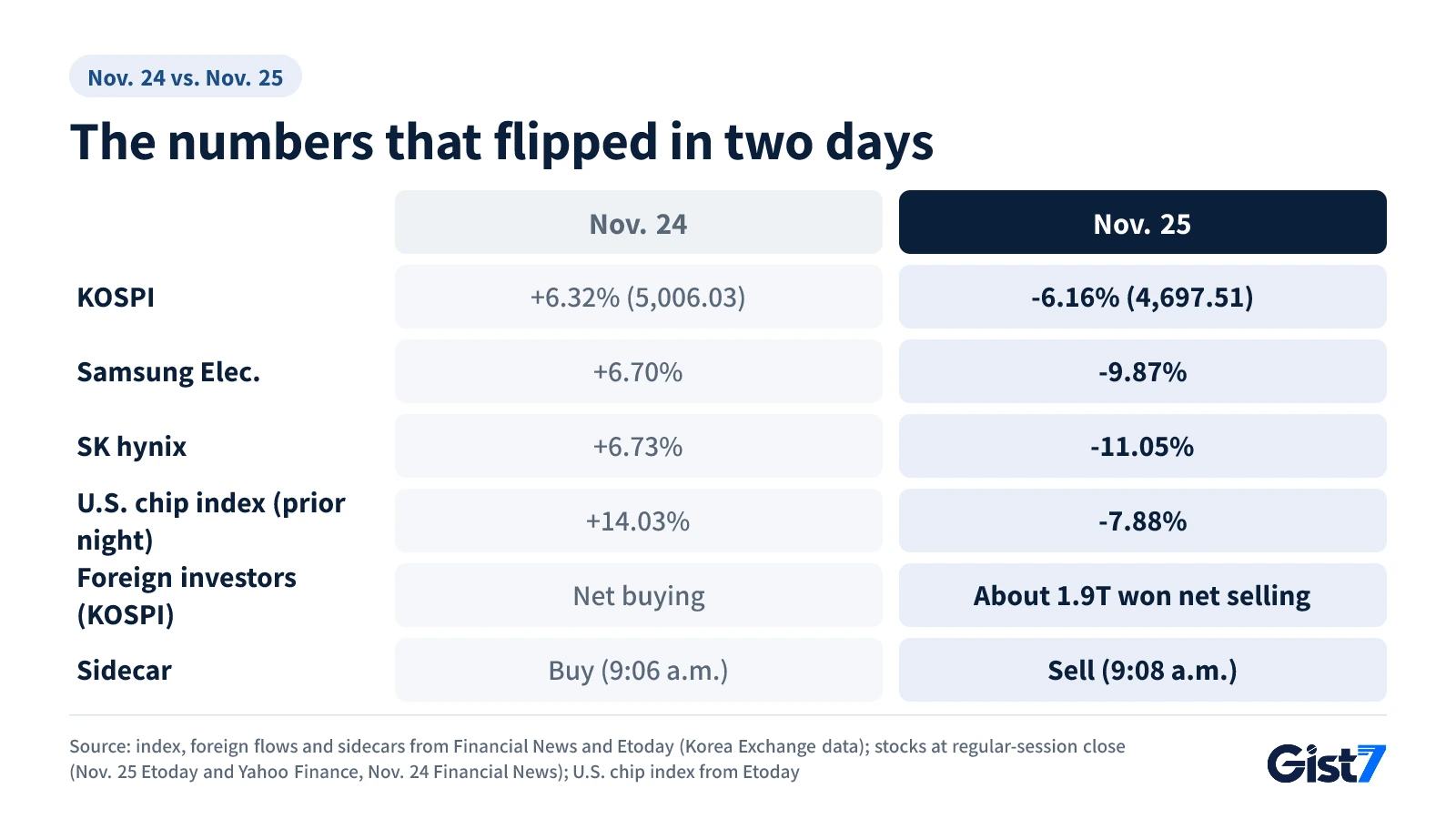
The KOSPI plunged 6.16% to 4,697.51 on Nov. 25, 2026, erasing a 6.32% rally from the day before. A 7.88% U.S. chip-index drop sent foreigners selling about 1.9 trillion won. Samsung Electronics and SK hynix, about 49% of the index including preferred shares (Gist 7 estimate), fell 9.87% and 11.05%.
- KOSPI closed at 4,697.51 (-6.16%), giving back the prior day's 297.49-point gain and ending 11.03 points below the Nov. 23 close
- Trigger: on Nov. 24 (ET) the Philadelphia Semiconductor Index fell 7.88%, Micron 11.01% and Nvidia 5.86%, alongside reports on a U.S. tariff probe
- Foreign net selling of about 1.9 trillion won; the year's 33rd sell-side sidecar at 9:08 a.m. KST
- Samsung Electronics (incl. preferred) and SK hynix are about 49% of KOSPI market value; the three share lines account for more than 85% of the day's value loss (Gist 7 estimate)
- 43 days of 5%-plus moves this year, the 10th back-to-back reversal of 5% or more, and the index about 48% below its June 22 high (9,114.55)
The KOSPI plunge came fast: South Korea's benchmark fell 308.52 points, or 6.16%, to close at 4,697.51 on Nov. 25 (Korea Exchange data via Etoday). That erased the previous day's 6.32% rally that had pushed the index back above 5,000, and left it 11.03 points below the Nov. 23 close. It was the lowest close since Jan. 13 (4,692.64), roughly a 10-month low (Financial News and Yahoo Finance closing data). Foreign investors sold a net of about 1.9 trillion won (about $1.4 billion) of KOSPI shares while individuals bought a net 1.4224 trillion won. The KOSDAQ lost 2.29% to 650.64.
How a 7.88% chip-index drop turned into a KOSPI plunge
The direct trigger was another chip sell-off in New York on Nov. 24 (ET). According to Etoday and Yahoo Finance closing data, the Philadelphia Semiconductor Index fell 7.88%, giving back more than half of its 14.03% jump on Nov. 23. The index tracks major U.S.-listed chip stocks, and Korean traders treat it as the overnight scorecard for Samsung and SK hynix. Nvidia (Nasdaq: NVDA) fell 5.86% and AMD (Nasdaq: AMD) dropped 8.86%. Micron Technology (Nasdaq: MU) sank 11.01%. SK hynix (KOSPI: 000660) ADRs traded in New York lost 9.90%.
Etoday pointed to three reasons for the U.S. slide. Investors took profits after Nvidia jumped more than 30% on CEO Jensen Huang's return, worries resurfaced about heavy AI capital spending and stretched valuations, and reports said the U.S. Trade Representative (USTR) was about to announce the results of its "overcapacity" tariff probe. USTR opened those Section 301 investigations on March 11, 2026, covering 16 trading partners including South Korea, China, the European Union, Japan and Taiwan (Sandler, Travis & Rosenberg trade report). Nvidia also has dates ahead: according to Etoday, Huang faces a closed-door House meeting on Dec. 1 and a public Senate hearing on Dec. 3. As on the day of the KOSPI's 5.2% drop over AMD export-control concerns last week, a single piece of U.S. chip news moved the whole Seoul market the next morning.
Seoul opened 3.94% lower at 4,809.00. At 9:08:32 a.m. KST, KOSPI 200 futures were down 5.12% at 738.20, triggering a sell-side "sidecar." A sell sidecar is a circuit breaker that suspends program sell orders for five minutes when KOSPI 200 futures stay more than 5% below the reference price for one minute; regular orders keep trading. It came one day after a buy-side sidecar, and it was the 33rd sell sidecar of the year (Asia Economy). The index touched an intraday low of 4,672.55. Taiwan's TAIEX fell 4.80% and Japan's Nikkei 225 lost 2.78% the same day (Yahoo Finance closes), so Seoul's drop was the deepest among its neighbors.
43 days of 5% swings: how volatile has the KOSPI become?
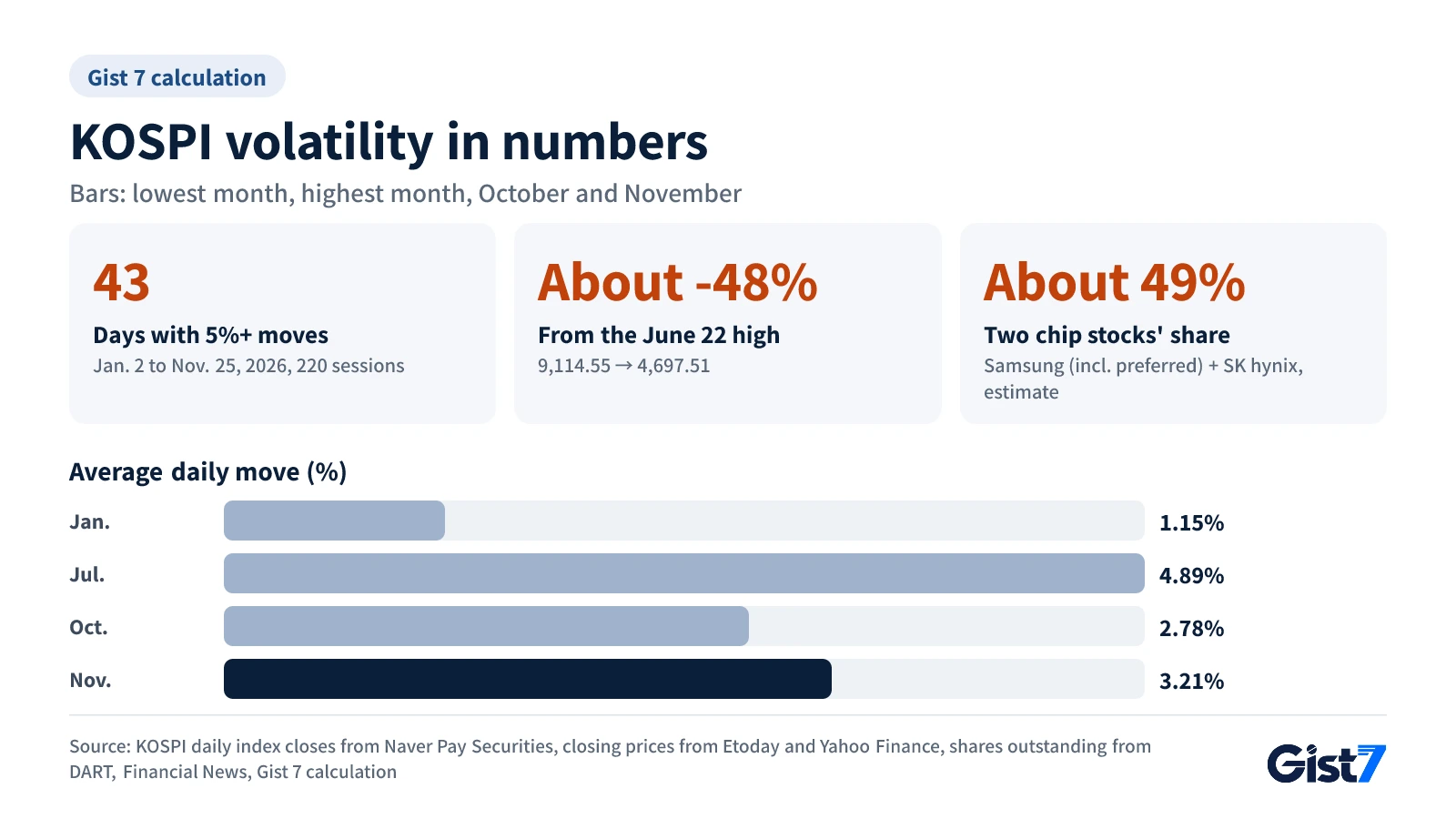
Out of 220 trading days from Jan. 2 to Nov. 25, 2026, the KOSPI moved more than 5% in a single day on 43 of them. Gist 7 calculated this from the KOSPI's daily index closes (regular session) on Naver Pay Securities. On 10 occasions the index moved more than 5% on two straight days in opposite directions. Over the same period the KOSPI fell to about 48% below its June 22 closing high of 9,114.55.
| 2026 | Trading days | Days with 3%+ moves | Days with 5%+ moves | Average daily move |
|---|---|---|---|---|
| January | 21 | 1 | 0 | 1.15% |
| February | 17 | 7 | 2 | 2.49% |
| March | 21 | 9 | 7 | 3.64% |
| April | 22 | 3 | 2 | 2.06% |
| May | 18 | 7 | 4 | 2.91% |
| June | 21 | 11 | 7 | 3.57% |
| July | 22 | 14 | 10 | 4.89% |
| August | 20 | 8 | 3 | 2.47% |
| September | 20 | 3 | 0 | 1.45% |
| October | 20 | 9 | 3 | 2.78% |
| November (through 25th) | 18 | 9 | 5 | 3.21% |
The average daily move is the mean of the absolute daily percentage changes in each month (KOSPI daily index closes from Naver Pay Securities, Gist 7 calculation). The index moved 1.15% a day on average in January, swung as much as 4.89% a day in July, calmed to 1.45% in September and then got choppier again in October and November.
One sharp drop is not enough to say the rebound is over. Still, this year the KOSPI has fallen more than 5% on the very next day after a 5%-plus gain four times, including this one (June 26, July 16, Aug. 3 and Nov. 25).
According to a brokerage analysis cited by Etoday, the KOSPI fell earlier and bottomed earlier than U.S. stocks during the dot-com bust, the global financial crisis and the 2022 tightening cycle. Those are only three past episodes, though, and there is no guarantee the same sequence will repeat. In July this year, the index kept falling even after a month of alternating plunges and sharp rebounds.
Gist 7 will be watching three things in order: whether foreign selling stops after one day, whether Huang's Dec. 3 hearing and the U.S. tariff announcement add to worries about AI spending, and what signal the Bank of Korea's Monetary Policy Board sends on the won and interest rates on Nov. 26.
Two chip stocks are 49% of the market: why does the whole index swing?
The biggest reason the KOSPI moves 6% in a day is that about 49% of its market value (including preferred shares) sits in two chipmakers. At the Nov. 25 regular-session close, Samsung Electronics (KOSPI: 005930) fell 9.87% to 170,700 won, SK hynix lost 11.05% to 1,030,000 won, and Samsung's preferred shares fell 10.19% to 134,800 won (Etoday, Yahoo Finance). Using those closing prices and shares outstanding at the end of 2025, Gist 7 estimates that these three lines alone lost about 216 trillion won in market value. That is more than 85% of the roughly 250 trillion won drop in total KOSPI market value implied by the index decline. The two companies earned more than 190 trillion won in operating profit in the third quarter alone, yet their shares fell around 10% in a single day.
Company snapshot
| Item | Samsung Electronics | SK hynix |
|---|---|---|
| Legal name | Samsung Electronics Co., Ltd. | SK hynix Inc. |
| Ticker and exchange (listed) | 005930 · KOSPI, preferred 005935 (1975) | 000660 · KOSPI (1996) |
| Headquarters | Suwon, Gyeonggi Province | Icheon, Gyeonggi Province |
| Founded | 1969 (as Samsung Electronics Industry) | 1949 as Kukdo Construction; entered chips in 1983 as Hyundai Electronics |
| Main business | Smartphones, TVs and appliances (DX division); DRAM, NAND and foundry (DS division) | Memory chips including DRAM and NAND flash |
| Q3 2026 operating profit | 107.4 trillion won (revenue 195.3 trillion won) | 83.3338 trillion won (revenue 104.6155 trillion won) |
| Market value (Nov. 25 close, Gist 7 estimate) | Common shares about 1,010 trillion won | About 750 trillion won |
| Versus 52-week high | 374,500 → 170,700 won (about -54%) | 2,987,000 → 1,030,000 won (about -66%) |
Legal names, listing, founding, headquarters and main business come from each company's 2025 annual report (DART). Third-quarter results come from Samsung's Oct. 29 and SK hynix's Oct. 28 earnings releases; 52-week highs are from Yahoo Finance. Market values are estimates: the Nov. 25 close multiplied by shares outstanding at the end of 2025 (annual reports).
In our Nov. 20 piece on the KOSPI drop, we compared the chip weighting of the Korean index with Taiwan and Hong Kong. This time the question is how much the two companies contributed to a single day's decline. Estimated the same way, the three share lines are worth about 1,870 trillion won combined, about 49% of the roughly 3,848 trillion won total KOSPI market value (Financial News).
The selling spread to companies around the two giants. At the regular-session close, Samsung Electro-Mechanics (KOSPI: 009150) fell 12.00% and SK Square (KOSPI: 402340) lost 11.19%, while the electrical and electronics sector dropped 9.81% (Asia Economy, Etoday).
When profits and share prices move this far apart, it means the stocks are being driven less by results already reported and more by expectations about whether AI spending will continue into next year and beyond. Each headline about Nvidia's leadership or tariffs shifts those expectations sharply, and half the index moves in the same direction. Biotech went the other way: at the regular-session close, Samsung Biologics (KOSPI: 207940) rose 5.66% to 1,363,000 won and Celltrion (KOSPI: 068270) gained 3.83% to 217,000 won, while the pharmaceutical sector rose 4.65% (Asia Economy, Etoday). Some of the money leaving chips appears to have moved into sectors less tied to the AI cycle.
What it means for foreign investors: why did foreign buying last only one day, and why did EWY fall first?
Foreign buying ended after a single day because U.S. chip stocks reversed overnight and foreign funds sold the big chipmakers first. Yesterday Gist 7's analysis of the 6.3% rally said the rebound needed sustained foreign buying to last more than a day; instead, foreign investors swung back to heavy net selling. The net sale was 1.8993 trillion won according to Etoday's market report and Asia Economy, and 1.9085 trillion won according to Financial News and Etoday's currency report. According to Etoday's currency report, it was the largest since Nov. 6 (2.6897 trillion won). Lee Kyung-min, an analyst at Daishin Securities, told Asia Economy that weaker AI investment sentiment, the switch to foreign net selling, and President Trump's remarks and tariff uncertainty weighed on the market.
The iShares MSCI South Korea ETF (NYSE Arca: EWY), listed in New York, had already closed down 3.70% at $130.70 on Nov. 24 (ET), before Seoul opened (Yahoo Finance). EWY is the main vehicle overseas investors use to trade Korean large caps in one basket. Because New York trades after Seoul closes, the ETF priced in the U.S. chip sell-off before Seoul could. On Nov. 23 it had also front-run the rebound with a 10.11% gain.
Converted into dollars after Seoul's close, the KOSPI's Nov. 25 loss was about 6.2%, almost the same as in won terms (6.16%). That is because the won weakened only slightly: the dollar rose 0.8 won to 1,343.2 won at 3:30 p.m. KST (Etoday, Seoul FX market). For a day when stocks fell more than 6%, the currency barely moved. According to Etoday, foreigners bought dollar futures as they sold shares and custody banks kept buying dollars, but exporters' dollar sales near 1,350 won capped the rise. Custody buying refers to dollar purchases by the banks that hold assets for foreign investors, made so the investors can send stock-sale proceeds home. The intraday high was 1,349.0 won. One currency dealer expected dividend-related dollar demand to keep upward pressure on the dollar-won rate through Friday, and saw the rate moving between 1,330 and 1,370 won (Etoday).
Market impact map
| Asset / indicator | Direction | Strength | Link (why) |
|---|---|---|---|
| KOSPI | ↓ | Strong | U.S. chip sell-off → two chipmakers worth nearly half the market fall about 10%, foreign net selling of about 1.9 trillion won |
| Large-cap chip and component stocks | ↓ | Strong | Doubts about sustained AI spending → Samsung Electronics -9.87%, SK hynix -11.05%, Samsung Electro-Mechanics -12.00% (regular-session close, Etoday, Yahoo Finance) |
| KOSDAQ | ↓ | Medium | Chip-equipment stocks fall (Jusung Engineering (KOSDAQ: 036930) -11.42%, Etoday); gains in large biotech names limit the decline |
| Pharma and biotech | ↑ | Medium | Money rotates into sectors less tied to chips → pharmaceutical sector +4.65%, Samsung Biologics +5.66% (regular-session close, Asia Economy, Etoday) |
| Dollar-won (USD/KRW) | ↑ | Weak | Dollar-futures and custody buying after foreign stock sales; exporter dollar sales near 1,350 won cap the rise (1,343.2 won) |
| EWY | ↓ priced in early | Medium | Reflected the U.S. chip sell-off in New York on Nov. 24, before Seoul opened (-3.70%) |
Little direct impact: 2-year Treasury, 10-year Treasury, dollar index (104.06 at 3:40 p.m. KST, Etoday), gold, oil (WTI), bitcoin, S&P 500, Nasdaq, Taiwan's TAIEX (the Nasdaq and S&P 500 were the cause rather than the effect, and the TAIEX (-4.80%) fell for the same reason, the U.S. chip sell-off, rather than because of the KOSPI)
- Everyday impact: Korean equity funds and the stock portion of retirement accounts gave back the Nov. 24 gain in one day and ended slightly below their Nov. 23 value.
- Everyday impact: With the dollar-won rate holding in the 1,340s, costs for currency exchange and overseas payments are almost unchanged.
Market reactions can vary with other factors, and this table is not a basis for investment decisions.
What to watch next
| Date (KST, with ET) | Indicator / event | Previous | Why it matters here | If it comes in… |
|---|---|---|---|---|
| Nov. 25 (Wed) 10:30 p.m. KST / 8:30 a.m. ET | U.S. October PCE prices and Q3 GDP second estimate (Bureau of Economic Analysis) | September PCE +3.6% y/y, core +3.1% (BEA) | Whether the U.S. rate path adds pressure on AI stock valuations (CPI vs. PCE explained) | Hotter than expected tends to lift U.S. yields and weigh on tech and chip stocks |
| Nov. 26 (Thu) around 10 a.m. KST / Nov. 25 around 8 p.m. ET | Bank of Korea Monetary Policy Board rate decision (meeting date from the BOK schedule) | 3.00% (raised Aug. 27, held in October, Bank of Korea) | Signal for the won's direction and foreign fund flows | One currency dealer expects limited impact because a hike is already anticipated (Etoday). A hike plus signals of more tends to strengthen the won and weigh on growth stocks; a hold tends to add pressure toward a weaker won |
| Dec. 1 (Tue), expected | Korea's November trade data (Ministry of Trade, Industry and Resources) | October chip exports $56.44 billion, +259.4% y/y (ministry) | Whether chip earnings hopes are backed by export numbers | Sustained strong chip export growth tends to support earnings expectations; a sharp slowdown tends to weigh on chip stocks |
| Dec. 3 (Thu, ET) = early Dec. 4 KST | Nvidia CEO Jensen Huang's public Senate hearing (schedule as reported by Etoday) | Closed-door House meeting expected Dec. 1 | Whether uncertainty around Nvidia's leadership persists | Rising concern about the probes tends to lift chip-stock volatility; resolution tends to ease worries about AI spending |
| Dec. 10 (Thu) 4:00 a.m. KST / Dec. 9 2:00 p.m. ET | FOMC rate decision (Dec. 8-9 meeting) | Held at 3.75-4.00%, two dissents favoring a hike (Oct. 28, Federal Reserve) | Whether conditions favor foreign money returning to Korean stocks | A hike or signals of further hikes tend to lift USD/KRW and add foreign selling pressure |
Frequently asked questions
Why did the KOSPI fall more than 6% on Nov. 25?
The Philadelphia Semiconductor Index dropped 7.88% on Nov. 24 (ET), reversing the boost from Jensen Huang's return to Nvidia after one day. Profit-taking, worries about AI spending and valuations, and reports on a U.S. overcapacity tariff probe all hit at once. Foreign investors sold about 1.9 trillion won, and Samsung Electronics (-9.87%) and SK hynix (-11.05%) dragged the index down.
Did the KOSPI give back all of the previous day's gain?
Yes, and a bit more. The index rose 297.49 points on Nov. 24 and fell 308.52 points on Nov. 25 to close at 4,697.51, which is 11.03 points below the Nov. 23 close. It was the lowest close since Jan. 13, roughly a 10-month low.
Why does the KOSPI swing 6% on back-to-back days?
Samsung Electronics (including preferred shares) and SK hynix make up about 49% of the KOSPI's market value (Gist 7 estimate), so when U.S. chip news moves those two stocks 10%, the whole index lurches. Foreign investors flipping between buying and selling from one day to the next adds to the swings. In 2026 through Nov. 25, the KOSPI moved more than 5% in a day on 43 days.
What is a sell-side sidecar, and when was it triggered?
A sell sidecar suspends program sell orders for five minutes when KOSPI 200 futures stay more than 5% below the reference price for one minute; ordinary orders continue to trade. On Nov. 25 it was triggered at 9:08:32 a.m. KST, the 33rd sell sidecar of the year.
Is the KOSPI rebound over?
One drop is not enough to say so. This year the KOSPI has fallen more than 5% on the day right after a 5%-plus gain four times, including this one. The variables to watch are whether foreign selling stops after a day, Jensen Huang's Dec. 3 hearing and the U.S. tariff announcement, and the Bank of Korea's Nov. 26 decision.
How large was the loss for dollar-based investors?
The dollar rose only 0.8 won to 1,343.2 won, so the KOSPI's loss in dollar terms was about 6.2%, nearly the same as in won. The New York-listed EWY had already dropped 3.70% on Nov. 24 (ET), pricing in the decline before Seoul opened.
References
- 하루 만에 6% 반등분 모두 토해냈다…코스피 4700선도 못지켜 [fn마감시황] — 파이낸셜뉴스
- 코스피 4700선 붕괴 마감시황 (2026-11-25) — 아시아경제
- 5000선 탈환 하루 만에 6% 폭락…코스피 4700선 붕괴 — 이투데이
- 코스피, 오후에도 4700선서 급락…외국인 1.5조 매도에 삼전닉스 9%대↓ — 이투데이
- [환율마감] 원·달러 소폭 상승, 커스터디 매수+달러화 강세 vs 네고 — 이투데이
- 뉴욕증시, 기술주 매도·관세 우려 속 혼조…나스닥 1.5%↓ [종합] — 이투데이
- 젠슨 복귀 효과 하루 만에 꺾여…美 반도체 8%↓ [뉴욕증시 무버] — 이투데이
- 코스피, 젠슨 황 복귀에 6.32% 급등…5000선 회복 [fn마감시황] — 파이낸셜뉴스
- 코스피 지수 일별 시세 — 네이버페이 증권
- KOSPI Composite Index (^KS11) Historical Data — Yahoo Finance
- New Section 301 Investigations Target 16 Trade Partners (2026-03-13) — Sandler, Travis & Rosenberg
- 삼성전자, 2026년 3분기 실적 발표 (2026-10-29) — 삼성전자 뉴스룸
- SK하이닉스, 2026년 3분기 경영실적 발표 (2026-10-28) — SK하이닉스 뉴스룸
- 삼성전자 사업보고서(2025년) — 금융감독원 DART
- SK하이닉스 사업보고서(2025년) — 금융감독원 DART
- Samsung Electronics (005930.KS) Historical Data — Yahoo Finance
- SK hynix (000660.KS) Historical Data — Yahoo Finance
- iShares MSCI South Korea ETF (EWY) Historical Data — Yahoo Finance
- PHLX Semiconductor (^SOX) Historical Data — Yahoo Finance
- TSEC weighted index (^TWII) Historical Data — Yahoo Finance
- Nikkei 225 (^N225) Historical Data — Yahoo Finance
- 통화정책방향 결정회의 일정 — 한국은행
- 한국은행 기준금리 추이 — 한국은행
- Release Schedule — 미 경제분석국
- Personal Income and Outlays, September 2026 — 미 경제분석국
- Meeting calendars and information — 연준
- Federal Reserve issues FOMC statement (2026-10-28) — 연준
- 2026년 10월 수출입 동향 (2026-11-01) — 산업통상부