PCE Inflation Report and BOK Rate Call: Thanksgiving Week

Key summary
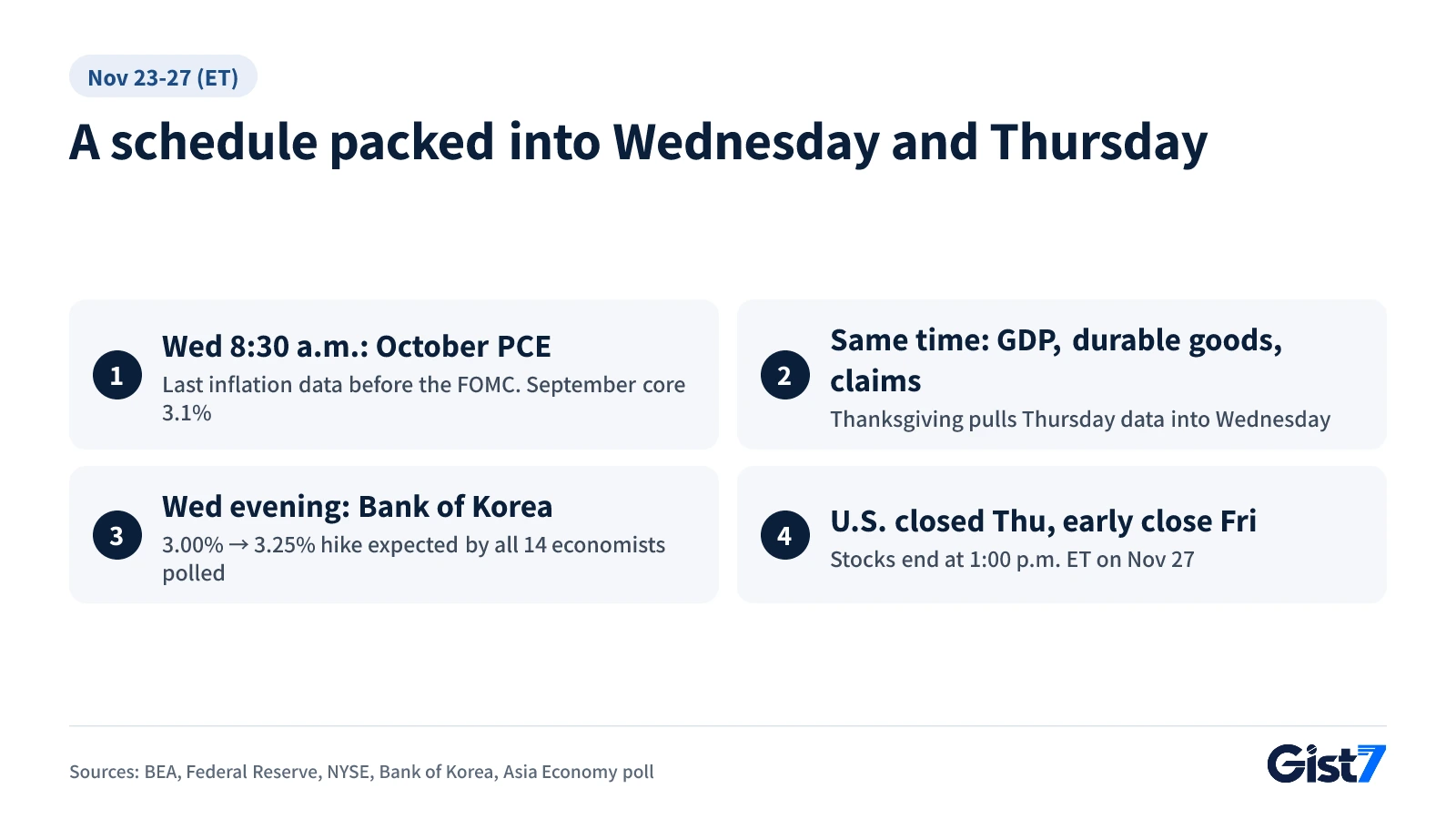
The October PCE inflation report is due November 25, 2026, at 8:30 a.m. ET, the Fed's last official inflation data before its December 8-9 meeting. Next, the Bank of Korea is expected to hike from 3.00% to 3.25%. U.S. markets close November 26.
- October PCE is due November 25 at 8:30 a.m. ET; November CPI (Dec 10) and PPI (Dec 15) come after the Fed's December 9 decision
- September core PCE was 3.1% year over year; markets expect 3.2% for October (Jin10), RBC 3.3%
- The Bank of Korea decides on November 26 (Seoul); all 14 economists in an Asia Economy poll expect a hike to 3.25%
- U.S. stock and bond markets close November 26; stocks close early at 1 p.m. ET on November 27
- Earnings focus on Dell (after the close November 24) and its AI server orders and backlog
The October PCE inflation report, based on the personal consumption expenditures price index, comes out on Wednesday, November 25, 2026, at 8:30 a.m. ET. About 12 hours later, on the morning of Thursday, November 26 in Seoul (Wednesday evening in New York), the Bank of Korea's Monetary Policy Board sets its last policy rate of the year. It is the final official inflation gauge the Federal Reserve will see before its December 8-9 Federal Open Market Committee (FOMC) meeting. According to the Bureau of Labor Statistics (BLS) schedule, the November consumer price index (CPI) is due December 10 and the producer price index (PPI) December 15, both after the decision. And both events fall in a holiday-shortened week that follows an 8.6% weekly drop in the S&P 500 (7,561.67 on November 13 to 6,910.39 on November 20, Yahoo Finance closing data).
The PCE price index measures the prices of what U.S. households actually spend money on, and it is the gauge the Fed uses for its 2% inflation target.
Why the PCE inflation report carries so much weight before the December FOMC
October PCE will not decide whether the Fed hikes in December. It will help decide by how much, and what comes after. The minutes of the October meeting, released November 18, say "almost all participants" expected further rate increases to be appropriate. "A couple of participants" said an increase of more than 25 basis points could warrant consideration at the next meeting if incoming inflation data were unfavorable. Among that incoming data, this PCE release is the last one before the meeting.
According to the Bureau of Economic Analysis (BEA), the PCE price index rose 0.5% in September from August and 3.6% from a year earlier. Core PCE, which strips out food and energy, rose 0.3% on the month and 3.1% on the year. A ChainCatcher article citing Jin10 data says markets expect core PCE to rise to 3.2% year over year in October. In its November 20 week-ahead note, RBC Economics forecast both headline and core PCE up 0.3% on the month, lifting the annual rates to 3.8% and 3.3%.
There is one more wrinkle this time. Because the October 2025 government shutdown stopped data collection, the BLS could not publish a 12-month change for October 2026 CPI; it released only the monthly figures (0.4% headline, 0.3% core). With forecasts for PCE framed in year-over-year terms, PCE is likely to be read as the first number showing October's annual inflation trend. That is Gist 7's interpretation.
| October core PCE (year over year) | How markets may read it |
|---|---|
| 3.3% or higher | Supports the minutes' talk of a hike larger than 25 basis points |
| Around 3.2% | Keeps a 25-basis-point December hike as the base case |
| 3.1% or lower | Could pull forward talk of when the hiking stops |
The second estimate of third-quarter gross domestic product (GDP) comes out at the same time. The BEA's advance estimate showed 3.4% annualized growth.
Bank of Korea decision on November 26: is a hike to 3.25% a done deal?
Markets almost unanimously expect a 25-basis-point hike, from 3.00% to 3.25%. The bigger questions are whether any board member dissents, and what the dot plot says about the next six months of rates.
According to the Bank of Korea, the policy rate rose twice this year, to 2.75% on July 16 and 3.00% on August 27, before a unanimous hold on October 22. In a November 16-19 poll by Korean daily Asia Economy, all 14 economists expected a hike and 10 expected a unanimous vote. They saw the dot-plot median at 3.50%. The case for a hike rests on hard numbers. Korean outlet BizWatch reports that third-quarter real GDP grew 1.0% from the previous quarter, far above the central bank's August forecast of 0.3%, and that October consumer prices rose 2.8%.
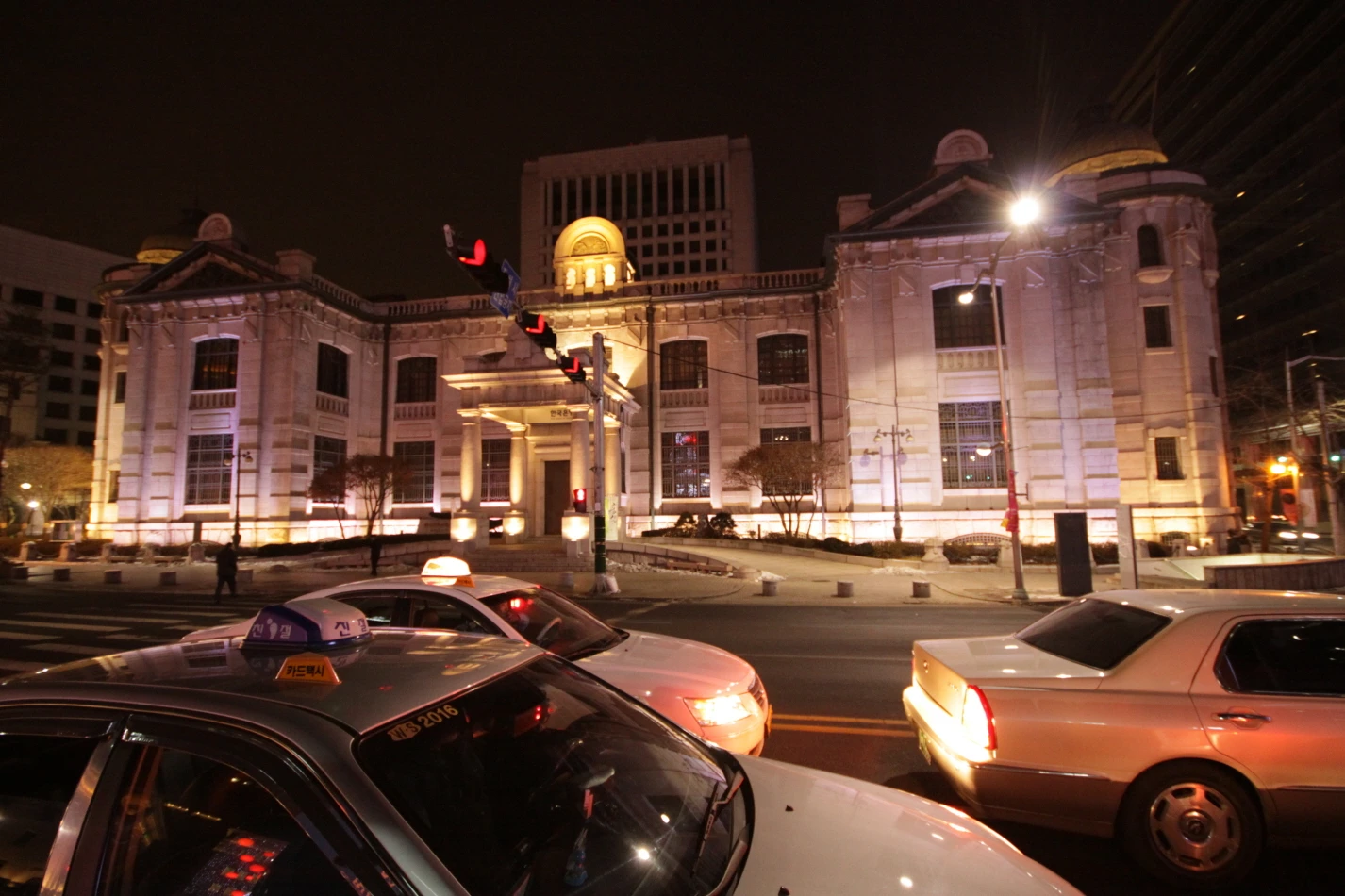
There are reasons for caution, too. The same report says private consumption fell 0.2% in the third quarter, the October consumer sentiment index slipped 1.2 points to 105.4, and the average rate on new household loans was 4.96% in September. Lim Jae-kyun of KB Securities said a hold cannot be ruled out given the weak stock market. U.S. markets will be closed when the decision lands, so Korean markets will digest it first, and alone.
Thanksgiving week schedule: why the data piles up on Wednesday
Next week's U.S. data is bunched on Wednesday because U.S. stock and bond markets close for Thanksgiving on November 26, so releases that would normally come Thursday move up a day. Seoul is 14 hours ahead of New York.
| Date and time (ET) | Region | Event | Previous |
|---|---|---|---|
| Nov 23 (Mon) or later | Korea | Korea Customs Service exports, Nov 1-20, preliminary (check agency notice for date) | Nov 1-10: $33.5 billion, +111.9% (7.5 working days; daily average +97.7%) |
| Nov 24 (Tue) 10:00 a.m. | U.S. | Conference Board consumer confidence, November | October 91.7 |
| Nov 25 (Wed) 8:30 a.m. | U.S. | October PCE prices, personal income and spending | September core PCE 3.1% |
| Nov 25 (Wed) 8:30 a.m. | U.S. | Q3 GDP second estimate, October durable goods orders | GDP advance 3.4% |
| Nov 25 (Wed) 8:30 a.m. | U.S. | Weekly initial jobless claims (moved up from Thursday) | 203,000 |
| Nov 25 (Wed) 2:00 p.m. | U.S. | Fed Beige Book | - |
| Nov 25 (Wed) evening | Korea | Bank of Korea rate decision (Nov 26 morning in Seoul) | 3.00% |
| Nov 26 (Thu) | U.S. | Thanksgiving, stock and bond markets closed | - |
| Nov 27 (Fri) 1:00 p.m. | U.S. | Early close for stocks (bonds 2:00 p.m.) | - |
Sources: BEA, Census Bureau, Federal Reserve, Conference Board and NYSE calendars; jobless claims from the Labor Department's November 19 release; exports from the Korea Customs Service's November 11 release.
Earnings: what Dell's AI server orders will show
After reports of probes into Nvidia (Nasdaq: NVDA) knocked more than 10% off the chip index in a single day, attention this week turns to AI server maker Dell Technologies (NYSE: DELL). According to Dell's results for its fiscal second quarter (ended in late July), released September 1, the company booked $60.9 billion in AI server orders, recognized $16.4 billion in AI server revenue and ended the quarter with a $95 billion backlog. Whether orders kept that pace, and whether the backlog grew from $95 billion, will be the yardstick for fears of an AI spending slowdown. We covered the sell-off in Nvidia probe reports and the Nasdaq plunge.
| Date (ET) | Company | Timing | Consensus EPS (Nasdaq) |
|---|---|---|---|
| Nov 23 (Mon) | Hewlett Packard Enterprise (NYSE: HPE) | After the close | $1.17 |
| Nov 24 (Tue) | Analog Devices (Nasdaq: ADI), Best Buy (NYSE: BBY) | Before the open | $3.89, $1.48 |
| Nov 24 (Tue) | Dell, HP Inc. (NYSE: HPQ), Workday (Nasdaq: WDAY) | After the close | $6.48, $0.74, $1.28 |
| Nov 25 (Wed) | Deere & Company (NYSE: DE) | Before the open | $4.07 |
Source: StockTitan earnings calendar (Nasdaq consensus as of November 20). With its second-quarter results, Dell guided to third-quarter revenue of $49.0 billion and adjusted EPS of $6.50.
A holiday after a sell-off: what thin trading can amplify
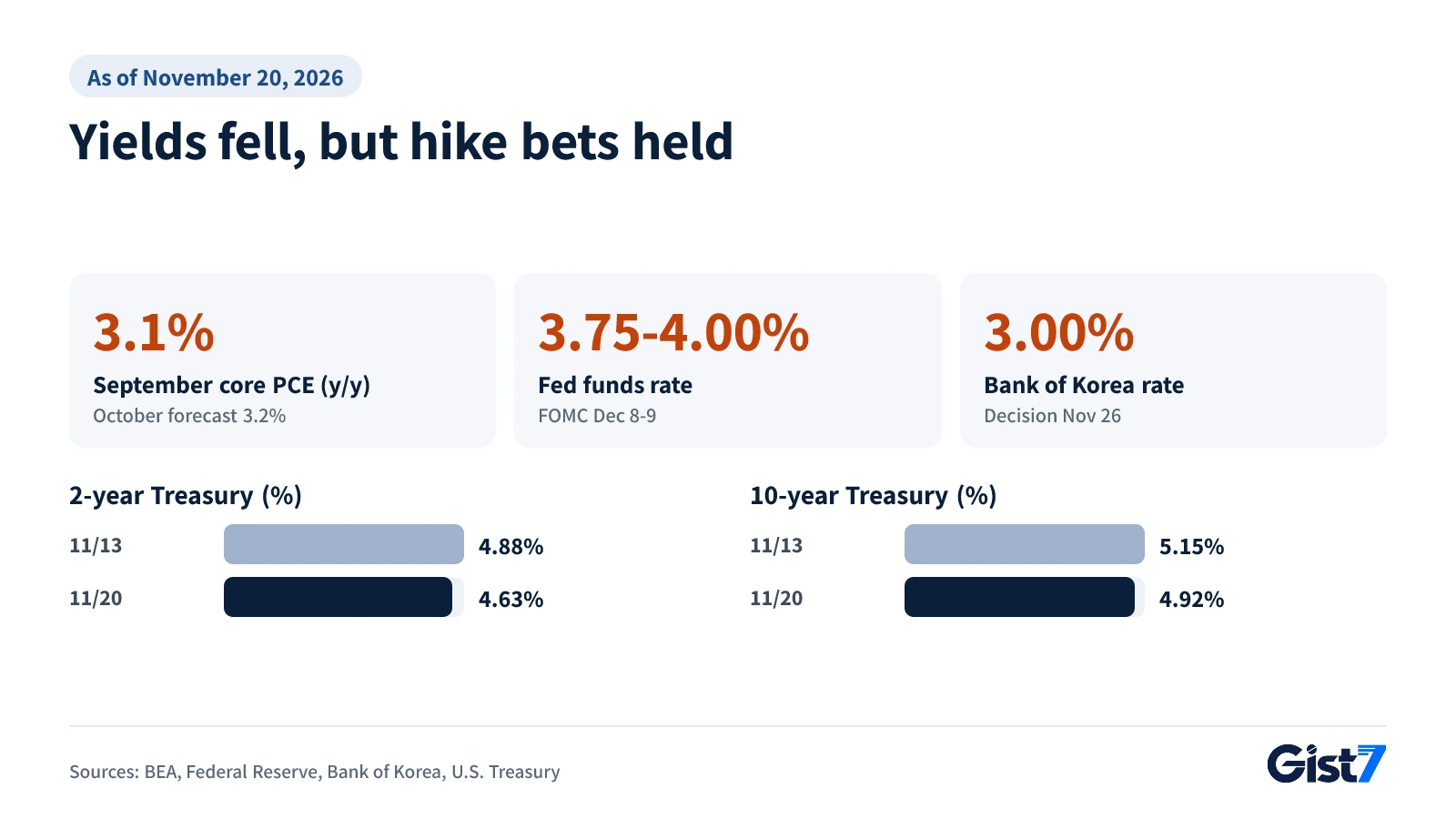
With fewer traders around over the holiday, even small news can move prices sharply. According to the Treasury Department, the 2-year yield fell 0.25 percentage point, from 4.88% on November 13 to 4.63% on November 20, and the 10-year fell 0.23 point, from 5.15% to 4.92%. In the same week the S&P 500 dropped 8.6%, while the Fed minutes still leaned toward more hikes. So Gist 7 reads the decline in yields less as a bet that the Fed will stop hiking and more as money moving out of stocks and into Treasuries. If PCE comes in hot while hike expectations hold, the familiar rule that falling yields support stocks could weaken further.
Crypto keeps trading around the clock even when U.S. markets are shut on November 26. Last week, bitcoin slid again over the weekend while U.S. stocks were closed, as we explained in why bitcoin broke below $60,000.
Market impact map
This week, PCE moves U.S. rates first and the Bank of Korea moves Korean rates and the won, while thin holiday trading could widen the swings.
| Asset / indicator | Direction | Strength | Link (why) |
|---|---|---|---|
| 2-year Treasury | Core PCE above 3.2% → ↑ / below → ↓ | Strong | Feeds straight into the expected size of the December hike (4.63% on Nov 20) |
| 10-year Treasury | Hot inflation → ↑ / soft → ↓ | Medium | Longer tightening math versus Treasury demand from stock sellers (4.92% on Nov 20) |
| Dollar index | Hot U.S. inflation → ↑ / soft → ↓ | Medium | U.S. rate expectations shift the gap with other currencies |
| USD/KRW | BOK hike plus soft U.S. inflation → ↓ / opposite → ↑ | Medium | Change in the U.S.-Korea rate gap (Fed upper bound 4.00%, BOK 3.00%) |
| Korea 3-year government bond | More 3.75% dots → ↑ | Strong | Prices in the number of hikes expected next year |
| Nasdaq, S&P 500 | Hot PCE → ↓ / soft → ↑ | Medium | Discount-rate pressure overlaps with Dell's results |
| KOSPI | Hawkish BOK → ↓ | Medium | Korea prices the decision alone on the U.S. holiday |
| Bitcoin | Risk-off during the holiday → ↓ | Weak | Trades 24/7, so it takes shocks first while U.S. markets are shut |
Little direct impact: Gold, WTI crude oil (both have weak links to this week's calendar)
- Loan rates in Korea: a Bank of Korea hike could push up the market rates that variable-rate loans track.
- Currency and cross-border shopping: in a Black Friday week, hot U.S. inflation tends to lift the dollar, which raises the cost of dollar purchases for buyers paying in won.
Market reactions can vary with other factors, and this table is not a basis for investment decisions.
What to watch next
| Date and time (ET) | Indicator / event | Previous | Relevance | If it comes in like this |
|---|---|---|---|---|
| Dec 4 (Fri) 8:30 a.m. | U.S. November jobs report | October payrolls +165,000, unemployment 4.1% (BLS) | Last jobs data before the FOMC | Strong hiring and wages → bigger-hike bets ↑, 2-year yield ↑ tendency |
| Dec 9 (Wed) 2:00 p.m. | FOMC decision and projections | 3.75%-4.00% (Fed) | Confirms the hike size PCE pointed to | A 50-basis-point move → dollar ↑, pressure on growth stocks |
| Dec 10 (Thu) 8:30 a.m. | U.S. November CPI | October +0.4% m/m, core +0.3% (BLS) | Arrives after the decision and shapes next year's path | Core at 0.3% or more again → more-hikes bets ↑ |
| Jan 14, 2027 (Thu, Seoul) | Bank of Korea rate meeting | Nov 26 decision (now 3.00%) | Checks the path signaled by this dot plot | Inflation staying in the high 2% range → more hike talk ↑ |
Frequently asked questions
When is the October PCE inflation report released?
According to the Bureau of Economic Analysis schedule, it comes out Wednesday, November 25, 2026, at 8:30 a.m. ET. The second estimate of third-quarter GDP is released at the same time.
If the Bank of Korea hikes in November, where will its rate be?
The policy rate is now 3.00%, so a 25-basis-point hike would take it to 3.25%. All 14 economists in Asia Economy's November 16-19 poll expected a hike, and the decision comes on the morning of November 26 in Seoul, which is the evening of November 25 in New York.
Is the U.S. stock market open on Thanksgiving?
No. The NYSE holiday calendar shows a full closure on Thursday, November 26, and an early close at 1:00 p.m. ET on Friday, November 27. SIFMA recommends that bond markets close November 26 and end at 2:00 p.m. ET on November 27.
What is the difference between PCE and CPI?
CPI tracks the price of a basket of goods consumers buy, while PCE covers all consumption spending made by or on behalf of households. Because coverage and weights differ, PCE usually runs below CPI, and the Fed uses PCE for its 2% target.
What happens at the December FOMC if PCE comes in hotter than expected?
In the October minutes, a couple of Fed officials said a hike larger than 25 basis points could be considered if inflation data were unfavorable. If core PCE tops the 3.2% year-over-year forecast, markets may price a bigger chance of a 50-basis-point move, but the decision also depends on other data such as the December 4 jobs report.
References
- Release Schedule — U.S. Bureau of Economic Analysis
- Personal Income and Outlays, September 2026 — U.S. Bureau of Economic Analysis
- Minutes of the Federal Open Market Committee, October 27-28, 2026 — Federal Reserve
- 한국은행 기준금리 추이 — 한국은행
- [금통위poll]① 11월 금리 인상…향후 관건은 "점도표 3.75%" — 아시아경제
- 올해 마지막 금통위…금리인상 '마침표' 찍을까 — 비즈워치
- Holidays & Trading Hours — NYSE
- December 2026 Release Schedule — U.S. Bureau of Labor Statistics
- Earnings Calendar Week of November 23, 2026 — StockTitan
- PCE to confirm the inflation problem, labor pulse still strong — RBC Economics
- Next week's macro outlook (Jin10 인용) — ChainCatcher
- Daily Treasury Par Yield Curve Rates, November 2026 — U.S. Department of the Treasury
- S&P 500 (^GSPC) Historical Data — Yahoo Finance
- US Consumer Confidence — The Conference Board
- 2026년 11월 1일~11월 10일 수출입 현황(잠정치) — 관세청(대한민국 정책브리핑)
- Holiday Schedule — SIFMA
- Consumer Price Index – October 2026 — U.S. Bureau of Labor Statistics
- Dell Technologies Delivers Second Quarter Fiscal 2027 Financial Results (Form 8-K Exhibit 99.1) — SEC