Treasury Stock Sales: Why Companies Do It and What to Check

Key summary
A treasury stock sale lets a company raise cash, pay for an acquisition, reward staff or swap shares. After South Korea's 2026 Commercial Act amendment, cancelling treasury shares is the default, so a sale needs shareholder approval; judge it by purpose, buyer, price and size (as of October 2026).
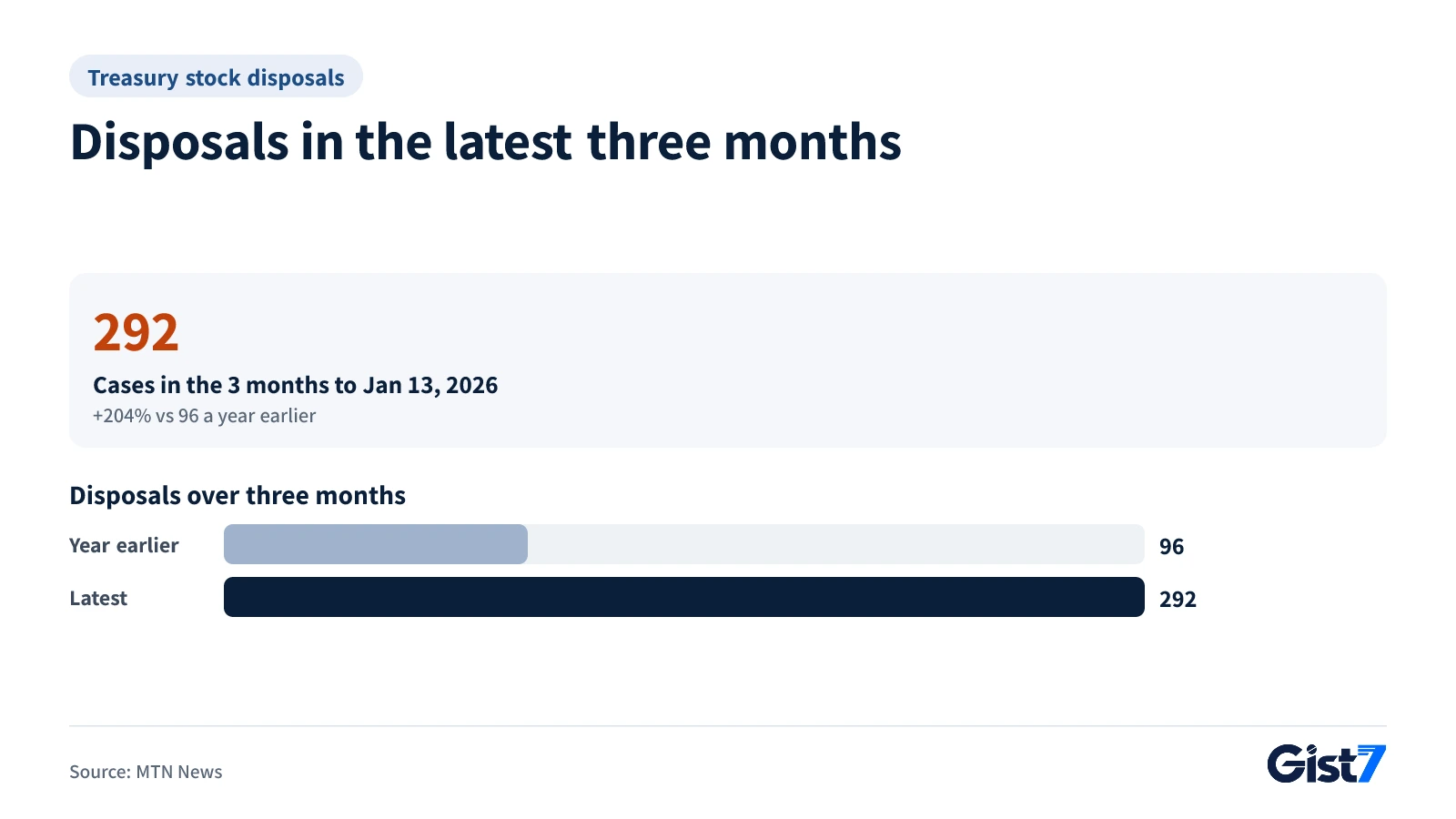
- South Korean listed firms disposed of treasury stock 292 times in the three months to January 13, 2026, versus 96 a year earlier.
- Companies sell for four main reasons: cash, acquisition payments, employee pay and share swaps.
- The amended Commercial Act requires new treasury shares to be cancelled within one year and existing ones within 1.5 years, unless shareholders approve a plan.
- A sale brings cash but adds shares to the market and gives up the chance to cancel them.
- When reading a filing, check the purpose, buyer, price, size and approval status.
Treasury stock sales are surging in South Korea: listed companies disposed of treasury stock 292 times in the three months to January 13, 2026, nearly triple the 96 cases a year earlier, according to MTN. The rush came ahead of an amended Commercial Act that makes cancelling treasury shares the default. This article explains why companies pursue a treasury stock sale, what they gain and lose, and how investors can read the filings (as of October 2026).
Why do companies sell treasury stock?
Treasury stock is a company's own shares that it bought back and still holds. A treasury stock sale, called a "disposal" in Korean filings, puts those shares back on the market or into a specific buyer's hands. The reported cases fall into four groups.
Cash needs come first. JST sold 900,000 shares, about 2.75 billion won, to an asset manager to fund operations and restructuring. CareGen planned to sell part of its holding to pay for clinical trials of its macular degeneration and dry eye drugs. The second use is acquisition payment: Daewoong handed over about 560,000 shares, roughly 12.1 billion won, to the sellers of Yoo2 Bio. Third is employee pay. Hanmi Pharmaceutical and others granted shares as bonuses or restricted stock units. Fourth are share swaps, in which drugmakers such as Ildong Holdings and Kukje Pharma exchanged stock under the banner of strategic alliances.
Timing played a part as well. Many firms moved before the cancellation rule applied, and the MTN report quoted critics who called the practice a stopgap to avoid cancellation. If shares are simply passed to another holder, the total share count does not fall.
What changed under South Korea's 2026 Commercial Act amendment?
The third Commercial Act amendment, passed by the National Assembly in February 2026, flipped the default for treasury shares from holding to cancelling. According to a Shin & Kim law firm newsletter, newly acquired shares must be cancelled within one year. Shares a company already holds get a six-month grace period after enforcement plus a one-year window, up to 1.5 years in total.
To keep or sell shares instead, the board must draw up a holding and disposal plan and win shareholder approval, renewed at each annual meeting. Four statutory purposes, including employee compensation, need only the plan and the approval. Broader business aims, such as adopting new technology or improving the capital structure, must first be written into the articles of incorporation. Dr.CR adds that pledging treasury shares as collateral, using them for exchangeable bonds, and allocating new shares against them in mergers or spin-offs are now barred. A board can no longer decide a disposal alone. The exact effective date should be checked in the promulgated law.
Is a treasury stock sale good or bad for the company?
It brings cash and flexibility, but it adds shares to the market and gives up the chance to cancel them. Which effect is larger depends on the purpose and the price.
| Area | Upside | Downside |
|---|---|---|
| Funding | Cash without borrowing or issuing new shares (operations, research, restructuring) | A sale at a low share price may fall short of the target |
| Deals and alliances | Pay for acquisitions in stock rather than cash; swaps build friendly ties | Shares the counterparty receives may reach the market later |
| Employee pay | Rewards staff without a cash outlay | Recipients who sell can weigh on the price |
| Shareholders | Value can rise if the money produces results | More shares in circulation dilute value per share, and a cancellation is forgone |
Cancellation shrinks the total share count and lifts value per share, while a sale puts more shares in circulation. Dr.CR notes that the old habit of treating treasury stock as a cash reserve is ending, which pushes firms to hold more cash and to use cash or new shares instead of share swaps in M&A.
Case study: CareGen's planned cash vs. the real figure
CareGen held 4,844,216 treasury shares, 9.02% of its issued stock, and planned to sell 383,577 of them (0.71%) to raise about 50 billion won. The plan assumed a reference price of 130,352 won. According to Dealsite, at the September 3, 2026 close of 43,750 won the proceeds shrink to about 16.8 billion won, more than 33 billion won short. Reaching 50 billion won would take roughly 1.14 million shares, which would add to the supply overhang. The company said it has no plan to sell more. The case shows that when the share price falls, the cash from a treasury stock sale falls with it.
How should investors read a treasury stock sale?
One filing does not settle whether a sale is good or bad news. Academic evidence also splits by purpose. In a 2005 study by Sul and Kim, direct disposals to raise operating funds or improve the financial structure significantly increased shareholder wealth, while disposals for executive and employee incentives had a negative effect. The data is two decades old, so it cannot be applied as is to a market where cancellation is the default.
A practical approach is to check five items in order.
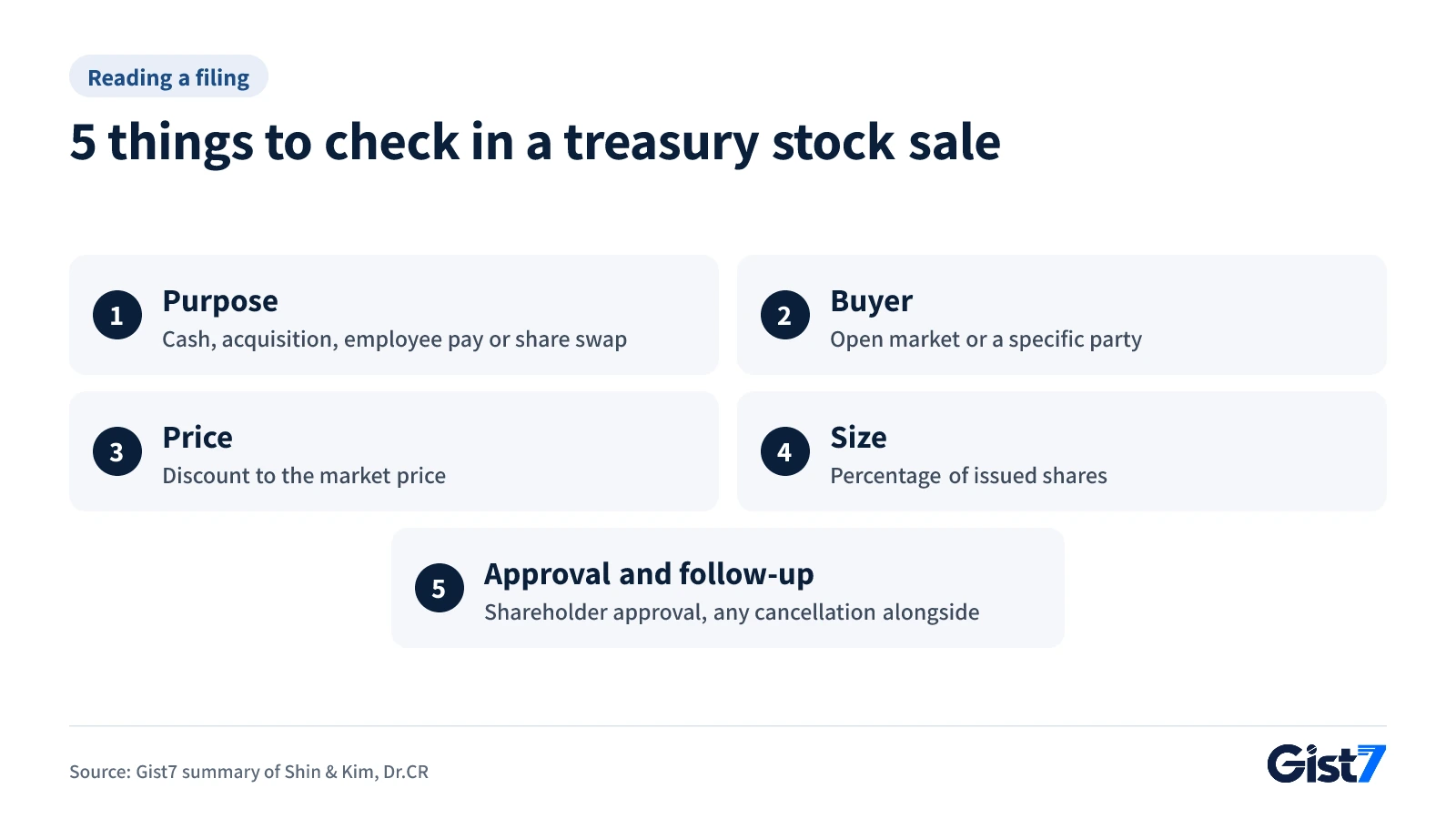
Look at the buyer and the price first. Whether shares go to the open market, to a partner company or to employees changes where the selling pressure ends up. This is an information summary, not investment advice. Read the original filing and decide for yourself.
What to watch next
Disposal filings and annual-meeting agenda items on holding and disposal plans are likely to increase before the grace period ends (Gist7's outlook). Two things are worth tracking: whether shareholders actually use their vote to check disposals that are now the exception, and whether the proceeds go to the purpose the company stated.
Frequently asked questions
Is a treasury stock sale good or bad news?
There is no single answer. Research found that disposals to raise operating funds or fix the financial structure were received positively, while disposals for employee incentives were negative. Purpose, buyer and price decide.
What is the difference between cancelling and selling treasury stock?
Cancellation destroys the shares, which cuts the total share count and raises value per share. A sale passes the shares to the market or a buyer, so the share count stays the same and the company receives cash.
Can South Korean companies still sell treasury stock after the amendment?
Yes, but the board needs a holding and disposal plan approved at the shareholders' meeting, renewed every year. Some business purposes must also be written into the articles of incorporation first.
By when must existing treasury shares be cancelled?
After a six-month grace period from enforcement, companies have one more year, so 1.5 years at most. Some industries with foreign-ownership caps may dispose of shares within three years instead.
What is an overhang?
An overhang is stock that could come onto the market later and weigh on the price. Treasury shares given to staff or partners create one because the recipients may sell them.
References
- Treasury stock 'workaround disposals' draw criticism — MTN News
- CareGen treasury stock disposal — Dealsite
- Third Commercial Act amendment passes the plenary session — Shin & Kim newsletter
- What changes with mandatory treasury share cancellation — Dr.CR
- The Announcement Effects of Stock Repurchase and Stock Dispositions on Shareholder Wealth — Sul and Kim, Korean Journal of Financial Management