KOSPI Plunge: SK hynix Sinks 7.9% Ahead of Nvidia Earnings
Key summary
The KOSPI plunge on Nov. 16, 2026 (-3.59% to 5,100.50) came as a U.S. chip sell-off, a DRAM price-fixing suit against Samsung and SK hynix, and pre-Nvidia caution hit at once. SK hynix fell 7.89%; the won held at 1,335.7 per dollar.
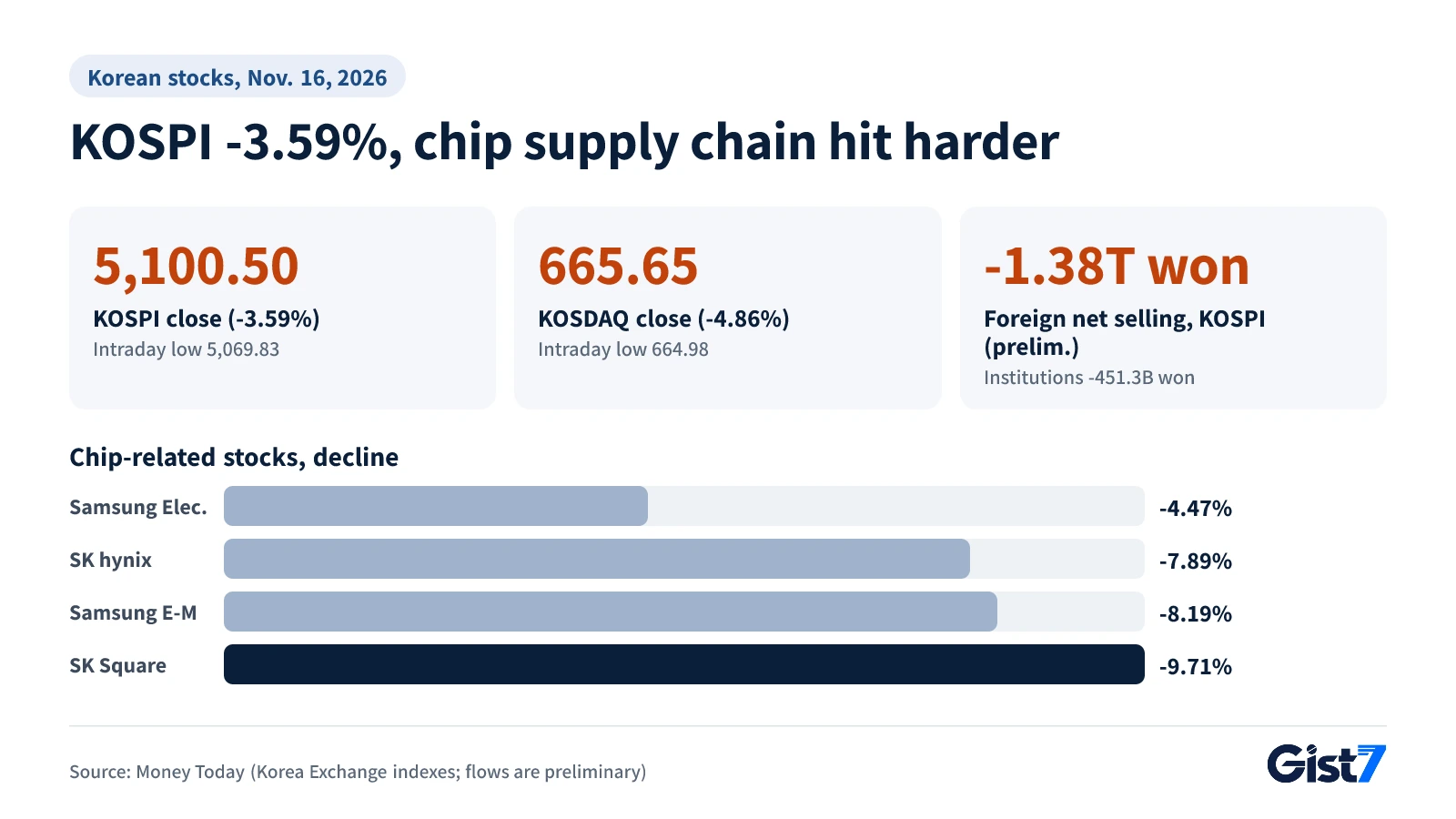
- Nov. 16, 2026: KOSPI 5,100.50 (-3.59%), KOSDAQ 665.65 (-4.86%); KOSPI down 5.11% over three sessions
- Foreigners sold a net 1.3769 trillion won and institutions 451.3 billion won of KOSPI shares; retail bought 1.3398 trillion won (prelim.)
- Nvidia supply-chain names fell hardest: SK hynix -7.89%, SK Square -9.71%, Samsung Electro-Mechanics -8.19%
- A U.S. court on Nov. 14 denied a motion to dismiss the DRAM price-fixing class action, so the case proceeds
- The won closed at 1,335.7 per dollar, 1.0 won stronger, helped by exporter dollar sales and a firmer yen
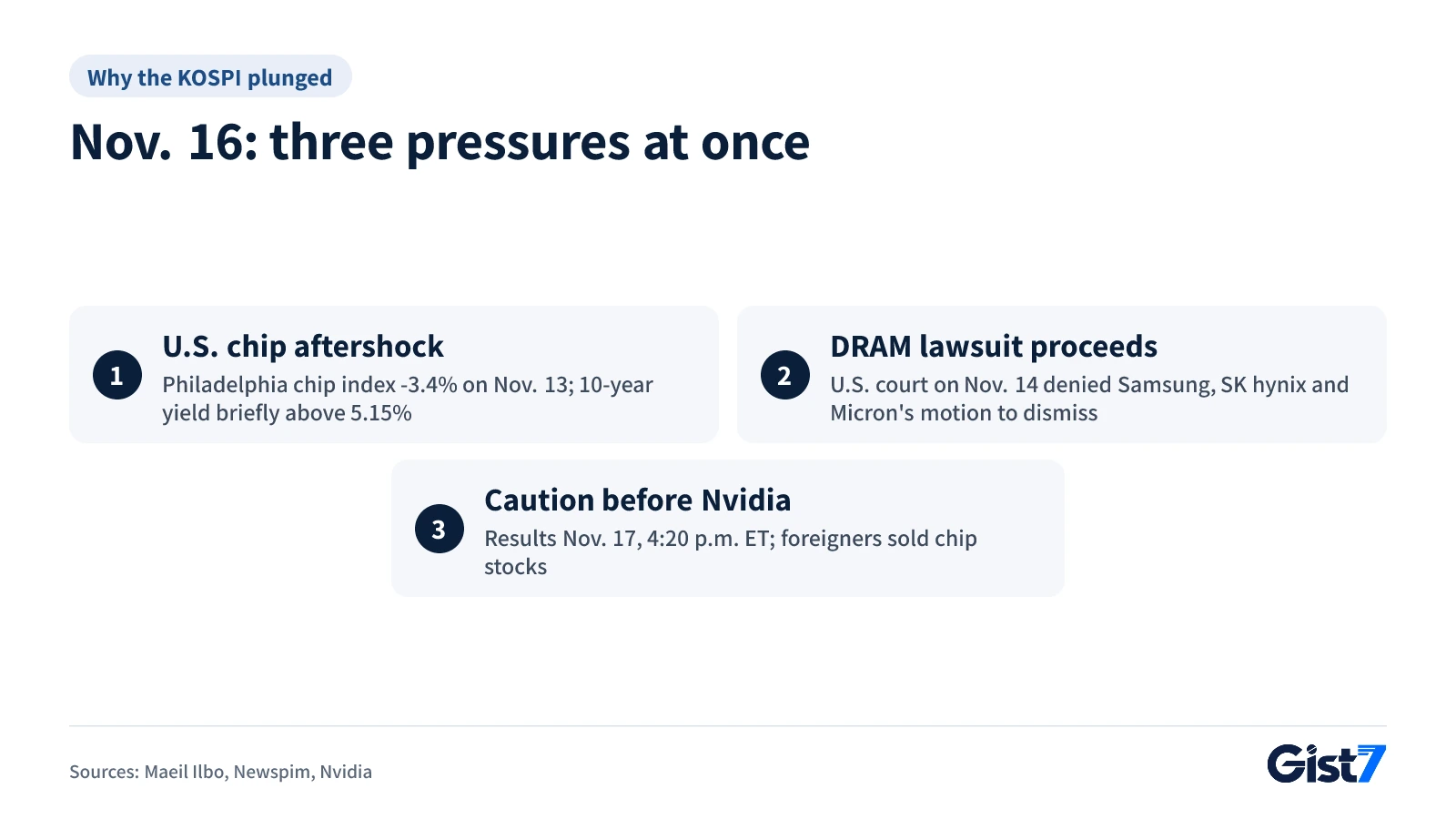
South Korea's benchmark KOSPI fell 190.03 points, or 3.59%, to 5,100.50 on Monday, November 16, 2026, while the tech-heavy KOSDAQ dropped 4.86% to 665.65. The KOSPI plunge came from three pressures hitting at once: the aftershock of Friday's U.S. chip sell-off, a U.S. DRAM price-fixing lawsuit against Samsung Electronics (KOSPI: 005930) and SK hynix (KOSPI: 000660) moving forward, and foreign investors cutting chip exposure ahead of Nvidia's earnings this week. According to preliminary figures compiled by Money Today, foreign investors sold a net 1.377 trillion won (about $1.03 billion) of KOSPI shares and institutions sold 451.3 billion won, while retail investors bought 1.34 trillion won.
The KOSPI plunge: three triggers and the day's flows
All three triggers pointed at semiconductors, and foreign and institutional investors did the selling. The index opened higher, then slid more than 4% intraday as sell orders piled into large-cap chipmakers. Money Today reported that the KOSPI opened at 5,305.40 (+0.28%), rose to 5,327.99, sank as low as 5,069.83 (-4.17%) and barely held the 5,100 level at the close. The KOSDAQ also opened higher at 705.88 before falling to 664.98.
| Nov. 16, 2026 | KOSPI | KOSDAQ |
|---|---|---|
| Open | 5,305.40 (+0.28%) | 705.88 (+0.89%) |
| Intraday high | 5,327.99 | 708.34 |
| Intraday low | 5,069.83 (-4.17%) | 664.98 (-4.96%) |
| Close | 5,100.50 (-3.59%) | 665.65 (-4.86%) |
| Foreign investors | -1.3769 trillion won | -209.7 billion won |
| Institutions | -451.3 billion won | -154.0 billion won |
| Retail investors | +1.3398 trillion won | +376.7 billion won |
Source: Money Today (Korea Exchange index data; investor flows are preliminary figures at the close). Maeil Ilbo put foreign net selling on the KOSPI at 1.3838 trillion won, so figures vary slightly by outlet.
This was not a one-day event. The KOSPI has now fallen for three straight sessions from 5,375.36 on Nov. 11, a 5.11% drop over that stretch (Gist 7 calculation). We covered the Nov. 13 session, when the index touched 5,500 and then reversed, in our piece on the KOSPI's 5,504-to-5,290 intraday reversal. On that day, money rotated from chips into banks. On Nov. 16, the selling spread across the entire chip supply chain.
Company snapshot
| Item | Details |
|---|---|
| Legal name | SK hynix Inc. |
| Ticker / exchange | 000660 · KOSPI / ADR SKHY · Nasdaq (listed July 10, 2026) |
| Headquarters | Bubal-eup, Icheon, Gyeonggi Province, South Korea |
| Founded | 1983 (as Hyundai Electronics Industries, per company history) |
| Industry | Memory chips (DRAM and NAND flash) |
| CEO | Kwak Noh-jung |
| Nov. 16 close | 1,120,000 won (-7.89%, Money Today) |
Why did SK hynix fall harder than Samsung Electronics?
SK hynix fell 7.89%, far more than Samsung Electronics' 4.47%, most likely because the selling concentrated in AI-linked chip stocks. Money Today reported that SK hynix closed at 1.12 million won and Samsung at 196,800 won. SK Square (KOSPI: 402340), which holds a stake in SK hynix, lost 9.71%, and Samsung Electro-Mechanics (KOSPI: 009150) fell 8.19%. No filing or report pins down exactly what drove the gap between the two chipmakers, so this explanation is an interpretation.
The DRAM lawsuit hits Samsung Electronics just as much as SK hynix, so it does not explain the gap between them. It did add a fresh burden for both. According to Newspim, the U.S. District Court for the Northern District of California on Nov. 14 (local time) denied a motion by Samsung Electronics, SK hynix and Micron Technology (Nasdaq: MU) to dismiss a DRAM price-fixing class action. The plaintiffs are 14 U.S. consumers and three small PC assemblers. They allege that since 2022 the three companies cut output of commodity DRAM and shifted capacity to high-bandwidth memory (HBM), causing shortages and a price spike. HBM is a type of memory for AI accelerators that stacks DRAM dies in layers to move data much faster.
The ruling is not a finding that collusion occurred. The court only found enough circumstantial facts to let the case proceed, and the three companies argue that their production cuts were independent business decisions (Newspim). A similar DRAM suit filed in 2018 was ultimately dismissed in 2022. What seemed to weigh on the market was the timing more than the case itself. With Nvidia's earnings, the key gauge of AI memory demand, two days away, news that memory supply strategy would be argued in court gave investors one more reason to sell.
Selling was even heavier among KOSDAQ equipment and component makers. Money Today reported that Simmtech (KOSDAQ: 222800) fell 13.38%, Jusung Engineering (KOSDAQ: 036930) 11.88% and EO Technics (KOSDAQ: 039030) 9.79%. Maeil Ilbo said chip materials, parts and equipment stocks, battery makers and biotech names were weak on the KOSDAQ. On the other side, KB Financial Group (KOSPI: 105560) rose 1.64% and Samsung Life Insurance (KOSPI: 032830) gained 0.60%. Maeil Ilbo added that food and consumer staples such as Samyang Foods (KOSPI: 003230), Lotte Wellfood (KOSPI: 280360) and KT&G (KOSPI: 033780) also rose. Gist 7 reads this as money moving into sectors whose earnings depend less on the AI investment cycle.
Ahead of Nvidia's earnings, what did the market sell in advance?
The market sold the uncertainty before Nvidia's results, not the results themselves. Nvidia (Nasdaq: NVDA) will report third-quarter results after the U.S. close on Nov. 17, at about 4:20 p.m. ET (6:20 a.m. Nov. 18 in Seoul), and hold its conference call at 5 p.m. ET, according to the company. It is the first earnings report under interim leadership since Jensen Huang's resignation. The background is in our piece on Huang's resignation and Nvidia's plunge.
Signals from Wall Street were weak too. According to Maeil Ilbo, on Nov. 13 (U.S. time) the Philadelphia Semiconductor Index fell 3.4%, while Advanced Micro Devices (Nasdaq: AMD) dropped 8.8%, Broadcom (Nasdaq: AVGO) 4.8% and CoreWeave (Nasdaq: CRWV) 6.1%. The 10-year Treasury yield briefly topped 5.15% the same day. Higher rates raise interest costs for AI companies that borrow to build data centers, which in turn clouds the outlook for memory orders. Maeil Ilbo also cited Treasury Secretary Scott Bessent, who pointed to Nvidia's China sales and mentioned the need to bring in an outside CEO, along with concerns about tighter U.S. export controls on AI chips to China.
Lee Kyung-min, an analyst at Daishin Securities, said caution was building ahead of Nvidia's earnings and the listing of Anthropic (private), while uncertainty from the scandal around former CEO Huang lingers (Maeil Ilbo). The full U.S. calendar for the week is in our preview of a U.S. market waiting on Nvidia.
The one question Gist 7 is watching this week: can Nvidia beat the $108 billion (±2%) third-quarter revenue outlook it gave in August, and can interim management explain its position on China sales and export controls? If both boxes are checked, Monday's selling will look like risk trimmed in advance. If not, it gives the chip supply-chain sell-off a reason to continue.
What it means for foreign investors: stocks fell 3.6%, so why did the won hold?
For overseas investors holding Korean stocks in dollars, Monday's loss was almost exactly the decline in share prices. Foreign investors sold more than 1 trillion won of stock, yet the won did not weaken. According to eToday, the won closed the daytime session (3:30 p.m. Seoul) at 1,335.7 per dollar, 1.0 won stronger, trading in a narrow 5.7-won range of 1,332.9 to 1,338.6.
Two things held the won up. Exporters kept converting dollar earnings into won, and when the yen turned stronger intraday, the won moved with it (eToday). Export data support the flow. Yonhap, citing preliminary Korea Customs Service data, reported that exports for Nov. 1-10 rose 111.9% from a year earlier. Adjusted for working days (7.5 this year vs. 7 last year), daily average exports were still up 97.7%, led by semiconductors. Selling in the stock market did not spill over into dollar demand in the currency market.
| For overseas investors | Figure | Basis |
|---|---|---|
| KOSPI (in won) | -3.59% | Nov. 16 close, Korea Exchange |
| Won per dollar | 1,335.7 (-1.0 won) | Nov. 16 daytime close, eToday |
| KOSPI (in dollars) | about -3.52% | Gist 7 calculation (vs. 1,336.7 on Nov. 13) |
| EWY regular session | $142.78 (-1.79%) | Nov. 13 close (ET), Yahoo Finance |
| EWY overnight trading | $139.21 (-2.50%) | around 2:18 a.m. ET Nov. 16 (4:18 p.m. Seoul), Yahoo Finance |
The iShares MSCI South Korea ETF (NYSE Arca: EWY) is the main vehicle overseas investors use to trade Korean equities. According to Yahoo Finance, EWY changed hands at $139.21 in overnight trading at around 4:18 p.m. Seoul time on Nov. 16, after the Seoul close, 2.50% below its Nov. 13 close. Overnight prices are based on thin volume and can differ from the regular session. For dollar-based investors, Monday's loss came from chip stocks rather than the currency, so the next checkpoint is Nvidia's report on the morning of Nov. 18 in Seoul (the evening of Nov. 17 in New York).
Market impact map
Background: On Nov. 13 (U.S. time) the Philadelphia Semiconductor Index fell 3.4% and the 10-year Treasury yield briefly topped 5.15% (Maeil Ilbo). Both were causes of Monday's move in Seoul, so they are left out of the table below.
| Asset / indicator | Direction | Strength | Link (why) |
|---|---|---|---|
| KOSPI | ↓ | Strong | Foreign net selling of 1.3769 trillion won and institutional selling of 451.3 billion won (prelim.) → dumping of chip heavyweights → -3.59% |
| Semiconductor stocks | ↓ | Strong | Caution before Nvidia's earnings, DRAM lawsuit proceeding → SK hynix -7.89%, Samsung Electronics -4.47% |
| KOSDAQ | ↓ | Strong | Chip equipment and parts slump → Simmtech -13.38%, Jusung Engineering -11.88% → -4.86% |
| Banks, insurers, food | ↑ | Weak | Buying shifted to sectors less exposed to the economy and AI spending → KB Financial +1.64% |
| U.S.-listed Korea ETF (EWY) | ↓ | Moderate | -2.50% in overnight trading after the Seoul close (Yahoo Finance) |
Little direct impact: 2-year Treasury yield, 10-year Treasury yield, dollar index, won/dollar, gold, oil (WTI), bitcoin, S&P 500, Nasdaq
- Currency exchange and overseas payments: Despite the equity rout, the won/dollar rate barely moved at 1,335.7. A bank dealer expects a 1,320-1,360 range for now (eToday).
- Equity funds and pensions: Among Korean equity products, those with heavier chip weightings took bigger losses on the day.
- Retail investors: Individuals bought a net 1.3398 trillion won of KOSPI shares. Stocks bought on margin face a higher risk of forced liquidation if the decline continues.
Market reactions can vary with other factors, and this table is not a basis for investment decisions.
What to watch next
| Date (Seoul time) | Indicator / event | Previous | Link to this story | If it comes in… |
|---|---|---|---|---|
| Nov. 18 (Wed) 06:20 (Nov. 17, 4:20 p.m. ET) | Nvidia fiscal 2027 Q3 results; call at 07:00 (5 p.m. ET) | Q2 revenue $96.2B; Q3 company outlook $108B ±2% (Nvidia) | Direction for chip heavyweights and foreign flows | A beat plus a clear China and export-control explanation tends to support chip stocks; a miss tends to extend supply-chain selling |
| Nov. 19 (Thu) 04:00 (Nov. 18, 2 p.m. ET) | FOMC minutes (Oct. 27-28 meeting) | n/a; released three weeks after the meeting (Fed) | 10-year yield above 5% and AI firms' funding costs | Concrete talk of further hikes tends to lift yields and weigh on growth stocks and emerging markets |
| Dec. 7 (Mon, U.S. time) | Deadline for defendants' answer in DRAM class action | Motion to dismiss denied Nov. 14 (Newspim) | Legal risk for Samsung Electronics and SK hynix | A detailed defense from the companies tends to ease lawsuit worries |
Dates are based on Nvidia's notice (conference call at 5 p.m. ET on Nov. 17), the Federal Reserve's November calendar (minutes at 2 p.m. ET on Nov. 18) and the court schedule reported by Newspim. The court's first case management conference is set for Jan. 12, 2027.
Frequently asked questions
Why did the KOSPI fall 3.6% on November 16?
Three pressures overlapped: the aftershock of a 3.4% drop in the Philadelphia Semiconductor Index on Nov. 13, a U.S. DRAM price-fixing lawsuit against Samsung Electronics and SK hynix moving forward, and caution before Nvidia's Nov. 17 (ET) earnings. Foreign investors sold a net 1.3769 trillion won of KOSPI shares (preliminary), mostly chip heavyweights.
Does the DRAM lawsuit mean Samsung and SK hynix colluded?
No. The U.S. District Court for the Northern District of California only denied the motion to dismiss and let the case proceed; it did not find that collusion occurred. The defendants say their output cuts were independent decisions, and their answer is due Dec. 7.
When does Nvidia report earnings?
Nvidia reports after the U.S. close on Nov. 17, at about 4:20 p.m. ET, with a conference call at 5 p.m. ET. In Seoul that is about 6:20 a.m. and 7 a.m. on Wednesday, Nov. 18.
Why did the won barely move while Korean stocks plunged?
Exporters kept selling dollars and the yen turned stronger intraday, offsetting the dollar demand from foreign stock sales. The won closed at 1,335.7 per dollar on Nov. 16, 1.0 won stronger.
How much did dollar-based investors lose on the day?
Because the won barely moved, the KOSPI's loss in dollar terms was about 3.52%, close to the 3.59% loss in won (Gist 7 calculation). The U.S.-listed EWY ETF traded at $139.21 in overnight trading after the Seoul close, 2.50% below its Nov. 13 close.
References
- 상승 출발했던 코스피 3.6% 급락 마감…5070까지 밀려 — 머니투데이
- 엔비디아 여진에 D램 담합 소송까지... 코스피 3.59% 급락 [마감시황] — 매일일보
- 美법원, D램 담합 소송 허용…삼성·SK하이닉스 'HBM 생산' 영향주나 — 뉴스핌
- [환율마감] 원·달러 껌장 속 소폭 하락, 네고+엔화 강세 — 이투데이
- 11월 초순 수출 112% 증가한 335억달러 — 연합뉴스(한민족센터)
- iShares MSCI South Korea ETF (EWY) Historical Data — Yahoo Finance
- NVIDIA Sets Conference Call for Third-Quarter Financial Results — NVIDIA
- NVIDIA Announces Financial Results for Second Quarter Fiscal 2027 — SEC EDGAR
- Federal Reserve Board — November 2026 calendar — Federal Reserve
- 회사 소개 — SK하이닉스
- SK하이닉스, 미국 나스닥 ADR 상장 — SK하이닉스 뉴스룸
- SK hynix Inc. (SKHY) — Yahoo Finance