KOSPI Below 5,000: When Will Foreign Selling Stop?
Key summary
The KOSPI fell below 5,000 as foreign selling ahead of Nvidia's earnings spread from chips to the whole market. On Nov. 17, 2026, it closed at 4,968.48 (-2.59%), its lowest since February. Foreigners sold about 3.8 trillion won in three sessions, yet the won fell by just 2.5 won per dollar.
- KOSPI closed at 4,968.48 (-2.59%) on Nov. 17, its first close below 5,000 in about nine and a half months
- Foreigners net sold 1.443 trillion won that day and about 3.8 trillion won over three sessions; institutions turned net buyers of 539.3 billion won
- On Nov. 16 chips led the fall; on Nov. 17 all top-20 stocks fell, with 709 decliners and 185 advancers
- The won held at 1,338.2 per dollar (+2.5), and the two-day loss in dollars was about 6.19%
- First checkpoints: Nvidia's Q3 results (Nov. 17 after the U.S. close) and Anthropic's listing on Nov. 19 (U.S. time)
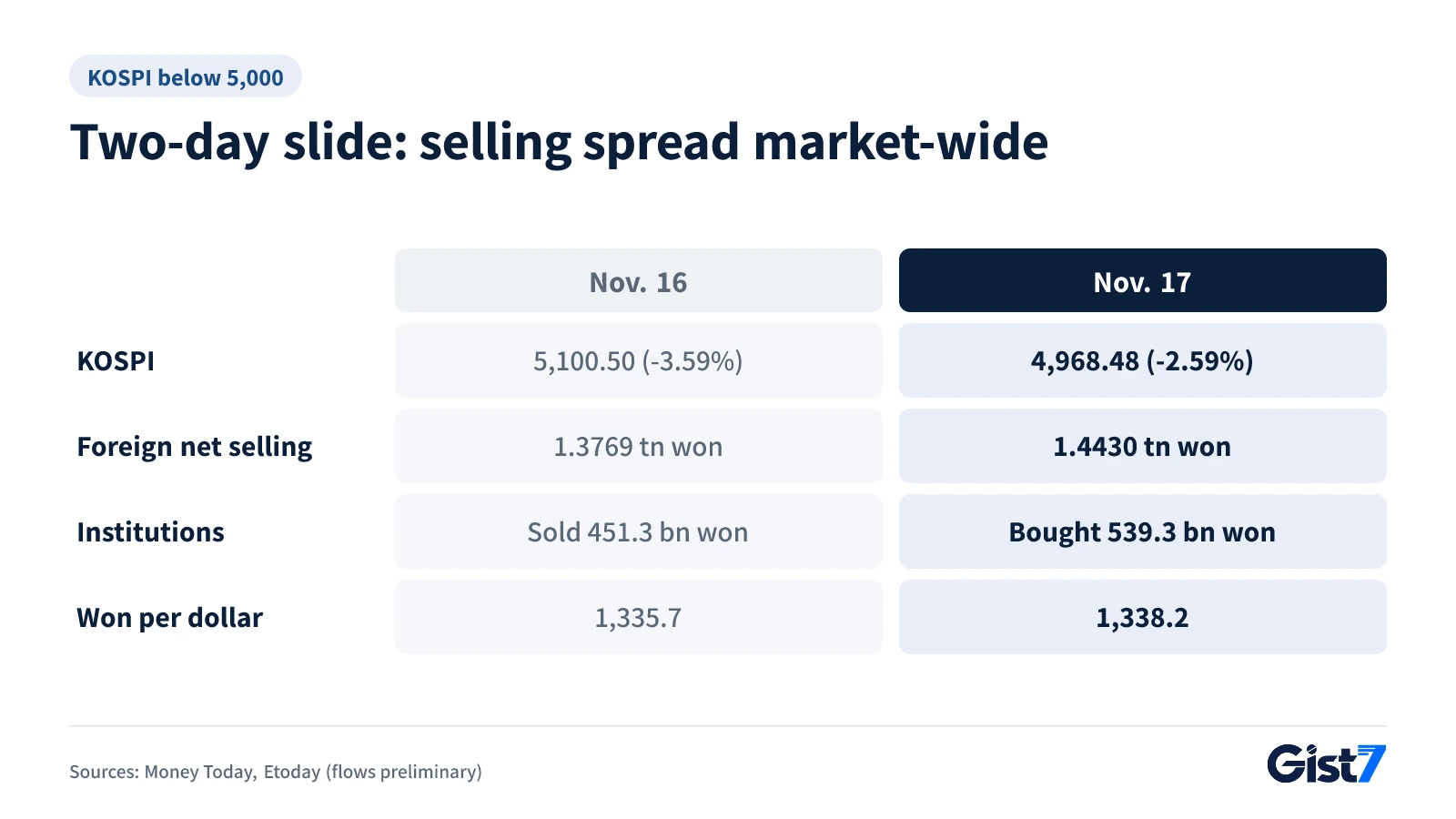
The KOSPI fell 132.02 points, or 2.59%, to 4,968.48 on Nov. 17, 2026, putting Korea's benchmark below 5,000 at the close. According to Money Today, it was the first close under that level since Feb. 2 (4,949.67), about nine and a half months ago. Foreign selling drove the KOSPI below 5,000: overseas investors dumped a net 1.443 trillion won of KOSPI shares that day, and Etoday puts their net selling over the past three sessions at about 3.8 trillion won. After a 3.59% drop the day before, the index has lost 6.09% in two sessions (from the Nov. 13 close of 5,290.53, Gist 7 calculation).
KOSPI below 5,000: what changed between the two sell-offs
Both days were steep declines, but they were not the same sell-off. On Nov. 16, chipmakers took the brunt while banks and food stocks actually rose. On Nov. 17, chip losses narrowed and almost every sector fell together. Decliners outnumbered advancers 709 to 185 (Etoday), and Money Today reported that all 20 of the largest KOSPI stocks by market value closed lower.
| Nov. 16 | Nov. 17 | |
|---|---|---|
| KOSPI close | 5,100.50 (-3.59%) | 4,968.48 (-2.59%) |
| KOSDAQ close | 665.65 (-4.86%) | 650.06 (-2.34%) |
| Foreign investors (KOSPI) | -1.3769 trillion won | -1.4430 trillion won |
| Institutions (KOSPI) | -451.3 billion won | +539.3 billion won |
| Individuals (KOSPI) | +1.3398 trillion won | +426.1 billion won |
| SK hynix | -7.89% | -1.96% |
| KB Financial | +1.64% | -2.97% |
| Won per dollar (3:30 p.m. close) | 1,335.7 (-1.0) | 1,338.2 (+2.5) |
Sources: Nov. 17 figures from Money Today and Etoday (flows are preliminary closing data); Nov. 16 figures from Money Today and Etoday as compiled in our SK hynix 7.9% plunge story. Etoday counts Nov. 17 foreign net selling at 1.4460 trillion won, so outlets differ slightly.
The buyers and sellers changed too. On Nov. 16, foreigners and institutions sold together while retail investors absorbed the shares. On Nov. 17, institutions turned net buyers of 539.3 billion won, and retail buying shrank to about a third of the previous day. Only foreign selling got bigger.
From chips to financials and utilities: why the selling spread
What set Nov. 17 apart was that the financial and insurance stocks that had attracted buying the day before were sold as well. According to Money Today, the electricity and gas sector fell 4.87%, and insurance, construction, machinery and transport equipment each lost more than 3%. Samsung Life Insurance (KOSPI: 032830) dropped 4.54%, Shinhan Financial Group (KOSPI: 055550) 3.53% and KB Financial Group (KOSPI: 105560) 2.97%. Only a few sectors, such as textiles and apparel and medical and precision instruments, gained.
Chip stocks actually fell less. Samsung Electronics (KOSPI: 005930) slid 3.30% to 190,300 won, and SK hynix (KOSPI: 000660) lost 1.96% to 1,098,000 won. Etoday noted that SK hynix closed below 1.1 million won for the first time in about seven months. Battery and robotics names were weaker: LG Energy Solution (KOSPI: 373220) fell 4.08%, Ecopro (KOSDAQ: 086520) 3.15%, and Robotis (KOSDAQ: 108490), which swung to a third-quarter loss, tumbled 8.64%.
The trigger came from Wall Street. According to Etoday, on Nov. 16 (U.S. time) the Philadelphia Semiconductor Index fell 5.28%, Nvidia (Nasdaq: NVDA) 4.12% and Micron Technology (Nasdaq: MU) 7.59%. The Nasdaq Composite dropped 2.49%, its third straight losing session. Money Today pointed to the leadership vacuum at Nvidia after Jensen Huang stepped down as CEO, caution ahead of Nvidia's earnings, and tighter AI chip export controls from the U.S. Bureau of Industry and Security, including curbs on Chinese remote access and prior approval for exports to Southeast Asia and Brazil.
Lee Kyung-min, head of FICC research at Daishin Securities, said continued foreign dumping pulled down the whole AI value chain and the hit to sentiment spread to other sectors (Money Today). Gist 7 reads this as investors cutting their overall exposure to Korean stocks rather than rotating between sectors. On the day only chips were sold, financials held the market up. On Nov. 17, that support was gone.
Why are foreigners still selling, and when will they come back?
Foreign investors are selling because they are not sure money will keep flowing into AI investment, and there is no date yet for their return. The first checkpoint is Nvidia's third-quarter results, due early Nov. 18 Korea time. Han Ji-young, an analyst at Kiwoom Securities, said the risk around former CEO Huang could shrink the Nvidia-centered AI investment and circular financing ecosystem, and that the Federal Reserve flagging AI as a risk in its Financial Stability Report fits the same picture (Money Today). Circular financing describes AI companies investing in one another and then using that money to buy each other's products.
The scale of the selling shows this is not just a chip story. According to Etoday, foreigners net sold about 3.8 trillion won on the KOSPI over three sessions and about 1.2 trillion won on the KOSDAQ over nine sessions. On Nov. 10, foreigners turned net buyers for the first time in eight sessions, as covered in our KOSPI 4.39% rebound story. Since Nov. 13 they have been net sellers for three straight sessions.
Nvidia will hold its conference call at 5 p.m. ET on Nov. 17 (7 a.m. Nov. 18 in Seoul), with results released about 40 minutes earlier (Nvidia announcement). Im Jeong-eun, an analyst at KB Securities, said Nvidia's results and outlook could mark a turning point for sentiment (Etoday).
| Signal that could bring foreigners back | When (Korea time) | Why it matters |
|---|---|---|
| Does Nvidia's Q3 revenue beat its own $108 billion ±2% outlook? | Early Nov. 18 (Wed) | Direct read on memory demand and flows into large chip stocks |
| Vera Rubin supply schedule, customers' spending plans for next year, a new CEO | Nov. 18 (Wed) 7 a.m. call | Key variables for Korean chip stocks, per Yang Hyun-kyung of iM Securities |
| Anthropic's IPO price and post-listing demand | Pricing Nov. 18, trading Nov. 19 (U.S. time) | Lee Sang-yeon of Shinyoung Securities: a strong debut could ease AI funding worries |
| Size of foreign net selling and the won | Every market close | Shows whether stock selling turns into money leaving the won |
Sources: Money Today (Nov. 17), Nvidia. The listing schedule for Anthropic (private) is as reported by Money Today.
What it means for overseas investors: why did EWY fall a day before Seoul?
Because the U.S.-listed Korea ETF priced in Seoul's Nov. 17 drop one day early. The iShares MSCI South Korea ETF (NYSE Arca: EWY) is the main vehicle overseas investors use to trade Korean equities. According to Yahoo Finance, EWY fell 4.36% to $136.55 in regular U.S. trading on Nov. 16, absorbing that day's U.S. chip rout before Seoul opened. In overnight trading after the Seoul close it was at $135.26, a move of less than 1%, but overnight volume is thin, so that is only a rough guide.
Measured in dollars, the KOSPI's two-day loss was about 6.19%, almost the same as the 6.09% loss in won. Even though foreigners sold about 3.8 trillion won of shares over three sessions, the won weakened by only 1.5 won per dollar over the two days, so the currency did not add to the loss.
| For dollar-based investors | Figure | Basis |
|---|---|---|
| KOSPI two-day return (won) | -6.09% | 5,290.53 on Nov. 13 to 4,968.48 on Nov. 17, Gist 7 calculation |
| Won per dollar | 1,336.7 to 1,338.2 | Nov. 13 derived from the Nov. 16 close and daily change; Nov. 17 is the 3:30 p.m. close (Etoday) |
| KOSPI two-day return (in dollars) | about -6.19% | Gist 7 calculation |
| EWY regular session | $136.55 (-4.36%) | Nov. 16 close (ET), Yahoo Finance |
The reason the won barely moved lies in currency flows. According to Etoday, the won weakened past 1,340 per dollar early on Nov. 17 as foreigners bought dollar futures, then exporters' dollar sales in the afternoon pulled it back to close at 1,338.2. Moon Jeong-hee, chief economist at KB Kookmin Bank, said foreign stock selling no longer translates directly into demand to convert won into dollars (Etoday). Why the won has stayed in a 1,320 to 1,360 range is covered in our weekly won-dollar review.
Market impact map
Background: on Nov. 16 (U.S. time) the Philadelphia Semiconductor Index fell 5.28% and the Nasdaq 2.49% (Etoday, Money Today). U.S. stocks were a cause of the move in Korea, so they are left out of the table.
| Asset / indicator | Direction | Strength | Link (why) |
|---|---|---|---|
| KOSPI | ↓ | Strong | Foreign net selling of 1.443 trillion won, all top-20 stocks lower → 4,968.48 |
| KOSDAQ | ↓ | Medium | Ninth straight session of foreign selling, robotics and battery stocks weak → -2.34% |
| KOSPI sectors (chips, financials, insurance, utilities, batteries) | ↓ | Medium | Selling spread from chips to the financials and insurers that rose the day before, utilities and batteries → electricity and gas -4.87%, Samsung Life -4.54%, LG Energy Solution -4.08%, Samsung Electronics -3.30% |
| Won per dollar | ↑ | Weak | Foreign buying of dollar futures and custody-related dollar buying, offset by exporters' dollar sales in the afternoon → +2.5 won |
| U.S.-listed Korea ETF (EWY) | ↓ | Strong | Priced in the U.S. chip sell-off before Seoul → -4.36% on Nov. 16 |
Little direct impact: 2-year Treasury yield, 10-year Treasury yield, dollar index, gold, WTI crude, bitcoin, S&P 500, Nasdaq
- Currency exchange and overseas payments: despite the stock slump, the won held around 1,338 per dollar. A foreign exchange market participant (a bank dealer) quoted by Etoday expects a 1,320 to 1,360 range for now.
- Funds and pensions: on Nov. 17 even Korean equity funds with little chip exposure had a hard time avoiding losses, because financials and utilities fell too.
Market reactions can change with other variables, and this table is not a basis for investment decisions.
What to watch next
| Date (Korea time; ET in brackets) | Indicator / event | Previous | Link to this story | If it comes in... |
|---|---|---|---|---|
| Nov. 18 (Wed) about 6:20 a.m., call 7 a.m. [Nov. 17, about 4:20 p.m. / 5 p.m. ET] | Nvidia fiscal 2027 third-quarter results | Q2 revenue $96.2 billion; Q3 company outlook $108 billion ±2% (Nvidia) | First test for foreign selling of chip stocks | A beat plus clarity on China and a new CEO tends to support large chip stocks; a miss tends to extend the selling |
| Nov. 19 (Thu) 4 a.m. [Nov. 18, 2 p.m. ET] | FOMC minutes (Oct. 27-28 meeting) | Released three weeks after the meeting (Fed) | U.S. yields and the discount rate on growth stocks | Detailed talk of further tightening tends to lift yields and weigh on emerging-market stocks |
| Nov. 19 (Thu, U.S. time) | Anthropic's first day of trading (price set Nov. 18) | Private (Money Today) | Sentiment toward AI funding | A high offer price and sustained buying tend to lift AI-related stocks |
| Nov. 26 (Thu) | Bank of Korea Monetary Policy Board rate decision | 3.00% (held on Oct. 22) | Won interest-rate appeal and foreign flows into bonds and stocks | A hike tends to support the won but raises the discount rate for stocks |
Schedules are based on Nvidia's announcement (call at 5 p.m. ET on Nov. 17, results at about 4:20 p.m. ET), the Federal Reserve's November calendar (minutes at 2 p.m. ET on Nov. 18) and Money Today's report on Anthropic. The issues for the Bank of Korea meeting are laid out in our November rate hike outlook.
Frequently asked questions
When did the KOSPI last close below 5,000?
On Feb. 2, 2026 (4,949.67), about nine and a half months before the Nov. 17 close of 4,968.48. The index has fallen for four straight sessions (Money Today, Etoday).
How much have foreign investors sold in Korea recently?
They net sold 1.443 trillion won of KOSPI shares on Nov. 17 (Money Today, preliminary), and Etoday puts the three-session total at about 3.8 trillion won. On the KOSDAQ they sold about 1.2 trillion won over nine sessions.
When will foreign investors buy Korean stocks again?
There is no firm date. Korean brokers point first to whether Nvidia's Q3 revenue beats its $108 billion ±2% outlook, whether the company clarifies its new CEO and China export issues, and whether Anthropic's Nov. 19 (U.S. time) debut goes well.
Why didn't the won fall much despite heavy foreign selling?
Exporters kept selling dollars, offsetting foreign-related dollar demand. The won closed at 1,338.2 per dollar on Nov. 17, weaker by just 2.5 won, and analysts say foreign stock sales no longer translate directly into currency conversion (Etoday).
How was the Nov. 17 drop different from Nov. 16?
On Nov. 16 chipmakers were hit hardest while banks and food stocks rose. On Nov. 17 chip losses narrowed, but electricity and gas (-4.87%), insurers and financials fell too, and all of the 20 largest KOSPI stocks closed lower.
References
- 젠슨 황 사임에 5000선 깨진 코스피, 엔비디아가 다시 살릴까? — 머니투데이
- 코스피, 4거래일 연속 하락에 5000선 붕괴…9개월 만에 최저 — 이투데이
- [환율마감] 원·달러 소폭 상승, 수급 힘겨루기 속 전고후저 — 이투데이
- 박스권에 갇힌 원·달러 환율, 얼마나 더 지속될까 — 이투데이
- 5000선 사수 중인 코스피…엔비디아가 구원투수 될까? — 머니투데이
- iShares MSCI South Korea ETF (EWY) Historical Data — Yahoo Finance
- NVIDIA Sets Conference Call for Third-Quarter Financial Results — NVIDIA
- NVIDIA Announces Financial Results for Second Quarter Fiscal 2027 — SEC EDGAR
- Federal Reserve Board — November 2026 calendar — Federal Reserve