KOSPI Reclaims 5,000 on Nvidia, but Why It Wobbled Midday
Key summary
Nvidia's results lifted the KOSPI back above 5,000 on Nov. 18, 2026, but chip profit-taking and China and CEO worries dragged it from 5,133 to 4,943 before a 5,067.44 close (+1.99%). Foreigners net sold about ₩330bn for a fourth day; institutions bought over ₩510bn.
- KOSPI closed at 5,067.44 (+1.99%) on Nov. 18 after swinging between an intraday high of 5,133.14 and a low of 4,943.17
- Nvidia's supply commitments rose from $279bn to $390bn, mainly on multi-year memory procurement (Nvidia CFO commentary, CNBC); SK hynix +4.19%, Samsung Electronics +2.31%
- Foreigners went from ₩139.9bn of net buying at 10:50 a.m. to net selling at the close; net selling shrank from ₩1.443 trillion on Nov. 17 to about ₩330bn on Nov. 18
- Institutions net bought ₩511.6bn (brokerages ₩318.9bn, investment trusts ₩221.3bn); pension funds flipped from morning selling to ₩66bn of buying at the close
- Won at 1,333.0 per dollar (-5.2 won); KOSPI's one-day return in dollar terms about +2.39%
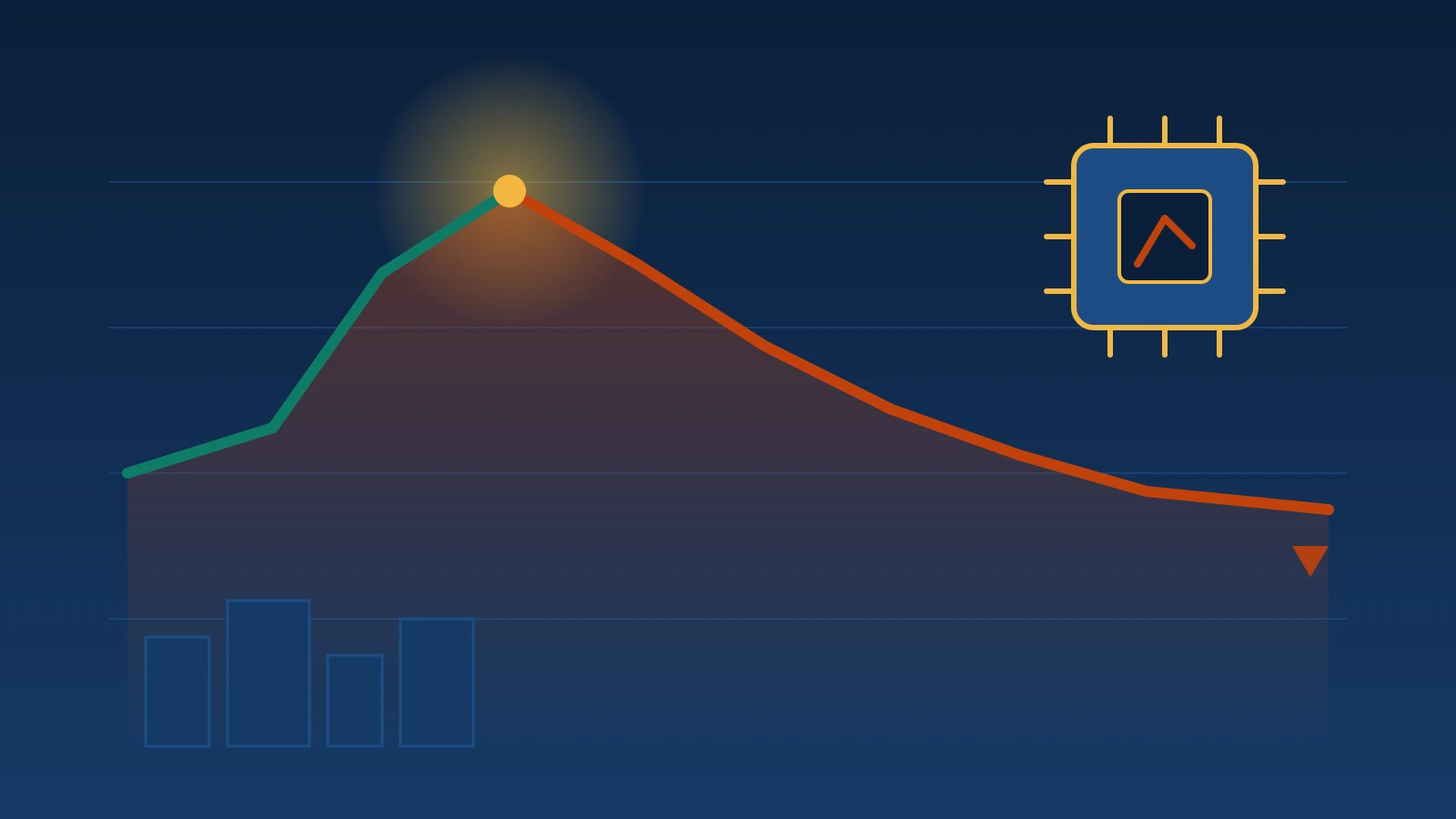
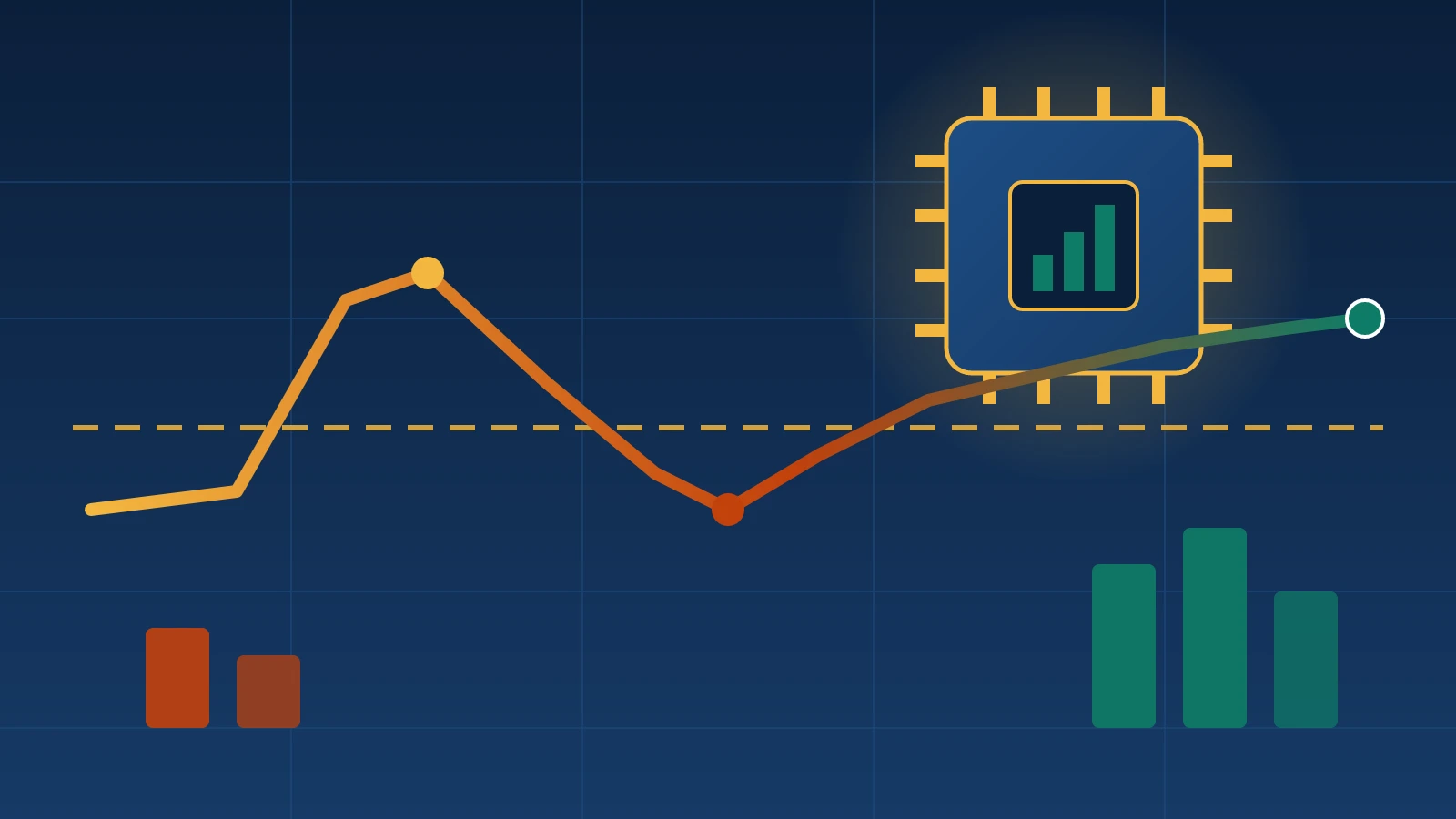
The KOSPI's return to 5,000 came at the close. On November 18, 2026, Korea's benchmark index jumped to 5,133.14 early in the session on Nvidia (Nasdaq: NVDA) earnings, turned negative around 11:17 a.m. Seoul time and slid to 4,943.17, then rallied on afternoon institutional buying to close up 98.96 points (1.99%) at 5,067.44 (Financial News, Korea Economic Daily). In a single session it reclaimed 5,000, lost it, and reclaimed it again. The KOSPI is the main index of large companies listed on the Korea Exchange.
KOSPI back above 5,000: what in Nvidia's results moved Korean chipmakers
The signal Nvidia sent to Korean chipmakers was a promise to buy more memory for longer. According to Nvidia's earnings release, revenue for the third quarter (ended October 25) was $115.8 billion, up 103% from a year earlier, and its fourth-quarter revenue outlook was $130 billion (plus or minus 3%). Nvidia's CFO commentary (filed with an SEC Form 8-K) and CNBC show supply and capacity commitments rising from $279 billion last quarter to $390 billion, mainly because of multi-year memory procurement. Interim chief executive Colette Kress raised the outlook for fiscal 2028 revenue growth from 70% to 75%.
Memory makers were the first to read those numbers. High-bandwidth memory (HBM) stacks several layers of DRAM to move data faster and sits right next to AI accelerators. So in Korea, stocks moved in the order of the memory supply chain.
| Stock | Nov. 18 close | Change | Flows and notes |
|---|---|---|---|
| SK hynix (000660) | ₩1,144,000 | +4.19% | Rose as high as ₩1,173,000 intraday; foreigners net sold ₩34.6bn |
| Samsung Electronics (005930) | ₩194,700 | +2.31% | Rose as high as ₩199,950 intraday; foreigners net sold ₩162bn |
| Samsung Electro-Mechanics (009150) | - | +7.43% | Electronic components rallied |
| SK Square (402340) | - | +4.42% | Holds a stake in SK hynix |
Sources: M Economy News (closing prices, intraday highs, foreign trading by stock), Aju Business Daily (Samsung Electro-Mechanics, SK Square). Foreign trading figures are preliminary closing data.
SK hynix (KOSPI: 000660) rose 4.19% and Samsung Electronics (KOSPI: 005930) gained 2.31%. Samsung Electro-Mechanics (KOSPI: 009150) climbed 7.43% and SK Square (KOSPI: 402340) added 4.42%, and Maeil Ilbo reported that holders of chip stakes such as Samsung Life Insurance (KOSPI: 032830) also gained. SK hynix shares rose on the day Nvidia reported, yet foreign investors were net sellers of both chip heavyweights. Domestic institutions were the ones supporting the higher prices.
Company snapshot
| Item | Details |
|---|---|
| Legal name | SK hynix Inc. |
| Ticker and exchange | 000660 · KOSPI (Korea Exchange) |
| Headquarters | Icheon, Gyeonggi Province, South Korea |
| Founded | Began chip business in 1983 as Hyundai Electronics (company incorporated in 1949); joined SK Group in 2012 |
| Industry | Semiconductors (memory: DRAM and NAND flash) |
| Main business | DRAM and NAND flash manufacturing; a major supplier of HBM for AI servers |
| Revenue | ₩97.1467 trillion in 2025 consolidated revenue (results released January 28, 2026) |
| Market cap | About ₩833.8 trillion (based on the ₩1,144,000 share price at 3:30 p.m. KST on Nov. 18, StockAnalysis) |
Sources: SK hynix Newsroom (2025 results), SK hynix 2025 annual report (Financial Supervisory Service DART), StockAnalysis
Why did the KOSPI turn negative at 11 a.m. despite Nvidia's beat?
The KOSPI dipped into the red around 11 a.m. because sell-the-news selling in chip heavyweights collided with uncertainties that the earnings numbers did not resolve. According to Financial News, the KOSPI stood at 4,999.99 at 10:50 a.m., having given back more than 80% of its early gains.
| Time (KST) | KOSPI | What the market was doing |
|---|---|---|
| 09:00 open | 5,098.82 (+2.62%) | Chip heavyweights opened sharply higher on Nvidia's results |
| Early session | 5,133.14 (+3.31%) | Intraday high |
| 10:50 | 4,999.99 (+0.63%) | Pension funds and retail selling, foreign buying shrinking |
| 11:21 | 4,962.39 (-0.12%) | Turned negative around 11:17 |
| Intraday low | 4,943.17 (-0.51%) | Time not confirmed in reports |
| 15:30 close | 5,067.44 (+1.99%) | Rebounded on afternoon institutional buying |
Sources: Financial News (open, high, 10:50, low, close), Korea Economic Daily (11:21). KST is 14 hours ahead of New York (ET).
The first factor was a sell-on-news reaction, where traders sell into good news. The Korea Economic Daily pointed to profit-taking in chip stocks as the reason for the reversal. According to Newspim, Samsung Electronics was up 4.05% at 9:05 a.m. but only 0.18% at 11 a.m. The sharp chip sell-off ahead of Nvidia's report is covered in our November 16 KOSPI plunge story.
The second factor was China. Nvidia said its fourth-quarter outlook excludes data center compute revenue from China. Newspim reported that interim CEO Kress told the earnings call that Nvidia had stopped shipping Hopper data center chips to China. Lee Jin-woo, head of research at Meritz Securities, said it remained unclear how much revenue depends on sales routed indirectly to China (Newspim).
The third factor was the leadership gap and interest rates. According to CNBC, Nvidia's board has no plans to bring Jensen Huang back as CEO and has hired an executive search firm to find a successor. Yang Hyun-kyung, an analyst at iM Securities, also noted lingering uncertainty over the choice of the next CEO (Financial News). The 10-year Treasury yield remained high at 5.08% (Maeil Ilbo). We explain why stocks fall when interest rates rise in a separate piece.
Foreigners bought in the morning and sold in the afternoon: whose money held the rebound?
The money that held the rebound came from domestic institutions, led by brokerages (financial investment) and asset managers (investment trusts). Foreign net selling stretched to a fourth day, but its size shrank to about a quarter of the previous day's. Lining up Financial News data by time of day shows flows nearly reversing within a single session.
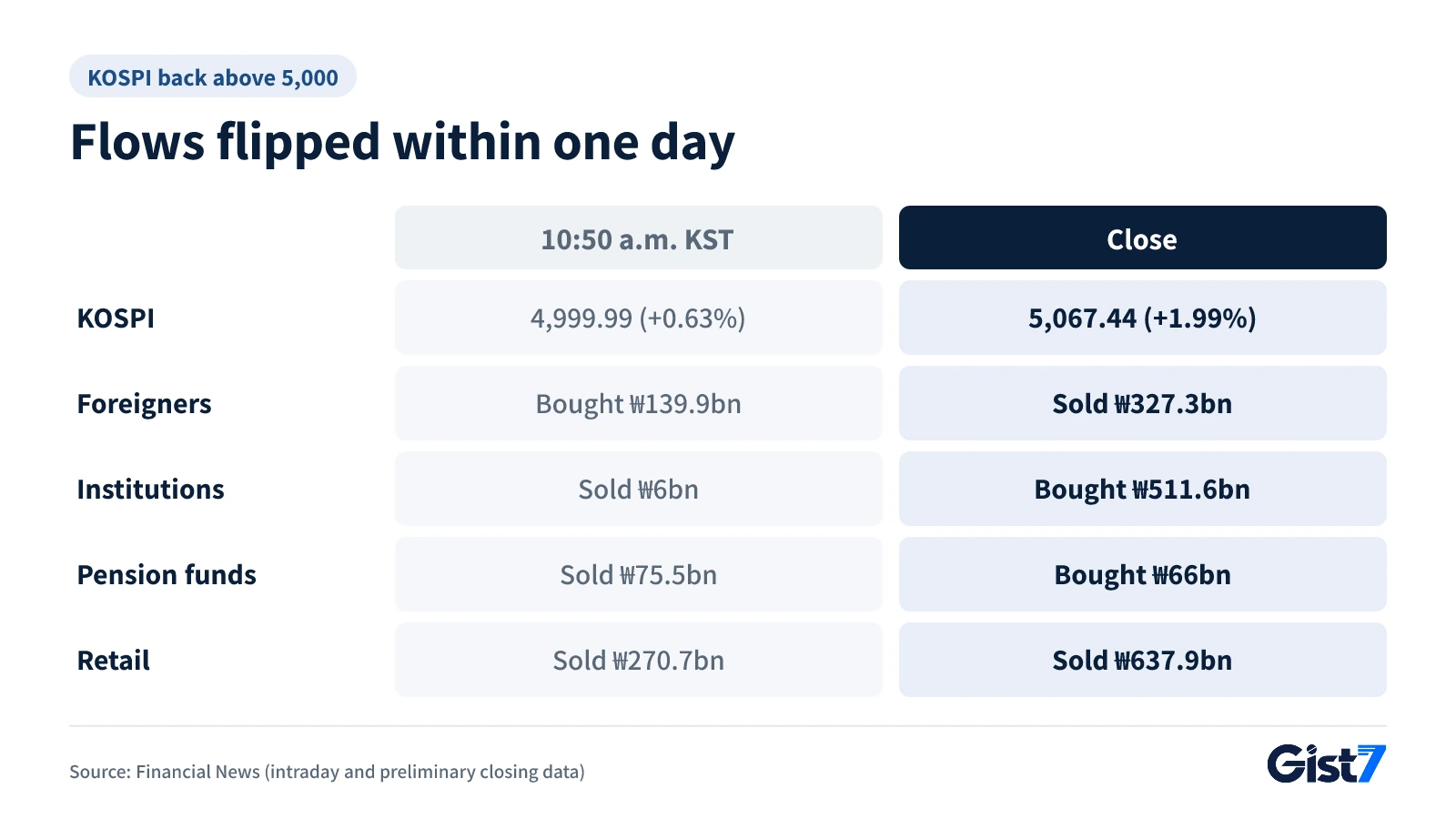
If the chart shows the big picture, the table below breaks down the buying by institutions and other corporations.
| Buyer type (KOSPI) | 10:50 a.m. | Close |
|---|---|---|
| Financial investment (brokerages) | Not reported | +₩318.9bn |
| Investment trusts (asset managers) | Not reported | +₩221.3bn |
| Brokerages and trusts combined | About +₩81.7bn | +₩540.2bn |
| Other corporations (not institutions) | Not reported | +₩460bn |
Source: Financial News (10:50 a.m. intraday data, closing data). Reported foreign net selling at the close ranges from ₩327.3 billion (Financial News) to ₩333.8 billion (EBN, Newsis), so the Korea Exchange's final figure may differ slightly.
Foreign investors were net buyers of ₩272.8 billion at 9:40 a.m. before turning to selling in the afternoon. Foreign net selling shrank from ₩1.443 trillion on November 17 to about ₩330 billion on November 18. The run of three straight days of selling above ₩1 trillion is covered in our story on the KOSPI falling below 5,000.
Institutions did not move as one. Pension funds were net sellers of as much as ₩126.6 billion at 10:30 a.m. but ended the day as net buyers of ₩66 billion (Financial News). Other corporations' net buying of ₩460 billion was also large; M Economy News data show ₩402.7 billion of it went into electrical and electronics stocks. Reports did not identify which companies did the buying.
As Gist 7 sees it, the day's rebound came from domestic money filling the gap left by lighter foreign selling. Brokerage proprietary trading and fund flows can change quickly with the direction of the index. Lee Kyung-min, an analyst at Daishin Securities, said the KOSPI's rebound could gain momentum if foreign flows turn to net buying (Aju Business Daily). Kang Jin-hyuk, a senior analyst at Shinhan Securities, said investor sentiment failed to turn decisively despite Nvidia's strong results (Financial News).
What it means for overseas investors: the won added a little to returns
Measured in dollars, the KOSPI's one-day return was about +2.39%, higher than +1.99% in won terms (Gist 7 calculation). The won-dollar rate fell from 1,338.2 to 1,333.0 won per dollar, a 0.39% gain for the won. Newsis said dollar selling by exporters pushed the rate lower. The won strengthened even though the dollar index stayed at 103.70, near the previous day's roughly 19-month high of 103.778 (M Economy News).
| For overseas investors | Figure | Basis |
|---|---|---|
| KOSPI one-day return (won) | +1.99% | 4,968.48 → 5,067.44 |
| Won per dollar | 1,338.2 → 1,333.0 | Seoul FX market daytime close (Newsis) |
| KOSPI one-day return (in dollars) | About +2.39% | Gist 7 calculation |
| EWY regular session | $135.32 (-0.90%) | Nov. 17 close in New York, Yahoo Finance |
| EWY overnight trading | $138.34 (+2.23%) | 2:16 a.m. ET on Nov. 18 (4:16 p.m. KST), Yahoo Finance |
The iShares MSCI South Korea ETF (NYSE Arca: EWY) is the main vehicle overseas investors use to trade Korean stocks. In the November 17 U.S. regular session it fell 0.90%, tracking Seoul's decline, and after Seoul closed on November 18 its overnight trading reflected the rebound. Overnight volume is thin, so the price in the U.S. regular session may differ.
Market impact map
Background: Nvidia reported after the U.S. close on November 17 ET, and the Philadelphia Semiconductor Index rose 0.34% that day (M Economy News). U.S. stocks were the cause of the move in Korea that day, so they are left out of the table.
| Asset / indicator | Direction | Strength | Link (why) |
|---|---|---|---|
| KOSPI | ↑ | Strong | Nvidia's expanded memory procurement → chip heavyweights rebound, institutions net buy ₩511.6bn → 5,067.44 |
| KOSDAQ | ↑ | Medium | Robotics stocks surge (Rainbow Robotics (KOSDAQ: 277810) +20.06%), institutional net buying → 662.81 (+1.96%) |
| Semiconductors and electronic components | ↑ | Strong | Multi-year memory procurement commitments → SK hynix +4.19%, Samsung Electro-Mechanics +7.43% |
| Pharma and biotech | ↓ | Weak | Sector lagged in the rebound (Maeil Ilbo) → Samsung Biologics (KOSPI: 207940) -3.39%, Celltrion (KOSPI: 068270) -2.58% (Aju Business Daily). Buying concentrated in chips is Gist 7's interpretation |
| Won per dollar | ↓ | Medium | Exporters selling dollars, stock rebound → 1,333.0 (-5.2 won) |
| Korea ETF listed abroad (EWY) | ↑ | Medium | Seoul's rebound reflected in overnight trading → +2.23% (indicative) |
Little direct impact: 2-year Treasury, 10-year Treasury, dollar index, gold, oil (WTI), bitcoin, S&P 500, Nasdaq
- Currency exchange and overseas payments: the won-dollar rate fell 5.2 won from the previous day, slightly easing the cost of buying dollars in Korea.
- Funds and pensions: among Korean equity funds, products heavy in chips and those heavy in biotech posted different results for the day.
Market reactions can vary with other factors, and this table is not a basis for investment decisions.
What to watch next
| Date (ET / KST) | Indicator or event | Previous | Why it matters here | If it comes in like this |
|---|---|---|---|---|
| Nov. 18 (Wed) 2:00 p.m. ET / Nov. 19 4:00 a.m. KST | FOMC minutes (Oct. 27-28 meeting) | Minutes, no figure (Fed calendar) | Pressure from a 10-year Treasury yield above 5% | Detailed talk of further tightening tends to lift yields and weigh on growth stocks such as chips |
| Expected Nov. 23 (Mon) | Korea Customs Service exports and imports for Nov. 1-20 (incl. chip exports) | Nov. 1-10 exports $33.5bn (+111.9%), chips $16.6bn (+331.2%) (Korea Customs Service, released Nov. 11) | Whether memory demand shows up in actual exports | Continued growth in chip exports tends to support earnings expectations for chip heavyweights |
| Nov. 25 (Wed) 8:30 a.m. ET / 10:30 p.m. KST | U.S. October PCE prices, Q3 GDP second estimate | September PCE 3.6% year over year, core 3.1% (BEA) | Fed tightening expectations and U.S. yields | Hotter than expected tends to lift yields and the dollar and pressure foreign money out of emerging-market stocks |
| Expected late November (media report: Nov. 26) | Bank of Korea Monetary Policy Board rate decision | 3.00% (raised Aug. 27, Bank of Korea) | Korean rates and foreign capital | A hike would support the won but weigh on stocks through a higher discount rate |
Dates are based on the Federal Reserve's November calendar (2:00 p.m. ET, November 18) and the BEA release schedule (8:30 a.m. ET, November 25). The Monetary Policy Board date is based on media reports and was not confirmed directly on the Bank of Korea's calendar. The Korea Customs Service's Nov. 1-20 trade data are expected on the 23rd because the 21st falls on a Saturday; the date should be rechecked against the agency's notice.
Frequently asked questions
When did the KOSPI get back above 5,000?
On November 18, 2026. The KOSPI rose 98.96 points (1.99%) to close at 5,067.44, reclaiming the 5,000 level a day after falling to 4,968.48 (Financial News).
Nvidia's results were strong, so why did the KOSPI turn negative intraday?
Traders sold chip heavyweights into the good news, and uncertainty over Nvidia's China revenue and its next CEO was not resolved by the earnings numbers. The KOSPI turned negative around 11:17 a.m. Seoul time and fell as low as 4,943.17 before rebounding on afternoon institutional buying (Korea Economic Daily, Financial News).
Did foreign investors sell Korean stocks again on November 18?
Yes. They were net buyers in the morning but net sold about ₩330 billion by the close (₩327.3 billion to ₩333.8 billion depending on the outlet). Foreign net selling shrank from ₩1.443 trillion on November 17 to about ₩330 billion on November 18.
Why does SK hynix stock move with Nvidia's earnings?
SK hynix is a major supplier of high-bandwidth memory (HBM), which sits next to AI accelerators, so Nvidia's sales and procurement plans read directly as memory demand. This time SK hynix rose 4.19% after Nvidia said its supply commitments grew to $390 billion because of multi-year memory procurement (CNBC).
Will the KOSPI rebound continue?
It cannot be called by date or level. Korean brokerages point to whether foreign investors turn to net buying, whether Anthropic (private), which is expected to list on the 19th (Maeil Ilbo report), draws strong demand, and whether the FOMC minutes released on November 18 ET (early November 19 in Seoul) signal further tightening.
References
- Lifted by Nvidia, pushed back by foreign selling: institutions reclaim KOSPI 5,000 [market close] — Financial News (Korean)
- Nvidia boost fades: KOSPI slips back below 5,000 on pension fund selling — Financial News (Korean)
- A brief Nvidia effect? KOSPI turns negative intraday, falls below 5,000 — Korea Economic Daily (Korean)
- Nvidia China revenue uncertainty sends KOSPI back below 5,000 — Newspim (Korean)
- [Market close] KOSPI reclaims 5,000 on Nvidia results, up nearly 2% on institutional buying — Aju Business Daily (Korean)
- KOSPI reclaims 5,000 on strong Nvidia results, rebounds 1.99% [market close] — Maeil Ilbo (Korean)
- KOSPI back above 5,000 on Nvidia results; won closes stronger at 1,333 — M Economy News (Korean)
- KOSPI ends three-day slide, reclaims 5,060 on institutional buying — EBN (Korean)
- Won closes at 1,333.0 per dollar, down 5.2 won — Newsis via Newstong (Korean)
- NVIDIA Announces Financial Results for Third Quarter Fiscal 2027 — Nvidia
- CFO Commentary on Third Quarter Fiscal 2027 Results (Form 8-K, Exhibit 99.2) — Nvidia / U.S. SEC
- Nvidia earnings live updates, Q3 fiscal 2027 — CNBC
- SK hynix 2025 results: revenue ₩97.1467 trillion, operating profit ₩47.2063 trillion — SK hynix Newsroom (Korean)
- Early-November exports up 112% to $33.5 billion — report on Korea Customs Service data (Korean)
- SK hynix annual report (2025) — Financial Supervisory Service DART (Korean)
- SK hynix (KRX: 000660) statistics — StockAnalysis
- iShares MSCI South Korea ETF (EWY) Historical Data — Yahoo Finance
- Federal Reserve Board — November 2026 calendar — Federal Reserve
- Release Schedule — U.S. Bureau of Economic Analysis
- Personal Income and Outlays, September 2026 — U.S. Bureau of Economic Analysis
- Base rate history — Bank of Korea (Korean)