Korea vs Japan prices: Is Korea now pricier than Japan?
Key summary
Korea vs Japan prices: in September 2026 Korea's consumer price level was about 1% above Japan's (101 vs Japan = 100, OECD). In 2024 Japan was pricier (80 vs 78). Inflation has been similar, so the shift came from the won-yen rate: 834.37 won per 100 yen on Nov. 16.
- OECD monthly comparative price levels: Korea 101 with Japan = 100 (September 2026)
- 2024 household consumption price level: Japan 80, Korea 78 (OECD average = 100), so the order flipped in two years
- 100 yen = 834.37 won (Nov. 16, 2026, ECOS); a 10,000-won meal went from about 935 yen (2019) to about 1,199 yen
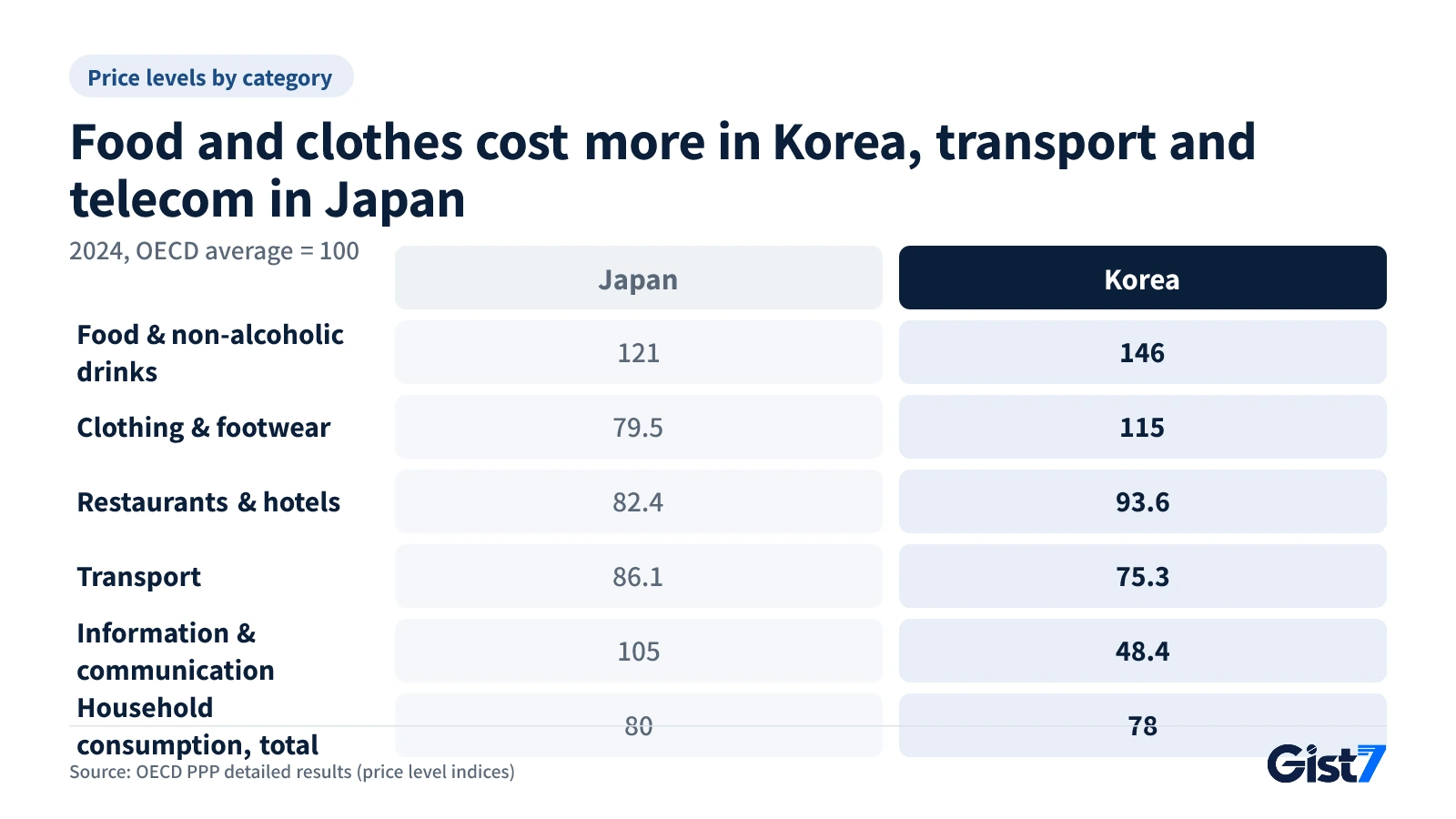
- Food (146 vs 121) and clothing (115 vs 79.5) cost more in Korea; transport, telecom and housing cost more in Japan (2024, OECD)
- October inflation was 2.8% in both Korea and Tokyo's 23 wards, so most of the felt gap comes from the exchange rate
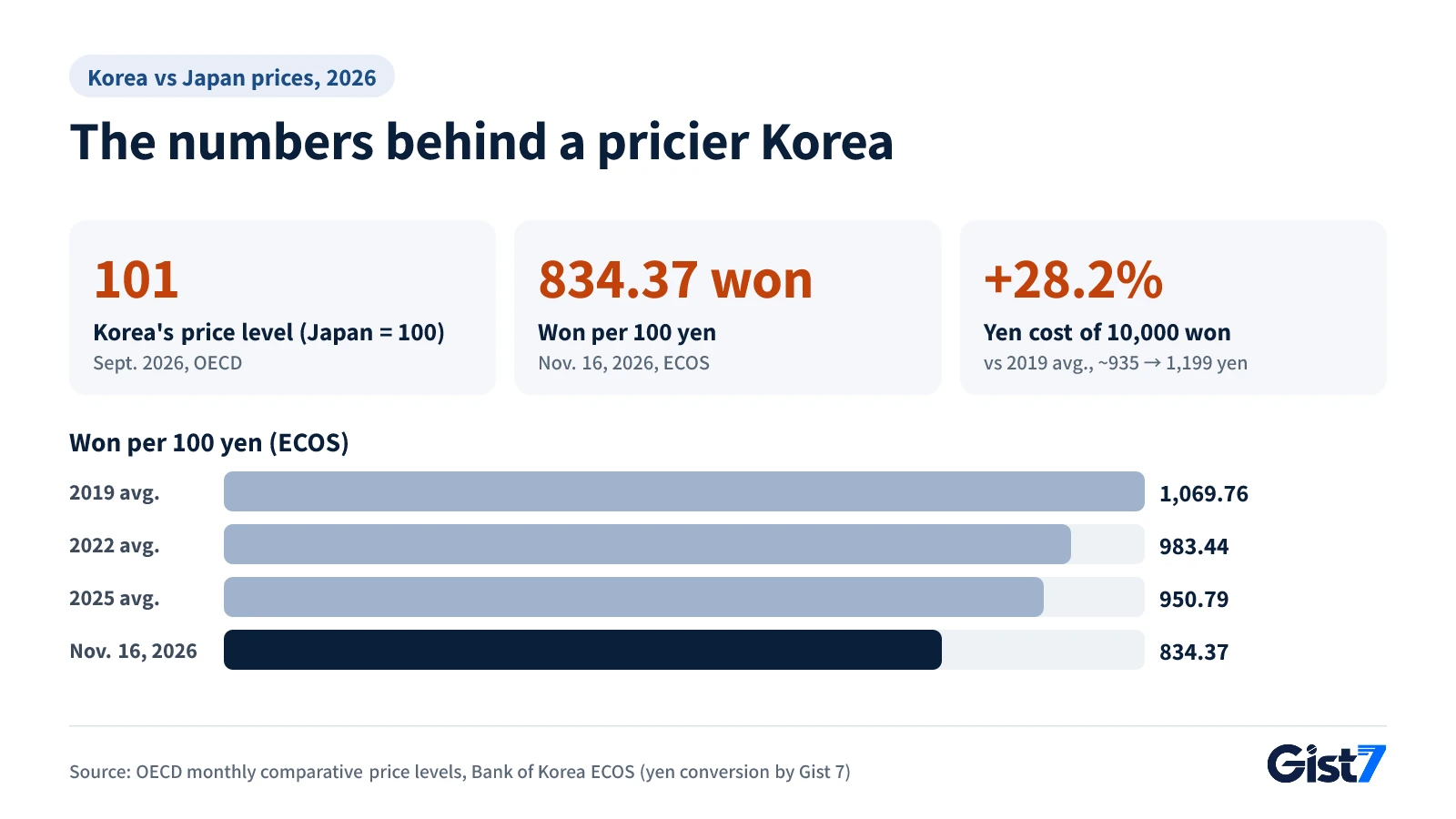
Korea's consumer price level was about 1% higher than Japan's in September 2026. In the OECD's monthly comparative price levels, the standard yardstick for Korea vs Japan prices, Korea scores 101 when Japan is set at 100. Two years earlier Japan was slightly more expensive (see table below). What flipped the order was the exchange rate more than inflation. According to the Bank of Korea's Economic Statistics System (ECOS), 100 yen bought just 834.37 won on Nov. 16, 2026.
Korea vs Japan prices: which country is more expensive now?
On a national average, Korea was about 1% more expensive than Japan in September 2026, and both sit at a little over 60% of the U.S. price level. A comparative price level converts the cost of the same consumer basket into a common currency at market exchange rates. It is calculated by dividing purchasing power parity (PPP) by the market exchange rate. PPP is a "price-based exchange rate" that would let you buy the same amount of the same goods in both countries. A reading above 100 means the country is more expensive than the base country.
| Measure | Korea | Japan | Which is higher |
|---|---|---|---|
| Household consumption price level, 2022 (OECD average = 100) | 84.5 | 95.1 | Japan, by about 13% |
| Household consumption price level, 2024 (OECD average = 100) | 78 | 80 | Japan, by about 3% |
| Comparative price level, September 2026 (U.S. = 100) | 63 | 62 | Korea, by about 2% |
| Comparative price level, September 2026 (Japan = 100) | 101 | 100 | Korea, by about 1% |
Sources: OECD PPP detailed results (price level indices, 2022-2024); OECD monthly comparative price levels (September 2026). The 63 and 62 on the U.S. = 100 basis are rounded, so the gap differs slightly from the Japan = 100 figure.
Annual figures are calculated at each year's average exchange rate. The main reason Japan's lead shrank from 13% in 2022 to 3% in 2024 was the weaker yen. On ECOS annual averages, 100 yen fell from 983.44 won in 2022 to 900.36 won in 2024. On Nov. 16, after the OECD's September reading, 100 yen fetched 834.37 won, 7% below even the 2024 average. Running the same calculation today would likely put Korea's number higher still.
These are national averages. The OECD does not publish an official price level comparison for Seoul and Tokyo alone, so comparing the two cities means looking at national averages together with each city's inflation rate.
By category: food and clothing cost more in Korea, transport and telecom in Japan
The averages are close, but the categories are not. In the OECD's 2024 price level indices (OECD average = 100), Korea scored 146 for food and non-alcoholic beverages and 115 for clothing and footwear, far above Japan's 121 and 79.5. Transport, information and communication, and housing were pricier in Japan.
| Category (2024, OECD average = 100) | Korea | Japan | More expensive |
|---|---|---|---|
| Food and non-alcoholic beverages | 146 | 121 | Korea |
| Clothing and footwear | 115 | 79.5 | Korea |
| Restaurants and accommodation | 93.6 | 82.4 | Korea |
| Transport | 75.3 | 86.1 | Japan |
| Information and communication | 48.4 | 105 | Japan |
| Housing, water, electricity and gas | 54.7 | 69.9 | Japan |
| Recreation, sport and culture | 80.7 | 88.3 | Japan |
Source: OECD PPP detailed results (price level indices). These use 2024 average exchange rates. Since the yen has weakened further against the won since then, prices in Korea look even higher to Japanese visitors today.
Where Japanese visitors feel that Korea is "expensive" is exactly in those categories. Groceries, restaurants, cafes and clothes shopping all carry higher price levels in Korea. Subway and bus fares and phone plans, which are cheaper than in Japan, make up only a small share of a Korea travel budget. Korea's food price level was 152 in 2022, 150 in 2023 and 146 in 2024, above Japan's 134, 127 and 121 in all three years.
A single burger tells the same story. In the Big Mac index data published by The Economist, a Big Mac cost 5,700 won ($3.84) in Korea and 500 yen ($3.08) in Japan in July 2026. At the exchange rates of that time, Korea was 24.4% more expensive. In July 2019 the prices were 4,500 won and 390 yen, a gap of 6.3%. Converting 5,700 won at the Nov. 16 rate (100 yen = 834.37 won) gives about 683 yen, roughly 37% more than in Japan (a Gist 7 calculation that assumes prices in both countries are unchanged since July).
Why "Korea is cheap" no longer holds: 834 won per 100 yen
If you had to name one reason Korean prices feel high to Japanese visitors, it is the won-yen exchange rate. The won value of 100 yen dropped from an average of 1,069.76 won in 2019 and 950.79 won in 2025 to 834.37 won on Nov. 16, 2026 (ECOS). A 10,000-won meal in Korea cost about 935 yen at the 2019 average rate. Today it costs about 1,199 yen.
| Period | Won per 100 yen | 10,000 won in yen | Change vs 2019 average |
|---|---|---|---|
| 2019 average | 1,069.76 won | about 935 yen | baseline |
| 2022 average | 983.44 won | about 1,017 yen | +8.8% |
| 2024 average | 900.36 won | about 1,111 yen | +18.8% |
| 2025 average | 950.79 won | about 1,052 yen | +12.5% |
| Nov. 16, 2026 | 834.37 won | about 1,199 yen | +28.2% |
Source: Bank of Korea ECOS (annual averages from "exchange rates of major currencies against the won"; Nov. 16 is the base and cross rate). Yen conversions are Gist 7 calculations.
In the second half of 2026 the bigger force was a stronger won. The Economist's Big Mac data records exchange rates on July 1, 2026, of 1,485.9 won and 162.135 yen per dollar. On Nov. 16 the won-dollar base rate was 1,333.7 won (ECOS), meaning the won gained a little over 11% against the dollar. The yen-dollar rate implied by that day's won-dollar and won-yen rates was about 159.85 yen, a move of only 1.4% from July. With the yen roughly flat and the won stronger, Korean prices measured in yen went up. We cover the won's recent path in our weekly won-dollar analysis.
Seoul and Tokyo inflation are running at a similar pace
Prices are rising at about the same speed in both countries. According to Statistics Korea, Korean consumer prices rose 2.8% year over year in October 2026, with eating out up 2.9%. According to Japan's Ministry of Internal Affairs and Communications, consumer prices in Tokyo's 23 wards (preliminary mid-month figures) also rose 2.8% in October. In Tokyo, eating out (4.6%) and hotel charges (6.7%) rose faster than in Korea.
| Item (year over year) | Korea (Oct. 2026) | Tokyo 23 wards (Oct. 2026) | Japan nationwide (Sept. 2026) |
|---|---|---|---|
| All items | +2.8% | +2.8% | +2.1% |
| Eating out | +2.9% | +4.6% | +2.5% |
| Accommodation | not available | +6.7% | +4.6% |
Sources: Statistics Korea, October 2026 consumer price trends; Statistics Bureau of Japan consumer price index (Tokyo ku-area October preliminary, nationwide September).
With inflation running at a similar pace, most of the gap in how expensive Korea feels to Japanese visitors comes from the exchange rate. Add the roughly 14% rise in yen terms versus the 2025 average rate to Korea's 2.9% rise in restaurant prices, and the yen a Japanese diner spends at a Korean restaurant has gone up by roughly 17% (Gist 7 estimate).
Market impact map
| Asset / indicator | Direction | Strength | Link (why) |
|---|---|---|---|
| Inbound tourism, duty-free and downtown retail in Korea | ↓ | Weak | Korean prices in yen are about 14% higher than at the 2025 average rate, raising the yen cost per Japanese visitor (the effect on visitor numbers is not yet confirmed) |
| Korean travel to Japan (airlines, travel agencies) | ↑ | Medium | 10,000 yen now costs 83,437 won versus 95,079 won at the 2025 average, supporting demand for trips to Japan |
| Korean exporters competing with Japan (autos, machinery, steel) | ↓ | Weak | A stronger won combined with a weak yen makes Japanese products relatively cheaper in overseas markets |
| Won cost of Japanese imports and parts | ↓ | Weak | For the same yen price, the won payment is about 12% lower than at the 2025 average |
Little direct impact: 2-year Treasury, 10-year Treasury, dollar index, USD/KRW, gold, oil (WTI), bitcoin, S&P 500, Nasdaq, KOSPI
In this story USD/KRW is a cause rather than an effect, so it is covered in the text above instead of the table.
- Everyday impact: For Japanese travelers, a trip to Korea with the same won budget now takes about 14% more yen than at the 2025 average rate. The same goes for study costs.
- Koreans traveling to Japan or buying from Japanese online stores pay about 12% less in won for yen-priced purchases.
- Card payments carry overseas transaction fees, and currency exchange rates vary by bank and exchange office, so the real cost is higher than the base-rate calculations above.
- Because Korea's food price level is high (146 in the OECD's 2024 data), cooking for yourself at your lodging may not be cheaper than in Japan.
Market reactions can vary with other factors, and this table is not a basis for investment decisions.
What to watch next
| Date (KST) | Indicator / event | Previous | Why it matters here | If it comes in... |
|---|---|---|---|---|
| Nov. 20 (Fri) 8:30 a.m. (6:30 p.m. ET Nov. 19) | Japan October nationwide CPI (Ministry of Internal Affairs and Communications) | September +2.1%, eating out +2.5% | Whether prices in Japan catch up | Faster Japanese inflation would tend to narrow the price gap somewhat |
| Nov. 26 (Thu) | Bank of Korea monetary policy decision | Base rate 3.00% (Bank of Korea) | Whether won strength continues | A hike could add upward pressure on the won and raise the yen cost of Korean prices |
| Nov. 27 (Fri) 8:30 a.m. (6:30 p.m. ET Nov. 26) | Tokyo 23 wards November CPI (preliminary mid-month) | October +2.8%, eating out +4.6% | Tokyo restaurant and hotel prices | Faster Tokyo service inflation would tend to shrink the perceived gap with Seoul |
| Dec. 2 (Wed) | Korea November consumer price trends (Statistics Korea) | October +2.8%, eating out +2.9% | Korean restaurant and personal service prices | Faster restaurant inflation would add to the currency effect in yen terms |
| Dec. 17-18 (Thu-Fri) | Bank of Japan Monetary Policy Meeting | Short-term policy rate 1.25% (held on Oct. 30, Bank of Japan) | Direction of the yen | A hike would tend to strengthen the yen and could ease the yen cost of Korean prices |
Dates follow the Statistics Bureau of Japan CPI release schedule, the e-Stat release calendar, the Bank of Korea's monetary policy meeting schedule, Statistics Korea's release calendar and the Bank of Japan's meeting schedule, and may change. For the Bank of Korea meeting outlook, see our BOK November rate hike outlook.
If the yen strengthens, will Korea get cheaper again?
Gist 7 sees the current reversal as a narrow gap created by the exchange rate. The OECD gap is only 1%, and inflation in the two countries has been similar. If the won-yen rate went back to its 2025 average (100 yen = 950.79 won), the same Korean prices would be a little over 12% cheaper in yen. In that case the order of national price levels could flip back again.
The category gaps are a different matter, and the exchange rate does not explain them. Food and clothing were more expensive in Korea than in Japan even in 2022, when the yen was stronger than it is today. Even if the exchange rate recovers, Japanese visitors may still find Korean supermarkets and restaurants "expensive."
Three things are worth watching. First, whether the Bank of Japan raises rates further and the yen strengthens. Second, whether the won keeps gaining after the Bank of Korea's decision. Third, whether restaurant and hotel prices in Tokyo keep rising faster than in Korea. If all three tilt toward Japan, the sense that "Korea is more expensive" could fade quickly.
Frequently asked questions
Is Korea more expensive than Japan?
On a national average, Korea was about 1% more expensive as of September 2026. With Japan set at 100 in the OECD's monthly comparative price levels, Korea scores 101. In the 2024 annual data (OECD average = 100), Japan was slightly more expensive at 80 versus Korea's 78, so the order has recently flipped.
Is Seoul more expensive than Tokyo?
The OECD does not publish an official price level comparison for Seoul and Tokyo alone. On a national basis Korea is about 1% higher, and October 2026 inflation was 2.8% both for Korea as a whole and for Tokyo's 23 wards. In Tokyo, eating out (4.6%) and hotel charges (6.7%) are rising faster than in Korea.
Are restaurants and groceries in Korea more expensive than in Japan?
In the OECD's 2024 price level indices (OECD average = 100), Korea scored 146 for food and 93.6 for restaurants and accommodation, above Japan's 121 and 82.4. The Economist's Big Mac index data shows the same: in July 2026 a Big Mac cost 5,700 won in Korea and 500 yen in Japan, making Korea 24.4% more expensive.
Why has the won-yen rate fallen so much?
The yen has been weak, and in the second half of 2026 the won also strengthened against the dollar. The won-dollar rate fell from 1,485.9 won on July 1 (per the Big Mac index data) to 1,333.7 won on Nov. 16 (ECOS), while the yen-dollar rate barely moved, from the 162 range to about 159.85. As a result, 100 yen fell to 834.37 won.
Will traveling in Korea get cheaper if the yen recovers?
The currency effect would shrink. If 100 yen returned to the 2025 average of 950.79 won, the same Korean prices would be a little over 12% cheaper in yen. But food and clothing were more expensive in Korea than in Japan even in 2022, when the yen was stronger, so the gap for groceries and shopping may remain.
References
- PPP detailed results, 2022 onwards: Price level indices (Korea, Japan) — OECD
- Monthly comparative price levels, September 2026 (Korea, Japan) — OECD
- Won per 100 yen, annual averages 2016-2025 — Bank of Korea ECOS
- Base and cross exchange rates, Nov. 16, 2026 — Bank of Korea ECOS
- Consumer price trends, October 2026 — Statistics Korea (Korea Policy Briefing)
- Consumer Price Index, Tokyo ku-area, October 2026 (preliminary) — Statistics Bureau of Japan
- Consumer Price Index, Japan, September 2026 — Statistics Bureau of Japan
- The Big Mac index data — The Economist (GitHub)