KOSPI Plunges 5.2% on AMD Export-Control Allegations
Key summary
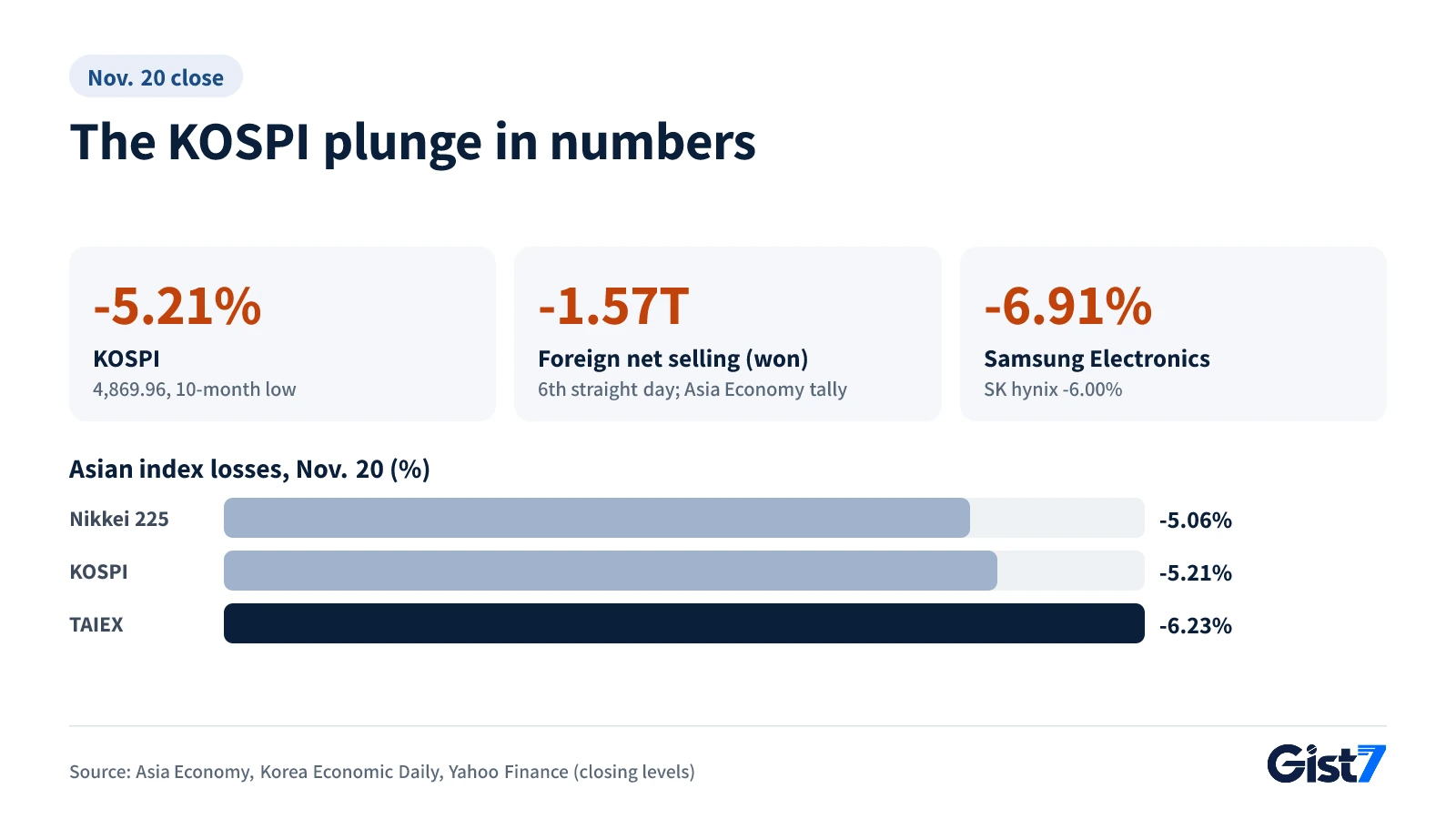
The KOSPI plunge on November 20, 2026 cut South Korea's benchmark 5.21% to 4,869.96, a 10-month low. AMD's 7.72% drop on China export-control allegations hit Samsung and SK hynix, and foreigners and institutions sold over 2.8 trillion won.
- KOSPI closed at 4,869.96 (-5.21%) and KOSDAQ at 645.68 (-5.71%); the KOSPI hit its lowest close since January 16
- The trigger was a report by short-seller-affiliated Hunterbrook alleging AMD export-control lapses; AMD says it complies with U.S. law
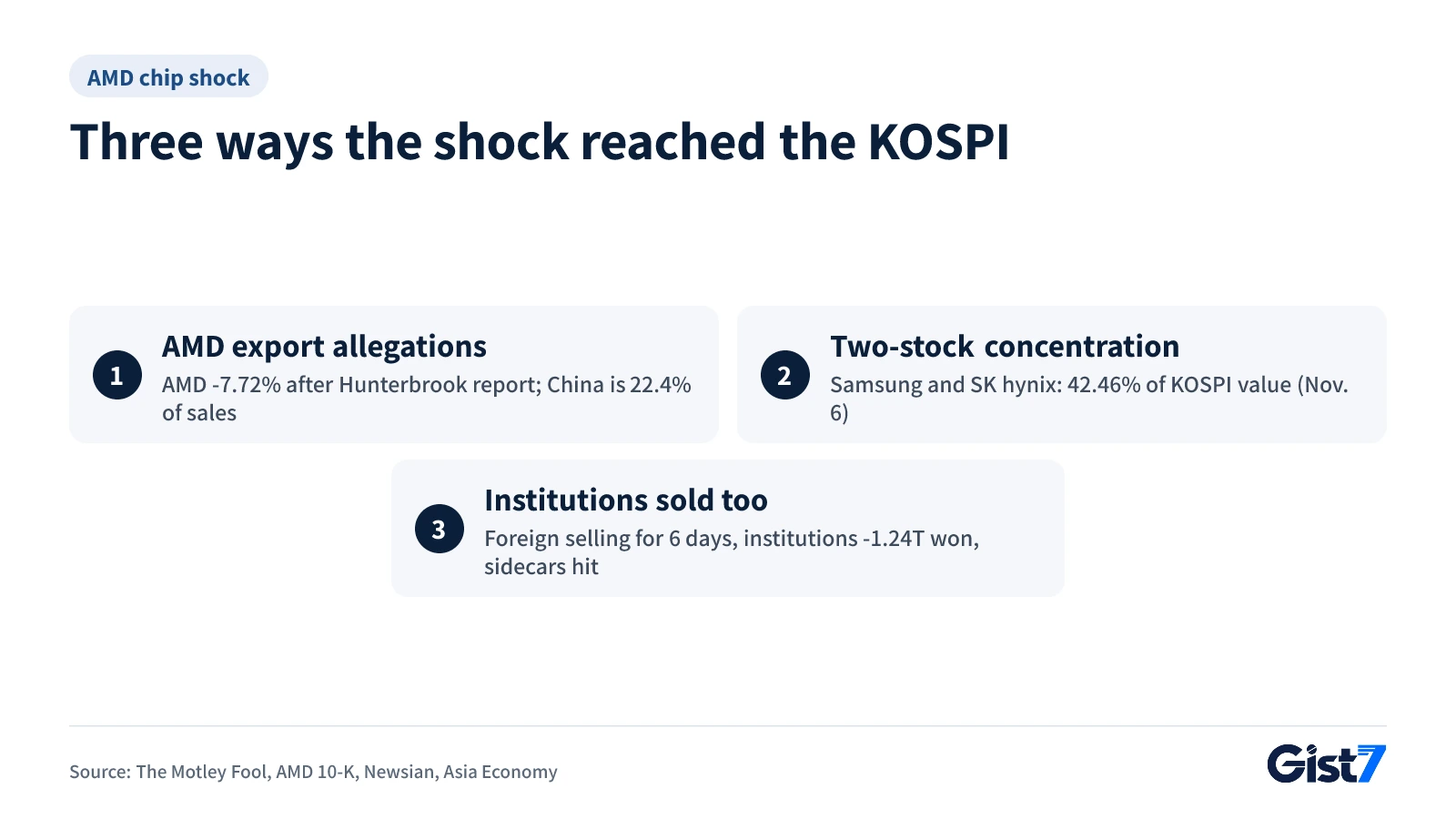
- Samsung Electronics and SK hynix made up 42.46% of KOSPI value (Nov. 6), so their 6-7% drops dragged the index hard
- Foreigners sold a net 1.5716 trillion won and institutions 1.2421 trillion won; individuals bought 2.316 trillion won; sell sidecars hit both markets
- Taiwan's TAIEX fell more (-6.23%) while Hong Kong's Hang Seng lost only 1.93% intraday: chip weight decided the damage
The KOSPI plunge on November 20, 2026 started with export-control allegations against U.S. chipmaker Advanced Micro Devices (Nasdaq: AMD). South Korea's benchmark index fell 267.93 points, or 5.21%, to 4,869.96, its lowest close since January 16 (4,840.74) and a 10-month low, according to Newspim and Etoday. Unlike November 17, when foreign investors sold 1.443 trillion won while domestic institutions bought 539.3 billion won, institutions also dumped more than 1.2 trillion won this time. Samsung Electronics (KOSPI: 005930) fell 6.91% and SK hynix (KOSPI: 000660) lost 6.00%.
What were the AMD export-control allegations behind the KOSPI plunge?
The question is whether AMD firmware kept flowing to a Chinese company under U.S. sanctions. Hunterbrook Media (private), which is affiliated with short seller Hunterbrook Capital (private), said in a report on November 19 (U.S. Eastern time) that Chinese server maker IEIT (Shenzhen Stock Exchange: 000977), added to the Commerce Department's Entity List in March 2025, has since put at least six newer versions of AMD firmware into its own updates, according to The Motley Fool. The Entity List is a roster of foreign companies that need a U.S. government license to receive American technology. Hunterbrook added that three server makers not on the list post firmware more than 99% identical to IEIT's.
AMD shares closed down 7.72% at $489.19 in New York on November 19, and the Nasdaq Composite fell 2.25% the same day (The Motley Fool, Newspim). That was also Anthropic's (Nasdaq: ANT) first trading day, which we covered in why the Nasdaq fell 2% on Anthropic's IPO day. AMD told Yahoo Finance that it "complies with applicable US export control laws and regulations" and said the report misrepresents its business practices. Hunterbrook itself said it does not know how IEIT obtained the code or whether a license existed, and readers should keep in mind that the publisher's affiliate is short AMD. As of midday November 20 in Seoul, no official U.S. government response had been reported.
There is a numerical reason an unproven allegation moved the stock so much. According to AMD's 2025 annual report (Form 10-K), 22.4% of revenue came from China, including Hong Kong. Tighter rules would hit earnings directly. And after Nvidia (Nasdaq: NVDA), a China-related allegation now touched AMD too, so investors read it as regulatory risk spreading across the whole AI chip sector. Lee Kyung-min, an analyst at Daishin Securities, told Newspim that the allegations against AMD following Nvidia spread regulatory worries across the industry.
Company snapshot (AMD, the source of the sell-off)
| Item | Details |
|---|---|
| Legal name | Advanced Micro Devices, Inc. |
| Listing | Nasdaq (ticker AMD), public since 1972 |
| Headquarters, founded | Santa Clara, California, 1969 |
| Segments | Data Center (AI accelerators, server CPUs), Client and Gaming, Embedded |
| Fiscal 2025 revenue | $34.639 billion, of which China (incl. Hong Kong) $7.751 billion (22.4%) |
| Market value | About $802 billion (Nov. 19 close of $489.19 × 1.640 billion shares outstanding as of Oct. 28, Gist 7 calculation) |
Company data are from AMD's fiscal 2025 Form 10-K and third-quarter 2026 Form 10-Q.
Why did Taiwan fall more and Hong Kong less? The chip weight inside each index
The same news hit markets differently because of how much of each index is chips. On November 20, Taiwan's TAIEX fell 6.23% to 36,033.29, the KOSPI fell 5.21% and Japan's Nikkei 225 dropped 5.06% to 56,436.65 (Yahoo Finance, closing levels), while Hong Kong's Hang Seng was down only 1.93% intraday on the 20th (per a Newspim report at 1:20 p.m. Seoul time). Newspim noted that the chip-heavy markets of Korea, Taiwan and Japan took the biggest losses.
| Market (Nov. 20) | Change | How concentrated in chips |
|---|---|---|
| TAIEX (Taiwan) | -6.23% | TSMC alone is more than 40% of market value (Focus Taiwan, Nov. 11) |
| KOSPI | -5.21% | Samsung Electronics 24.27% + SK hynix 18.19% = 42.46% (as of Nov. 6, Newsian) |
| Nikkei 225 | -5.06% | Price-weighted index where high-priced chip-equipment stocks carry big weight |
| Hang Seng (intraday) | -1.93% | Led by internet platforms and financials, small weight in chipmakers |
With two stocks making up more than 40% of the KOSPI, drops of 6.91% and 6.00% in those two alone pull the index down by roughly 2.8 percentage points (a simple calculation using Nov. 6 weights, Gist 7). That is just over half of the KOSPI's 5.21% loss. Taiwan leans even more on a single company, TSMC (Taiwan Stock Exchange: 2330, NYSE ADR: TSM), and fell harder. Hong Kong's largest stocks are internet and financial names rather than chipmakers, which appears to explain why the AMD shock reached it less.
Institutions sold too: how was this different from six days of foreign selling?
What set the day apart is that foreign investors and institutions together sold more than 2.8 trillion won of KOSPI stocks. According to Asia Economy's closing tally, foreigners were net sellers of 1.5716 trillion won and institutions of 1.2421 trillion won, while individuals were net buyers of 2.316 trillion won. It was the sixth straight day of foreign net selling (Korea Economic Daily). The KOSDAQ closed at 645.68 (-5.71%), with foreigners selling a net 224.1 billion won and institutions 112.2 billion won, while individuals bought 346.8 billion won.
| Investor (KOSPI) | Net trading, Nov. 20 | What it means |
|---|---|---|
| Foreign | -1.5716 trillion won | Sixth straight day of net selling, focused on large chipmakers |
| Institutional | -1.2421 trillion won | Sold alongside foreigners; program trading was also a net seller |
| Individual | +2.3160 trillion won | Practically the only buyer absorbing the drop |
Foreign net selling was reported at 1.14 trillion to 1.59 trillion won depending on when the tally was taken; this article uses Asia Economy's figure.
The KOSPI sidecar was triggered at 11:54 a.m. and the KOSDAQ sidecar at 1:28 p.m. Seoul time. A sidecar is a circuit-breaker-style mechanism that suspends program trading orders for five minutes when futures prices swing sharply; on the KOSPI it was set off when KOSPI 200 futures fell more than 5% from the previous day (Newspim). It was the first time in 10 trading days, since November 6, that both markets triggered one on the same day, and program trading ended with net selling of 1.3626 trillion won (Korea Economic Daily). Electricity and gas (+0.42%) was the only KOSPI sector that rose (Asia Economy).
On November 17, when the KOSPI broke below 5,000 after foreigners sold 3.8 trillion won over three days, the selling was mostly foreign. This time institutions joined in. Han Ji-young, an analyst at Kiwoom Securities, said shares could not hold up even after good news such as Nvidia's strong earnings, and that there is effectively no buyer to absorb foreign selling (Newspim, Asia Economy). With 5,000 broken again, reference points are more useful than forecasts. The day's intraday low of 4,831.69 sits close to the January 16 close of 4,840.74, so whether that zone holds is the first check. After that, the variables are whether foreign net selling extends to a seventh day and whether the U.S. government responds to the AMD allegations.
Down 5.6% in dollars: why were overseas investors' losses bigger?
Measured in dollars, the KOSPI fell about 5.65%. While the index dropped 5.21%, the won weakened 0.47%, from 1,330.0 to 1,336.2 per dollar, adding to losses in dollar terms (Etoday closing rate, Gist 7 calculation). The won fell for the first time in three sessions and touched 1,340.3 intraday. According to Etoday, dollar buying by custodian banks, converting the proceeds of foreign stock sales, outweighed dollar selling by exporters.
The iShares MSCI South Korea ETF (NYSE Arca: EWY), the main U.S.-listed Korea fund, fell 1.57% to $134.59 in New York on November 19 (Yahoo Finance). That price does not yet fully reflect Seoul's November 20 plunge, so whether EWY catches up with the KOSPI's close during the November 20 U.S. session is the first number overseas investors will see. EWY had already slid 5.7% from $142.78 on November 13 through November 19.
For foreign investors, the day combined chip regulatory risk with a weaker won. If the won weakens back into the 1,340s, dollar losses grow, which can create a loop in which foreign selling pushes up the exchange rate and the exchange rate invites more selling. A dealer at a commercial bank quoted by Etoday cited next week's Samsung Electronics dividend payment as a factor that could push the dollar higher against the won and expects a range of 1,320 to 1,370 won through month-end.
Market impact map
| Asset / indicator | Direction | Strength | Link (why) |
|---|---|---|---|
| KOSPI | ↓ | Strong | Samsung and SK hynix are over 42% of market value, and foreigners and institutions sold together (Nov. 20, -5.21%) |
| Chip stocks (Samsung Electronics, SK hynix) | ↓ | Strong | Regulatory worries over AI accelerators spill into the demand outlook for HBM and other memory (Nov. 20, -6.91% and -6.00%) |
| KOSDAQ | ↓ | Strong | Chip materials and equipment stocks gave back AI supply-chain hopes (Nov. 20, -5.71%) |
| USD/KRW | ↑ | Medium | Custodian dollar demand from foreign stock sales (Nov. 20, 1,336.2 won, +6.2 won) |
| Nasdaq | ↓↑ | Medium | Effect after Nov. 20: pressure if Washington responds with probes or rules; direction unclear if there is no response |
| S&P 500 | ↓↑ | Weak | Effect after Nov. 20: a burden if chip rules spread to big-tech earnings outlooks; unclear until Washington responds |
| TAIEX, Nikkei 225 | ↓ | Strong | Same chip supply chain (see the table above for losses) |
Little direct impact: 2-year Treasury, 10-year Treasury, dollar index, gold, WTI crude, bitcoin
- Everyday impact: with the won at about 1,336 per dollar, overseas card payments and currency exchange got slightly more expensive for Koreans. If the rate stays above 1,340, import prices come under pressure.
- Retail investors who borrowed against their shares (margin loans) can face forced selling if declines continue and collateral ratios fall short, so it is worth checking a broker's collateral notices.
- Korean retirement and pension accounts heavy in domestic equity funds or ETFs show large swings in value this week.
Market reactions can vary with other factors, and this table is not a basis for investment decisions.
What to watch next
| Date (Seoul time / U.S. ET) | Indicator / event | Previous | Link to this story | If it comes in… |
|---|---|---|---|---|
| Nov. 23 (Mon), expected | Korea Customs Service exports, Nov. 1-20 | Oct. 1-20 exports $61.6 billion (+105.4%), chips +222.5% (Korea Customs Service) | Whether regulatory worries are reaching actual chip exports | Continued chip growth tends to expose the gap between regulatory fear and earnings |
| Nov. 25 (Wed) 10:30 p.m. KST / 8:30 a.m. ET | U.S. October PCE prices, Q3 GDP second estimate | September PCE +3.6% y/y, core +3.1% (BEA) | Tech-stock discount rates and foreign risk appetite | A hotter print tends to lift the dollar and add foreign selling pressure on emerging-market stocks |
| Nov. 26 (Thu) | Bank of Korea rate decision | 3.00% (raised Aug. 27, Bank of Korea) | Korean rates and the won | A hawkish tone supports the won; a hold or easing signal adds upward pressure on USD/KRW |
| Dec. 1 (Tue), expected | Korea's November trade data (Ministry of Trade) | October exports $115.3 billion (+93.7%), chips $56.44 billion (+259.4%) | A full month of chip exports to test regulatory fears | Continued chip export growth tends to support earnings outlooks for big chipmakers |
Dates are based on the BEA release schedule (8:30 a.m. ET) and the Bank of Korea's monetary policy meeting calendar. The customs agency normally publishes 1-20 day data on the 21st; with the 21st falling on a Saturday, Monday the 23rd is expected. The Ministry of Trade has customarily released monthly trade data on the 1st. Any reaction from the Commerce Department's Bureau of Industry and Security (BIS) to the AMD allegations has no set date, but it could change the direction of chip stocks as soon as it comes.
Frequently asked questions
Why did the KOSPI fall more than 5% on November 20?
AMD fell 7.72% in New York the day before on allegations of breaching U.S. export controls on China, raising fears that regulatory risk would spread across AI chips. The chip-heavy KOSPI closed down 5.21% at 4,869.96 as foreigners and institutions together sold more than 2.8 trillion won.
Have Hunterbrook's allegations against AMD been confirmed?
Not as of November 20, 2026. Hunterbrook says blacklisted IEIT kept using AMD firmware but admits it does not know how the code was obtained or whether a license existed, and AMD says it complies with U.S. export laws. The publisher's affiliate is also short AMD.
Why did Taiwan's stock market fall more than Korea's?
TSMC alone accounts for more than 40% of Taiwan's market value, so chip shocks hit the TAIEX more directly. The index fell 6.23% on November 20 versus 5.21% for the KOSPI, while Hong Kong's Hang Seng, with little chip weight, fell less than 2% intraday.
What is a sidecar, and when was it triggered?
A sidecar suspends program trading orders for five minutes when futures prices swing sharply. On November 20, sell sidecars were triggered on the KOSPI at 11:54 a.m. and on the KOSDAQ at 1:28 p.m. Seoul time, the first same-day trigger in both markets in 10 trading days.
How far could the KOSPI fall after breaking 5,000?
No one can say for certain. The nearby reference points are the November 20 intraday low of 4,831.69 and the January 16 close of 4,840.74; whether foreign net selling extends to a seventh day and how Washington responds to the AMD allegations are the next variables.
How does foreign selling affect the won?
When foreigners convert the proceeds of stock sales into dollars, the won weakens. The won closed 6.2 won weaker at 1,336.2 per dollar on November 20, so the KOSPI's loss in dollar terms was about 5.65%, larger than in won.
References
- 코스피·코스닥 5% 하락 마감…"시장 참여자 매수 의지 약해져" (아시아경제)
- [마감시황] '검은 금요일' 코스피 4800선 추락…10개월 만에 최저 (뉴스핌)
- 코스피 4869 마감…외국인 1조2682억원 순매도, 양 시장 매도 사이드카 (한국경제)
- [환율마감] 원·달러 사흘만 상승, 주가 급락에 위험회피 (이투데이)
- AMD발 악재에 아시아 증시 '검은 금요일'…동반 하락세 (뉴스핌)
- [AI 쇼크 그 후①] 삼전·하닉 쏠림이 키운 코스피 충격…반등 조건은 (뉴시안)
- Taiex ends sharply higher as TSMC soars almost 5% on dividends, sales (Focus Taiwan)
- First Nvidia, Now AMD: A Short Seller Just Put Its China Business Under the Microscope (The Motley Fool)
- AMD stock drops after Hunterbrook Media raises export control concerns (Yahoo Finance)
- AMD Form 10-K, fiscal year 2025 (미국 증권거래위원회)
- AMD Form 10-Q, 2026년 3분기 (미국 증권거래위원회)
- iShares MSCI South Korea ETF (EWY) 가격 기록 (Yahoo Finance)
- TSEC 가권지수 가격 기록 (Yahoo Finance)
- 닛케이225 가격 기록 (Yahoo Finance)
- 2026년 10월 1~20일 수출입 현황(잠정치) (관세청, KDI 경제정보센터 게재)
- 2026년 10월 수출입 동향 (산업통상부)
- 통화정책방향 결정회의 일정 (한국은행)
- 한국은행 기준금리 추이 (한국은행)
- Release Schedule (미 경제분석국)
- Personal Income and Outlays, September 2026 (미 경제분석국)