Alphabet Earnings Miss: Why Google Fell Despite 25% Growth
Key summary
Alphabet's Q3 earnings miss on October 28, 2026 sent Google shares down about 10% after hours. Revenue grew 25% to $127.58 billion, but investment losses, slower search sales and negative free cash flow left EPS below the $3.02 consensus (as of Oct. 29, 2026).
- An earnings miss is judged against what the market expected, not against last year
- Alphabet's Q3 revenue rose 25%, yet revenue, operating income, search revenue and EPS all landed below consensus
- The biggest drag on net income was a valuation loss on stakes such as SpaceX, about $8.2-9 billion depending on the report
- Cloud revenue jumped 103% and beat estimates, but heavy capex left free cash flow negative for a second straight quarter (-$9.07 billion)
- The CFO's warning that capex will "increase significantly" next year weighed on the stock as much as the quarter itself
Alphabet, Google's parent company, reported third-quarter results on October 28, 2026 (U.S. time). Revenue rose 25% to $127.58 billion, but earnings per share came in below the $3.02 that Wall Street had expected, and the stock slid about 10% in after-hours trading. This Alphabet earnings miss is what Korean media called an "earnings shock." Here is how the numbers add up.
What Is an Earnings Miss, and How Is It Different From an Earnings Surprise?
An earnings miss, often labeled an "earnings shock" in Korean coverage, happens when a company's quarterly results fall well short of analyst consensus. When results beat consensus by a wide margin, it is an earnings surprise. The test is not whether results improved on last year but whether they reached the number the market was expecting. A company can grow and still disappoint, and its share price tends to move by the size of the broken expectation.
There is no official threshold for how far below consensus counts as a "shock." Investors usually look first at earnings per share (EPS, net income divided by shares outstanding) and operating profit rather than revenue. Weak guidance, meaning the company's own outlook, makes the reaction worse.
Alphabet's Earnings Miss: How Far Below Expectations Was Q3?
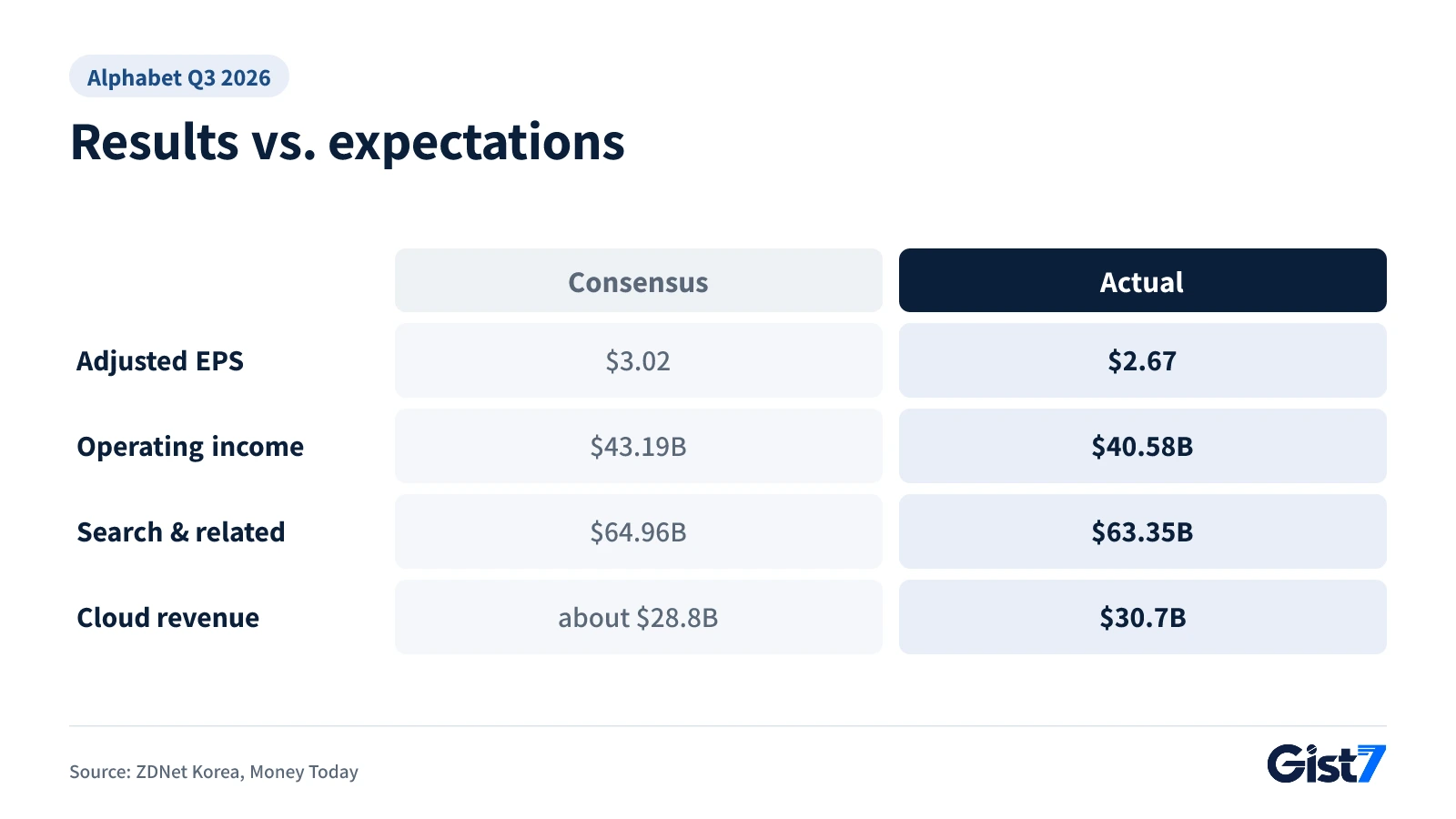
The figures below come from ZDNet Korea and Money Today. Consensus numbers differ slightly depending on the data provider.
| Item | Actual | Consensus | Gap |
|---|---|---|---|
| Revenue | $127.58 billion | $128.22 billion | about -0.5% |
| Operating income | $40.58 billion | $43.19 billion | about -6.0% |
| Search and related revenue | $63.35 billion | $64.96 billion | about -2.5% |
| Adjusted EPS | $2.67 | $3.02 | about -11.6% |
| Cloud revenue | $30.7 billion | about $28.7-28.8 billion | about +7% |
EPS differs by report. Based on net income of $26.17 billion, EPS was $2.12; on an adjusted basis it was $2.67. Either way it is under $3.02. Net income fell about 25% from $34.98 billion in the same quarter last year. According to Money Today, revenue and adjusted profit missed together for the first time in nearly four years.
The Biggest Cause: Non-Operating Losses on Equity Stakes
The core business held up. Operating income rose 30% to $40.6 billion, a 31.8% margin (Block Media). What pulled net income down came from outside operations.
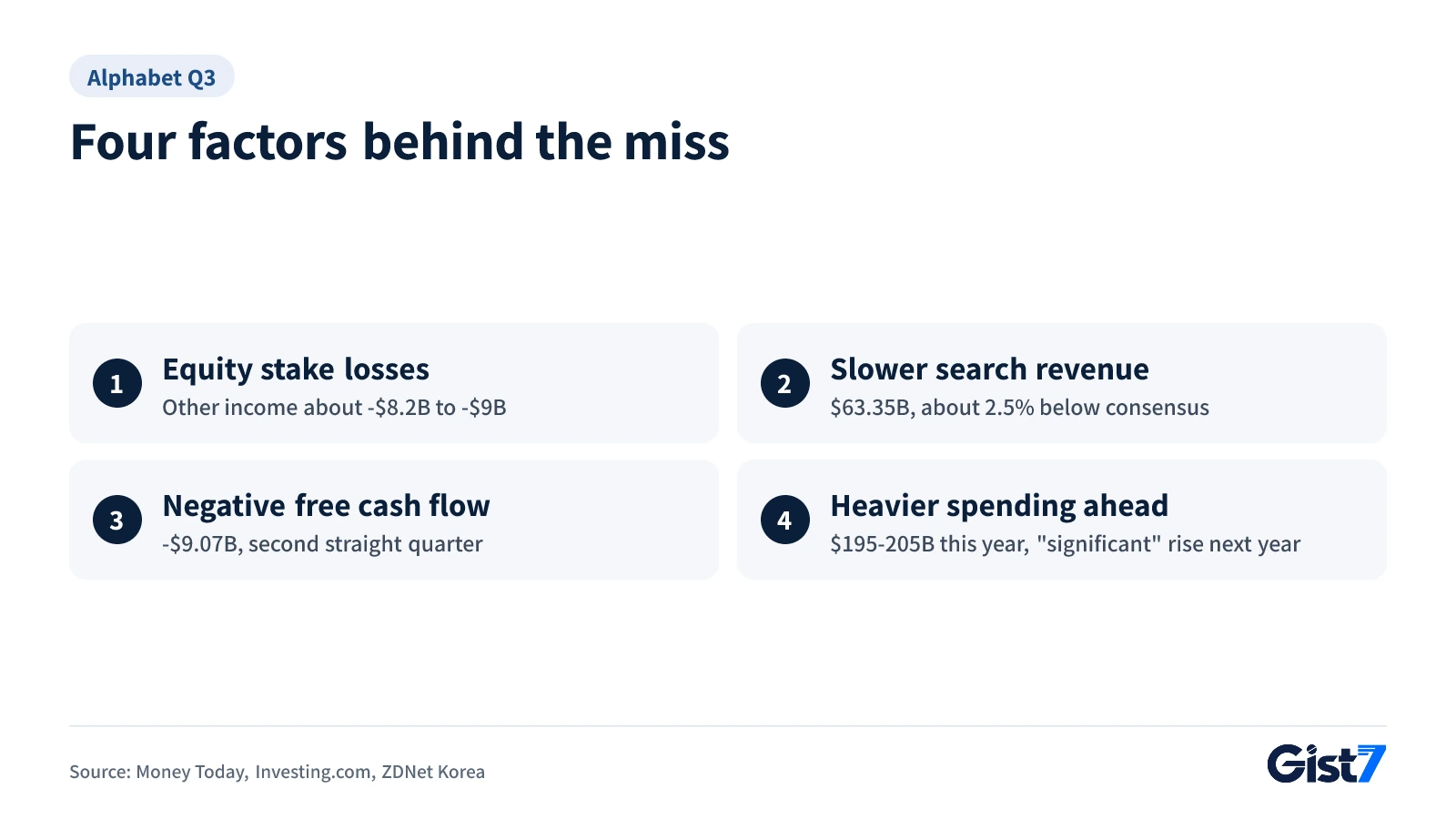
Investing.com reported other income and expense of negative $8.2 billion, mainly an unrealized loss on the SpaceX stake. Money Today put the valuation loss on holdings including SpaceX and Anthropic at $8.7 billion, and Block Media counted a net loss of about $9 billion on debt and equity securities. The scopes differ, but the direction is the same.
The comparison base also mattered. According to Money Today, Alphabet booked a $99 billion valuation gain on the same kinds of stakes in the second quarter. Valuation gains and losses are paper entries, not cash leaving the company, but they widen the swings in quarterly net income.
Why Did Search Revenue Fall Short?
Search and related revenue was $63.35 billion, up 12% but about 2.5% below consensus. According to Money Today, CEO Sundar Pichai named currency moves as the biggest factor and said a rise in queries entering AI Mode also played a part. AI Mode searches are reported to earn less ad revenue than standard searches.
On the same call, Pichai said AI investment had pushed query growth to its highest rate in five years (ZDNet Korea). YouTube ad revenue rose 9% to $11.2 billion (Investing.com). In short, people are searching more, but each search may be worth less.
Why Is Cash Shrinking When Cloud Revenue Doubled?
Google Cloud revenue rose 103% to $30.7 billion, with operating income of $11.1 billion (a 36.2% margin) and a backlog of $561 billion (Investing.com). Cloud was effectively the only segment that beat expectations.
The catch is the spending behind that growth. Third-quarter capital expenditure was $51.36 billion, up from $44.9 billion in the prior quarter, though below the roughly $55.1 billion analysts expected. Full-year 2026 guidance of $195 billion to $205 billion was kept. Next year is the issue: according to Money Today, CFO Anat Ashkenazi said capex would "increase significantly" and that details would come with fourth-quarter results.
Free cash flow (operating cash flow minus capital spending) was negative $9.07 billion, the second straight quarterly deficit. Long-term debt reached $125.1 billion, up 479% from a year earlier (Money Today, Tech42). Tech42 reported a view in the market that "AI spending is eating into cash faster than it is turning into revenue."
Gist7's View: The Shock Came From Cracked Expectations, Not Just the Numbers
Looking only at the one-off valuation loss, the miss seems unrelated to the core business. But it is hard to explain a drop of nearly 10% with that alone. Gist7's reading is that the market saw three things at once: search revenue below expectations, negative free cash flow, and a warning of heavier spending next year. Cloud's strength could not mask them.
The currency explanation also leaves questions. According to Investing.com, total Q3 revenue growth was 25% both as reported and in constant currency, and the currency headwind is expected to grow slightly in Q4. If currency were the whole story for search, those numbers would be hard to square, so search profitability deserves a closer look.
What to watch next
- The size of next year's capex, due with fourth-quarter results
- How AI Mode growth affects ad revenue per query
- How quickly the $561 billion cloud backlog turns into revenue
- Valuation swings on stakes such as SpaceX and Anthropic. We covered the Anthropic angle in Anthropic's IPO filing, a valuation of up to $2 trillion, and what to check before investing
This is not investment advice. Base any decision on current filings and your own situation.
Frequently asked questions
What does earnings shock mean?
It means a company's quarterly results fall well below analyst consensus. In English coverage the usual term is an earnings miss. The test is whether results met market expectations, not whether they beat last year, and the opposite case is an earnings surprise.
Why did Alphabet miss earnings when revenue grew 25%?
Revenue growth was strong, but EPS ($2.67 adjusted against $3.02 expected), operating income and search revenue all came in below consensus. Negative free cash flow and a warning of higher capex next year added to the disappointment.
Why did Google's Q3 net income fall?
Mostly a valuation loss on stakes such as SpaceX, reported at roughly $8.2 billion to $9 billion depending on the outlet. Alphabet booked a large gain on the same holdings in Q2, so the swing was big.
How far did Google stock fall after earnings?
About 10% in after-hours trading on October 28 (U.S. time). The regular-session close is reported as $322 to $325 depending on the source, and the reaction in the October 29 regular session needs separate confirmation.
How did Google Cloud perform in Q3 2026?
Revenue was $30.7 billion, up 103%, with operating income of $11.1 billion. Both beat estimates, making Cloud nearly the only segment to top expectations this quarter.
Does an earnings miss always push a stock down?
No. Share prices also react to guidance and to how much was already priced in, so stocks sometimes rise after a miss or fall after a beat.
References
- Alphabet earnings shock: "capex to rise sharply next year," shares fall 10% — Money Today
- Alphabet Q3 revenue of about 171 trillion won misses expectations despite strong results — ZDNet Korea
- Google Q3 net income down 25%, an earnings shock; shares fall after results — Block Media
- Earnings call transcript: Alphabet Q3 2026 profit miss sparks 10% after-hours drop — Investing.com
- AI boom shakes profitability: Alphabet falls more than 10% on earnings shock — Tech42