Anthropic IPO Filing: $2T Valuation Talk and Risks to Weigh

Key summary
The Anthropic IPO process went public on October 26, 2026, when its S-1 was filed with the SEC for a Nasdaq listing under ANT. A raise of up to $100 billion at a valuation of up to $2 trillion is being reported. First-half revenue was $16.29 billion, net loss $80.75 billion (as of October 27, 2026).
- Anthropic made its S-1 public on October 26, 2026 (US time); the Nasdaq ticker is ANT.
- The $2 trillion valuation and $100 billion raise are press reports; the filing leaves price and share count blank.
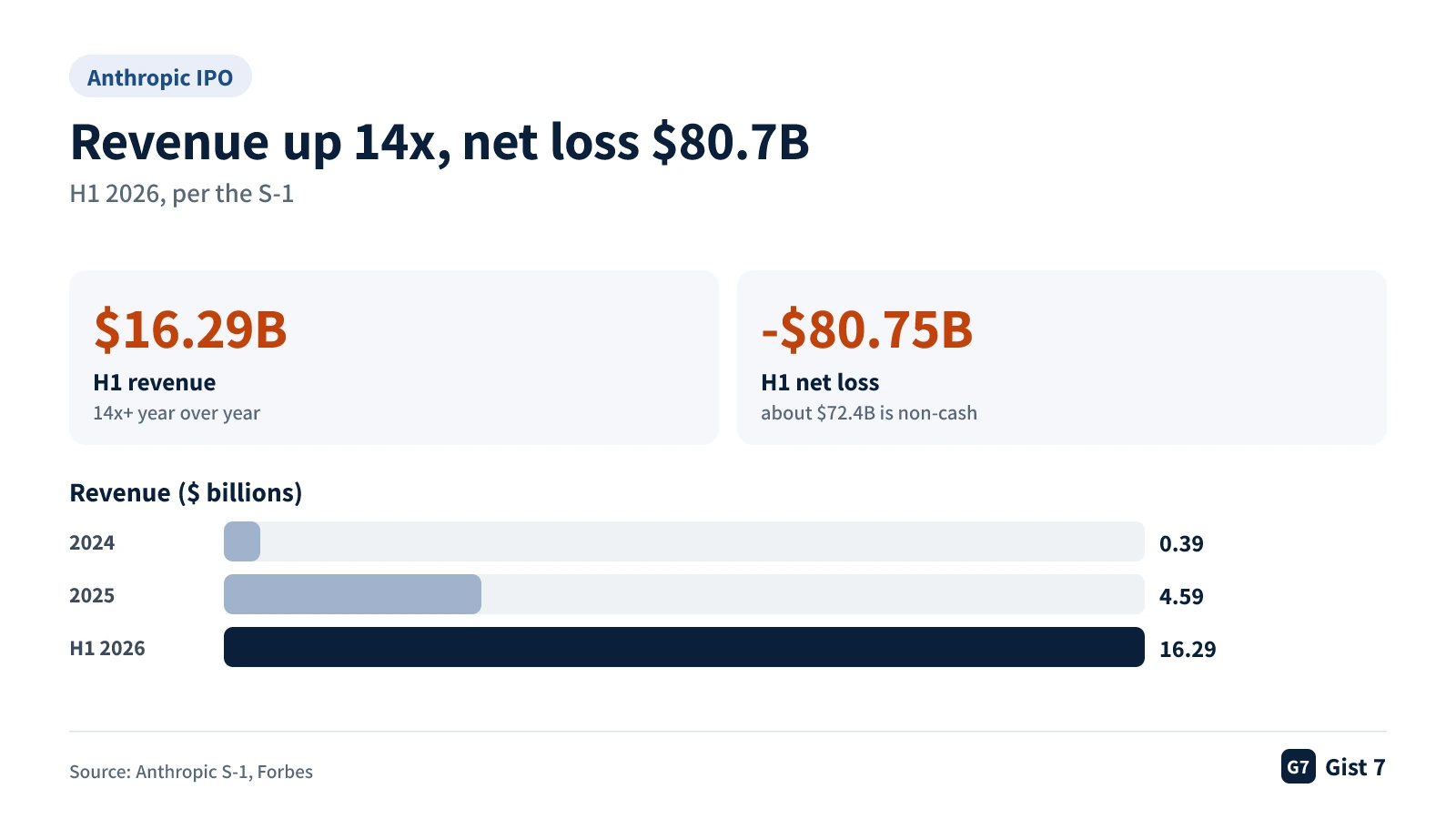
- H1 2026 revenue was $16.286 billion and net loss $80.748 billion, about $72.4 billion of it non-cash.
- Long-term compute commitments, possible slower growth, customer and partner concentration, and founder and trust control are the key checkpoints.
Why is the Anthropic IPO such a big story?
The Anthropic IPO matters first because of its size. According to The Wall Street Journal, as relayed by Korean outlets such as Kyunghyang Shinmun, the company could be valued at up to $2 trillion and is aiming to raise about $100 billion. If it hits that target, it would surpass SpaceX, which listed in June 2026 at a $1.77 trillion valuation after raising $75 billion, and become the largest IPO ever. Those figures come from people familiar with the matter, not from the filing itself. Reuters, cited by Hankyung, reported that some investors value Anthropic closer to $1.5 trillion.
The second reason is timing. Anthropic is moving ahead of OpenAI, the maker of ChatGPT, at a moment when investors are arguing about whether AI spending has run too hot. The listing is being read as a test of what public markets will actually pay for a frontier AI lab. A related story of AI-driven pressure on valuations is covered in why China tech stocks are falling.
What the S-1 shows: revenue up 14x, net loss of $80.7 billion
According to the S-1 filed with the SEC, revenue for the first half of 2026 was $16.286 billion, more than 14 times the roughly $1.16 billion of the same period a year earlier. Full-year revenue was $386 million in 2024 and about $4.59 billion in 2025, so the first six months of 2026 alone brought in more than three times last year's total.
| First half of 2026 | Amount |
|---|---|
| Revenue | $16.286 billion |
| Operating loss | $693 million |
| Net loss | $80.748 billion |
| Fair-value changes on convertible notes etc. (non-cash) | about $72.4 billion |
| Cash and short-term investments (June 30) | about $131.7 billion |
How bad is an $80.7 billion net loss?
The headline looks alarming, so the composition matters. Per the filing, about $72.4 billion of the net loss comes from changes in the fair value of convertible notes, derivatives and SAFEs (simple agreements for future equity). When a company's value rises, those instruments become more expensive to carry on paper, and the difference is booked as a loss. It is an accounting charge, not cash leaving the building.
The operating picture is improving. The first-half operating loss was $693 million, down 68% from a year earlier, and Forbes and Hankyung report that the second quarter showed a $974 million operating profit, the first profitable quarter. Still, a net loss this large will make post-listing earnings hard to read, as some analysts note.
Five risks to weigh before investing
These are checkpoints, not confirmed problems.
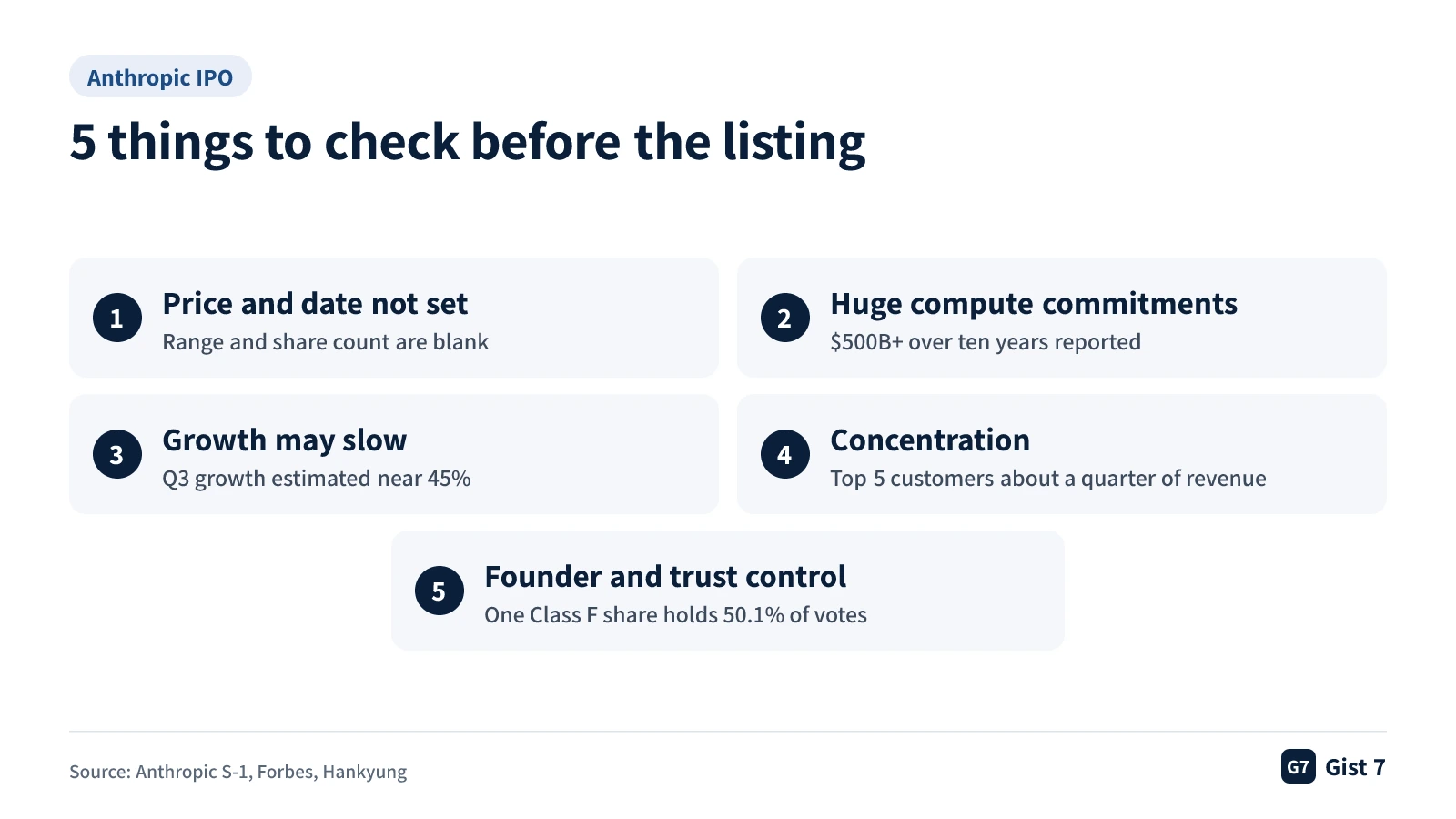
- Price and timing are not set. The filing leaves the price range and share count blank, and reports only point to a November listing. Talk of the valuation has already slipped from $2 trillion to about $1.5 trillion in some accounts.
- Compute commitments are enormous. Forbes cites more than $500 billion of spending arrangements over roughly ten years, while another report puts the figure above $600 billion. Because the numbers differ by outlet, check the final filing. If revenue growth stalls, fixed costs bite.
- Growth may be slowing. Forbes estimates third-quarter revenue growth at about 45%, down from more than 140% in the second quarter.
- Customer and partner concentration. The top five customers account for roughly a quarter of revenue, and Amazon, Google and Microsoft are at once investors, suppliers and rivals. Critics call the flow of investment back into cloud spending a circular arrangement.
- Governance limits outside shareholders. One Class F share held by the founders' entity carries 50.1% of the votes on general matters, and the Long-Term Benefit Trust elects a majority of the board. The filing itself calls Anthropic a "controlled company" under Nasdaq rules.
Reports also point to risk factors covering misuse of AI and legal disputes with the government. Whether to buy is a decision for you after reading the full filing and later amendments, ideally with professional advice.
When and how will the listing happen?
According to the cover page of the S-1, Class A common stock is expected to trade on the Nasdaq Global Select Market under the ticker "ANT". It is a listing application, so nothing is trading yet. Goldman Sachs and Morgan Stanley lead the underwriting, joined by more than 20 banks including J.P. Morgan, Citigroup, Barclays and Wells Fargo. The price and exact date should appear in an amended filing (S-1/A).
Market impact map
Anthropic's listing is one company's event, but its size could shift sentiment across AI stocks and the wider IPO market. Pricing and timing have not been set, so the scale of the impact depends on how the offering is received (as of November 8, 2026).
| Asset / indicator | Direction | Strength | Why (the link) |
|---|---|---|---|
| S&P 500 | ↑↓ depending on demand | Weak | Limited until index inclusion is decided after listing |
| Nasdaq | ↑↓ depending on demand | Moderate | A strong debut could lift AI sentiment; a giant offering could also pull money out of existing tech names |
| AI chips and HBM (Nvidia, SK Hynix and others) | ↑ | Moderate | Expectation that IPO proceeds flow into AI infrastructure |
| Large tech investors in Anthropic | ↑ | Weak | Their stakes get repriced at the IPO valuation |
| IPO and venture markets | ↑ | Moderate | A successful mega-listing tends to pull other AI listings forward |
Little direct impact: US 2-year Treasury yield, US 10-year Treasury yield, Dollar index, Korean won per dollar, Gold, Oil (WTI), Bitcoin, KOSPI
Everyday impact
- Large tech IPOs have often seen sharp price swings in their first days of trading.
- Retirement accounts and index funds heavy in tech may feel any shift in AI sentiment.
Market reactions can vary with other factors, and this table is not a basis for investment decisions.
What to watch next
| Date (ET) | Release / event | Previous | Why it matters here | If it comes in… |
|---|---|---|---|---|
| Nov 10 (Tue), 8:30 a.m. | US October CPI | September: 3.7% y/y (BLS) | Rates and growth-stock valuations | A hotter print tends to raise rate pressure, which hurts loss-making growth stocks |
| Nov 17 (Tue), ~4:20 p.m. | Nvidia Q3 FY2027 results | Q2 revenue $96.2B; company Q3 outlook $108.0B | A read on AI spending | Beating the outlook could lift AI sentiment; a miss could feed doubts about AI spending |
| Dec 4 (Fri), 8:30 a.m. | US November jobs report | October: +165,000 jobs, unemployment 4.1% | Growth and the rate path | Strong hiring tends to push back expected rate cuts |
| Dec 9 (Wed), 2:00 p.m. | Fed FOMC decision (Dec 8–9 meeting) | Held at 3.75–4.00% (Oct 28; two members favored a hike) | IPO market mood | A hawkish signal tends to cool the IPO market |
Gist7 take: what this listing signals
This is more than one company's debut. It is the first big public test of how far the market will price AI. Revenue is climbing steeply, but so are the commitments behind it. Three things to watch: the price range in the amended filing, whether growth holds in the first quarterly report after listing, and the timetable for other AI companies such as OpenAI. For individual investors, the sensible order is to wait until subscription and trading details are fixed, then follow your broker's notices.
Frequently asked questions
When will Anthropic go public?
Reports point to a Nasdaq listing in November, but no exact date has been disclosed. As of October 27, 2026, the price range and share count are blank in the filing and will be set in an amended filing.
What is Anthropic's ticker and exchange?
Class A common stock is expected to trade on the Nasdaq Global Select Market under the ticker ANT. Trading has not started yet.
Why is the net loss $80.7 billion when revenue grew 14x?
About $72.4 billion of the net loss is a non-cash accounting charge from fair-value changes on convertible notes and derivatives. The operating loss was far smaller, at $693 million.
Is the $2 trillion valuation confirmed?
No. It comes from Wall Street Journal reporting based on sources, and Reuters reported some investors value the company near $1.5 trillion. The filing contains no price range.
Can retail investors outside the US buy Anthropic shares?
Once listed, shares will likely be tradable through brokers that support US stocks, but subscription methods and timing are not set. Check your broker's notices.
References
- Anthropic, PBC Form S-1 Registration Statement, SEC EDGAR
- Anthropic files for IPO, valuation up to $2 trillion expected (Kyunghyang Shinmun, Korean)
- Anthropic files for Nasdaq listing, $1.5 trillion valuation put to the test (Hankyung, Korean)
- Anthropic files for Nasdaq IPO amid AI investment worries (Financial News, Korean)
- Anthropic's IPO: What Its S-1 Reveals About The AI Boom, Forbes
- Consumer Price Index release schedule — U.S. Bureau of Labor Statistics
- Consumer Price Index, September 2026 — U.S. Bureau of Labor Statistics
- Meeting calendars — Federal Reserve
- FOMC statement, October 28, 2026 — Federal Reserve
- NVIDIA Sets Conference Call for Third-Quarter Financial Results — NVIDIA
- NVIDIA second quarter fiscal 2027 results — SEC filing
- The Employment Situation, October 2026 — U.S. Bureau of Labor Statistics