Bitcoin liquidations briefly push BTC below $67,000
Key summary
Bitcoin liquidations came in two waves. On Nov. 13, 2026, the break below $70,000 forced about $1.3 billion of crypto futures shut (83% longs), over $670 million of it in bitcoin. Late on Nov. 13 (ET), BTC briefly hit $66,369 on Coinbase, a 3-month low. U.S. PPI and ETF outflows blocked a bounce.
- Bitcoin fell to $66,789 on Coinbase around 9:30 p.m. ET on Nov. 13 and to $66,369 around 11:10 p.m. ET, its lowest level since Aug. 19, about three months.
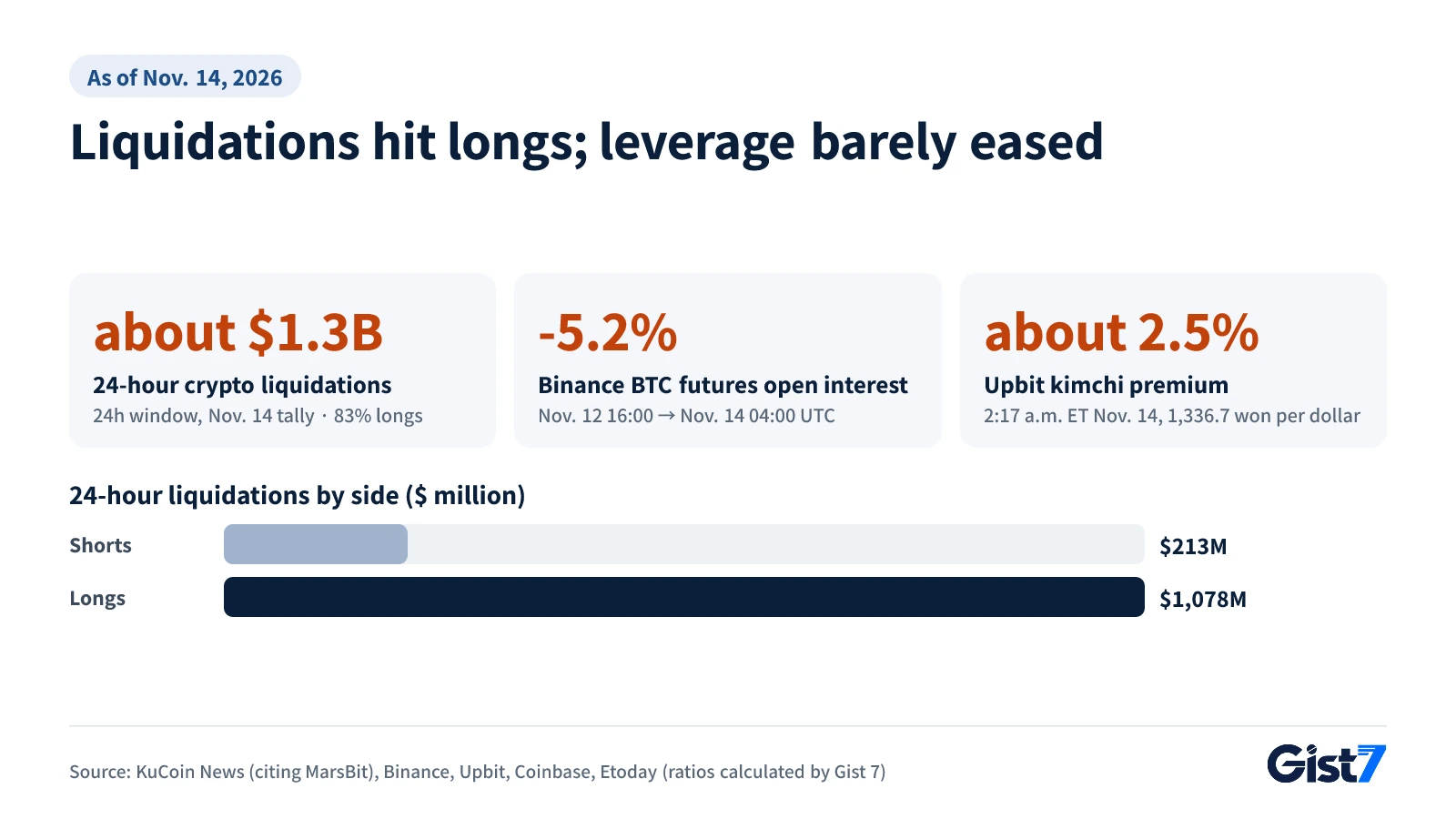
- About $1.3 billion of crypto positions were liquidated in 24 hours, including roughly $670 million in bitcoin; 83% were longs in the Nov. 14 KuCoin News tally (citing MarsBit).
- The first leg down came before the U.S. producer price report, and the 6.5% annual PPI rise then took away reasons for a rebound.
- Binance open interest fell 5.2% and funding cooled below its baseline, but the long-short account ratio rose from 2.81 to 3.19, so long positioning remains crowded.
- Upbit quoted bitcoin at 92.22 million won on Nov. 14, a kimchi premium of about 2.5%, nearly all of it matching the won premium on tether.
Bitcoin liquidations came in two waves. On Friday, Nov. 13, 2026, the break below $70,000 forced about $1.3 billion of crypto futures positions shut in a single day (83% of them longs), with bitcoin liquidations alone topping $670 million, according to Newspim, citing data from CoinGlass (private). Late that Friday in New York, bitcoin slid to $66,789 on Coinbase (Nasdaq: COIN) around 9:30 p.m. ET and to $66,369 around 11:10 p.m. ET, based on five-minute candles. According to Cryptoticker, that is the lowest level since Aug. 19 on CoinGecko (private) daily data, about three months. During the second leg, daily liquidations neared $700 million, Tokenpost reported in a Nov. 14 afternoon (Seoul time) story. A U.S. producer price report and spot ETF outflows set the backdrop, but leveraged bets on higher prices made the fall deeper.
Bitcoin liquidations hit $1.3 billion: what happened over two days
Most of the roughly $1.3 billion in 24-hour crypto liquidations, including about $670 million in bitcoin, happened on Nov. 13 as $70,000 gave way; KuCoin's Nov. 14 tally of $1.291 billion covers an overlapping 24-hour window, according to Newspim and KuCoin News. The second leg below $67,000 came later. The first drop also came before the U.S. producer price index (PPI) release. According to Newspim, bitcoin fell to $67,652 during Asian hours on Nov. 13, and about $500 million was liquidated just as $70,000 broke. Because each 24-hour window keeps rolling, totals differ by time, so the table lists them with timestamps.
| Time (ET) | Price or event | Source |
|---|---|---|
| Nov. 12, 11:30 p.m. | $68,856 (-6.48% in 24 hours); $677.16 million in bitcoin liquidations, 96% longs | Blockmedia (CoinGlass) |
| Nov. 13, 5:10 a.m. | Partial rebound to $69,300; more than $1.3 billion liquidated market-wide in 24 hours | Newspim (CoinGlass) |
| Nov. 13, 8:30 a.m. | October PPI: +0.3% month over month, +6.5% year over year | U.S. Bureau of Labor Statistics (BLS) |
| Nov. 14 tally | $1.291 billion liquidated in 24 hours ($1.078 billion longs, $213 million shorts), 164,145 traders | KuCoin (private) News, citing MarsBit |
| Nov. 13, 9:30 p.m. → 11:10 p.m. | Coinbase $66,789 → low of $66,369 | Coinbase five-minute candles |
| Nov. 14, 2:17 a.m. | Coinbase $67,321; Upbit (operated by Dunamu, private) 92.22 million won | Coinbase and Upbit quotes |
The producer price index measures changes in the prices businesses receive for goods and services. According to the BLS, October PPI rose 6.5% from a year earlier, the largest gain since November 2022. Digital Today reported that bitcoin failed to retake $70,000 even though the monthly gain came in 0.1 percentage point below forecasts. On the FedWatch tool from CME Group (Nasdaq: CME), the odds of a quarter-point hike in December rose from 85.4% on Nov. 12, before the PPI, to 89.7% after it, Digital Today reported. The PPI was less the trigger than the data that took away reasons to bounce. ETF money was leaving too. According to Farside Investors (private), U.S. spot bitcoin ETFs saw net outflows of $185.4 million on Nov. 13, with $143.5 million from IBIT, run by BlackRock (NYSE: BLK), as reported by Economy Bloc. U.S. stocks also slipped that day on chip selling and higher yields (why the Nasdaq fell on Nov. 13). The five-week bitcoin slide and ETF outflows are covered in our earlier bitcoin and ETF outflow analysis. This time, that trend turned into a leverage flush once $70,000 gave way.
What is a forced liquidation, and why does it deepen a drop?
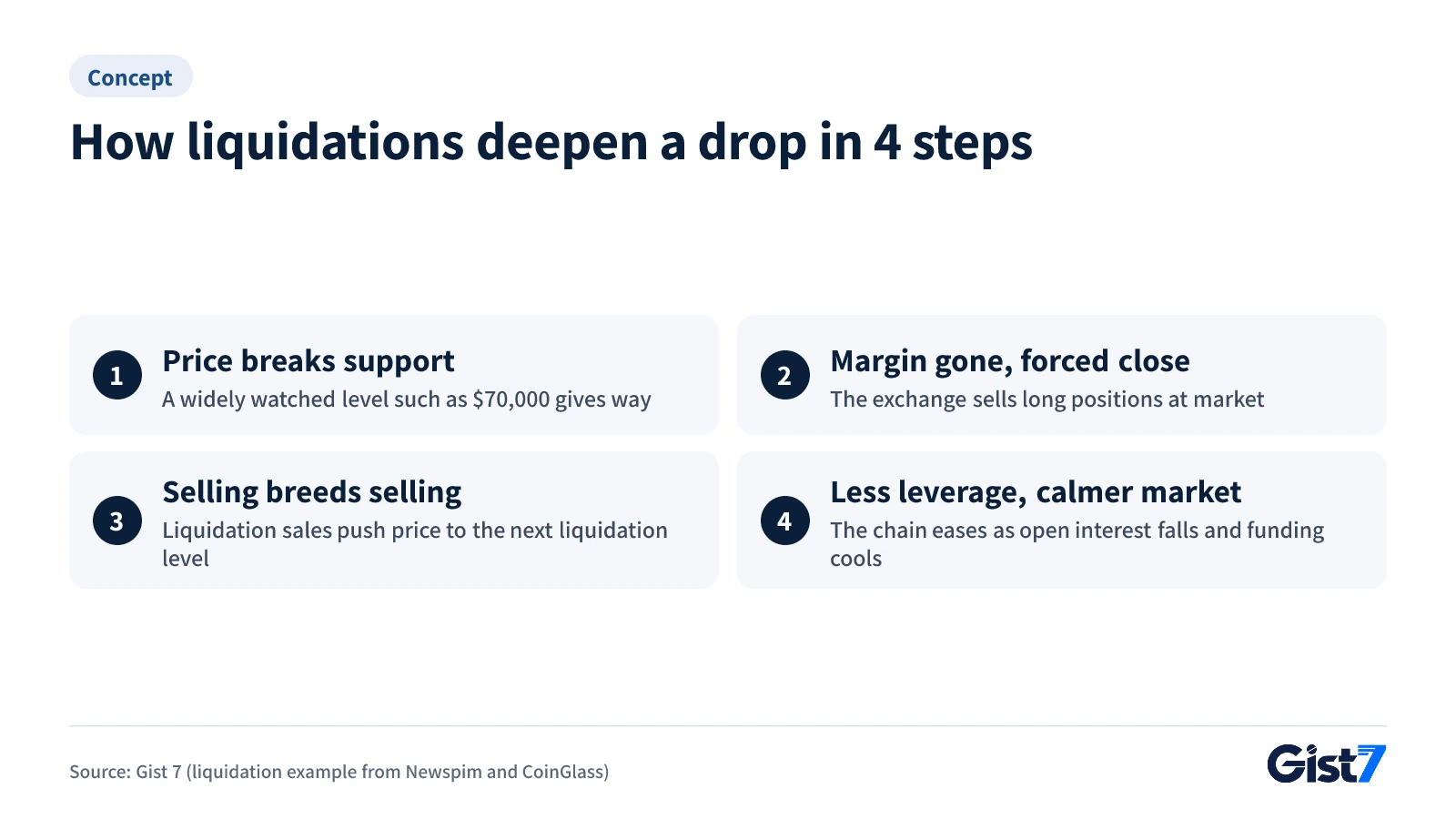
A forced liquidation happens when a trader who posted margin and borrowed to enlarge a position loses enough to reach the margin threshold, and the exchange closes the position at market price. When a long is liquidated, the exchange sells that amount into the market, and the selling pushes the price toward the next trader's liquidation level. That chain reaction is a liquidation cascade.
The higher the leverage, the shorter the distance to liquidation. The table below is a simple calculation for a long opened at $70,000 (it ignores maintenance margin and fees, so real liquidations come a little earlier; Gist 7 calculation).
| Leverage | Drop the position can absorb | Liquidation zone for a $70,000 long |
|---|---|---|
| 5x | about 20% | about $56,000 |
| 10x | about 10% | about $63,000 |
| 20x | about 5% | about $66,500 |
| 50x | about 2% | about $68,600 |
A 20x long would have hit its limit near this week's low. Just below a widely watched level like $70,000, liquidation prices and stop-loss orders tend to pile up. When that level breaks, liquidations fire all at once, which is what Newspim described when about $500 million was liquidated as $70,000 broke.
Bitcoin funding rate and open interest: how much leverage is left?
Leverage has shrunk but has not been flushed out, according to public data on the bitcoin perpetual futures contract (BTCUSDT) at Binance (private). A perpetual future is a futures contract with no expiry, and open interest is the total number of contracts still open. Binance BTCUSDT open interest fell 5.2%, from 102,149 BTC at 16:00 UTC on Nov. 12 to 96,873 BTC at 04:00 UTC on Nov. 14. Across the market, bitcoin futures open interest stood at $48.87 billion at 04:30 UTC on Nov. 13, down 4.32% from a day earlier, according to Blockmedia, citing CoinGlass.
The funding rate is the payment longs and shorts exchange every eight hours to keep perpetual futures prices tied to the spot price. When it is positive, longs pay shorts; when it is negative, shorts pay longs. Binance BTCUSDT funding settled at its 0.0100% baseline at 00:00 UTC on Nov. 13, then cooled to 0.0013% at 08:00 UTC, in the middle of the sell-off. It rose back to 0.0040% at 16:00 UTC and 0.0060% at 00:00 UTC on Nov. 14, and never turned negative. Dropping below the baseline shows froth cooled, but not enough to tilt the market toward shorts.
The long-short account ratio shows the remaining tilt toward longs more clearly. At Binance it rose from 2.81 at 08:00 UTC on Nov. 12, before the drop, to 3.46 at 11:00 UTC on Nov. 13, and was still 3.19 at 04:00 UTC on Nov. 14. Some accounts may have opened new longs to buy the dip. If so, there could still be positions left to liquidate if the price slips again.
Weekend bitcoin risk and the view from South Korea
On weekends, thin trading lets the same liquidation selling move prices more, and in South Korea the won price floats on a premium of about 2.5% while the exchange rate stays frozen at Friday's close. Crypto trades while stock and currency markets and U.S. spot ETFs are closed, but volume drops sharply. Binance spot BTC/USDT volume ran at $1.1 billion to $1.2 billion a day on Nov. 9 to 12, but only $400 million on the previous Saturday, Nov. 7 (UTC days; Binance spot data, Gist 7 tally).
The kimchi premium is the percentage by which bitcoin on South Korean exchanges trades above the overseas dollar price converted into won. At 2:17 a.m. ET on Nov. 14, Upbit quoted bitcoin at 92.22 million won. Multiplying Coinbase's $67,321 at the same time by the Nov. 13 Seoul daytime close of 1,336.7 won per dollar (3:30 p.m. local time, Etoday) gives about 89.99 million won, a premium of about 2.5% (Gist 7 calculation). Most of that premium comes from the dollar itself: tether (USDT), a dollar-pegged token, traded at 1,369 won on Upbit, already 2.4% above the exchange rate.
The won-based floor sits in a similar place. Upbit's price on Nov. 14 was 4.4% above its 52-week low of 88.342 million won on Aug. 14, while the dollar price was about 4% above CoinGecko's Aug. 19 daily value of $64,686. The two lows fall on different dates because the won price also moves with the exchange rate and the kimchi premium.
Market impact map
| Asset or indicator | Direction | Strength | Link (why) |
|---|---|---|---|
| Bitcoin | ↓ | Strong | Forced long liquidations deepened the drop. $67,321 (2:17 a.m. ET, Nov. 14, Coinbase) |
| Ether | ↓ | Medium | Below $2,000 for the first time since August (Newspim). Of $190.35 million in ether liquidations on Nov. 13, 91% were longs (Blockmedia) |
| Bitcoin futures open interest | ↓ | Medium | Liquidations cut leveraged positions. Binance BTCUSDT -5.2% (16:00 UTC Nov. 12 → 04:00 UTC Nov. 14) |
Little direct impact: 2-year Treasury, 10-year Treasury, dollar index, USD/KRW, gold, oil (WTI), S&P 500, Nasdaq, KOSPI
Market reactions can vary with other factors, and this table is not a basis for investment decisions.
- Background factors (causes rather than results of this drop): 10-year Treasury yield at 5.123% and the dollar index above 103, its highest since April last year (Newspim, Nov. 13 story); Nasdaq closed down 0.91% on Nov. 13 (Yahoo Finance)
- Investors in South Korea: the won price of bitcoin depends on the dollar price, the won-dollar rate and the kimchi premium. Tether traded at 1,369 won on Upbit on Nov. 14 (previous close 1,365 won), 2.4% above the Nov. 13 exchange rate.
- Offshore futures traders: when trading is thin, as on weekends, the same leverage can reach its liquidation price faster.
What to watch next
| Date (ET) | Indicator or event | Previous | Why it matters here | If it comes in... |
|---|---|---|---|---|
| Every U.S. trading day from Mon., Nov. 16 (tallied the next morning) | U.S. spot bitcoin ETF net flows | -$185.4 million on Nov. 13 (Farside Investors, via Economy Bloc) | Shows whether spot buying returns | Several days of inflows could support a post-liquidation rebound; continued outflows tend to keep pressure on |
| Wed., Nov. 25, 8:30 a.m. | U.S. October PCE prices | September +3.6% year over year (BEA) | The Fed's preferred inflation gauge | A hot reading raises rate pressure, which tends to hurt leveraged longs |
| Fri., Dec. 4, 8:30 a.m. | U.S. November jobs report | October payrolls +165,000, unemployment 4.1% (BLS) | Could change the path of rate hikes | A cooling job market could raise hopes of a slower pace, easing pressure on risk assets |
| Wed., Dec. 9, 2:00 p.m. | FOMC decision and projections (Dec. 8-9 meeting) | 3.75%-4.00% (Fed, held on Oct. 28) | A quarter-point hike is almost fully priced | A hike with weak signals of more could ease uncertainty |
Frequently asked questions
Why did bitcoin fall below $67,000?
The first drop came on Nov. 13 during Asian trading, when the break below $70,000 set off a cascade of forced long liquidations. The October PPI, up 6.5% from a year earlier and released amid spot ETF outflows, then firmed up bets on a December Fed hike and removed reasons for a rebound. By late Friday, Nov. 13 (ET), bitcoin had slid to $66,369 on Coinbase.
What is a bitcoin liquidation?
A liquidation happens when a trader using borrowed money loses enough that the margin is nearly gone, and the exchange closes the position at market price. Closing a long means selling, which can push the price further and trigger other liquidations. The higher the leverage, the smaller the move needed to wipe out a position.
What does a positive funding rate mean?
It means longs pay shorts on perpetual futures, which signals stronger demand on the bullish side. During this drop, Binance funding cooled to 0.0013%, below its 0.0100% baseline, so froth eased, but it never turned negative. The remaining tilt toward longs shows up more clearly in the long-short account ratio, which went from 2.81 to 3.19.
Is bitcoin more volatile on weekends?
Weekend trading is thinner, so the same amount of selling can move prices more. Binance spot BTC/USDT volume was $400 million on Saturday, Nov. 7, about a third of the $1.1 billion to $1.2 billion traded on weekdays (Gist 7 tally). Stock and currency markets and U.S. ETFs are closed, so other markets cannot absorb the selling.
How is the kimchi premium calculated?
Divide the won price on a Korean exchange by the overseas dollar price times the won-dollar rate, then subtract 1. Using Upbit's 92.22 million won and Coinbase's $67,321 at 2:17 a.m. ET on Nov. 14, plus the Nov. 13 Seoul daytime close of 1,336.7 won per dollar, the premium was about 2.5%.
References
- Producer Price Index News Release, October 2026 — 미 노동통계국(BLS)
- [코인 시황] 비트코인 일시 6만7000달러대로 급락…ETF 자금 이탈에 13억달러 강제 청산 — 뉴스핌 (2026-11-13)
- 비트코인, '심리적 지지선' 7만달러 3개월 만 붕괴…롱 6.8억달러 '폭풍 청산' — 블록미디어 (2026-11-13)
- 비트코인 하루 4% 하락…미국 PPI 둔화에도 6만8000달러대 머물러 — 디지털투데이 (2026-11-14)
- Bitcoin drops below $68,000, $1.29 billion in liquidations in 24 hours — KuCoin News (2026-11-14)
- Bitcoin price below $67,000, lowest since August — Cryptoticker (2026-11-14)
- [저녁 뉴스브리핑] 비트코인 6만7000달러 밑으로 外 — 토큰포스트 (2026-11-14)
- 미국 비트코인 현물 ETF, 2483억원 규모 순유출 — 이코노미블록 (2026-11-14, 파사이드 인베스터스 집계)
- [환율마감] 원·달러 5거래일만 반등, 유가·미국채 금리 급등 — 이투데이 (2026-11-13)
- Funding Rate History (BTCUSDT 무기한 선물, 공개 API: fapi.binance.com/fapi/v1/fundingRate?symbol=BTCUSDT) — 바이낸스
- Trading Data (BTCUSDT 미결제약정·롱숏 비율, 공개 API: fapi.binance.com/futures/data/openInterestHist·globalLongShortAccountRatio) — 바이낸스 선물
- BTC-USD 5분봉 (Exchange API) — 코인베이스
- KRW-BTC·KRW-USDT 시세 (Quotation API) — 업비트
- Meeting calendars and information — 미 연방준비제도
- Release Schedule — 미 경제분석국(BEA)
- Schedule of Releases for the Employment Situation — 미 노동통계국(BLS)