Seongsu-dong Seoul: Famous Tourist Spot, Things to Know
Key summary
Seongsu-dong, the "Brooklyn of Seoul," went from a royal horse pasture and factory district to a famous tourist spot in Korea. Foreign card spending there rose 100.6% in January–September 2026 (Seoul city), and its official land price rose about 2.1x in roughly 10 years.
- Seongsu-dong went from a Joseon-era royal horse pasture (Ttukseom) to a racetrack and a 1990s factory and handmade shoe district before becoming a famous tourist spot in Korea.
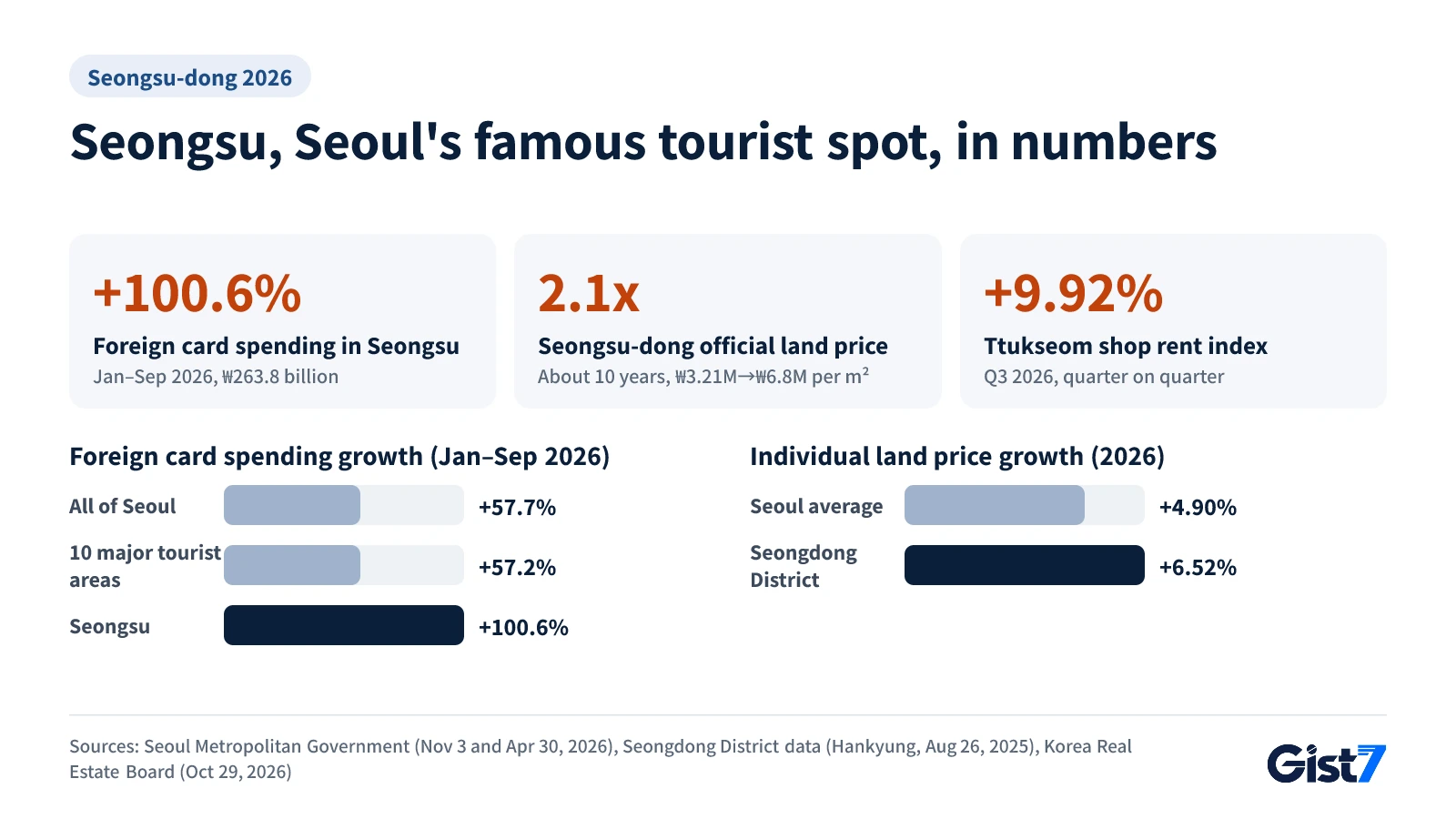
- Foreign card spending around Seongsu rose 100.6% to ₩263.8 billion in January–September 2026, the fastest growth among Seoul's 10 major tourist areas (Seoul city).
- Seongsu-dong's official land price rose about 2.1x in roughly 10 years, from ₩3.21 million to ₩6.8 million per m² (Seongdong District data); the Ttukseom shop rent index rose 9.92% quarter on quarter in Q3 2026.
- Reused factories, pop-up stores, headquarters moves such as Musinsa's, and foreign tourists drove the boom; Seongdong District has responded with an anti-gentrification ordinance since 2015.
- The key question now is whether rents outpace sales, and whether weekday office demand can act as a cushion.
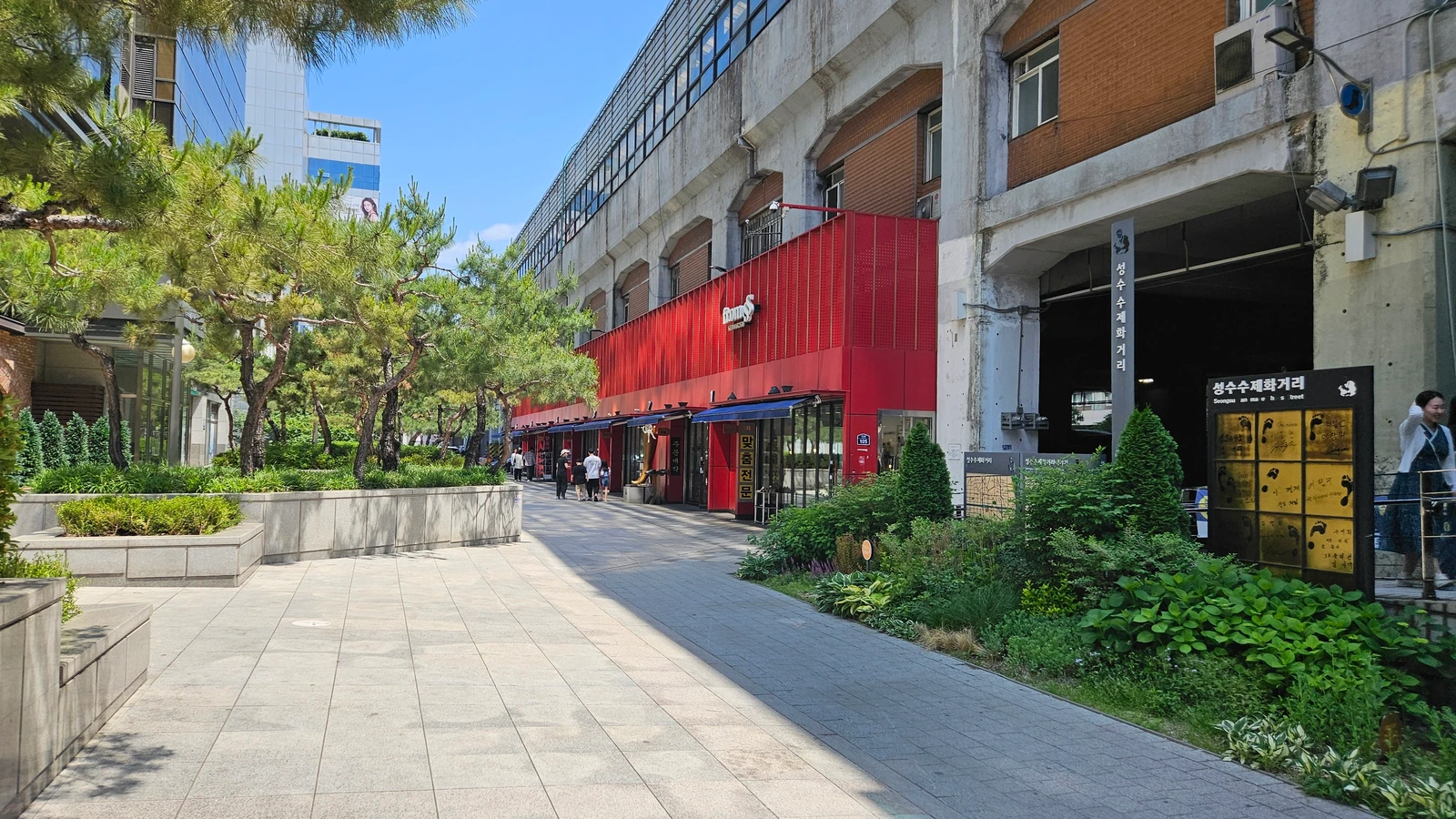
₩263.8 billion. That is how much foreign visitors spent by card around Seongsu from January to September 2026, according to the Seoul Metropolitan Government, up 100.6% from a year earlier and the fastest growth among Seoul's 10 major tourist areas. Seongsu-dong, on the north bank of the Han River in Seongdong District, has become a famous tourist spot in Korea that travelers now plan a separate day for, and the new center of the Seoul sightseeing map as of November 2026. Myeongdong is still bigger at ₩1.7356 trillion, but no area is growing faster.
Not long ago this was a factory district, not a tourist destination. Once empty factories and warehouses turned into cafes, galleries and pop-up stores, land prices followed. According to Seongdong District data reported by the Korea Economic Daily (Hankyung) on August 26, 2025, Seongsu-dong's official land price more than doubled in about 10 years, from ₩3.21 million to ₩6.8 million per square meter, and market prices climbed far more steeply.
Seongsu-dong history: from royal horse pasture to handmade shoe street
Seongsu-dong began as Ttukseom, a royal horse pasture in the Joseon era, then became a racetrack after the Korean War, a district of small factories and shoemakers in the 1990s, gained Seoul Forest in 2005, and is now a tourist hotspot. According to an essay by Professor Shin Byung-ju published on the Seoul Metropolitan Government's Media Hub, the name Ttukseom comes from "dok" (纛), the large banner raised during royal processions, and from the early Joseon period the area held a horse pasture and royal hunting grounds that kings visited often.
The same essay says the Ttukseom racetrack opened here after the Korean War and moved to Gwacheon in 1989. In the 1990s Seongsu-dong was an industrial area packed with small factories, and workshops making shoes by hand clustered into what is now the Seongsu Handmade Shoe Street. In the 2000s IT ventures moved into old factory buildings, and Seoul Forest opened on the former racetrack site in 2005.
| Period | What Seongsu and Ttukseom looked like | Source |
|---|---|---|
| Joseon era | Royal horse pasture and hunting ground; the name Ttukseom comes from the "dok" (纛) banner | Seoul Media Hub (Shin Byung-ju) |
| After the Korean War to 1989 | Ttukseom racetrack, moved to Gwacheon in 1989 | Seoul Media Hub (Shin Byung-ju) |
| 1990s | Industrial area of small factories and handmade shoe workshops | Seoul Media Hub (Shin Byung-ju) |
| 2005 | Seoul Forest opens on the former racetrack site | Seoul Media Hub (Shin Byung-ju) |
| January 2010 | Seongsu IT and distribution development promotion district first designated | Seoul Metropolitan Government Notice No. 2026-503 |
| September 2015 | Seongdong District anti-gentrification ordinance takes effect | Korea Law Information Center |
| September 2026 | District unit plan adopted for the semi-industrial zone of Seongsu-dong 1-ga and 2-ga | Seoul Metropolitan Government Notice No. 2026-503 |
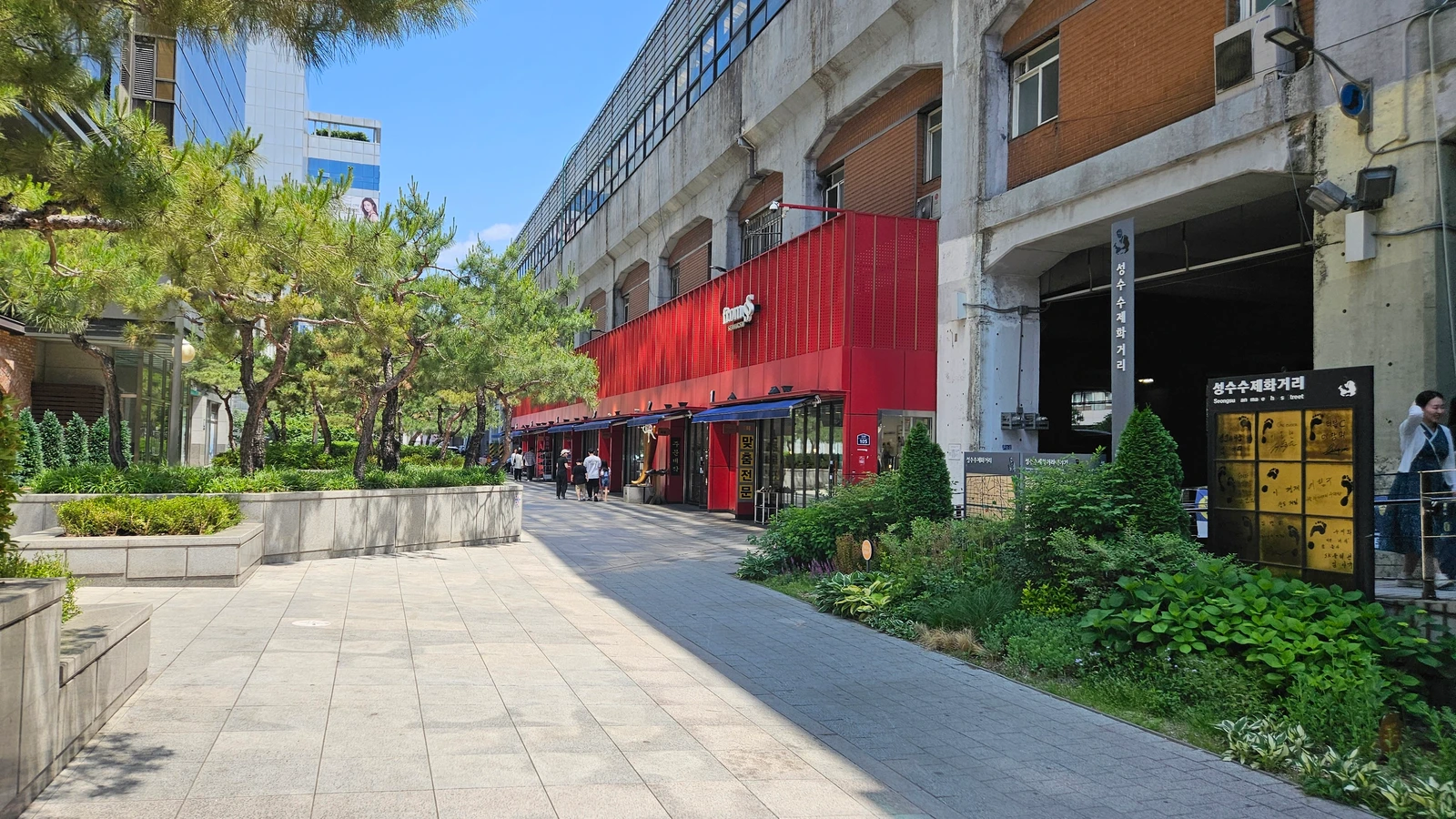
The factory-town character still shows up in zoning. A semi-industrial zone is a land-use category that allows factories while also mixing in housing and commerce. The district unit plan area for Seongsu's semi-industrial zone, announced by Seoul on September 3, 2026, covers 1,583,881 square meters of Seongsu-dong 1-ga and 2-ga, and 94.6% of it is semi-industrial land. The notice lets buildings that bring in recommended industries such as IT and cultural content get up to 1.2 times more floor area ratio and height.
Why did Seongsu-dong take off? Empty factories, pop-ups, headquarters, foreign visitors
Seongsu-dong took off because four things came together: large, cheap empty factories; pop-up stores that rent those spaces for short periods; company headquarters moving in from Gangnam; and foreign tourists who come to see all of it.
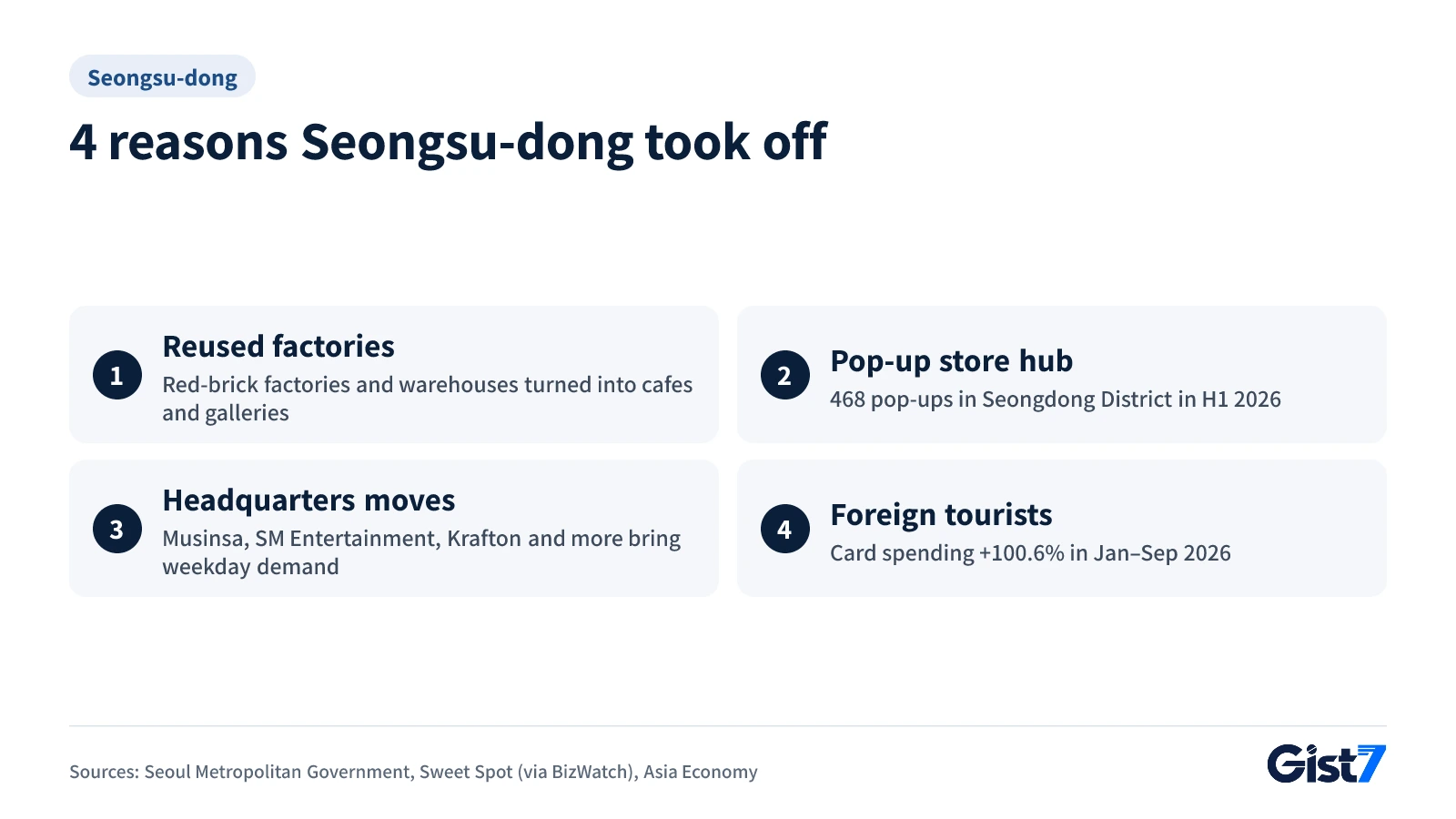
Reused factories. Seongsu-dong's Daelim Changgo was built as a rice mill in the 1970s and used as a warehouse from the 1990s (Seoul Media Hub). As red-brick factories and warehouses like it were turned into cafes and galleries instead of being torn down, Seongsu-dong came to be called the "Brooklyn of Seoul," as the title of that Seoul Media Hub article puts it, a comparison with New York's old factory district.
The capital of pop-up stores. A pop-up store is a temporary shop that opens for a few weeks or months. According to a BizWatch report (October 21, 2026) citing data from pop-up space platform Sweet Spot, Seongdong District hosted 468 pop-ups in the first half of 2026, up 8.8% from 430 a year earlier. Seongsu pop-ups are still plentiful, but Seongdong's share of all pop-ups in Seoul fell from 35% to 26%. BizWatch read this as pop-ups spreading to other areas such as Yongsan.
Headquarters on the move. Musinsa (unlisted) moved its headquarters from Gangnam District to Seongsu-dong in 2022 (Asia Economy, March 31, 2026). SM Entertainment (KOSDAQ: 041510) moved into D Tower in Seongsu-dong, and Krafton (KOSPI: 259960) is building a new headquarters on the former E-Mart Seongsu store site. The same article, citing NAI Korea, said office transactions in Seongsu-dong grew from ₩122.2 billion in 2023 to ₩499.3 billion in 2025. More office workers mean weekday lunch and dinner demand, which smooths out sales compared with areas that rely only on weekend tourists.
Foreign tourists. According to Seoul's "January–September 2026 Seoul Tourism and Consumption Trends," foreign card spending in Seoul rose 57.7% to ₩8.8435 trillion over the period, and spending around Seongsu rose 100.6%, doubling. Shopping made up 46.0% of all foreign spending in Seoul. The city's count is based on Shinhan Card data from the Korea Tourism Data Lab, so cash payments are not included.
| Seoul area (Seoul city data) | Foreign card spending, Jan–Sep 2026 | Change vs. a year earlier |
|---|---|---|
| All of Seoul | ₩8.8435 trillion | +57.7% |
| 10 major tourist areas combined | ₩5.3159 trillion | +57.2% |
| Myeongdong area | ₩1.7356 trillion (largest of the 10) | Not in the press release |
| Seongsu | ₩263.8 billion | +100.6% (fastest of the 10) |
| Alley commercial districts combined | ₩308.2 billion | +80.5% |
| Traditional markets combined | ₩228.2 billion | +48.8% |
The 10 major tourist areas are the Myeongdong area, Apgujeong, Gangnam Station, Hongik University Station (Hongdae), COEX and Bongeunsa, Cheongdam-dong and Dosan Park, Seongsu, Lotte World Tower, Sinsa Garosu-gil, and Yeouido IFC and The Hyundai Seoul. By district, foreign card spending in Seongdong rose 102.8%, lifting its share of the Seoul total from 3.9% to 5.2%. Seongsu and Ttukseom stations on Seoul Subway Line 2 and Seoul Forest Station on the Suin-Bundang Line make it easy to get there from Myeongdong or Gangnam. Visitor numbers keep rising too. According to the Ministry of Culture, Sports and Tourism (November 26, 2026), 2.16 million foreign visitors came to Korea in October, up 24.0%, bringing the January–October total to 19.27 million. We covered the wider visitor trend in our piece on Korea's 20 million tourists.
How much have Seongsu-dong land prices and rents risen?
The official land price has roughly doubled in a decade, while market prices and shop rents have risen far more steeply. The official land price (gongsi jiga) is the per-square-meter value the government sets each year as of January 1; it serves as the basis for taxes such as property tax and for welfare programs.
| Indicator | Figure | Basis and source |
|---|---|---|
| Seongsu-dong official land price (per m²) | ₩3.21 million → ₩6.8 million (about 2.1x) | Over about 10 years, Seongdong District data (reported by Hankyung, Aug 26, 2025) |
| Seongdong District individual land price growth | +4.82% in 2025 → +6.52% in 2026 (2nd in Seoul; Seoul average +4.90%) | Seoul Metropolitan Government |
| Seongdong District standard land price growth | +6.20% in 2026 (3rd in Seoul; Seoul +4.89%) | Ministry of Land, Infrastructure and Transport 2026 standard land announcement (Dec 17, 2025) |
| Ttukseom commercial district shop rent index | +9.92% quarter on quarter (Seoul +0.43%) | Q3 2026, Korea Real Estate Board |
| Seongsu-dong office transactions | ₩122.2 billion → ₩499.3 billion | 2023→2025, NAI Korea |
The official land price figure follows Seongdong District data reported by Hankyung (August 26, 2025), the standard land figure follows Newsis coverage of the transport ministry's announcement, and the rent index follows Metro Seoul's coverage of the Korea Real Estate Board's Q3 rent survey. According to Seoul city, Seongdong's 2026 individual land price growth (6.52%) was second only to Yongsan District (9.20%).
The gap with market prices is even wider. ₩6.8 million per square meter works out to about ₩22.48 million per pyeong (3.3 m²). Asia Economy (March 31, 2026) reported that Seongsu-dong land went for ₩20 million to ₩30 million per pyeong only 15 years ago, and that deals of ₩300 million or more now appear in Seongsu's office core. Because the official price is a tax benchmark, it tracks market prices late and low. For shops, Sweet Spot data (reported by BizWatch) show that key money on Yeonmujang-gil is about 20 times what it was five years ago, and rent per 3.3 m² has tripled. Key money (gwolligeum) is what an incoming tenant pays the previous tenant for the goodwill of the business.
The Bank of Korea's rate hike to 3.25% on November 26 raises interest costs for buyers who borrow to purchase buildings, which could slow land price gains.
What Seongsu has given Seoul's economy, and what it has cost
Seongsu-dong has sharply increased sales, wages, taxes and tourism spending. In return, it has pushed out existing merchants and small factories that could not keep up with rent. The economic value of the Seongsu area rose by about ₩33.3 trillion compared with 2014 (Herald Economy on a Hanyang University study commissioned by Seongdong District, January 2026).
| Item | Change | Period |
|---|---|---|
| Business sales | ₩24.2 trillion → ₩51.2 trillion | 2014→2023 |
| Total worker wages | ₩2.5 trillion → ₩6.2 trillion | 2014→2024 |
| Corporate tax | ₩222.8 billion → ₩470 billion | 2014→2024 |
| Foreign tourist spending | ₩13.3 billion → ₩198.9 billion | 2018→2024 |
| Foreign visitors (Seongdong District count) | 60,000 → 3 million | 2018→2024 |
Only the foreign visitor row comes from Seongdong District's own count (reported by Hankyung); the rest comes from the Hanyang University study. The district commissioned that study, which is worth keeping in mind when reading the figures.
The cost comes from rent. Some landlords prefer pricier short-term pop-up leases over long-term tenants (BizWatch). When that happens, neighborhood shops with thin margins, handmade shoe workshops and small factories are the first to struggle. When long-time residents and merchants are pushed out by rising rents, the process is called gentrification.
Seongdong District moved early against Seongsu-dong gentrification with a September 2015 ordinance on community cooperation and sustainable development zones, which sets up sustainable development zones and a residents' council and defines a rent increase of more than 5% at lease renewal as a "sharp rent increase." In 2023 the district expanded the zone 8.6 times to cover most of Seongsu-dong, and a 2021 survey found that shops whose landlords signed a coexistence agreement stayed open 79 months on average versus 52 months for those without one, although the agreements are not legally binding (Asia Economy, August 2023).
From Gist 7's point of view, Seongsu's future depends on whether rents rise faster than sales. Foreign card spending doubled in January–September, but the Ttukseom rent index also rose about 10% in a single quarter. The drop in pop-up share from 35% to 26% can be read as a sign that some brands are leaving an expensive Seongsu. On the other hand, if headquarters and offices keep moving in, weekday demand becomes a cushion. The thing to watch is whether Seongsu settles in as a place where people work, not just a tourism fad.
Market impact map
| Asset / indicator | Direction | Strength | Link (why) |
|---|---|---|---|
| Seongsu shop rents (Ttukseom district) | ↑ | Strong | Foreign and pop-up demand pushed the rent index up 9.92% quarter on quarter in Q3 2026 |
| Seongsu office sales and leasing | ↑ | Medium | Headquarters moves by Musinsa, Krafton and others lifted office transactions more than fourfold from 2023 |
| Fashion and beauty retail | ↑ | Medium | 46.0% of foreign card spending in Seoul is shopping, making Seongsu stores a sales channel to foreigners |
| REITs and construction (Seongsu redevelopment, offices) | ↑↓ | Weak | Redevelopment and office demand push up; the November rate hike raises funding costs |
| Tourism, duty-free and travel sectors | ↑ | Weak to medium | October visitors rose 24.0% to 2.16 million and 46.0% of foreign card spending in Seoul is shopping, so tourism spending grows |
| Other Seoul retail districts (Yongsan, etc.) | ↑ | Weak | As Seongsu rents rose, pop-ups spread out and Seongdong's pop-up share fell from 35% to 26% |
Little direct impact: US 2-year Treasury, US 10-year Treasury, Dollar Index, won/dollar, gold, oil (WTI), bitcoin, S&P 500, Nasdaq, KOSPI
- Travelers: The Bank of Korea's ECOS data put the won/dollar base rate at ₩1,342.7 on November 27, 2026, so spending ₩10,000 in Seongsu costs about $7.45. Under Article 6 of Korea's Special Rules on VAT and Individual Consumption Tax for Foreign Tourists (checked November 27, 2026), instant tax refunds at participating tax-free shops apply to purchases under ₩1 million (about $745) per transaction and up to ₩5 million in total after arrival.
- Merchants and tenants: Seongdong's ordinance defines a rent or deposit increase of more than 5% at renewal as a sharp rent increase. It is worth checking whether a coexistence agreement is in place before signing.
- Residents: Seongdong's individual land prices rose 6.52% in 2026, raising the base for holding taxes such as property tax. Seoul housing costs are covered in our Seoul rent piece.
Market reactions can vary with other factors, and this table is not a basis for investment decisions.
What to watch next
| Date (KST) | Indicator / event | Previous | Why it matters here | If it comes in... |
|---|---|---|---|---|
| Early December (expected) | Bank of Korea October balance of payments (preliminary) | September travel receipts $2.49 billion, travel balance -$770 million (ECOS) | National base for sales in tourist districts like Seongsu (total foreign spending in Korea) | Higher travel receipts signal that spending in tourist districts like Seongsu continues; lower receipts suggest spending slowed, possibly due to a stronger won |
| Mid-December (expected) | Transport ministry 2027 standard land prices (draft) | 2026 Seongdong standard land +6.20% | Official benchmark for Seongsu land and holding taxes | A big rise means higher holding taxes for landlords and more pressure to pass them on in rent |
| Late December (expected) | Culture ministry November inbound tourism trends | October 2.16 million, +24.0% (Culture ministry, Nov 26) | Visitor numbers behind Seongsu's foreign spending | Continued 20%-plus growth supports tourist-district sales; a slowdown could weaken demand for pop-up and shop leases |
Dates are based on previous release timing (Bank of Korea September balance of payments on November 5, the transport ministry's 2026 standard land announcement on December 17, 2025, and the culture ministry's September data on October 22 and October data on November 26). Check each agency's release calendar for exact dates.
For reference, the Korea Real Estate Board's Q4 2026 commercial real estate rent survey, which tracks Seongsu shop rents directly, is expected in late January 2027 (the Q4 2025 survey came out on January 29, 2026). The Ttukseom rent index rose 9.92% quarter on quarter in Q3.
Frequently asked questions
What was Seongsu-dong originally?
In the Joseon era it was the Ttukseom area, home to a royal horse pasture and hunting grounds, and after the Korean War it hosted the Ttukseom racetrack, which moved to Gwacheon in 1989. In the 1990s it was an industrial area of small factories and handmade shoe workshops, and Seoul Forest opened on the former racetrack site in 2005.
Why is Seongsu-dong called the "Brooklyn of Seoul"?
Because its red-brick factories and warehouses were turned into cafes, galleries and shops instead of being demolished, much like New York's Brooklyn, where an old factory district became a cultural hub. Daelim Changgo, built as a rice mill in the 1970s, is a well-known example.
How much have Seongsu-dong land prices risen?
According to Seongdong District data reported by Hankyung in August 2025, Seongsu-dong's official land price rose about 2.1x in roughly 10 years, from ₩3.21 million to ₩6.8 million per square meter. Seongdong's individual land prices rose 6.52% in 2026, second only to Yongsan among Seoul's 25 districts, and actual transaction prices are far higher than the official figure.
How much do foreign tourists spend in Seongsu-dong?
According to Seoul city, foreign card spending around Seongsu reached ₩263.8 billion in January–September 2026, up 100.6% from a year earlier. That was the fastest growth among Seoul's 10 major tourist areas.
How many pop-up stores are there in Seongsu-dong?
Sweet Spot data (reported by BizWatch) show 468 pop-ups in Seongdong District in the first half of 2026, up 8.8% from a year earlier. However, the district's share of all pop-ups in Seoul fell from 35% to 26%.
How is Seongdong District fighting gentrification?
In response to Seongsu-dong gentrification, Seongdong District enacted a sustainable development zone ordinance in September 2015, creating sustainable development zones and a residents' council and encouraging coexistence agreements between landlords and tenants. In 2023 it expanded the zone to cover most of Seongsu-dong, but the agreements are not legally binding.
How do I get to Seongsu-dong in Seoul?
Get off at Seongsu or Ttukseom Station on Seoul Subway Line 2, or Seoul Forest Station on the Suin-Bundang Line. It is an easy subway ride from other Seoul sights such as Myeongdong and Gangnam.
Can I get an instant tax refund when shopping in Seongsu-dong?
At tax-free shops for foreign tourists, you can buy at the tax-exclusive price (instant refund) when a single transaction is under ₩1 million and your total instant-refund purchases after arrival are ₩5 million or less (Article 6 of the Special Rules on VAT and Individual Consumption Tax for Foreign Tourists, checked November 27, 2026). Check first that the shop is a registered tax-free shop.
References
- (석간) 서울 외국인 관광객 소비액 9개월 만에 8조 8천 억… 지난해 연간 실적 넘어 역대 최대 (2026.11.3) — 서울특별시
- (석간) 서울시, 2026년도 개별공시지가 결정·공시 (2026.4.30) — 서울특별시
- 서울특별시 고시 제2026-503호 성수 준공업지역 지구단위계획구역 지정 및 계획 결정 (2026.9.3) — 서울특별시
- 서울특별시 성동구 지역공동체 상호협력 및 지속가능발전구역 지정에 관한 조례 — 국가법령정보센터
- 성동구 핫플 성수동 10년간 경제적 가치 33조 늘어난 배경? (2026.1.11, 한양대 산학협력단 용역) — 헤럴드경제
- 상가 불황 속 '외국인 효과'…뚝섬·명동·광안리 임대료 껑충 (2026.10.29, 한국부동산원 3분기 상업용부동산 임대동향) — 메트로신문
- 내년 공시가격 표준지 3.35%·단독주택 2.51% 상승…서울 4.5%↑ (2025.12.17, 국토교통부 발표) — 뉴시스
- 10년 만에 성수동 천지개벽…도시재생으로 경제가치 1.5조 (2025.8.26, 성동구 자료) — 한국경제