Korean batteries and Chile lithium: 97% of carbonate imports
Key summary
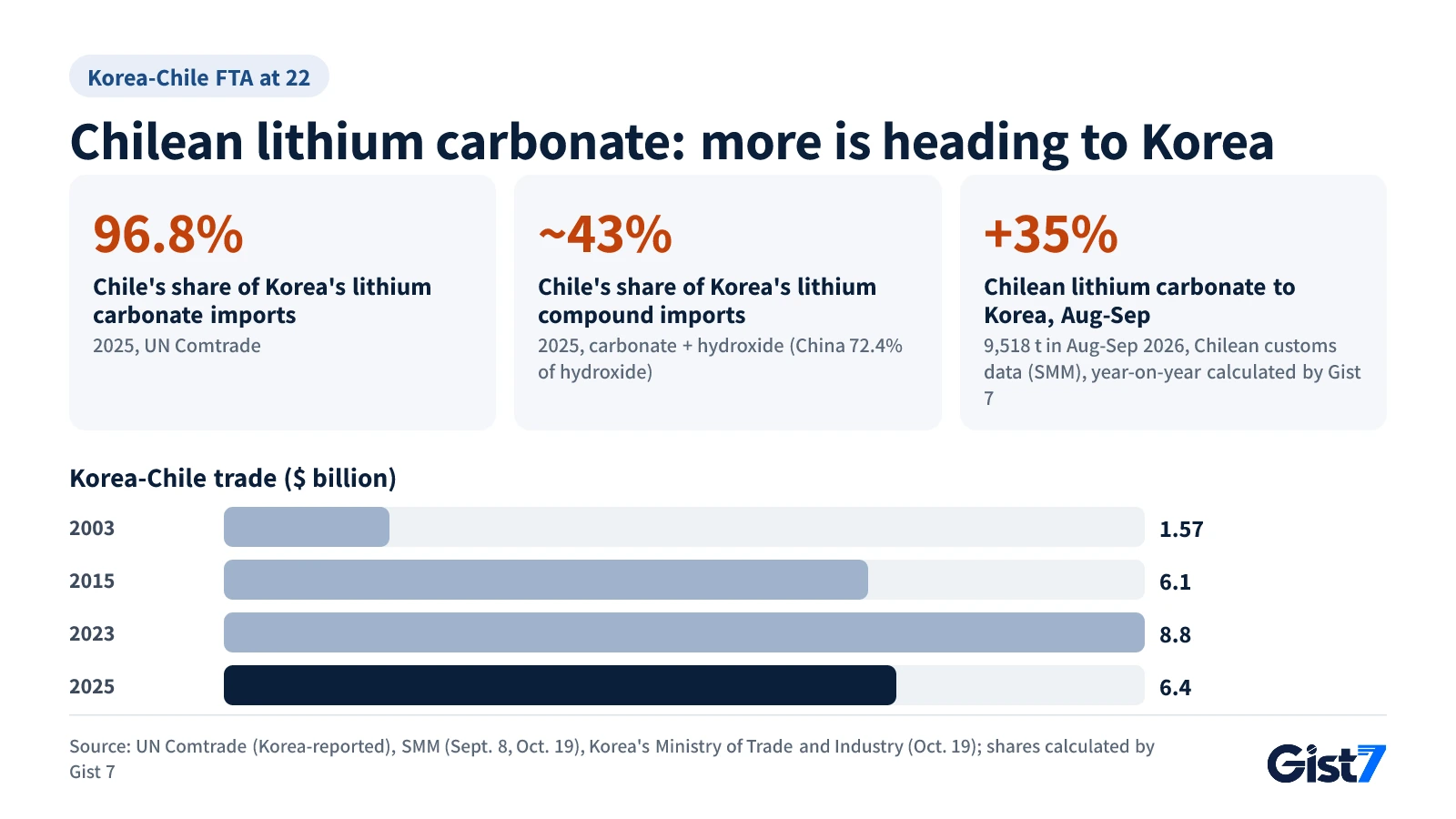
Chile lithium supplied 96.8% of South Korea's 2025 lithium carbonate imports, but China supplied 72% of its hydroxide, so Chile's share of all lithium compounds was about 43%. Chilean data show Aug.-Sept. 2026 shipments to Korea about 35% above a year earlier; falling copper weighs on total trade.
- Chile supplied 96.8% of South Korea's lithium carbonate imports in 2025, but China supplied 72.4% of its lithium hydroxide, leaving Chile at about 43% of all lithium compounds (UN Comtrade)
- Korea's share of Chile's lithium exports rose from 15% in 2024 to 22% in 2025, making it the No. 2 buyer after China (Subrei)
- Chilean customs data (via SMM) show 6,630 tonnes of lithium carbonate shipped to Korea in August 2026 and 2,888 tonnes in September, about 35% more than a year earlier over the two months (large monthly swings). Chile's lithium exports rose 165% in January-October (Central Bank of Chile data, reported by Redimin)
- When lithium prices fell in 2023-2025, Korea's imports of Chilean lithium carbonate dropped 84% by value, and copper ore became the top product
- Korea-Chile trade grew from $1.57 billion in 2003 to $6.4 billion in 2025, about 4.1 times (Korea's trade ministry). Copper imports more than tripled in value while volume fell 5%, so most of the gain came from price
More Chile lithium is heading to South Korea. Chilean customs data show 9,518 tonnes of lithium carbonate shipped to Korea in August-September 2026, about 35% more than a year earlier (calculated from SMM figures). Month to month the flow swung sharply, from 6,630 tonnes in August to 2,888 tonnes in September. Chile lithium prices averaged more than double their 2025 level in January-October (Central Bank of Chile data, reported by Redimin), while copper, half of what Korea buys from Chile, fell 17.2% in November through the 26th (LME spot, Cochilco data).
How much do Korean batteries rely on Chile lithium?
Korea buys almost all of its lithium carbonate from Chile (96.8% of 2025 imports) and about 43% of all lithium compounds (UN Comtrade, Korea-reported data). The reason is simple: Chile is effectively the only country selling Korea lithium carbonate in volume. Of the $338 million in lithium carbonate Korea imported in 2025, $327 million came from Chile and $7 million from China, while Argentina supplied almost nothing (it shipped $96 million in 2024, UN Comtrade). Lithium hydroxide, used in high-nickel batteries, is a different story: China supplied 72.4% and Chile 20.4%.
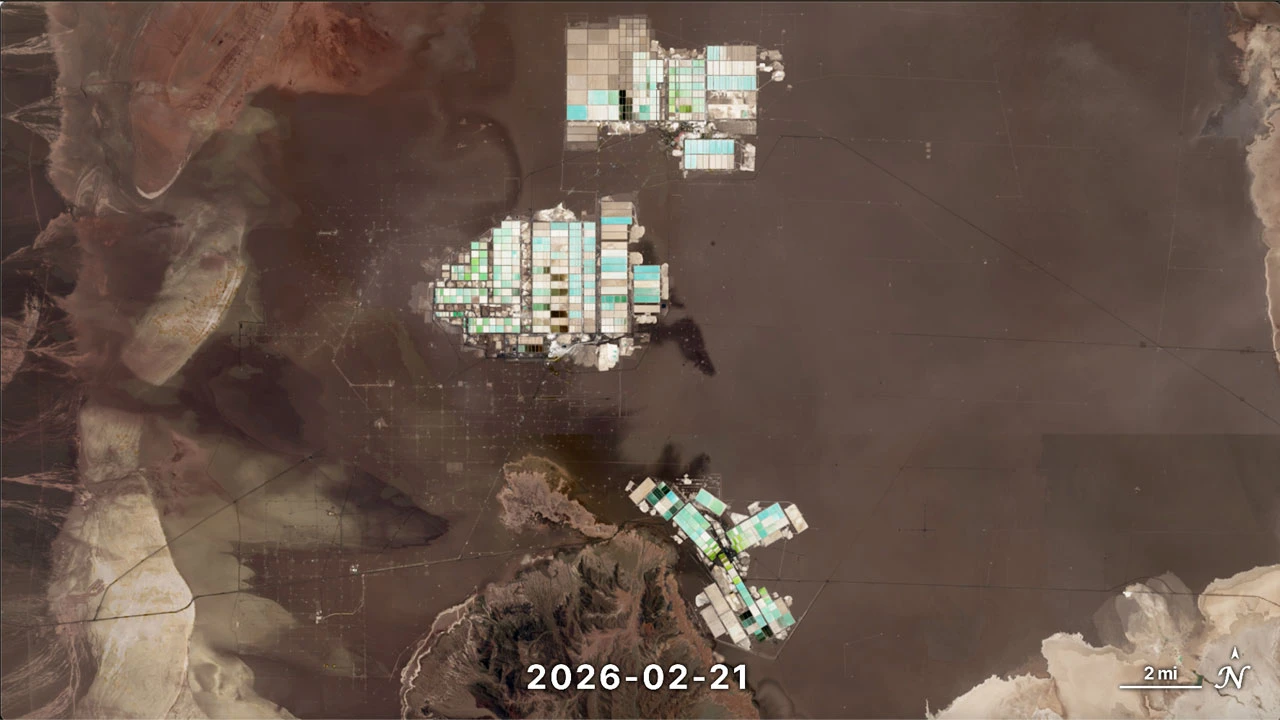
Lithium carbonate goes mainly into lithium iron phosphate (LFP) and mid- to low-nickel batteries, while lithium hydroxide goes into high-nickel batteries (Asia Economy). LG Energy Solution (KOSPI: 373220) signed a long-term deal with Chile's SQM (Sociedad Química y Minera · NYSE: SQM · Santiago Stock Exchange: SQM-B) for about 100,000 tonnes of lithium carbonate and hydroxide over 2023-2029 (Asia Economy, July 2023).
Import values swung because of price. Korea's imports of Chilean lithium carbonate fell 84.3%, from $2.1 billion in 2023 to $327 million in 2025, as volume dropped 38.2% and the price per kilogram fell 74.6%. Copper ore became the top product over the same period. In Korean data, volumes of Chilean lithium carbonate plunged between 2023 and 2024, then partly recovered with a 30% rise in 2025 (UN Comtrade). In 2026 prices turned up again. Chile's lithium sold for an average of $18,850 a tonne in January-October, more than double 2025, and lithium carbonate made up 74% of $5.2 billion in exports, up 165% (Redimin, Central Bank of Chile data). Lithium sulfate went entirely to China as of September (SMM).
How big a customer is Korea for Chile lithium?
Korea ranks second, after China. According to the lithium market report of Chile's Undersecretariat for International Economic Relations (Subrei), Korea's share of Chile's lithium exports rose from 15% in 2024 to 22% in 2025, while China's slipped from 70% to 67% (Portal Minero, July 15). Applied to Chile's $2.4 billion in 2025 lithium exports, that puts shipments to Korea at about $530 million. Korean data put Chilean lithium carbonate and hydroxide combined at about $490 million that year. The gap likely reflects FOB (price at the port of export) versus CIF (delivered price including freight and insurance) valuation and shipping lags (Gist 7 estimate). Korea took 3.9% of Chile's total goods exports in January-June 2026 (BioBioChile, July 8).
Within Chile's lithium policy, Korea has mostly been a customer rather than an investor. In 2018 a POSCO (now POSCO Holdings · KOSPI: 005490) and Samsung SDI (KOSPI: 006400) consortium was selected under the preferential lithium supply program of Chile's development agency Corfo to make about 19,000 tonnes of cathode material a year (Reporte Minero, March 12, 2018). The project collapsed in 2019 when the POSCO-Samsung consortium dropped its investment (confirmed by Corfo in July 2019, Reporte Minero). In December 2025, NovaAndino Litio (unlisted), a Codelco-SQM joint venture in which state-owned Codelco (unlisted) holds the majority, was set up to run lithium operations in the Salar de Atacama until 2060 (La República, December 27, 2025). That joint venture is likely to be the counterparty when the LG Energy Solution-SQM contract ends in 2029.
What does the minerals MOU change for Korea's lithium supply?
It moves government talks up to the ministerial level. According to Korea's Ministry of Trade and Industry, the Mineral Resources Partnership memorandum of understanding signed at the July 30 summit in Santiago (local time) covers everything from joint exploration to processing, smelting, recycling and investment, and raises the resources cooperation committee to minister level. The Free Trade Commission, meeting on October 19 for the first time in 10 years, also discussed upgrading the FTA, including minerals cooperation (Ministry of Trade and Industry).
Sourcing outside Chile is growing too. Under an MOU reported on November 11 for POSCO Future M (KOSPI: 003670) to supply LG Energy Solution with 720,000 tonnes of LFP cathode and synthetic graphite anode material over 2027-2033, POSCO is pursuing a strategy of using lithium from Argentine salt flats (Redimin). Gist 7 sees the minerals MOU as supply insurance more than a price fix. With Chile now competing with Argentina for Korean demand, a ministerial channel gives Korea a place to negotiate contract terms early.
Did copper prices drive the fourfold rise in Korea-Chile trade?
Largely, yes. Trade grew from $1.57 billion in 2003 to $6.4 billion in 2025, about 4.1 times (Ministry of Trade and Industry), but while the value of copper imports from Chile rose from $730 million to $2.4 billion, volume fell 5%. The Korea-Chile FTA, Korea's first free trade agreement, took effect in April 2004 (Diario Financiero).
| Korean data | 2003 (pre-FTA) | 2023 (peak) | 2025 | vs. 2003 |
|---|---|---|---|---|
| Chile → Korea (Korean imports) | $1,057.6 million | $7,572.0 million | $4,741.1 million | 4.5x |
| Korea → Chile (Korean exports) | $517.2 million | $1,246.4 million | $1,681.3 million | 3.3x |
| Total trade | $1,574.8 million | $8,818.4 million | $6,422.4 million | 4.1x |
| Korea's trade balance | -$540.4 million | -$6,325.7 million | -$3,059.8 million | deficit 5.7x |
Source: UN Comtrade 2025 · 2023 · 2003, Korea-reported data.
New products also mattered. Molybdenum ores and concentrates, about $10 million in 2003, and lithium carbonate, almost nil ($1.3 million in 2003), each reached the $300 million range by 2025 (UN Comtrade 2003). Gist 7 sees the clearest effect of tariff cuts in food such as pork (volume up 2.4 times) and wine (volume up 13 times) (same source). In copper ores and concentrates Chile ranks first with 26.9% of Korea's imports, and Peru ($440 million) is second in Latin America, fifth overall (UN Comtrade 2025 copper ore).
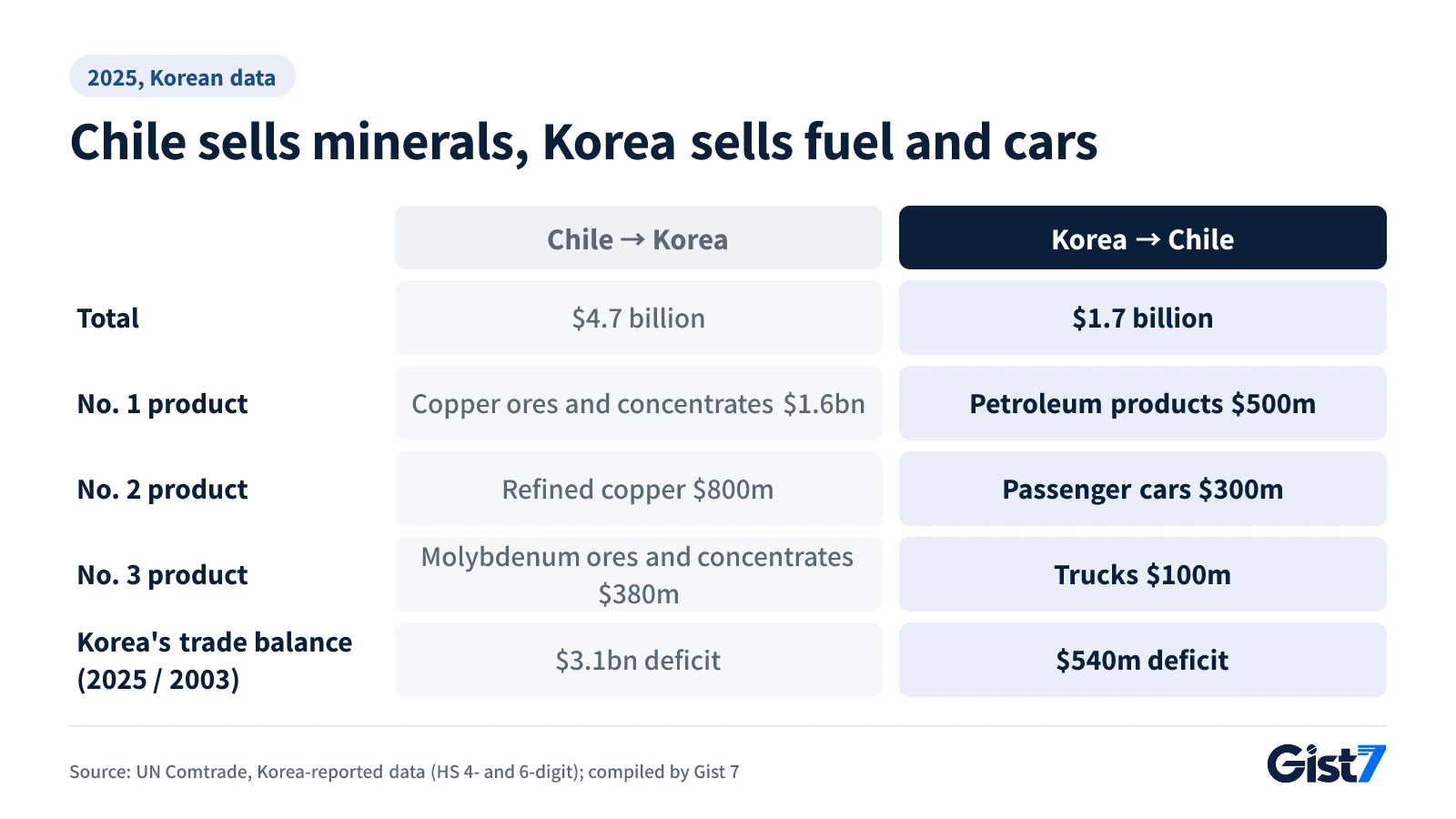
Korea's top exports to Chile are petroleum products ($500 million) and passenger cars ($300 million). Korea's wider export reliance on chips is covered in Korea's $1 trillion in exports and the 49% chip share, and Latin American markets without an FTA in Mexico's tariffs and Korean exports.
Market impact map
| Asset / sector | Direction | Strength | Link (why) |
|---|---|---|---|
| Chilean lithium producers (SQM, etc.) | ↑ | Medium | Chile lithium averaged $18,850 a tonne in January-October, more than double 2025 (Central Bank of Chile data, reported by Redimin). Tends to feed into selling prices with a lag |
| Korean battery sector (cells, cathodes) | ↑↓ | Weak | Higher lithium prices tend to help cathode makers with price-linked contracts ↑ and squeeze short-term margins at cell makers that pass costs on slowly ↓ |
| Copper (LME) | ↓ | Medium | Down 17.2% in November through the 26th (LME spot, Cochilco data). $5.43 a pound on November 26 (Redimin copper report). Lowers the value of Korea's imports from Chile |
| Chilean peso (CLP) | ↑↓ | Weak | Higher lithium exports bring in more dollars, but the larger copper slide works the other way. 1,041 pesos per dollar on November 26 (Redimin). For commodity-exporter currencies and the dollar, see strong dollar and emerging-market stocks |
Little direct impact: 2-year Treasury, 10-year Treasury, dollar index, won/dollar, gold, oil (WTI), bitcoin, S&P 500, Nasdaq, KOSPI
- Everyday impact: Higher lithium prices raise EV battery costs and, if passed on, tend to shrink room for cuts in what buyers actually pay for electric cars.
- Lower copper prices tend to ease cost pressure on copper-heavy goods such as cables and air conditioners.
Market reactions can vary with other factors, and this table is not a basis for investment decisions.
What to watch next
| Date (Korea time) | Indicator / event | Previous | Why it matters here | If it comes in... |
|---|---|---|---|---|
| Dec 1 (Tue), morning (scheduled); Nov 30 evening ET | Korea's November trade data (Ministry of Trade and Industry) | October exports to Latin America about $3.0 billion (-37%) (ministry's October release) | Exports to Latin America, which includes Chile | A continued decline would signal weaker exports to the region, including Chile |
| Dec 7 (Mon) (scheduled), Chile release | Central Bank of Chile November trade data | January-October 2026 cumulative lithium exports $5.2 billion (reported by Redimin) | Chile's lithium and copper exports | If lithium keeps rising, shipments to Korea may rise too |
| Around Dec 15 (Tue) (scheduled) | Korea's final November trade data (Korea Customs Service) | November 2025 lithium carbonate imports from Chile $20.48 million (UN Comtrade monthly) | Korea-side imports of Chilean lithium | A rise would confirm in Korean data what Chilean data show |
| Dec 16 (Wed) 06:00; Dec 15, 4 p.m. ET / 6 p.m. Chile | Central Bank of Chile monetary policy meeting | Policy rate 4.5% (held on October 27, Central Bank of Chile) | Peso | A cut would tend to weigh on the peso, a hike would support it, a hold would matter little |
The Dec 1 and around-Dec 15 dates are expected based on usual release patterns.
Frequently asked questions
How much does South Korea rely on Chile lithium?
It depends on the product. In 2025, 96.8% of Korea's lithium carbonate imports came from Chile, but China supplied 72.4% of the lithium hydroxide used in high-nickel batteries, so Chile accounted for about 43% of all lithium compounds (UN Comtrade, Korea-reported data). From Chile's side, 22% of its lithium exports went to Korea, second only to China (Subrei).
Is Korea buying more Chilean lithium in 2026?
Chilean data show rising volumes. According to Chilean customs data compiled by SMM, 6,630 tonnes of lithium carbonate were shipped to Korea in August and 2,888 tonnes in September, swinging month to month but about 35% more than a year earlier over the two months. Korea-side figures are published by the Korea Customs Service's trade statistics.
How much has Korea-Chile trade grown since the FTA?
According to Korea's Ministry of Trade and Industry, trade grew from $1.57 billion in 2003, before the FTA took effect, to $6.4 billion in 2025, about 4.1 times. The Korea-Chile FTA, in force since April 2004, was Korea's first free trade agreement. The peak year was 2023 ($8.8 billion), when lithium prices were high.
Is the FTA the reason trade quadrupled?
Only partly. Copper imports from Chile rose from $730 million in 2003 to $2.4 billion in 2025 while volume fell 5%, so most of the gain came from higher copper prices. New products such as lithium and molybdenum also mattered. Gist 7 sees the clearest tariff-cut effect in food such as pork and wine, where volumes jumped.
What does Chile sell Korea, and what does Korea sell Chile?
Of $4.7 billion in 2025 imports from Chile, copper ores and concentrates ($1.6 billion) and refined copper ($800 million) ranked first and second. Of $1.7 billion in Korean exports to Chile, petroleum products ($500 million) and passenger cars ($300 million) led (UN Comtrade, Korea-reported data).
If lithium prices rise, will overall Korea-Chile trade grow?
Lithium is pushing in that direction, but the total depends on copper. Copper, half of Korea's imports from Chile, fell 17.2% in November through the 26th (LME spot, Cochilco data), which could offset much of the lithium gain.
References
- 11th Korea-Chile Free Trade Commission (October 19, 2026) — Ministry of Trade and Industry (Korea)
- Korea and Chile expand future-industry base through critical minerals, investment and defense cooperation (July 31, 2026) — Ministry of Trade and Industry (Korea)
- Korea-Chile trade by product, 2025 (Korea-reported data) — UN Comtrade
- Chile se consolida como tercer productor global de litio en 2025 (Subrei report, July 15, 2026) — Portal Minero
- Chile's lithium carbonate exports in September 2026 were 18,900 mt (October 19, 2026, Chilean customs data) — SMM
- Lithium Carbonate Prices Dip, Chile Exports 24,100 mt in August (September 8, 2026) — SMM
- Exportaciones de litio se disparan 165% hasta octubre (November 10, 2026, Central Bank of Chile data) — Redimin
- Precio del cobre repunta 2,24% (November 26, 2026) — Redimin
- LG Energy Solution Secures 100,000 Tons of Lithium from Chile's SQM (July 7, 2023) — Asia Economy
- Chile y Corea del Sur relanzan comisión económica del TLC (July 31, 2026) — Diario Financiero