Korea imported cars: Tesla beats German brands, Kia grows
Key summary
In the Korea imported cars market, Tesla ranked first in October 2026 with 9,165 units; the five German brands held 46.8% of imports that month (KAIDA). In Germany, Kia rose 19.4% and Hyundai fell 15.3% (KBA). Korea ran a $3.49 billion car trade deficit with Germany in 2025 (UN Comtrade).
- Tesla led Korea's imported car market from January to October 2026 with 98,313 cars (31.6%), ahead of BMW (63,562) and Mercedes-Benz (49,993)
- BMW and Mercedes-Benz fell from a combined 47.4% in 2025 to 36.5% in Jan-Oct 2026, while the EV share of imports rose from 29.7% to 47.3%
- Hyundai and Kia registered 134,581 cars in Germany from January to October, about 5.4% of new cars; the Kia EV2 and Hyundai Inster ranked 23rd and 24th among EVs in October
- In 2025 Korea imported $5.46 billion of cars from Germany and exported $1.96 billion, a deficit of $3.49 billion
- From Dec. 1 an EU hybrid safeguard caps Korean hybrids at 67,924 cars over 200 days
In the Korea imported cars market, 31,117 passenger cars were newly registered in October 2026, and the top brand was Tesla (Nasdaq: TSLA) with 9,165 units. Mercedes-Benz (Mercedes-Benz Group · Frankfurt: MBG) followed with 6,744 and BMW (Frankfurt: BMW) with 5,633, according to the Korea Automobile Importers & Distributors Association (KAIDA). The No. 1 brand in Korea is now an American EV maker, yet the five German brands combined still outsell Tesla. In Germany, the picture runs the other way: Kia registrations rose 19.4% in October while Hyundai fell 15.3%, according to Germany's Federal Motor Transport Authority (KBA). Measured in money, car trade between the two countries still runs a German surplus.
Korea imported cars: how much ground did German brands lose in 2026?
The combined share of Germany's two biggest brands, BMW and Mercedes-Benz, fell from 47.4% for full-year 2025 to 36.5% in January to October 2026, a drop of 10.9 percentage points (Gist 7 calculation based on KAIDA's 2025 annual data and the 2026 year-to-date figures). For October alone, the five German brands (Mercedes-Benz, BMW, Volkswagen, Porsche and Audi) registered 14,556 cars, or 46.8% of imported passenger cars. The same five brands held 56.1% in full-year 2025.
| Brand | 2025 full year | Jan-Oct 2026 | Oct 2026 |
|---|---|---|---|
| Tesla | 59,916 (3rd) | 98,313 (31.6%, 1st) | 9,165 (1st) |
| BMW | 77,127 (1st) | 63,562 (2nd) | 5,633 (3rd) |
| Mercedes-Benz | 68,467 (2nd) | 49,993 (3rd) | 6,744 (2nd) |
| Volkswagen, Porsche, Audi | 26,872 | — | 2,179 (950, 768, 461) |
Source: KAIDA (as reported by ZDNet Korea and Autoview on Nov. 4, 2026, and OSEN on Jan. 6, 2026). Year-to-date figures for Volkswagen (Volkswagen Group · Frankfurt: VOW3), Porsche (Porsche AG · Frankfurt: P911) and Audi (a Volkswagen Group subsidiary) were not in the published reports.
Tesla registered 98,313 cars in Korea from January to October, up 105.0% from a year earlier. Its lead over second-place BMW is 34,751 units, so it is likely to finish first for a full year for the first time. Mercedes-Benz has 49,993 so far; to beat its 2025 total of 68,467, it would need to sell more than 18,000 cars in the last two months.
Why Tesla beat German brands: half of Korea's imports are now EVs
The main reason is that Korea's imported car market moved quickly to electric vehicles. According to KAIDA, imported EV registrations reached 147,006 from January to October 2026, up 100.6%, for a 47.3% share of imports. That is up from 29.7% in 2025, so the EV share came close to half in less than a year. Hybrids fell 4.8% to 134,883 over the same period.
The model ranking makes the gap clearer. The Tesla Model Y sold 78,631 units from January to October, more than the second-place Mercedes E-Class (21,034) and the third-place BMW 5 Series (18,917) combined. The best-selling German models are sedans like the E-Class and the 5 Series, while new demand went to EVs such as the Model Y. In other words, the ranking changed because of the product mix rather than brand preference. Germany Trade & Invest (GTAI) reported that seven in ten EVs imported into Korea in 2025 came from China. BYD (Hong Kong: 1211) climbed to fourth place with 21,731 registrations from January to October. The growth of lower-priced Chinese-made EVs adds to the pressure on German brands.
How many Korean cars sell in Germany? Kia up 19.4%, Hyundai down 15.3%
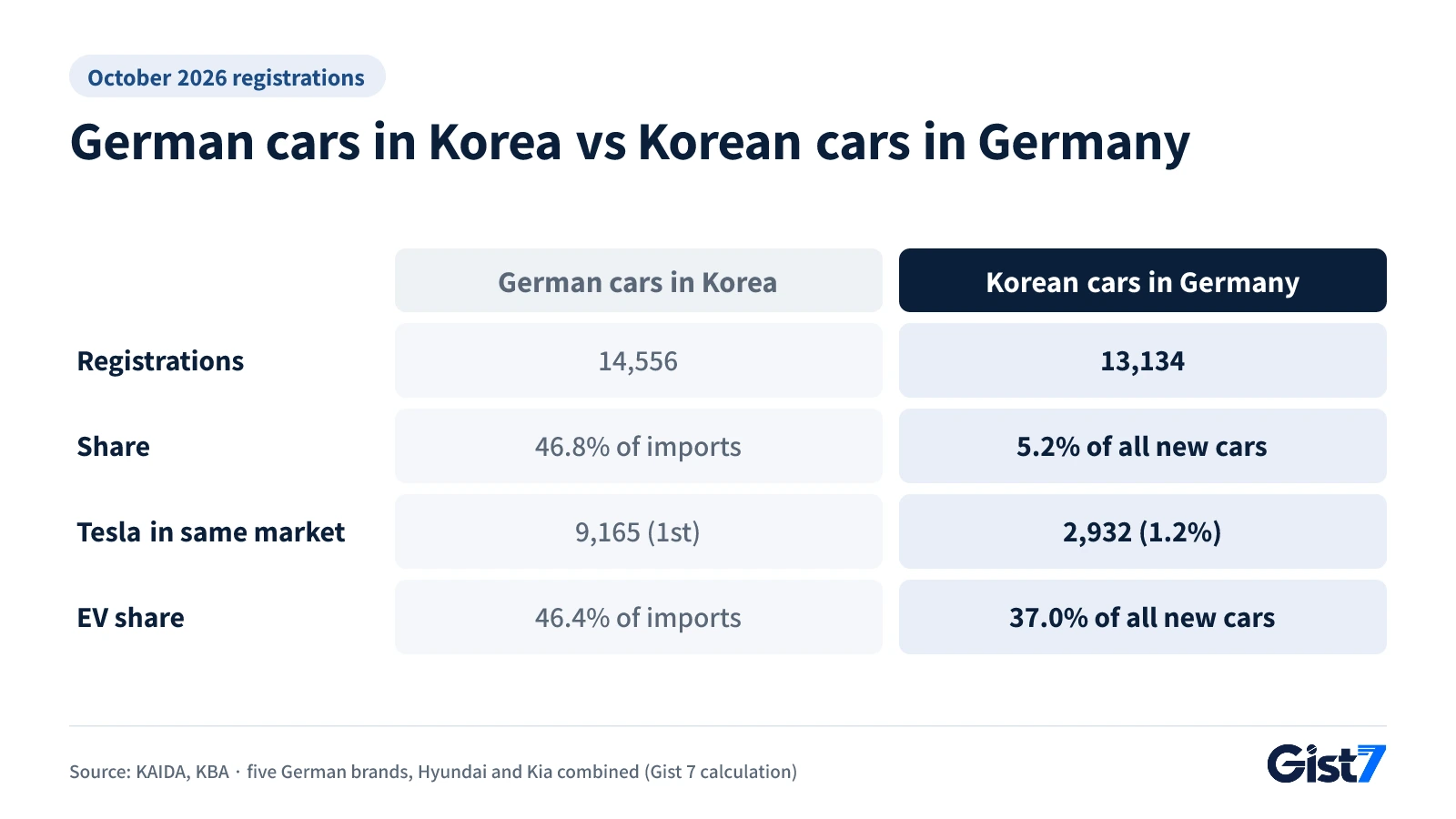
According to the KBA, of the 254,492 new cars registered in Germany in October 2026, Hyundai Motor (KOSPI: 005380) accounted for 6,961 (a 2.7% share) and Kia (KOSPI: 000270) for 6,173 (2.4%). From January to October, Hyundai registered 78,361 cars (down 0.8% year on year) and Kia 56,220 (up 10.0%). Together they hold about 5.4% of German new car registrations.
Small EVs appear to be helping Kia grow. According to electrive, a German EV news site that analyzes KBA data, the Kia EV2 ranked 23rd in October's EV registrations with 1,387 units, and the Hyundai Inster ranked 24th with 1,343. From January to October, the Inster reached 11,462 (18th), the EV3 8,261 (27th) and the EV2 7,172. Germany's EV market itself grew 79.5% to 94,086 units in October, so 37.0% of all new cars were battery-electric.
| October 2026 | German cars in Korea | Korean cars in Germany |
|---|---|---|
| Registrations | 14,556 (five brands) | 13,134 (Hyundai, Kia) |
| Share | 46.8% of imported cars | 5.2% of all new cars |
| Tesla in the same market | 9,165 (1st) | 2,932 (1.2%) |
| EV share | 46.4% of imported cars | 37.0% of all new cars |
Source: KAIDA, KBA (combined by Gist 7). The Korean figure covers imported cars only, while the German figure covers all new cars, so the shares use different denominators.
Who runs the surplus in Korea-Germany car trade? Germany, by $3.49 billion in 2025
In money terms, Germany is far ahead. Korea's 2025 passenger car trade (HS 8703) as reported to the UN trade database (UN Comtrade) shows $5.46 billion of imports from Germany and $1.96 billion of exports to Germany. Korea's car trade balance with Germany was a deficit of $3.49 billion.
| Year | Car imports from Germany | Korean car exports to Germany | Korea's trade balance |
|---|---|---|---|
| 2010 | $1.67 billion | $0.53 billion | -$1.15 billion |
| 2015 | $5.94 billion | $1.14 billion | -$4.81 billion |
| 2020 | $5.77 billion | $1.32 billion | -$4.45 billion |
| 2024 | $5.36 billion | $1.27 billion | -$4.08 billion |
| 2025 | $5.46 billion | $1.96 billion | -$3.49 billion |
Source: UN Comtrade (as reported by Korea, all of HS 8703 including used cars), Gist 7 calculation.
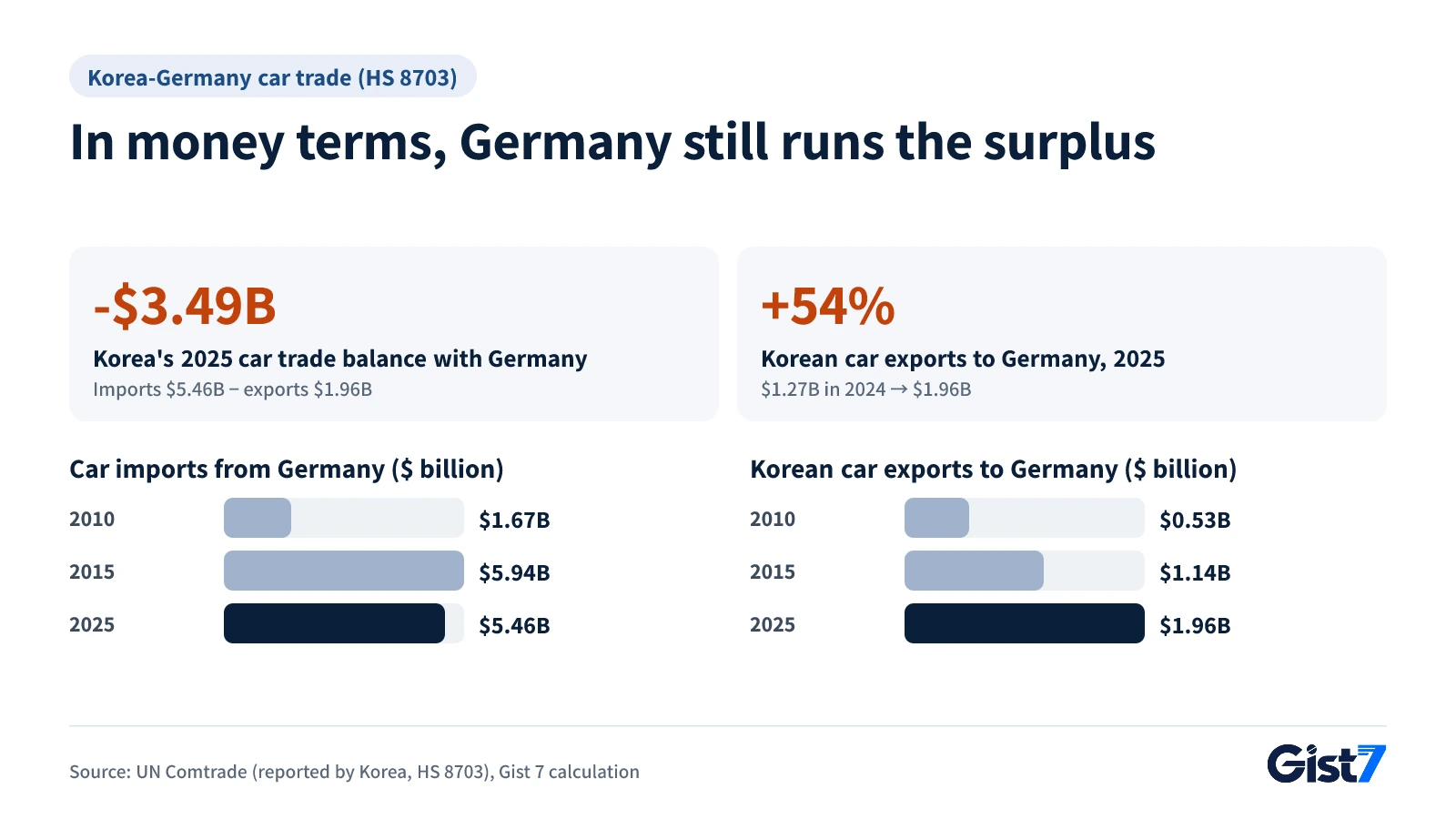
After the Korea-EU free trade agreement (FTA) was provisionally applied in July 2011, Korea's car imports from Germany grew to $5.46 billion in 2025, about 3.3 times the 2010 level. The deficit narrowed as Korean car exports to Germany rose 54% in 2025, but not every Korean-brand car sold in Germany is shipped from Korea. Kia's plant in Slovakia built about 300,000 vehicles in 2025, and Kia announced the start of EV2 production there in March 2026 (Kia Europe press release). So even if sales in Germany rise, Korea's exports in trade statistics may not rise by as much.
There is also a new factor. According to Korea's Ministry of Trade and Industry (also reported by Hellot and Kuki News), the European Commission announced provisional safeguard measures on imported hybrid cars on Nov. 24. A safeguard is an emergency import limit used when imports surge. From Dec. 1, 2026, to June 18, 2027, Korea has a duty-free quota of 67,924 cars, and volumes above it cannot be imported. Korea exported 107,104 hybrids to the EU in 2025. The ministry said the short-term impact should be limited, but some room for new export growth may be lost.
Gist 7 sees the shift in Korea as driven by powertrains more than brand strength. The numbers to watch are the EV shares in both countries, not the rankings. We covered Korea's overall exports in Korea's $1 trillion in exports compared with Japan, and a population comparison of the two countries in Korea's 0.80 fertility rate versus Germany's 1.32.
Market impact map
| Asset / indicator | Direction | Strength | Link (why) |
|---|---|---|---|
| Hyundai, Kia (hybrid exports to Europe) | ↓ tendency | Weak | The EU hybrid quota (67,924 cars for Korea over 200 days) may limit room for new exports to the EU |
| Hyundai, Kia (small EVs in Europe) | ↑ tendency | Weak | German EV registrations up 79.5%, with the EV2 and Inster ranked 23rd and 24th among EVs |
| German carmakers (Mercedes-Benz, BMW, Volkswagen) | ↓ tendency | Weak | 47% of Korean import demand (Jan-Oct) moved to EVs, cutting the share of German brands focused on sedans and hybrids |
| Tesla, Chinese-made EVs (BYD, etc.) | ↑ tendency | Medium | Tesla held 31.6% in Jan-Oct, and BYD ranked fourth among Korean imports with 21,731 cars |
| Euro/won exchange rate | ↑↓ | Weak | A weaker won (stronger euro) raises the import cost of German cars, and a stronger won does the opposite |
Little direct impact: 2-year Treasury, 10-year Treasury, dollar index, won/dollar, gold, oil (WTI), bitcoin, S&P 500, Nasdaq, KOSPI
- Korean consumers: buyers of imported cars have more EV choices, and German brands may change discounts or pricing.
- German consumers: Korean brands such as the EV2 and Inster add options in the small EV segment.
- Export jobs: the EU quota may affect how many hybrids Korean plants plan to export.
Market reactions can vary with other factors, and this table is not a basis for investment decisions.
What to watch next
| Date (Korea time) | Indicator / event | Previous value | Link to this story | If it comes in like this |
|---|---|---|---|---|
| Dec. 1 (Tue) | EU provisional hybrid safeguard takes effect | Korea's 2025 hybrid exports to the EU: 107,104 (Ministry of Trade and Industry) | Korea's first-quarter quota: 30,566 | If the quota fills quickly, growth in hybrid exports to the EU may stall |
| Dec. 1 (Tue), expected | Korea's November trade data (Ministry of Trade and Industry) | October car exports $6.55 billion, +18.1% | Overall car export trend | Continued growth in EU exports would signal steady European demand |
| Early Dec., expected | KAIDA November imported car registrations | October: 31,117, Tesla 9,165 | Gap between Tesla and German brands | If Mercedes-Benz and BMW move ahead again, October's No. 1 was a monthly swing |
| Dec. 7 (Mon, German time) | KBA November registrations by brand and model (FZ10) | October: Hyundai 6,961, Kia 6,173 | Korean cars in Germany | If Kia keeps growing, the EV2 effect is taking hold |
| Mid-Dec., expected | Korea's November auto industry report | October car exports to the EU $1.18 billion, +58.2% | Value of exports to the EU | If EU export growth falls well below October's +58.2%, the pre-quota rush is over |
Frequently asked questions
What is the best-selling imported car brand in Korea?
Tesla, with 98,313 cars from January to October 2026, or 31.6% of imported passenger cars. BMW (63,562) and Mercedes-Benz (49,993) are second and third, according to KAIDA. For full-year 2025, BMW was first and Tesla third.
Do German cars still sell well in Korea?
They lost the top brand spot but remain the largest group. The combined share of BMW and Mercedes-Benz fell from 47.4% in 2025 to 36.5% in January to October 2026. In October alone, the five German brands registered 14,556 cars, or 46.8% of imports, against Tesla's 29.5%.
Why did German brands fall behind Tesla in Korea?
Mainly because import demand shifted to EVs. The EV share of imports reached 47.3% from January to October 2026, up from 29.7% in 2025, while hybrids fell 4.8%. Top German models are sedans such as the E-Class and 5 Series, while new demand went to EVs like the Tesla Model Y.
How many Hyundai and Kia cars are sold in Germany?
According to the KBA, Hyundai registered 78,361 cars (3.16% share) and Kia 56,220 (2.27%) from January to October 2026, about 5.4% combined (based on 2,476,290 new cars, Gist 7 calculation). In October, Kia rose 19.4% and Hyundai fell 15.3%. Among EVs, the Hyundai Inster leads with 11,462 so far this year.
Who has the surplus in Korea-Germany car trade?
Germany. In Korea's 2025 passenger car trade (HS 8703) as reported to UN Comtrade, Korea imported $5.46 billion from Germany and exported $1.96 billion, a deficit of $3.49 billion. Cars that Kia builds in Europe do not appear in Korea's export statistics.
How does the EU hybrid safeguard affect Korean cars?
From Dec. 1, 2026, to June 18, 2027, Korean-made hybrids cannot enter the EU above a duty-free quota of 67,924 cars. Korea's trade ministry said the quota is based on 2025 exports of 107,104 plus 15%, so the short-term impact should be limited, though room for new export growth may shrink.
References
- Fahrzeugzulassungen im Oktober 2026 (Pressemitteilung Nr. 44/2026) — Kraftfahrt-Bundesamt
- 수입차 10대 중 3대가 테슬라…벤츠·BMW 제치고 신규 등록 1위 (KAIDA 10월 집계) — ZDNet Korea
- (참고자료) EU, 수입 하이브리드 자동차에 대한 글로벌 세이프가드 잠정조치 발표 — 산업통상부
- 한국-독일 승용차(HS 8703) 수출입 2025 — UN Comtrade
- Neuzulassungen im Oktober: Elektrischer Mercedes GLC schon auf Platz 3 — electrive