Korea Hits 20 Million Tourists: Is a Trip Pricier Now?

Key summary
Korea passed 20 million tourists for the first time on November 12, 2026, and foreign card spending rose 47.7% through September (MCST). But the won has strengthened since August: at the November 20 rate, a trip costs 6.9% more in dollars and 14.0% more in yen than at 2025's average (Bank of Korea).
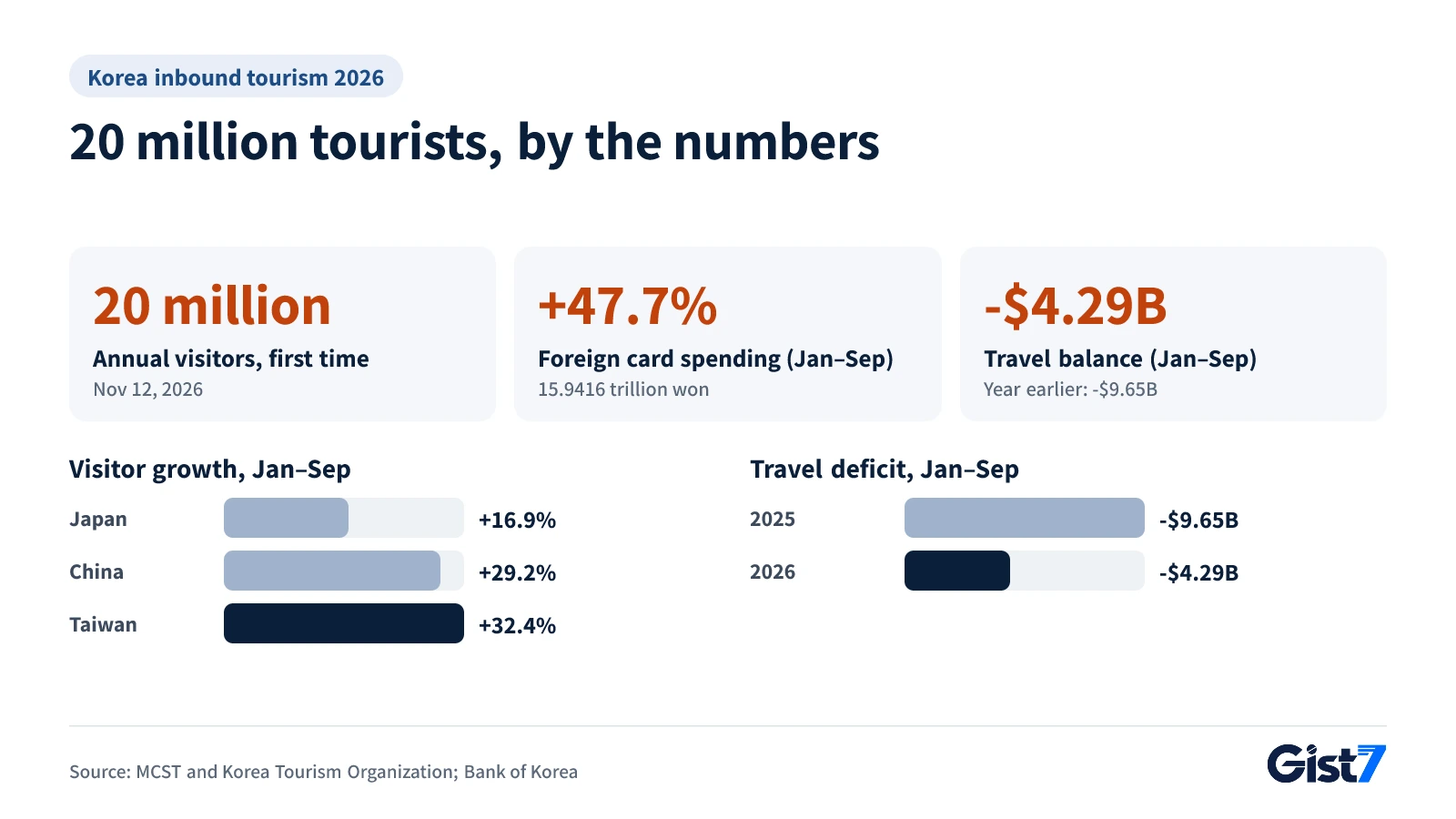
- Foreign visitors to Korea topped 20 million for the year for the first time on November 12, 2026 (provisional 19.97 million through November 11, MCST)
- January–September arrivals: 17.11 million (+21.5%), led by China at 5.47 million (+29.2%), Japan at 3.12 million (+16.9%) and Taiwan at 1.86 million (+32.4%)
- Foreign card spending reached 15.9416 trillion won (+47.7%), and the travel deficit shrank about 55%, from $9.65 billion to $4.29 billion
- At the November 20 rate, spending 100,000 won in Korea costs 6.9% more in dollars, 14.0% more in yen and 13.4% more in Taiwan dollars than at 2025's average (yuan: -0.9%)
- Instant tax refunds: under 1 million won per purchase, 5 million won total, minimum purchase 15,000 won (law checked November 21, 2026)
Korea welcomed its 20 millionth foreign visitor of the year on November 12, 2026, the first time the country has drawn 20 million tourists in a single year. According to the Ministry of Culture, Sports and Tourism (MCST), annual arrivals have doubled in the 14 years since they first topped 10 million in 2012. Yet a trip there now costs more: at the November 20 exchange rate in the Bank of Korea's Economic Statistics System (ECOS), spending the same amount in Korea takes 6.9% more dollars and 14.0% more yen than at 2025's average rate.
20 million tourists: who came, and how fast
MCST counted a provisional 19.97 million foreign arrivals through November 11, with a provisional daily average of 64,000 this year. Last year's full-year record of 18.94 million had already fallen on October 27, about two months before the year was out.
From January through September 2026, 17.11 million visitors arrived, up 21.5% from 14.08 million a year earlier. MCST's September tourism report shows China sent the most people (5.47 million), while Taiwan grew fastest (+32.4%). September alone brought 2.06 million visitors, 21.1% more than a year earlier.
| Origin | Visitors, Jan–Sep | Change | Currency effect (Jan–Sep) |
|---|---|---|---|
| China | 5.47 million | +29.2% | Yuan +8.4% |
| Japan | 3.12 million | +16.9% | Yen -3.0% |
| Taiwan | 1.86 million | +32.4% | Taiwan dollar +0.9% |
| Americas | 1.62 million | +12.0% | US dollar +2.8% |
| Europe | 1.19 million | +20.0% | Euro +5.7% |
| Hong Kong | 550,000 | +18.6% | Hong Kong dollar +2.4% |
| Total | 17.11 million | +21.5% |
Sources: MCST and Korea Tourism Organization, January–September 2026 inbound tourism reports; Bank of Korea ECOS table "Exchange Rates of Major Currencies against the Won." The currency effect shows how many more won one unit of each home currency bought on average in January–September 2026 (simple mean of nine monthly averages, Gist 7 calculation) than in 2025. A plus sign means the same money went further in Korea.
The last column hints at one driver of this year's boom. Chinese visitors got 8.4% more won per yuan on average, and their numbers rose 29.2%. The yen, by contrast, bought 3.0% fewer won, and Japanese arrivals grew a below-average 16.9%. Currency is not the whole story, though. Taiwan's currency gain was only 0.9%, yet it was the fastest-growing market.
Why now: a weak won, Korean culture and regional airports
MCST's explanation and the data point to three overlapping factors: a cheap won in the first half, a Korean culture wave that now reaches into spending, and more ways to fly in without passing through Seoul.
The won was weak early in the year. The won-dollar rate is the number of won needed to buy one dollar; the higher it goes, the cheaper Korea gets for foreigners. On ECOS monthly averages it climbed to 1,527.3 in June 2026, 7% above the 2025 average. In the same month one yuan cost 225.51 won, 14% more than the 2025 average of 197.78.
Interest in Korean culture has moved from watching to buying. In MCST's 2026 Overseas Hallyu Survey of 27,400 people in 30 countries and territories who have experienced Korean culture, 65% said it positively affects their purchases of Korean products and services, up from 58% and 64% in the previous two years. Respondents rated Korean food (55%) and Korean beauty (53%) as popular at home about as often as music (54%) and TV dramas (51%). The survey did not poll visitors directly, but it suggests that trips built around concerts are now joined by trips for food and beauty.
Entry routes have widened too. Arrivals through airports outside the Seoul area, such as Gimhae (Busan), Jeju, Cheongju and Daegu, reached 3.24 million in January–September, up 37.4%. Add 1.58 million arrivals at seaports outside the Seoul area and that is 28.2% of the total. The government says that after the 11th National Tourism Strategy Meeting, chaired by the president on February 25, it pushed easier immigration procedures, more international flights at regional airports and penalties for price gouging. MCST added that growth held up despite Middle East tensions and high oil prices since the start of the year.
How much do foreign tourists spend in Korea?
Foreign visitors spent 15.9416 trillion won on credit cards in Korea in January–September 2026, up 47.7% from 10.794 trillion won a year earlier, according to MCST. That is more than double the 21.5% rise in arrivals. Per visitor, it works out to roughly 930,000 won, 21% more than about 770,000 won in the same period last year (Gist 7 calculation).
For the economy as a whole, the Bank of Korea's travel account is the measure. It takes what foreigners spend in Korea (travel receipts) and subtracts what Koreans spend abroad (travel payments). Study and training costs are included.
| Jan–Sep cumulative | 2025 | 2026 | Change |
|---|---|---|---|
| Travel receipts (foreigners' spending in Korea) | $16.34 billion | $21.50 billion | +31.6% |
| Travel payments (Koreans' spending abroad) | $25.99 billion | $25.79 billion | -0.8% |
| Travel balance | -$9.65 billion | -$4.29 billion | Deficit down about 55% |
Sources: Bank of Korea, Balance of Payments for September 2026 (preliminary); ECOS table "Balance of Payments" (quarterly sums). Q3 2026 figures are preliminary.
The deficit more than halved in a year because foreigners spent more. Koreans' spending abroad barely changed. In the second quarter (April–June) the travel account even posted a $462 million surplus, before slipping back into deficit in July–September, when Koreans head abroad for summer holidays. In September alone the travel balance was -$770 million, a smaller gap than the -$960 million of a year earlier.
Why did travel receipts measured in dollars rise less (31.6%) than card spending measured in won (47.7%)? Two reasons. The two statistics cover different things (card payments only versus all travel spending), and the weak won in the first half made the same dollar spending look bigger in won. Dividing travel receipts by arrivals gives about $1,257 per visitor, 8% more than about $1,160 a year earlier (Gist 7 calculation).
Is Korea more expensive now? The won has strengthened since August
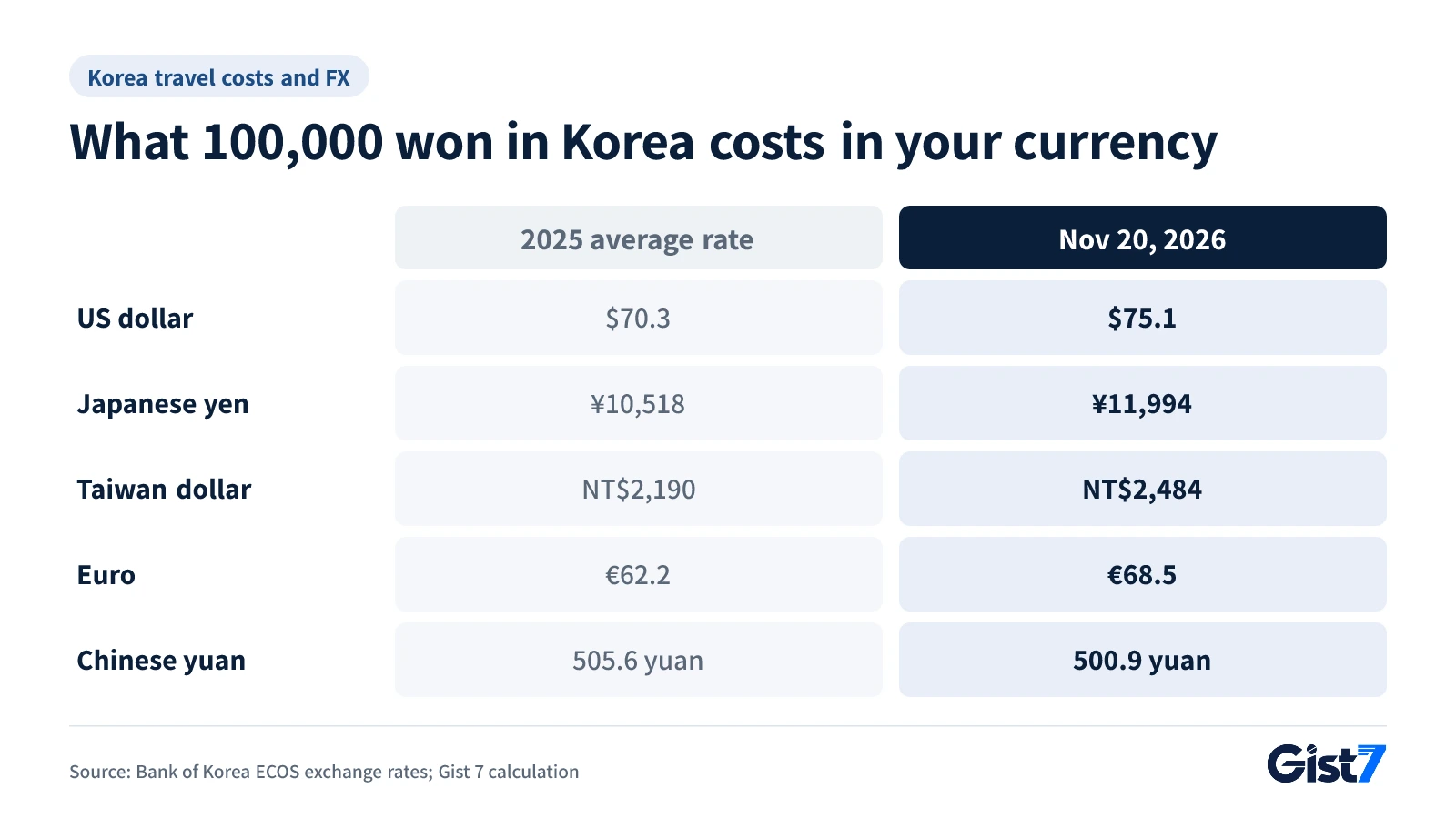
Compared with 2025's average exchange rate, a trip to Korea at the November 20 rate costs 6.9% more in dollars and 14.0% more in yen. Put simply, spending the same 100,000 won takes that much more of your own money. The monthly average won-dollar rate fell from 1,497.43 in July to 1,406.3 in August and 1,337.66 in October. We tracked that move in our weekly won-dollar analysis.
| Currency | 2025 average | Nov 20, 2026 | Cost of spending 100,000 won |
|---|---|---|---|
| US dollar | 1,422.22 won | 1,330.8 won | $70.3 → $75.1 (+6.9%) |
| Japanese yen (per 100 yen) | 950.79 won | 833.73 won | ¥10,518 → ¥11,994 (+14.0%) |
| Taiwan dollar | 45.67 won | 40.26 won | NT$2,190 → NT$2,484 (+13.4%) |
| Euro | 1,607.46 won | 1,459.62 won | €62.2 → €68.5 (+10.1%) |
| Chinese yuan | 197.78 won | 199.65 won | 505.6 yuan → 500.9 yuan (-0.9%) |
Source: Bank of Korea ECOS table "Exchange Rates of Major Currencies against the Won" (2025 average; rate posted on November 20). Home-currency costs are Gist 7 calculations. For example, one dollar bought 1,330.8 won on November 20, 6.4% fewer than the 2025 average, so spending 100,000 won took 6.9% more dollars.
Korean prices have risen on top of that. On the ECOS consumer price index (CPI) table, prices in October 2026 were 2.8% higher than a year earlier. For an American visitor, a 6.9% currency effect plus 2.8% inflation means paying around 10% more than at 2025's average. The inflation figure is October's year-over-year rate, so its reference period differs slightly from the 2025 average exchange rate. The yuan is the exception: Chinese visitors face almost no currency penalty, only roughly the rise in prices. For how Korean prices feel to Japanese travelers, see our Seoul vs. Tokyo price comparison.
Here is Gist 7's reading. The cheap won played a part in the first-half boom, and much of that edge has faded since August. Even so, September arrivals grew 21.1%, almost the same as the 21.5% average for January–September. Trips are booked months ahead, so currency moves show up in the numbers with a lag. Whether the stronger won dents demand will become clear in the October–December data and the fourth-quarter travel account.
How foreign travelers can cut costs: instant tax refunds and payment currency
Travelers cannot pick the exchange rate, but they can choose how they claim tax refunds and how they pay. Under Korea's Special Regulations on VAT and Individual Consumption Tax for Foreign Tourists and their enforcement rules (in force since January 2, 2026; checked on the Korean Law Information Center on November 21, 2026), the instant tax refund rules are as follows.
- Eligible purchases: at least 15,000 won per transaction, tax included, at a tax-free shop registered for foreign tourists
- Instant refund (paying the tax-free price at the counter): under 1 million won per transaction, and no more than 5 million won in total per entry to Korea
- The goods must leave Korea within three months of purchase
Card payments deserve a quick check as well. Foreign cards carry the issuer's overseas transaction fee. If you choose to pay in your home currency at the terminal (dynamic currency conversion, or DCC), you may pay a second conversion cost, so it is better to confirm on the receipt that you were charged in won. When exchanging cash, compare the posted rate and the fee together.
Market impact map
| Asset / indicator | Direction | Strength | Link (why) |
|---|---|---|---|
| Airlines and travel | ↑ | Medium | Stronger international demand, including +37.4% arrivals at regional airports, can feed ticket and tour package sales |
| Hotels, restaurants and other domestic services | ↑ | Medium | Foreign card spending up 47.7% can lift card revenue at hotels and restaurants |
| Cosmetics, beauty and medical tourism | ↑ | Medium | With 53% saying Korean beauty is popular, visits can turn into cosmetics purchases and dermatology clinic revenue |
| Duty-free shops and department stores | ↑↓ | Weak | More visitors mean more foot traffic, but prices in foreign-currency terms have risen since August, which may hit high-end shopping first |
Little direct impact: won-dollar rate (travel receipts bring in dollars, but they are small next to September's $61.46 billion current account surplus), 2-year Treasury, 10-year Treasury, dollar index, gold, oil (WTI), bitcoin, S&P 500, Nasdaq, KOSPI (Korea's benchmark stock index)
- Travel budget: at the November 20 rate, a Korea trip costs 6.9% more in dollars, 14.0% more in yen, 13.4% more in Taiwan dollars and 10.1% more in euros than at 2025's average, and 0.9% less in yuan.
- Prices: Korean consumer prices rose 2.8% year over year in October. Budget for that on top of the currency effect.
- Currency exchange and cards: fees and choosing the payment currency (DCC) are covered in the tax refund and payment section above.
- Koreans traveling abroad: the strong won has eased their costs. Travel payments in January–September were flat at -0.8%.
Market reactions can vary with other factors, and this table is not a basis for investment decisions.
What to watch next
| Date (Korea time) | Indicator / event | Previous | Why it matters here | If it comes in... |
|---|---|---|---|---|
| Late November (expected) | MCST and Korea Tourism Organization October inbound tourism report | September: 2.06 million, +21.1% (MCST) | Arrivals in the third month of a stronger won | Growth holding in the 20% range would signal demand outweighs the currency; a slide into the 10% range would signal price pressure |
| Early December (expected) | Korea's national statistics office, November consumer prices | October: +2.8% (ECOS) | The price side of a visitor's travel costs | A high reading, together with the strong won, would push visitors' costs up further |
| Early December (expected) | Bank of Korea October balance of payments (preliminary) | September travel balance: -$770 million (Bank of Korea) | Gap between foreigners' spending in Korea and Koreans' spending abroad | A smaller deficit means visitor spending held up; a larger one may mean the strong won boosted outbound travel and slowed visitor spending |
These dates are estimated from earlier release timing (September tourism report on October 22, September balance of payments on November 5, October CPI on November 3). Check each agency's release calendar for exact dates.
Frequently asked questions
How many foreign tourists visited Korea in 2026?
MCST announced that foreign visitors to Korea passed 20 million for the year for the first time on November 12, 2026. The provisional count through November 11 was 19.97 million, with about 64,000 arrivals a day on average. Annual arrivals have doubled in the 14 years since they first topped 10 million in 2012.
Which countries sent the fastest-growing number of tourists?
In January–September 2026, China sent the most visitors at 5.47 million, while Taiwan grew fastest at 32.4%. Arrivals from China rose 29.2%, Europe 20.0%, Japan 16.9% and the Americas 12.0% (MCST and Korea Tourism Organization).
How much does each foreign tourist spend in Korea?
Dividing January–September foreign credit card spending of 15.9416 trillion won by 17.11 million visitors gives roughly 930,000 won per person, 21% more than about 770,000 won a year earlier (Gist 7 calculation). On the Bank of Korea's travel receipts, it is about $1,257 per visitor. Card data leave out cash, so actual spending differs.
Is a trip to Korea more expensive than last year?
In most currencies, yes. At the November 20, 2026 exchange rate, spending 100,000 won in Korea costs 6.9% more in dollars, 14.0% more in yen, 13.4% more in Taiwan dollars and 10.1% more in euros than at 2025's average rate. Korean consumer inflation of 2.8% (October, year over year) comes on top. Only the yuan carries almost no currency penalty.
What are Korea's instant tax refund rules for foreign tourists?
Purchases of at least 15,000 won per transaction, tax included, at a registered tax-free shop qualify. An instant refund, where you pay the tax-free price at the counter, is available for purchases under 1 million won per transaction and up to 5 million won in total per entry. The goods must leave Korea within three months of purchase (Korean Law Information Center, checked November 21, 2026).
Do more foreign tourists put Korea's travel account in surplus?
Not yet. The January–September 2026 travel balance was -$4.29 billion, about 55% smaller than -$9.65 billion a year earlier. The second quarter showed a $462 million surplus, but the third quarter swung back into deficit as Koreans traveled abroad over the summer (Bank of Korea).
References
- Foreign visitors to Korea pass 20 million (Nov 12, 2026), Ministry of Culture, Sports and Tourism
- 17.11 million visitors through September 2026 (September 2026 inbound tourism report, Oct 22, 2026), Ministry of Culture, Sports and Tourism
- Balance of Payments for September 2026 (preliminary) (Nov 5, 2026), Bank of Korea, posted by the KDI Economic Information and Education Center
- Economic Statistics System (ECOS): exchange rates of major currencies against the won, travel account, consumer price index, Bank of Korea
- Special Regulations on VAT and Individual Consumption Tax for Foreign Tourists (in force Jan 2, 2026), Korean Law Information Center