How Much Is Rent in Seoul in 2026, and Why Is It Rising?

Key summary
Rent in Seoul averaged 1.661 million won ($1,243) a month for an apartment in September 2026 (Korea Real Estate Board). With jeonse deals down 27.4%, monthly rent took 51.0% of apartment leases, a first. Foreign residents, 52.5% of whom rent monthly, feel it most.
- Average Seoul apartment rent: 1.661 million won a month, up 218,000 won in a year (September 2026, Korea Real Estate Board)
- Officetel average 961,000 won, villa (low-rise multi-family) 675,000 won (September and August)
- Monthly rent took 51.0% of Seoul apartment leases in January to September 2026, the first time above 50%
- 52.5% of foreign residents in Seoul rent monthly, versus 28% of all respondents (2024 Seoul Survey)
- Official consumer price data show housing rent up only 1.4% year on year (October 2026, National Data Office)
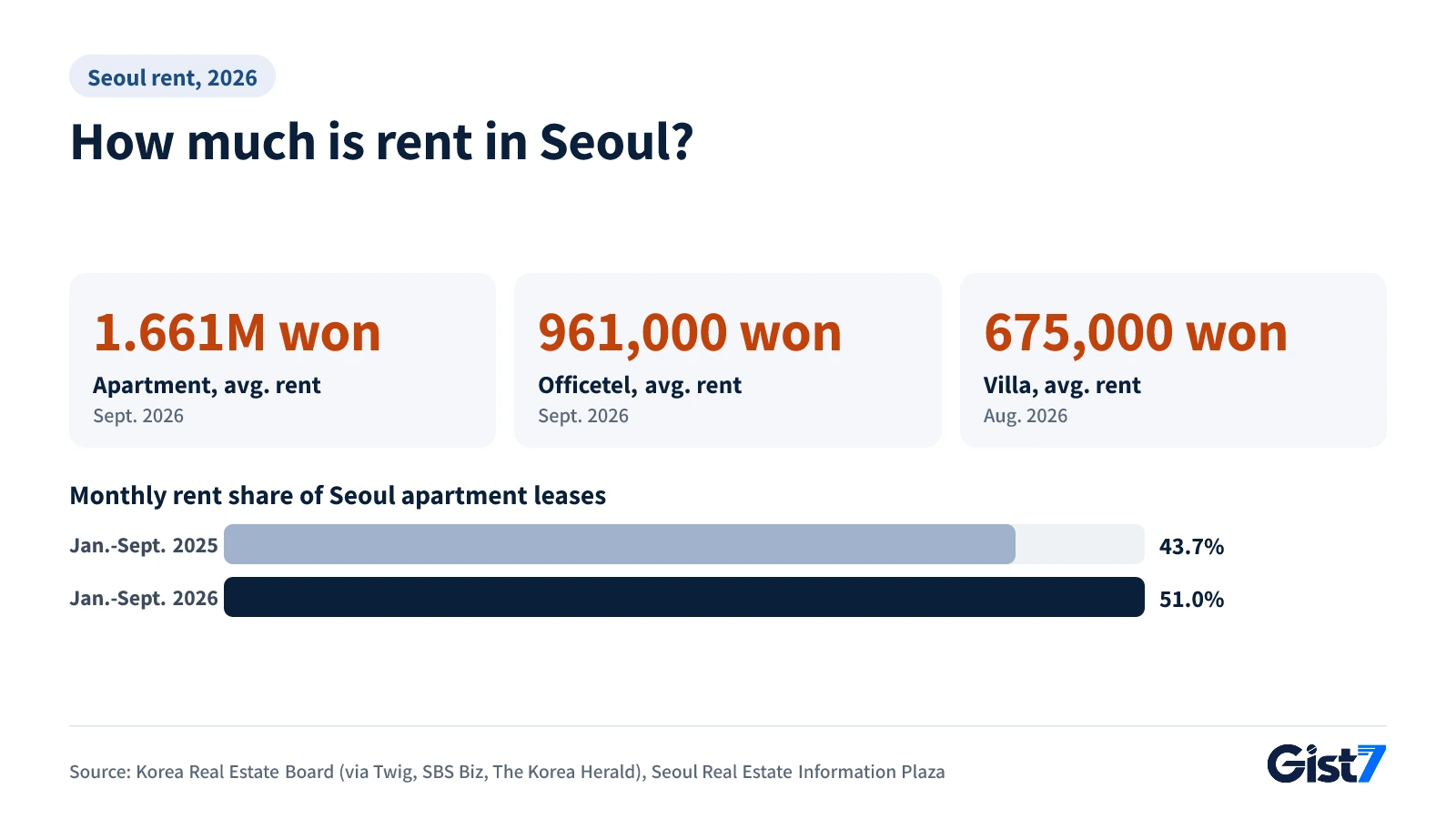
Rent in Seoul now averages 1.661 million won a month for an apartment, or about $1,243, as of September 2026. According to Twig, which cited Korea Real Estate Board data, that is 218,000 won more than a year earlier (1.443 million won), a rise of roughly 15%. Because this is an average, part of the jump may reflect larger apartments moving from jeonse to monthly or semi-monthly rent, so it does not mean the same home now costs 15% more. Officetels average 961,000 won and villas (low-rise multi-family buildings) 675,000 won, and both are climbing. The driver is what Koreans call the shift "from jeonse to wolse": as lump-sum deposit leases dry up, tenants are pushed into monthly rent across the whole city.
How much is rent in Seoul? Average deposit and rent by housing type
If you rent in Seoul, expect to pay about 1.6 million won a month for an apartment, around 900,000 won for an officetel and roughly 600,000 to 700,000 won for a villa. Deposits vary far more: converted to dollars, they run from about $17,000 for an officetel to about $146,000 for an apartment (at 1,336.7 won per dollar). An officetel is a compact studio-type unit in a mixed-use building, popular with single renters. The table shows the latest Korea Real Estate Board figures as reported in the press.
| Housing type | Average monthly rent | Average deposit | In US dollars (rent / deposit) | As of |
|---|---|---|---|---|
| Apartment | 1.661 million won | 195.68 million won | about $1,243 / about $146,000 | September 2026 |
| Officetel | 961,000 won | 22.86 million won | about $719 / about $17,000 | September 2026 |
| Villa (low-rise multi-family) | 675,000 won | 61.17 million won | about $505 / about $46,000 | August 2026 |
Source: Korea Real Estate Board (apartments via Twig, Oct. 21; officetels via SBS Biz, Oct. 15; villas via The Korea Herald, Oct. 1). Dollar figures use the Seoul daytime closing rate of 1,336.7 won per dollar on Nov. 13.
Rents are rising quickly. Seoul officetel rents climbed 1.02% in the third quarter of 2026 from the previous quarter, faster than the national average of 0.86% (SBS Biz, Korea Real Estate Board). Average villa rent rose for a 16th straight month through August to a record high (The Korea Herald).
The official inflation number looks much smaller. In the October 2026 consumer price report released Nov. 3 by the National Data Office, Korea's statistics agency, housing rent rose just 1.4% from a year earlier. That index blends jeonse and monthly rent nationwide and includes homes on existing leases. Gist 7 sees this as the main reason it diverges from the jump in Seoul's average rent.
From jeonse to monthly rent: over half of Seoul apartment leases
The biggest reason rent in Seoul is rising is that the supply of jeonse homes has shrunk. According to Twig's analysis of Seoul Real Estate Information Plaza data, monthly rent accounted for 87,870, or 51.0%, of the 172,227 apartment leases signed in Seoul from January to September 2026. That is 7.3 percentage points higher than a year earlier (43.7%). Since the city began compiling the data in 2011, the annual monthly-rent share had never topped 50%. Jeonse deals fell 27.4% over the same period.
Jeonse is a Korean lease in which the tenant hands over a large lump-sum deposit, often a big share of the home's value, and pays no monthly rent for about two years. The full deposit comes back when the lease ends. Twig listed five reasons jeonse is disappearing:
- Fewer new apartments being completed
- Heavier taxes on multi-home owners and owners who don't live in their homes
- A requirement that buyers in land-transaction permit zones live in the homes they buy
- Tighter rules on jeonse loans
- More existing tenants renewing their leases
The balance between supply and demand has tilted too. The KB jeonse supply-demand index compiled by the research institute of KB Financial Group (KOSPI: 105560 · NYSE: KB) reached 120.7 in September 2026, the highest since Korea's 2020 tenant-protection laws took effect (cited by Twig). A reading above 100 means more people are looking for jeonse homes than are offering them. Listings are thin as well: as of Oct. 20, Seoul had 20,680 apartment jeonse listings, down 10.4% from the start of the year, and 17,651 monthly-rent listings, down 17.4% (Asil data, cited by Twig).
Interest rates matter here. The Bank of Korea's base rate is 3.00%, and markets are weighing a possible hike at the Nov. 26 meeting (our Bank of Korea November rate outlook). When loan rates rise, borrowing to fund a jeonse deposit gets more expensive, and more tenants may cover the shortfall with monthly rent instead.
Why foreign renters in Seoul feel the squeeze more
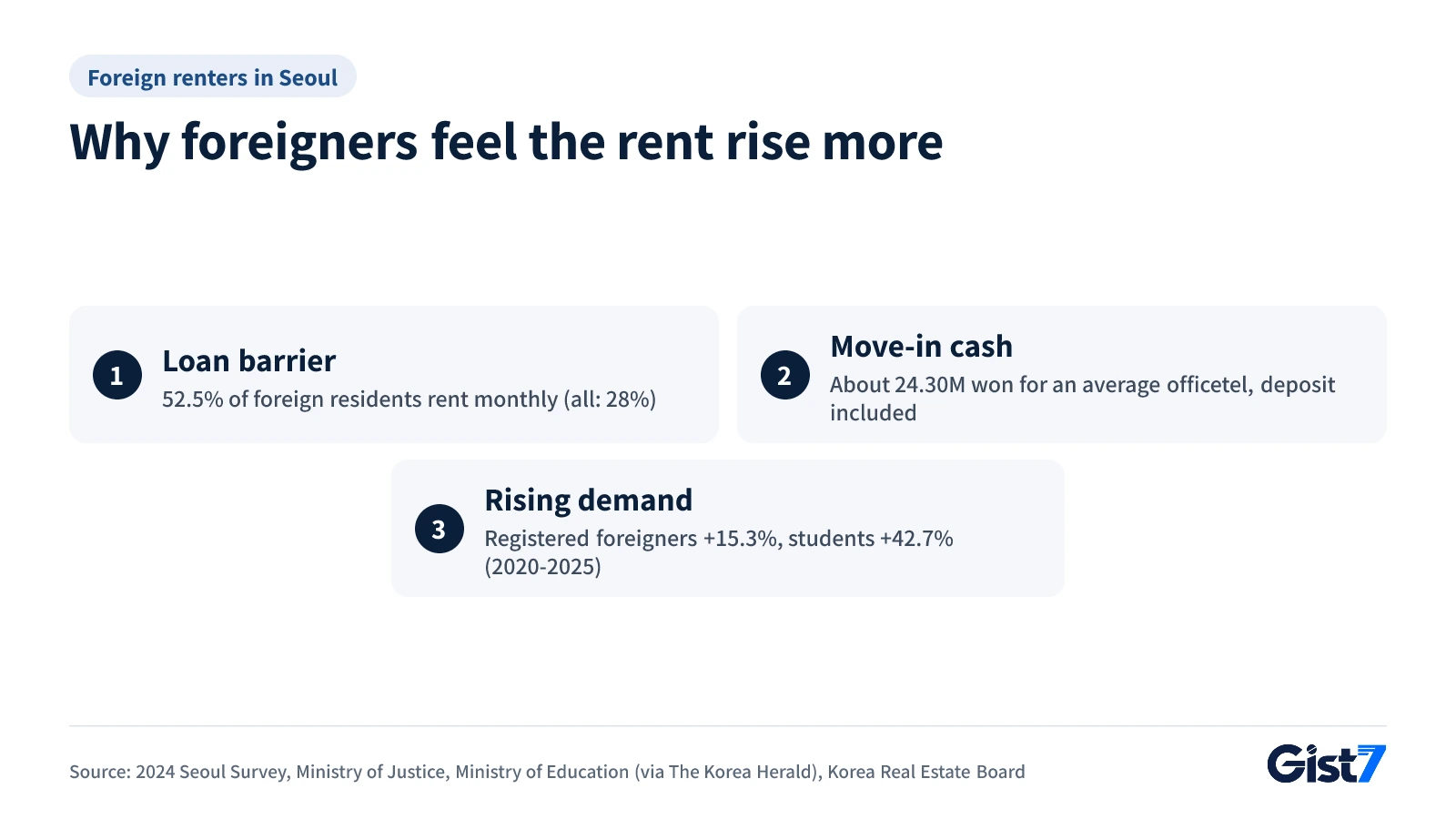
Foreign residents often have little choice but to rent monthly, so they absorb rent increases more directly than Korean tenants. In the 2024 Seoul Survey cited by The Korea Herald, 52.5% of foreign residents in Seoul lived in monthly rentals, close to double the 28% share among all respondents.
| Item | Foreign residents in Seoul | All of Seoul | Source / period |
|---|---|---|---|
| Share living in monthly rentals | 52.5% | 28% | 2024 Seoul Survey |
| Population | 279,629 registered foreign residents (+15.3%, 2020 to 2025) | - | Ministry of Justice, 2025 |
| International students | 90,524 at Seoul universities (+42.7%, 2020 to 2025) | - | Ministry of Education, 2025 |
Source: The Korea Herald (Oct. 1).
The main reason is access to credit. An official at the Seoul Foreign Residents Center in Yeongdeungpo-gu told The Korea Herald that many foreign residents seem to have trouble getting loans, which leads them to choose monthly rentals. Without a loan to fund a jeonse deposit, the remaining option is a lease with a lower deposit and higher monthly rent. Language barriers and unfamiliarity with Korean lease contracts were also cited as disadvantages.
Demand is growing. As the table shows, registered foreign residents and international students have both increased sharply over five years, and the Seoul Global Center said rental inquiries have risen along with student numbers. The city connects tenants with agents who can consult in foreign languages through its designated Global Real Estate Agencies.
The cash you need to move in, including the broker's fee
Monthly rent is only part of the bill. At move-in you need the deposit, the first month's rent and the broker's fee at once. The cap on brokerage fees is set by the enforcement rules of Korea's Licensed Real Estate Agents Act. According to Yeongdeungpo-gu Office guidance (checked Nov. 15, 2026), the transaction value of a monthly lease is calculated as "deposit + monthly rent × 100," and if that comes to less than 50 million won, the multiplier is 70 instead of 100. For homes with a transaction value of 100 million won to under 600 million won, the cap is 0.3%. For residential officetels of 85 square meters or less, it is 0.4%.
| Based on average lease | Transaction value (converted) | Brokerage fee cap | Cash at move-in (deposit + first month + fee) |
|---|---|---|---|
| Apartment | 361.78 million won | about 1.085 million won (0.3%) | about 198.43 million won (about $148,000) |
| Villa (low-rise multi-family) | 128.67 million won | about 386,000 won (0.3%) | about 62.23 million won (about $47,000) |
| Officetel | 118.96 million won | about 476,000 won (0.4%) | about 24.30 million won (about $18,000) |
The table combines each housing type's average deposit and average rent into a single illustrative lease. Real contracts differ. The broker's fee is negotiated within the cap, and building maintenance fees vary too much to include. If you have no won income and are wiring the deposit from abroad, the exchange rate changes what it costs you (our weekly USD/KRW review).
A large deposit also means checking how you will get it back. According to the Seoul Housing Portal's guide to the Korea Housing & Urban Guarantee Corporation (HUG) deposit return guarantee (checked Nov. 15, 2026), foreigners can apply alongside individuals and companies. Applicants must live in the home and have completed a move-in report and obtained a fixed-date stamp on the lease. Before signing, foreign tenants should confirm how to meet those requirements through HiKorea or the HUG call center (1566-9009).
Market impact map
| Asset / indicator | Direction | Strength | Link (why) |
|---|---|---|---|
| REITs and private rental operators | ↑ | Weak | Monthly rent now 51.0% of Seoul apartment leases, widening the rental income base |
| Banks (jeonse loans) | ↓ | Weak | Jeonse deals down 27.4% in January to September, reducing new jeonse loan demand |
| Domestic consumer sectors | ↓ | Weak | An extra 218,000 won a month in average apartment rent leaves tenants that much less to spend |
| Korea 3-year government bond yield | ↑ | Weak | Official housing rent inflation is still low at 1.4%, so the effect is small. If Seoul's rent surge shows up more in the index, it could strengthen the case for a Bank of Korea hike |
Little direct impact: 2-year Treasury, 10-year Treasury, dollar index, USD/KRW, gold, oil (WTI), bitcoin, S&P 500, Nasdaq, KOSPI
- Everyday impact: higher fixed costs leave monthly renters less room to save. At the average apartment rent, a year of rent comes to about 19.93 million won.
- Foreigners who fund a deposit by wiring money from abroad need more foreign currency for the same deposit when the won strengthens.
- The average officetel deposit of 22.86 million won is about $17,100 at 1,336.7 won per dollar, before bank or remittance-service fees and the exchange spread.
- If jeonse loan rates rise, more leases may convert part of the deposit into monthly rent (semi-jeonse).
Market reactions can vary with other factors, and this table is not a basis for investment decisions.
What to watch next
| Date (KST) | Indicator / event | Previous | Why it matters here | If it comes in... |
|---|---|---|---|---|
| Nov. 19 (Thu) | Korea Real Estate Board weekly apartment price trends (every Thursday) | Seoul jeonse +0.17% (week of Nov. 9, Korea Real Estate Board) | Whether jeonse prices keep pushing tenants to monthly rent | Faster jeonse gains tend to lift demand for monthly rentals |
| Nov. 26 (Thu) | Bank of Korea monetary policy decision | Base rate 3.00% (Bank of Korea) | Jeonse loan rates and the pace of conversion to monthly rent | A hike tends to raise the cost of borrowing for a deposit |
| Dec. 2 (Wed) | November consumer prices (National Data Office) | Housing rent +1.4% y/y (October, National Data Office) | How much of the housing cost rise official inflation captures | A faster rent reading adds housing to the inflation-pressure debate |
Dates follow the Korea Real Estate Board's weekly release cycle (every Thursday), the Bank of Korea's monetary policy meeting calendar and the National Data Office's release schedule. The board's monthly housing price survey, which reports Seoul's average apartment rent, is also worth watching, but we could not confirm the October release date on an official schedule, so it is left out of the table. Times are Korea Standard Time (KST, 14 hours ahead of US Eastern Time).
Three things foreign renters should check before signing
In a city where monthly rent now accounts for more than half of apartment leases, foreign tenants should weigh three things before signing: the cash needed at move-in, the total housing cost over the lease, and a way to get the deposit back.
- Cash at move-in: the deposit, first month's rent and broker's fee combined. For an average officetel, that is about 24.30 million won (about $18,000). If you are wiring the money from abroad, include the exchange rate and transfer costs.
- Total cost over the lease: rent goes out every month, so a two-year lease at the average officetel rent adds up to about 23.06 million won. Maintenance fees vary by building and need to be checked separately.
- Deposit protection: foreigners can join HUG's deposit return guarantee, but it requires a move-in report and a fixed-date stamp. Confirm before signing that you can meet those conditions.
This rise looks more like a structural change than a seasonal one. The monthly-rent share passed 50% for the first time on a January-to-September basis in 2026, and both jeonse and monthly-rent listings are shrinking. On the other side, official housing rent inflation is only 1.4%, and if jeonse listings recover and the KB index falls back toward 100, rent increases could slow.
Frequently asked questions
How much does an officetel or villa cost to rent in Seoul?
According to Korea Real Estate Board data, a Seoul officetel averaged 961,000 won a month (about $719) with a 22.86 million won deposit in September 2026. Villas (low-rise multi-family homes) averaged 675,000 won a month with a 61.17 million won deposit in August, after 16 straight monthly increases.
Why is rent in Seoul rising so fast?
Because jeonse deals and listings have both shrunk. Seoul apartment jeonse deals fell 27.4% year on year in January to September 2026, with fewer new completions, heavier taxes on multi-home and absentee owners, and tighter jeonse loan rules cited as causes. Tenants who can't find jeonse homes move to monthly rent, lifting demand.
Why do so many foreigners in Seoul rent monthly?
An official at the Seoul Foreign Residents Center said many foreigners struggle to get loans and so choose monthly rentals. In the 2024 Seoul Survey, 52.5% of foreign residents in Seoul rented monthly, far above the 28% of all respondents. Loan eligibility depends on personal circumstances and each lender's review, so check directly with the institution.
How is the real estate broker's fee calculated for a monthly lease?
The transaction value is "deposit + monthly rent × 100," or × 70 if the result is under 50 million won. The cap is 0.3% for homes valued at 100 million to under 600 million won and 0.4% for residential officetels of 85 square meters or less, with the actual fee negotiated within the cap (enforcement rules of the Licensed Real Estate Agents Act, Yeongdeungpo-gu Office guidance checked Nov. 15, 2026).
Why does official inflation show housing rent up only 1.4%?
The rent index blends jeonse and monthly rent nationwide and includes homes on existing leases. That appears to be why it moves slowly even as Seoul's average apartment rent rises nearly 15% in a year, a figure that may also reflect larger apartments switching to monthly rent. Housing rent rose 1.4% year on year in October 2026 (National Data Office).
Will rent in Seoul keep rising?
No one can say for sure, but jeonse supply is the key signal. The KB jeonse supply-demand index stood at a high 120.7 in September 2026, and both jeonse and monthly-rent listings are below their levels at the start of the year. If listings recover and the index falls toward 100, increases could slow.
References
- October 2026 Consumer Price Trends (Korean) — National Data Office via Korea.kr
- Monthly rent takes over Seoul as the jeonse-to-wolse shift spreads to outer districts (Korean) — Twig
- Seoul officetels in Q3: sale price gains slow, monthly rent up 1% (Korean) — SBS Biz
- Rising rents narrow housing choices for Seoul's foreign residents — The Korea Herald/ANN (The Star)
- Real estate brokerage fee rates (Korean) — Yeongdeungpo-gu Office
- Jeonse deposit return guarantee guide (Korean) — Seoul Housing Portal, Seoul Metropolitan Government