KOSDAQ Rebounds 3.3% as Chip Gear Stocks Defy Foreign Selling
Key summary
The KOSDAQ rebound on Nov. 19, 2026, came in the afternoon: after a 650.39 low it closed up 3.32% at 684.81 as institutions bought and chip equipment stocks foreigners had dumped surged. Korea's exports topped $1 trillion that day, yet foreigners kept selling for an 11th session.
- KOSDAQ closed at 684.81 (+3.32%) and KOSPI at 5,137.89 (+1.39%); at 1:21 p.m. the KOSDAQ was up only 0.64%
- Chip materials, parts and equipment stocks surged, led by HPSP (+11.76%) and Leeno Industrial (+10.56%); institutions net bought about 210 billion won on the KOSDAQ
- Foreigners net sold 205-213 billion won on the KOSDAQ and 404-437 billion won on the KOSPI; KOSDAQ selling has now run 11 sessions
- Korea's cumulative exports passed $1 trillion at 2:09 p.m. (trade ministry); chip exports reached $396.8 billion in January-October
- The won firmed to 1,330.0 per dollar (-3.0 won), lifting the KOSDAQ's dollar return to about +3.55%
The KOSDAQ rebound was built in the afternoon. On November 19, 2026, the day of Korea's national college entrance exam, the market opened an hour late, slid as low as 650.39 and then closed up 22.00 points (3.32%) at 684.81, according to Korea Exchange data reported by Etoday and Digital Daily. The KOSDAQ is the Korea Exchange's market for smaller, growth-oriented companies. The main KOSPI index also fell as low as 4,963.61 before ending up 1.39% at 5,137.89. Foreign investors sold more than 200 billion won of KOSDAQ shares again, while domestic institutions were net buyers of about 210 billion won.
When did the KOSDAQ rebound start? From a 650 low to a 684 close
The KOSDAQ fell as much as 1.09% in the morning, turned positive at 667.03 (+0.64%) by 1:21 p.m. Seoul time, and its gain roughly quintupled by the close (Edaily, Etoday). From the intraday low of 650.39 to the close, the index climbed 5.29% (Gist 7 calculation).
| Time (Seoul) | KOSDAQ | What was happening |
|---|---|---|
| 10:00 open | 668.31 (+0.83%) | Opened an hour late because of the college entrance exam |
| 10:25 | 655.57 (-1.09%) | Worries about a U.S. rate hike, chip stocks weak |
| 11:57 | 656.42 (-0.96%) | Entertainment, travel and cosmetics strong; 10 stocks at the daily limit-up |
| 13:21 | 667.03 (+0.64%) | Foreigners net sold 187.9 billion won; individuals absorbed it |
| 16:30 close | 684.81 (+3.32%) | Intraday low was 650.39 |
Sources: Korea Economic Times (10:25), Junggi Economy (11:57), Edaily (13:21), Etoday and Digital Daily (close and low). Reports did not say when the low was hit. Seoul is 14 hours ahead of New York (ET).
The morning pressure came from U.S. rate worries and a 2.89% drop in Nvidia (Nasdaq: NVDA). According to the Korea Economic Times, Federal Reserve Governor Christopher Waller raised the possibility of a December rate hike, and the minutes of the October Federal Open Market Committee (FOMC) meeting also showed concern about inflation. What rose at the same time were China-related consumer stocks. According to Junggi Economy, Korea's trade ministry announced on the 18th, alongside a Korea-China summit, that the follow-up negotiations on services and investment under the Korea-China free trade agreement (FTA) had been substantially concluded, with China agreeing to give Korea most-favored-nation treatment in film and games. Studio Dragon (KOSDAQ: 253450) and tour operator Yellow Balloon Tour (KOSDAQ: 104620) hit the daily limit-up.
Why the KOSDAQ rose: chip equipment stocks that foreigners had dumped bounced back
Chip materials, parts and equipment makers sat at the center of the afternoon rally. In Korea these suppliers are often grouped under the shorthand "sobujang": companies that make the materials, components and manufacturing tools used to build semiconductors. According to Etoday, all 10 of the KOSDAQ's largest stocks by market value rose.
| Stock | Change on Nov. 19 | Foreign trading, Nov. 5-18 (Sisa Journal-e) |
|---|---|---|
| HPSP (KOSDAQ: 403870) | +11.76% | Net sold 35.7 billion won |
| Leeno Industrial (KOSDAQ: 058470) | +10.56% | Net bought 13.2 billion won |
| Wonik IPS (KOSDAQ: 240810) | +8.33% | Not reported |
| Jusung Engineering (KOSDAQ: 036930) | +6.31% | Net sold 137.4 billion won |
| Simmtech (KOSDAQ: 222800) | +4.83% | Net sold 189.7 billion won |
Sources: Asia Economy, Etoday and Digital Daily (Nov. 19 moves); Sisa Journal-e (foreign trading, based on Korea Exchange data)
What stands out is that several of the stocks foreigners sold hardest over the previous two weeks rose sharply that day. Sisa Journal-e counted 1.277 trillion won of net foreign selling on the KOSDAQ from November 5 to 18, and 52.4% of it (668.9 billion won) was in chip materials, parts and equipment.
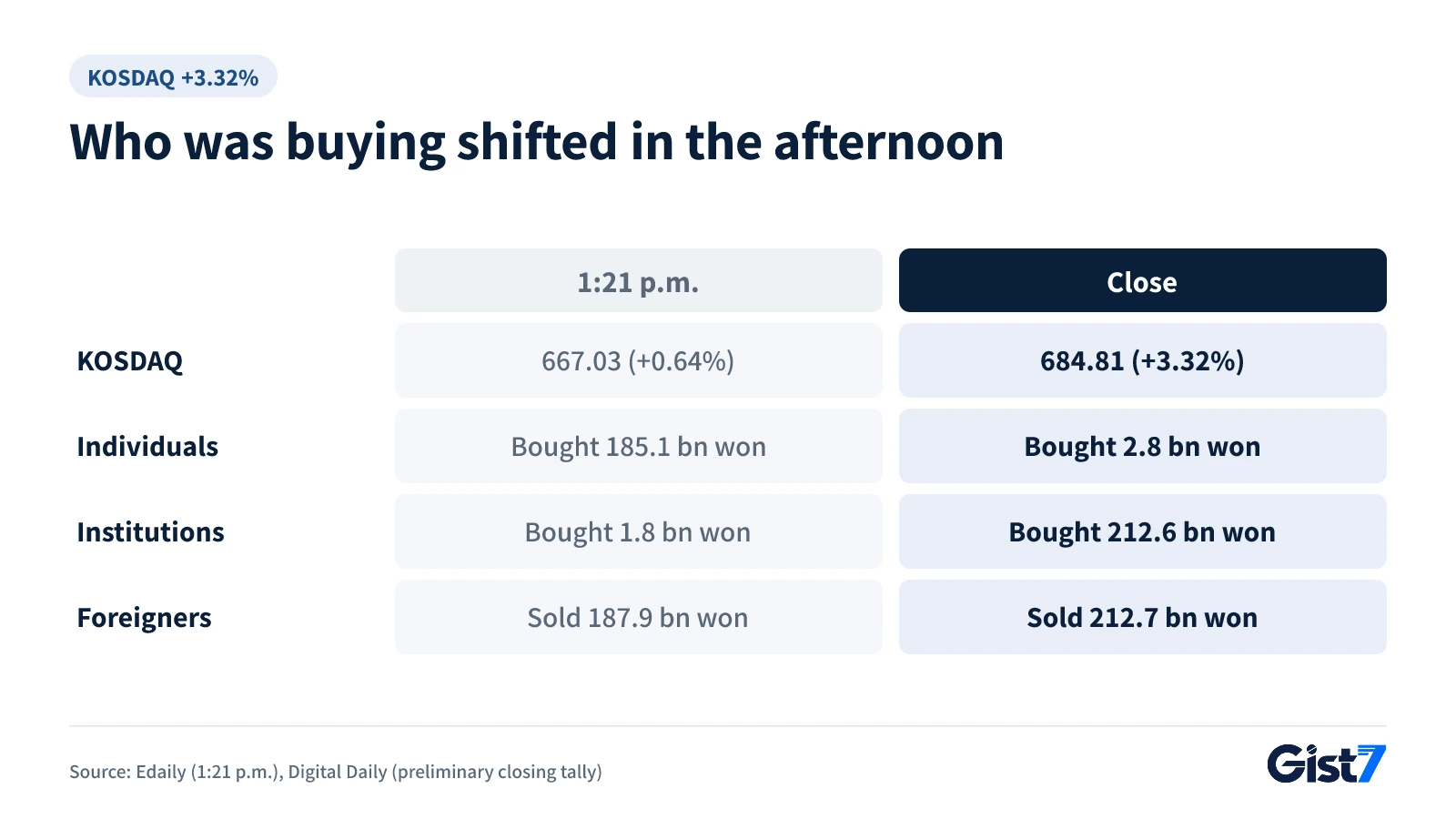
By the closing tallies, institutions net bought 210.8 billion to 214.0 billion won on the KOSDAQ and foreigners net sold 205.0 billion to 212.7 billion won (Etoday, Digital Daily, Asia Economy; the figures are preliminary and differ by outlet). Individuals, who had bought 185.1 billion won by 1:21 p.m., were roughly flat by the close. In other words, the main buyer on the index level switched from individuals to institutions during the afternoon. Reports did not say which stocks institutions bought.
Reports offered four explanations for why chip equipment led. First, buyers stepped into chip stocks that had fallen hard (Digital Daily). Second, expectations of solid AI chip demand after Nvidia's earnings played a role (Digital Daily). Third, the KOSDAQ 150 index's regular rebalancing, effective December 11, raised hopes of passive fund inflows into newly added stocks (Newspim). Fourth, the announcement at 2:09 p.m. that annual exports had passed $1 trillion came out, and Etoday's headline tied the market's higher close to that news. No available source shows which of these drove institutional buying. A day when the KOSDAQ jumped more than 5% and triggered a buy sidecar was covered in our November 11 KOSDAQ surge story. On the KOSPI, Samsung Electro-Mechanics (KOSPI: 009150) rose 9.26% and SK hynix (KOSPI: 000660) gained 3.41%.
The exam-day pattern held as well. Wide Economy, using Korea Exchange data, found that the KOSDAQ outperformed the KOSPI on 7 of the last 10 exam days, and this year the KOSDAQ (+3.32%) again beat the KOSPI (+1.39%). That is not evidence the pattern will repeat.
KOSDAQ up 3.55% in dollars: why are foreigners still selling after 11 sessions?
Foreign selling did not stop. Sisa Journal-e, using Korea Exchange data, counted 10 straight sessions of net foreign selling on the KOSDAQ from November 5 to 18; with more net selling on the 19th, the streak reached 11 sessions (Gist 7 count). Foreigners also sold 403.6 billion to 437.4 billion won on the KOSPI. Sisa Journal-e read the selling as a response to earnings pressure at chip equipment and materials companies, noting that some face margin squeeze from higher costs and currency swings.
| For overseas investors | Figure | Basis |
|---|---|---|
| KOSDAQ one-day return (won) | +3.32% | 662.81 → 684.81 |
| KOSPI one-day return (won) | +1.39% | 5,067.44 → 5,137.89 |
| Won per dollar | 1,333.0 → 1,330.0 | Seoul FX market, 3:30 p.m. (Digital Daily) |
| KOSDAQ return (in dollars) | About +3.55% | Gist 7 calculation |
| KOSPI return (in dollars) | About +1.62% | Gist 7 calculation |
| EWY reference price | $136.73 | Nov. 18 regular-session close in New York, Yahoo Finance |
| EWY overnight trading | $140.01 (+2.40%) | 2:53 a.m. ET on Nov. 19 (4:53 p.m. Seoul), Yahoo Finance |
The iShares MSCI South Korea ETF (NYSE Arca: EWY) is the main vehicle overseas investors use to trade Korean stocks. Overnight trading is thin, so the regular U.S. session price can differ. Because the won strengthened 0.23%, dollar-based returns were slightly higher than won-based returns.
Gist 7's read: the KOSDAQ rebound was a day when domestic institutional buying filled the gap left by foreign sellers. The three days in which foreigners sold 3.8 trillion won of KOSPI shares are covered in our story on the KOSPI falling below 5,000. Institutional buying can reverse within a day, so whether foreign net selling shrinks is the signal to watch for whether the rebound lasts.
Korea's exports top $1 trillion: what it says for chip equipment stocks and the won
According to the Korea Economic Daily, Korea's trade ministry announced that the country's cumulative exports for the year exceeded $1 trillion at 2:09 p.m. on November 19. Korea is the fourth country to reach $1 trillion in annual exports, after the United States, Germany and China, and its chip exports from January to October hit a record $396.8 billion.
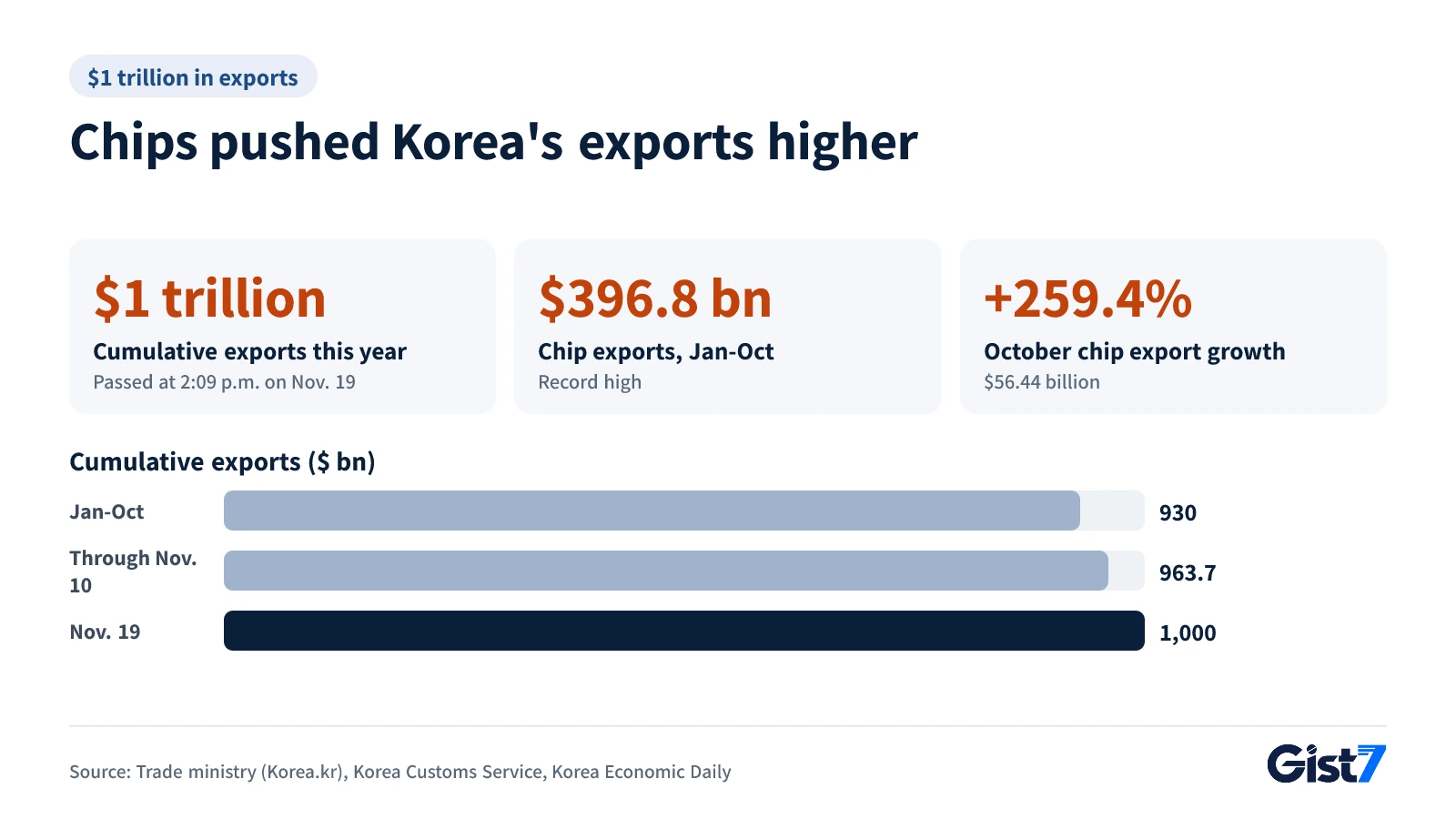
Export numbers and equipment stocks are linked. According to Korea.kr, the government's policy briefing site, chip exports in October rose 259.4% from a year earlier to $56.44 billion, driven by AI-related demand for memory and higher prices. Selling more memory requires more factories, and those orders go to equipment and parts makers. Still, DS Asset Management said that already-announced capacity plans are largely priced in, and what matters is how much earnings forecasts improve from here (Sisa Journal-e).
For the won, strong exports are a source of support. When companies convert export dollars into won, demand for the won tends to rise. On the day, though, the dollar moved only 3.0 won lower, so the export news alone did not swing the currency much.
Market impact map
| Asset / indicator | Direction | Strength | Why |
|---|---|---|---|
| KOSDAQ | ↑ | Strong | Chip materials, parts and equipment surged as institutions net bought about 210 billion won → 684.81 (+3.32%) |
| KOSPI | ↑ | Medium | Samsung Electro-Mechanics and SK hynix rebounded despite about 400 billion won of foreign selling → 5,137.89 (+1.39%) |
| Chip equipment and parts stocks | ↑ | Strong | Rebound after steep losses plus AI demand hopes → HPSP +11.76%, Leeno Industrial +10.56% |
| Entertainment, content and travel stocks | ↑ | Strong | Korea-China FTA follow-up deal → KOSPI entertainment and culture sector +9.39% (Asia Economy) |
| Won per dollar | ↓ | Weak | Strong exports, stock rebound → 1,330.0 (-3.0 won, 3:30 p.m.) |
| Overseas-listed Korea ETF (EWY) | ↑ | Medium | Seoul rebound priced in during overnight trading → +2.40% (indicative) |
Market reactions can vary with other factors, and this table is not a basis for investment decisions.
Little direct impact: 2-year Treasury, 10-year Treasury, dollar index, gold, oil (WTI), bitcoin, S&P 500, Nasdaq
- Funds and pensions: among Korean equity funds, those heavy in KOSDAQ small and mid caps and chip equipment did better on the day.
- Currency exchange: the won-dollar rate fell 3.0 won, making it slightly cheaper to buy dollars in Korea.
- Export jobs: the trade ministry said it would channel export gains into regional economies and jobs for young people (Korea Economic Daily).
What to watch next
| Date (ET / Seoul) | Indicator or event | Previous | Why it matters here | If it comes in like this |
|---|---|---|---|---|
| Expected Nov. 23 (Mon) Seoul | Korea Customs Service exports and imports for Nov. 1-20 | Nov. 1-10 exports $33.5 billion (+111.9%), chips $16.6 billion (Korea Customs Service) | Whether chip exports keep feeding equipment orders | Continued growth tends to support earnings hopes for chip equipment and parts makers |
| Nov. 25 (Wed) 8:30 a.m. ET / 10:30 p.m. Seoul | U.S. October PCE prices, Q3 GDP second estimate | September PCE +3.6% y/y, core +3.1% (Bureau of Economic Analysis) | The Fed hike worries behind the morning drop | Hotter than expected tends to lift yields and the dollar and add foreign selling pressure on emerging-market stocks |
| Nov. 26 (Thu) Seoul | Bank of Korea rate decision | 3.00% (raised Aug. 27, Bank of Korea) | Korean won rates and the discount rate for growth stocks | A hike would support the won but raise the discount-rate burden on KOSDAQ growth stocks |
| Dec. 9 (Wed) 2:00 p.m. ET / Dec. 10 4:00 a.m. Seoul | FOMC decision (Dec. 8-9, with economic projections) | Previous meeting Oct. 27-28 (Fed calendar) | U.S. rates behind foreign selling | A hike or hawkish tone tends to lift the dollar and add foreign selling pressure on Korean stocks |
| Dec. 11 (Fri) Seoul | KOSDAQ 150 regular rebalancing takes effect (16 added, 16 removed) | Announced by Korea Exchange on Nov. 18 (Newspim) | Hopes of passive inflows into added stocks | Trading in added and removed stocks tends to rise around the effective date |
Dates come from the Bank of Korea's monetary policy meeting schedule, the Bureau of Economic Analysis release schedule (8:30 a.m. ET), the Fed's FOMC calendar and Newspim's report. Korea Customs Service data for November 1-20 is expected on the 23rd because the 21st falls on a Saturday.
Frequently asked questions
Why did the KOSDAQ rise on November 19, 2026?
Chip materials, parts and equipment stocks that foreigners had sold heavily for two weeks surged while institutions net bought about 210 billion won on the KOSDAQ. HPSP (+11.76%), Leeno Industrial (+10.56%) and Wonik IPS (+8.33%) led. Reported explanations include a rebound after steep losses, AI chip demand hopes after Nvidia's earnings, the KOSDAQ 150 rebalancing and news that exports passed $1 trillion. Entertainment and travel stocks also rose on the Korea-China FTA follow-up deal.
Have foreign investors stopped selling KOSDAQ stocks?
No. Foreigners net sold 205.0 billion to 212.7 billion won on the KOSDAQ on November 19 (preliminary figures vary by outlet). That follows 10 straight sessions of net selling from November 5 to 18 (1.277 trillion won, Sisa Journal-e), making it 11 sessions.
What does $1 trillion in Korean exports mean for stocks?
Rising chip exports tend to feed expectations of memory capacity expansion and orders for equipment and parts makers. But some analysts say announced expansion plans are already largely priced in, so future earnings forecasts matter more.
Is the KOSDAQ usually strong on Korea's college entrance exam day?
Wide Economy, using Korea Exchange data, found the KOSDAQ beat the KOSPI on 7 of the last 10 exam days. In 2026 the KOSDAQ (+3.32%) again outpaced the KOSPI (+1.39%), but past patterns are not evidence of future results.
How did Korean stocks do in dollar terms on November 19?
The won strengthened from 1,333.0 to 1,330.0 per dollar. That put dollar-based returns slightly above won-based returns: about +3.55% for the KOSDAQ and about +1.62% for the KOSPI (Gist 7 calculation).
References
- 수출 1조 달러 소식에 환호 코스피 1%·코스닥 3% 상승 마감 — 이투데이
- "수능날 5000선 무너졌다가 반전"…코스피 1.4% 상승, 코스닥 3.3% 급등 — 디지털데일리
- 코스피, 기관 순매수 전환에 1%대 상승…5130선 마감 — 아시아경제
- 외국인, 코스닥 10일 연속 순매도···과반이 '반도체 소부장' — 시사저널e
- '오후 2시 9분'…대한민국 수출 1조달러 넘겼다 — 한국경제
- 코스피·코스닥 동반 상승…한중 FTA 기대에 오락·문화주 강세 — 이데일리
- 수능날 증시 '찬바람'…코스피·코스닥 1%대 하락 — 경제타임스
- [오전시황] 한한령 해제 기대에 엔터·여행·화장품 급등...상한가 10종목 — 중기이코노미
- [특징주] 코스닥150 신규 편입株 '들썩'…씨어스 15% 급등 — 뉴스핌
- 수능날 강세 보인 코스닥, 10년 중 7차례 코스피 압도 — 와이드경제
- 우리나라 수출 첫 9000억 달러 돌파…"11월 중 1조 달성 확실시" — 대한민국 정책브리핑
- 2026년 11월 1일 ~ 11월 10일 수출입 현황 [잠정치] — 관세청 (정책브리핑)
- iShares MSCI South Korea ETF (EWY) Historical Data — Yahoo Finance
- 통화정책방향 결정회의 일정 — 한국은행
- 한국은행 기준금리 추이 — 한국은행
- Release Schedule — 미 경제분석국
- Personal Income and Outlays, September 2026 — 미 경제분석국
- Meeting calendars and information — 연준