South Korea birth rate rebounds to 0.80: why still below Germany?
Key summary
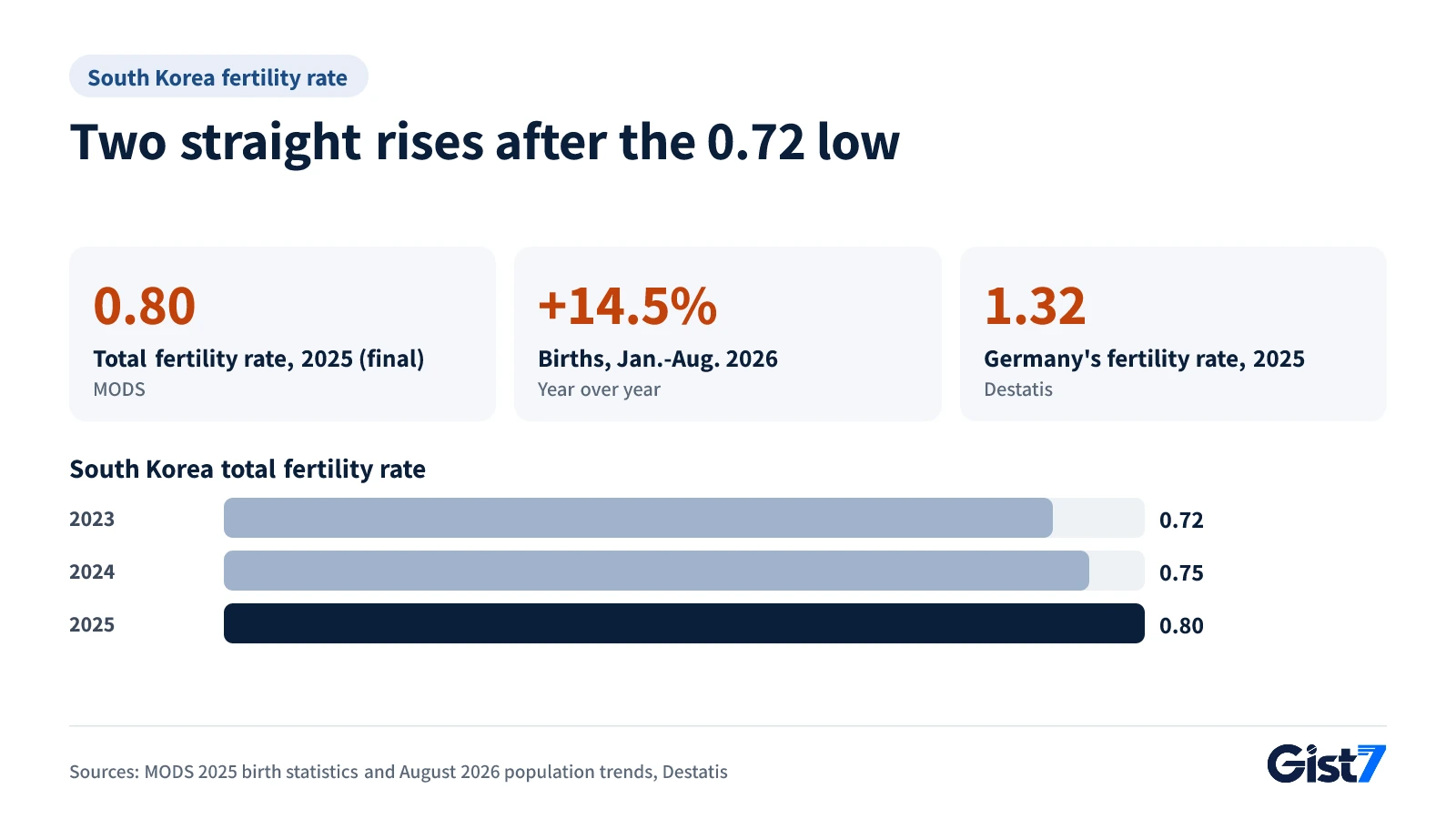
The South Korea birth rate rose from 0.72 in 2023 to 0.80 in 2025, and 2026 births are up 14.5% (MODS), driven by post-pandemic weddings and later motherhood. It still trails Germany (1.32) because only 5.5% of Korean births are outside marriage (Germany: 31.7%) and immigration adds little.
- Total fertility rate: 0.72 (2023) → 0.75 (2024) → 0.80 (2025, final); 0.87 in August 2026 (monthly)
- 193,783 births in January-August 2026 (+14.5%), far above the official projection, which assumed a 0.65 low in 2025
- Drivers: more marriages in 2023-2025, higher fertility at ages 35-39 (43.0 → 52.1 per 1,000), and the large cohort born in the early 1990s
- Germany's rate fell to 1.32 in 2025 but is still about 1.65 times Korea's; births outside marriage are 5.5% in Korea vs. 31.7% in Germany, so fewer weddings hit Korean births directly
- Economic effects: baby spending now, workforce and pensions only from the 2040s; a 1.2% drop in August 2026 marriages is a signal to watch
South Korea's total fertility rate bottomed out at 0.72 in 2023, then rose to 0.75 in 2024 and 0.80 in 2025, according to final 2025 birth statistics published on August 26, 2026, by the Ministry of Data and Statistics (MODS, formerly Statistics Korea). The South Korea birth rate rebound has carried into 2026: 193,783 babies were born from January through August, 14.5% more than a year earlier. The total fertility rate is the average number of children a woman is expected to have over her lifetime. Even at 0.80, though, Korea sits at about 60% of Germany's 1.32 and remains the OECD country with the lowest fertility.
Is the South Korea birth rate really rising again?
Yes. Korea's monthly total fertility rate was 0.87 in August 2026, up 0.09 from 0.78 a year earlier. It followed 0.88 in June and 0.89 in July, making three straight months in the high 0.8s. According to MODS's August 2026 population trends report, released October 28, 23,703 babies were born in August, up 13.0% and the most for any August since 2019.
| Year | Births | Total fertility rate | Marriages |
|---|---|---|---|
| 2023 | 230,028 | 0.72 | 193,657 |
| 2024 | 238,317 | 0.75 | 222,412 |
| 2025 | 254,341 | 0.80 | 240,326 |
| Jan.-Aug. 2026 | 193,783 (+14.5%) | 0.87 (August, monthly) | 165,874 (+5.2%) |
Sources: MODS, 2025 birth statistics (final) and August 2026 population trends (preliminary). Monthly fertility rates are seasonal, so compare the same month across years.
If the January-August pace holds through December, a simple calculation puts 2026 births at about 290,000, the most since 2019 (302,676), by Gist 7's estimate. The increase in births is also well ahead of official expectations. The government's December 2023 population projection (medium scenario) assumed the fertility rate would fall to 0.65 in 2025. The actual figure was 0.80.
Why fertility is rising: weddings, women in their late 30s, a big generation
Marriage is the first driver. Weddings postponed during the COVID-19 pandemic bunched up afterward, lifting marriages from 193,657 in 2023 to 222,412 in 2024 (+14.8%) and 240,326 in 2025 (+8.1%). In Korea nearly all children are born to married couples, so weddings turn into births one or two years later. First births rose 8.6% to 158,700 in 2025, and first children made up 63.8% of all births in August 2026.
The second driver is catch-up childbearing among women in their late 30s. Births per 1,000 women aged 35 to 39 climbed from 43.0 in 2023 to 52.1 in 2025, a bigger gain than for women aged 30 to 34 (66.7 to 73.1). It looks like women who delayed having children are now having them.
The third factor is cohort size. Korea recorded more than 700,000 births a year from 1991 to 1995, and those children are now in their early to mid-30s. That raises the number of births, but it does not directly lift the fertility rate, which is measured per woman. The rise in the rate itself comes from the first two factors. Expanded government support is often mentioned too, but no official estimate isolates its effect.
Why Korea's fertility rate is still far below Germany's 1.32
Korea's fertility rate is far lower than Germany's mainly because Korean children are almost all born within marriage (5.5% born outside marriage in 2025, against 31.7% in Germany) and because Korea has no large immigrant population lifting the numbers. Germany's Federal Statistical Office (Destatis) reported on July 1, 2026, that the German rate fell 2.7% to 1.32 in 2025 from 1.35 in 2024. The two countries are moving in opposite directions: Germany's rate has declined every year since 2022, while Korea's has risen since 2024.
| Item | South Korea | Germany |
|---|---|---|
| Total fertility rate, 2024 | 0.75 | 1.35 |
| Total fertility rate, 2025 | 0.80 | 1.32 |
| Recent trend | Up two years in a row since 2024 | Down every year since 2022 |
| Births, 2025 | 254,341 | 654,241 (postwar low) |
| Share of births outside marriage, 2025 | 5.5% | 31.7% |
| Mother's average age at first birth, 2025 | 33.2 | 30.5 |
Sources: MODS, 2025 birth statistics; Destatis press release No. 230 and births table (as of July 1, 2026). Germany's share is 207,388 births to unmarried parents divided by all births (Gist 7 calculation). The 2024 OECD average fertility rate was 1.40 (OECD Family Database, as cited by MODS).
First, marriage and childbirth are linked differently. In Germany, one in three babies born in 2025 had unmarried parents. In Korea, births outside marriage run at about 14,000 a year, so fewer weddings translate almost one for one into fewer births. That is also why Korea's rebound arrived together with a rise in marriages.
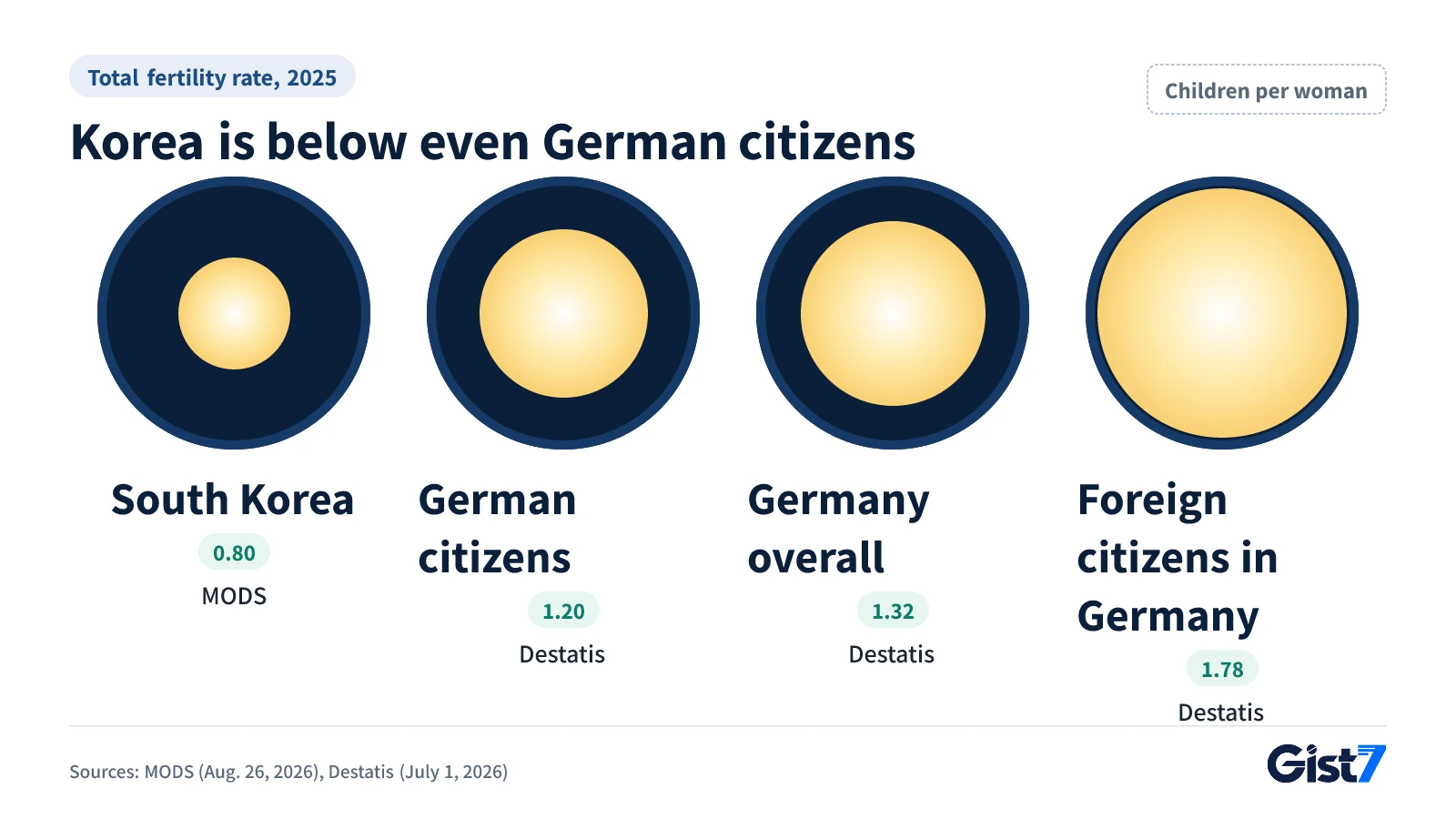
Second, immigration. According to Destatis, women with German citizenship had a fertility rate of 1.20 in 2025, while women with foreign citizenship had 1.78. Korea's 0.80 is lower even than the figure for German citizens alone.
Third, timing. Korean mothers have their first child about three years later than German mothers. The later the first birth, the less room there may be for a second or third.
What the fertility rebound means for Korea's economy
A higher birth rate lifts spending on babies right away, but its effect on the workforce, growth and pensions shows up only about 20 years later. A child born in 2026 reaches working age (15 to 64) in 2041. Until then, the economic cost of low fertility, a shrinking pool of workers, is already locked in.
- Workforce: In the 2023 projection (medium scenario), Korea's working-age population falls from 36.74 million in 2022 (71.1% of the total) to 16.58 million in 2072 (45.8%). That projection assumed fertility would bottom at 0.65, so if actual fertility stays higher, the numbers from the 2050s onward could shrink less.
- Growth: Fewer workers lower potential growth, the pace an economy can sustain without stoking inflation. For now, productivity and higher employment among women and older people have to fill the gap. Youth jobs are covered in our analysis of Korea's October employment data.
- Pensions: Under the pension reform passed by the National Assembly in March 2025, the National Pension contribution rate rises from 9.5% in 2026 by 0.5 percentage point a year to 13% in 2033. The government said this pushes back the projected depletion of the pension fund from 2056 to 2071, assuming fund returns rise from 4.5% to 5.5% (Korea.kr policy briefing). Children born now will start paying contributions only in the 2040s.
- Domestic demand: More births mean more demand right away for formula, baby goods, postnatal care centers and pediatric care. More weddings also add to housing demand from newlyweds; Seoul housing costs are covered in our look at Seoul rents.
Gist 7 reads the rebound as confirmation that fertility has passed its low, but it is too early to call it a change in trend. Marriages fell 1.2% year over year in August 2026, and the share of second and third children among births actually declined. The next test is whether fertility stays in the 0.8s once the post-pandemic wedding wave has passed.
Market impact map
| Asset or indicator | Direction | Strength | Why |
|---|---|---|---|
| Baby and maternity spending (formula, baby goods, postnatal care) | ↑ | Medium | Births up 14.5% in January-August widen the customer base |
| Pediatric and obstetric medical services | ↑ | Weak | More births mean more deliveries and checkups |
| Newlywed housing demand (smaller homes in the Seoul area) | ↑ | Weak | Marriages rose in 2024-2025, though August 2026 marriages fell 1.2% |
Little direct impact: 2-year Treasury yield, 10-year Treasury yield, dollar index, won-dollar rate, gold, oil (WTI), bitcoin, S&P 500, Nasdaq, KOSPI
- Everyday impact: More births can mean tighter competition for postnatal care center places and pediatric appointments. In January-August, births in Seoul rose 17.6%, faster than the national 14.5%.
- More weddings add to rental demand from newlyweds, but with marriages down in August, it is not yet clear that this demand will keep growing.
Market reactions can vary with other factors, and this table is not a basis for investment decisions.
What to watch next
| Date (Korea time) | Indicator or event | Previous | Why it matters here | If it comes in like this |
|---|---|---|---|---|
| Late November (expected) | September 2026 population trends, including Q3 fertility rate (MODS) | August births 23,703; monthly fertility rate 0.87 | Whether the rebound holds in the second half | Double-digit birth growth points to an annual rate in the high 0.8s; a drop to single digits signals a slowdown |
| December (expected) | 2025-based population projections (MODS) | 2022-based medium scenario: fertility low of 0.65 in 2025; working-age population of 16.58 million in 2072 | The baseline for long-term workforce and pension outlooks | A higher fertility assumption makes the long-run workforce and pension outlooks less bleak |
| Late December (expected, about six weeks away) | October 2026 population trends (MODS) | October 2025: about 22,000 births and about 19,600 marriages (MODS) | Whether marriages keep falling | Another drop in marriages would signal slower birth growth from 2027 |
Dates follow MODS's release practice (population trends at the end of the second month after the reference month) and its 2026 work plan (population projections in December), and may change. Korea time is 8 hours ahead of CET in winter.
Frequently asked questions
What was South Korea's fertility rate in 2025?
0.80. That is the final figure published by the Ministry of Data and Statistics on August 26, 2026, up 0.05 from 0.75 in 2024 and the second straight annual increase. Births rose 6.7% to 254,341.
Why is South Korea's birth rate rising again?
The biggest reason is a wave of weddings in 2024 and 2025 that had been postponed during the pandemic. Catch-up births among women aged 35 to 39 added to it: their fertility rose from 43.0 per 1,000 in 2023 to 52.1 in 2025. A large generation born in 1991-1995 also pushed up the number of births.
Does South Korea still have the lowest fertility rate in the OECD?
Yes. In OECD data for 2024, cited by Korea's statistics ministry, Korea had the lowest rate among the 38 members at 0.75, far below the next lowest, Spain and Poland at 1.10. The OECD average was 1.40. Korea's 2025 rate of 0.80 is still well short of that.
Why is South Korea's birth rate lower than Germany's?
In 2025, Germany's rate was 1.32 and Korea's 0.80 (Destatis, MODS). In Germany, one in three babies is born to unmarried parents, but in Korea only 5.5% are, so fewer marriages mean fewer births almost immediately. In Germany, women with foreign citizenship (1.78) also lift the overall rate.
Will a higher birth rate delay the depletion of Korea's national pension fund?
Not in the short run. Children born today will start paying contributions only in the 2040s. The government says its 2025 reform, together with an assumed rise in fund returns, pushes depletion back from 2056 to 2071; any fertility gains would show up in later projections.
References
- Population trends, August 2026 (Oct. 28, 2026) — Ministry of Data and Statistics (MODS)
- 2025 birth statistics, final (Aug. 26, 2026) — MODS (posted by KDI Economic Information Center)
- Total fertility rate falls to 1.32 children per woman in 2025 (July 1, 2026) — Destatis
- Live births and deaths table (as of July 1, 2026) — Destatis
- Population projections 2022-2072 (Dec. 14, 2023) — Statistics Korea briefing, Korea.kr
- Pension reform bill passes the National Assembly (Mar. 20, 2025) — Korea.kr policy news
- 2026 work plan (Dec. 11, 2025; population projections due in December) — MODS