Why Poland protests are shaking the zloty and the economy
Key summary
The Poland protests stem from a fight over control of the Constitutional Tribunal between the Tusk government and President Nawrocki. After the court's president was suspended on Oct. 30, 2026, the zloty slid to 4.4372 per euro on Nov. 3, and S&P cut Poland's outlook to negative on Nov. 6.
- The protests are about the Constitutional Tribunal, not living costs: the president swore in only three of eight judges elected by parliament
- Hundreds gathered outside the court after its president was suspended on Oct. 30, and President Nawrocki cut short a foreign trip
- The zloty slid to 4.4372 per euro on Nov. 3, then recovered to 4.3925 on Nov. 6
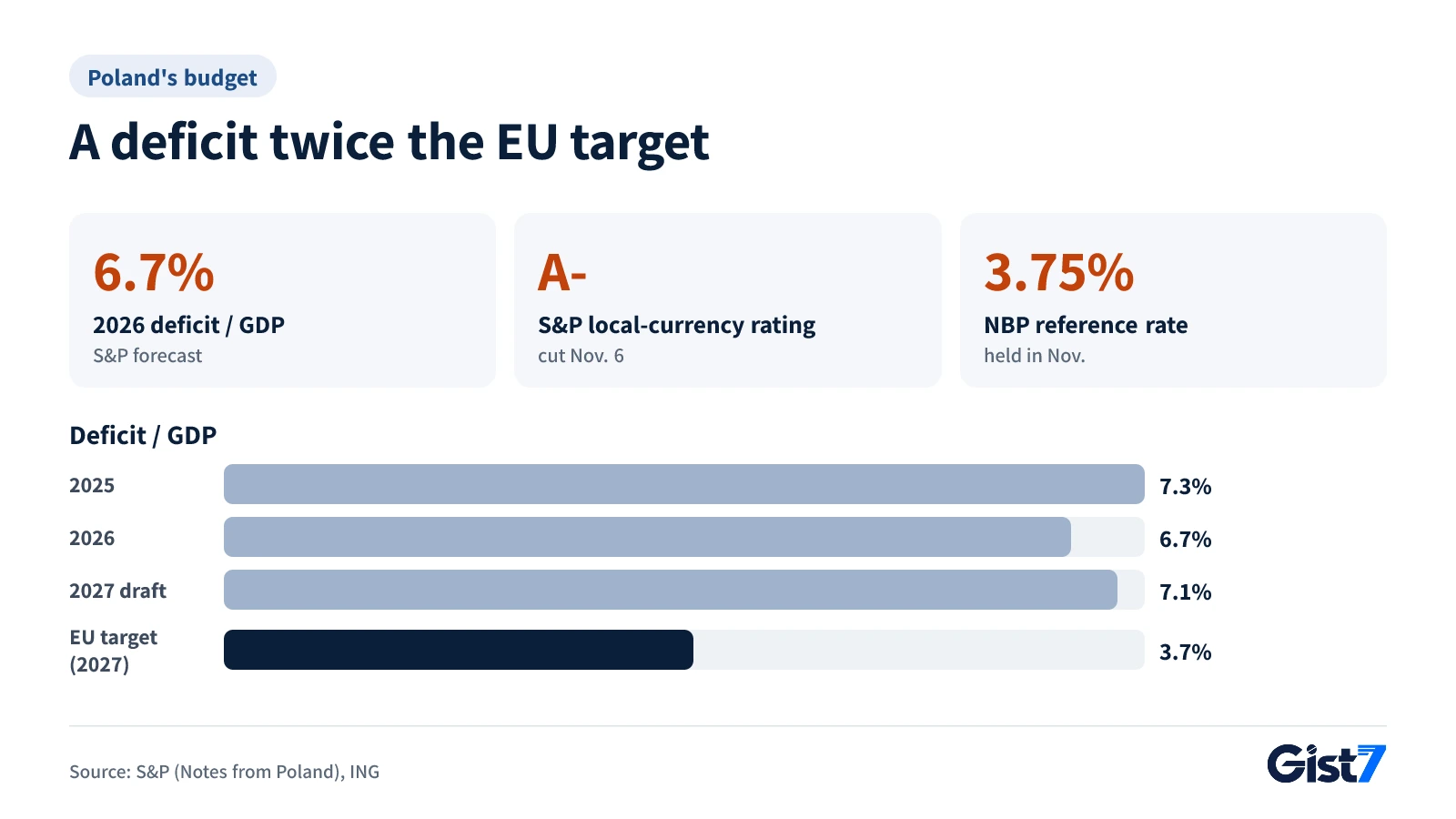
- S&P expects a 2026 deficit of 6.7% of GDP and says political polarization is blocking fiscal consolidation
- Spillover is limited so far but could reach German trade, EU funding and Ukraine's EU accession standards
Protesters surged toward the gate of Poland's Constitutional Tribunal in Warsaw on the night of Oct. 30, 2026, and three people were arrested. Earlier that day, a judge had suspended the tribunal's president and vice president for a month. In short, the Poland protests are about who controls the country's top constitutional court, and they have pitted the government directly against the president. According to Al Jazeera, the crowd was made up mostly of supporters of the opposition Law and Justice party (PiS), and President Karol Nawrocki turned his plane around mid-trip to fly home.
Why the Poland protests started: a decade-long fight over the top court
The roots go back to 2015. The Constitutional Tribunal rules on whether laws comply with the constitution and can stop them from taking effect, so who sits on its bench matters politically. According to Al Jazeera, PiS took power in 2015 and appointed new judges even to seats that were already lawfully filled, and over eight years in government it was criticized for tightening political control over the courts.
Donald Tusk returned as prime minister in December 2023 promising to restore judicial independence. In 2026, the Sejm, Poland's lower house, elected eight new judges to the 15-member tribunal, but Nawrocki, a PiS ally, swore in only three. The other five took their oaths before parliament, and the tribunal's president blocked them from hearing cases. On Oct. 30, Judge Anna Korwin-Piotrowska suspended tribunal president Bogdan Święczkowski and his deputy, and the dispute spilled into the street.
Who is protesting, and why?
This is less a nationwide cost-of-living protest than a political standoff between two camps. The crowd outside the tribunal is made up mainly of PiS supporters who call the suspension a "coup." The tribunal's official account used the same word. Tusk countered that the judges are not politically neutral and that the move was needed to restore the rule of law.
Nawrocki held emergency talks at the presidential palace on Oct. 31, citing a threat to internal security, but according to Al Jazeera, Tusk's Civic Coalition stayed away and no deal emerged. The European Commission told The Kyiv Independent that electing the eight judges "lies within the constitutional power of the Sejm," in effect siding with the government. The U.S. Embassy in Poland says gatherings outside the tribunal have continued since Sept. 11, and a large march is planned for Independence Day on Nov. 11.
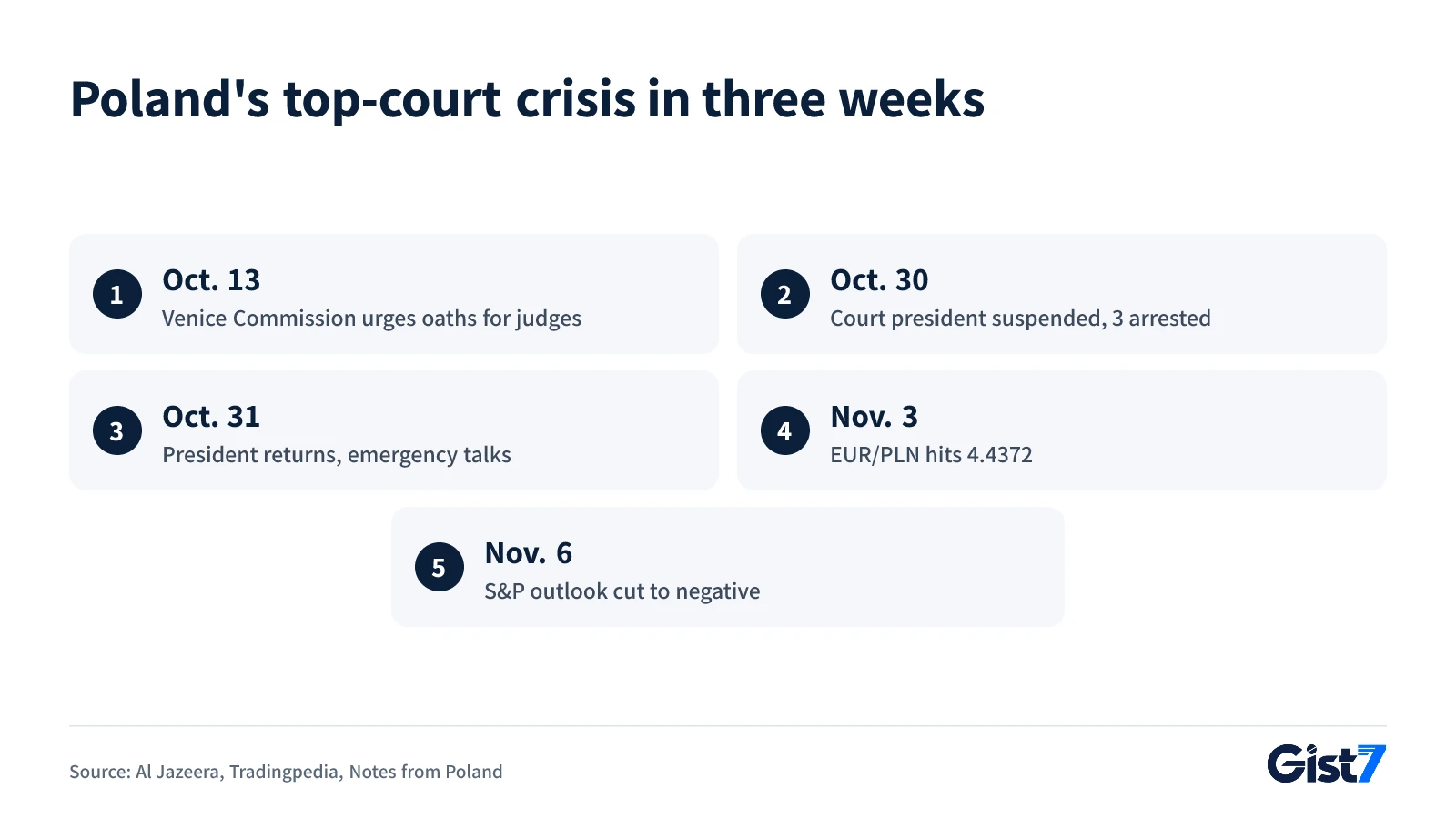
| Date (2026) | What happened |
|---|---|
| Oct. 13 | The Council of Europe's Venice Commission urges the president to swear in the remaining judges |
| Oct. 30 | Tribunal president and deputy suspended for a month, police deployed, three arrested in night protest |
| Oct. 31 | President returns and calls emergency talks (no deal) |
| Nov. 3 | EUR/PLN touches 4.4372 (weaker zloty) |
| Nov. 6 | S&P cuts Poland's rating outlook to negative |
| Nov. 11 | Independence Day march planned in Warsaw |
How is Poland's economy affected?
The currency reacted first. According to Tradingpedia, the euro rose to 4.4372 zloty on Nov. 3 after weekend protests, leaving the zloty lagging other Central European currencies. Commerzbank is the most bearish on the zloty among the three main Central European currencies. Using the European Central Bank's reference rate, the euro had eased back to 4.3925 zloty by Nov. 6.
The bigger issue is the budget. According to Notes from Poland, S&P revised Poland's outlook to negative on Nov. 6 and cut its local-currency rating from A to A-. S&P expects deficits of 7.3% of GDP in 2025, 6.7% in 2026 and 7.1% under the 2027 draft budget, far from the EU target of 3.7% for 2027. It said "political polarisation hinders fiscal consolidation" and warned that presidential vetoes and the court crisis could weaken policy predictability. Moody's had already cut Poland to A3 in September.
Prices and rates are holding up for now. According to Statistics Poland (GUS), the October flash estimate showed consumer prices up 3.5% year over year and down 0.4% from September. ING reported that the National Bank of Poland (NBP) held its reference rate at 3.75% in November while raising its 2027 inflation forecast to 4.2%. Bonds have reacted more to oil than to politics. According to Poland Insight, the 10-year yield fell toward 6.1% in early November on hopes of easing in the Iran conflict, though it traded below 5% before the Middle East escalation.
How could the crisis spill over to neighboring countries?
The spillover is limited so far, but a long standoff could spread in three directions. The first is Germany. According to Polskie Radio, Poland-Germany trade reached a record of about €90 billion in the first half of 2025. With trade that large, political and fiscal uncertainty that delays investment decisions in Poland could raise costs for German companies that produce there.
The second is EU funding. According to Pollar, Poland had secured €42 billion, or 76.85%, of its €54.72 billion allocation from the EU recovery fund (KPO) by August. Judicial independence is one of the conditions the EU checks before paying out, so the question is whether funds could be frozen over rule-of-law concerns, as happened with Hungary. For now the Commission is backing the government, and there is no sign of a payment freeze.
The third is Ukraine. According to The Kyiv Independent, after rule-of-law backsliding in Poland and Hungary, the EU is demanding stronger judicial safeguards from countries that want to join. The longer Poland's crisis lasts, the tougher the judicial-reform bar could become in Ukraine's accession talks. The Czech koruna and the Hungarian forint did not swing as much as the zloty in early November.
Gist 7's take: the real risk is a year-long deadlock, not the crowds
Measured by crowd size, this crisis is not huge: reports put the gatherings outside the tribunal in the hundreds. What worries markets is the deadlock behind them. With parliamentary elections roughly a year away, a president wielding vetoes against a government with a parliamentary majority means budget reforms to cut the deficit are effectively on hold. That structure, not the protests, is why S&P lowered its outlook.
The economy itself is still sturdy. S&P expects growth to average close to 3% in 2027-2029 and calls the economy resilient. The problem is that Poland must keep issuing bonds to fund its deficit. If politics stalls, that borrowing gets more expensive and the zloty becomes vulnerable to even small shocks. The Nov. 11 Independence Day march and the end of the tribunal president's one-month suspension in late November are the next flashpoints.
Questions for the coming weeks
- Whether the Nov. 11 Independence Day march stays peaceful
- Who leads the tribunal once the one-month suspension expires in late November
- Whether the 2027 budget can get past a presidential veto
- Whether Fitch and other rating agencies follow S&P
Market impact map: the zloty and bonds moved first
The impact is concentrated in Polish assets; the direct effect on U.S. and Korean markets is small. The table below shows how this event connects to each asset, based on Nov. 3 to 6, 2026.
| Asset / indicator | Direction | Strength | Link (why) |
|---|---|---|---|
| Zloty (EUR/PLN) | ↑ (weaker zloty) | Medium | Political conflict plus fiscal strain made it the weakest Central European currency (4.4372 on Nov. 3) |
| Polish 10-year bond yield | ↑↓ conditional | Medium | A weaker rating outlook pushes yields up, while falling oil pulls them down (about 6.1% in early November) |
| Poland's credit rating | ↓ | Strong | S&P outlook negative, local-currency rating cut from A to A- (Nov. 6) |
| Polish government borrowing costs | ↑ conditional | Medium | Poland sold PLN 41.4 billion of bonds in October alone; a higher risk premium would raise interest costs |
Little direct impact: 2-year Treasury, 10-year Treasury, dollar index, KRW/USD (South Korean won per dollar), gold, oil (WTI), bitcoin, S&P 500, Nasdaq, KOSPI (South Korea's main index) / Czech koruna, Hungarian forint (less volatile than the zloty in early November)
- Travel and currency exchange: a weaker zloty can make trips to Poland slightly cheaper for visitors paying in dollars or euros.
- Exporters: battery and appliance makers with plants in Poland, and defense exporters selling to Warsaw, may feel changes in local budgets and the exchange rate.
- EU-funded projects: a long political deadlock could delay infrastructure projects financed by the recovery fund.
Market reactions can vary with other factors, and this table is not a basis for investment decisions.
What to watch next
| Date (ET) | Indicator / event | Previous | Why it matters here | If it comes in... |
|---|---|---|---|---|
| Wed., Nov. 11, 8 a.m.-noon (2-6 p.m. Warsaw) | Independence Day march in Warsaw (U.S. Embassy notice) | Gatherings outside the tribunal since Sept. 11 | Shows whether political tension escalates | Clashes would tend to add pressure on the zloty |
| Late November (expected) | End of the tribunal president's one-month suspension (from Oct. 30) | Suspended | Next test of who controls the court | Attempts to return and new clashes would tend to raise policy uncertainty |
| Late November (expected) | Poland's November flash CPI, Statistics Poland (GUS) | October: 3.5% y/y (GUS) | Shapes the rate path and the zloty | A higher reading tends to lift rate-hike bets and support the zloty |
| Wed., Dec. 2 | NBP Monetary Policy Council decision (meeting Dec. 1-2) | 3.75% (ING) | Monetary policy amid the political crisis | Extended holds and dovish signals tend to weigh on the zloty |
| Wed., Dec. 9, 2:30 p.m. press conference | Federal Open Market Committee (FOMC) decision (Dec. 8-9) | 3.75%-4.00% | U.S. tightening tends to pressure emerging-market currencies | A hike: dollar ↑, zloty and other Central European currencies ↓ as a tendency |
For why U.S. rate-hike bets have climbed, see why AI stocks fell after the U.S. midterms.
Frequently asked questions
Why are people protesting in Poland?
The protests stem from a clash between the government and the president over control of the Constitutional Tribunal. After a judge suspended the court's president on Oct. 30, 2026, opposition PiS supporters who called it a coup gathered outside the court.
Why are Tusk and Nawrocki at odds?
Prime Minister Tusk says judges appointed under the former PiS government are not politically neutral and wants to restore judicial independence. President Nawrocki, a PiS ally, swore in only three of the eight judges elected by parliament.
Did the protests affect the zloty?
Yes. The euro rose to 4.4372 zloty on Nov. 3, leaving the zloty weaker than other Central European currencies. By the European Central Bank's Nov. 6 reference rate, it had recovered to 4.3925.
What happened to Poland's credit rating?
S&P revised Poland's outlook to negative on Nov. 6 and cut its local-currency rating to A-. It cited a 2026 deficit of 6.7% of GDP and political polarization that blocks fiscal reform.
How could neighboring countries be affected?
The impact is limited so far. A prolonged crisis could affect supply chains with Germany, Poland's largest trading partner, EU recovery-fund payments and the judicial standards required in Ukraine's EU accession talks.
Does this affect investors or travelers outside Poland?
The direct impact on U.S. or Korean markets is small. Companies with plants in Poland and defense exporters may feel changes in local budgets and exchange rates, and a weaker zloty can make travel to Poland slightly cheaper.
References
- Protests outside Poland's constitutional court: What's the crisis about? — Al Jazeera
- Polish president holds crisis talks in court standoff — Al Jazeera
- EU Commission backs Poland government over constitutional court crisis — The Kyiv Independent
- Political Standoff Intensifies Pressure on Polish Zloty — Tradingpedia
- Euro foreign exchange reference rates (6 November 2026) — European Central Bank
- Rating agency S&P shifts Poland's credit outlook to negative and lowers currency rating — Notes from Poland
- Flash estimate of the consumer price index in October 2026 — Statistics Poland (GUS)
- National Bank of Poland holds rates despite higher 2027 inflation forecast — ING Think
- Polish Bonds Rebound as 10-Year Yield Nears 6.1% — Poland Insight
- European Commission approves 7.9 billion euro KPO payment to Poland — Pollar
- Poland-Germany trade hits record €90 billion in first half of 2025 — Polskie Radio
- Schedule of Monetary Policy Council meetings — National Bank of Poland
- Demonstration Alert: Week of Polish Independence Day — U.S. Embassy & Consulate in Poland