Foreigners in Korea: What 2.66 Million Earn and Send Home
Key summary
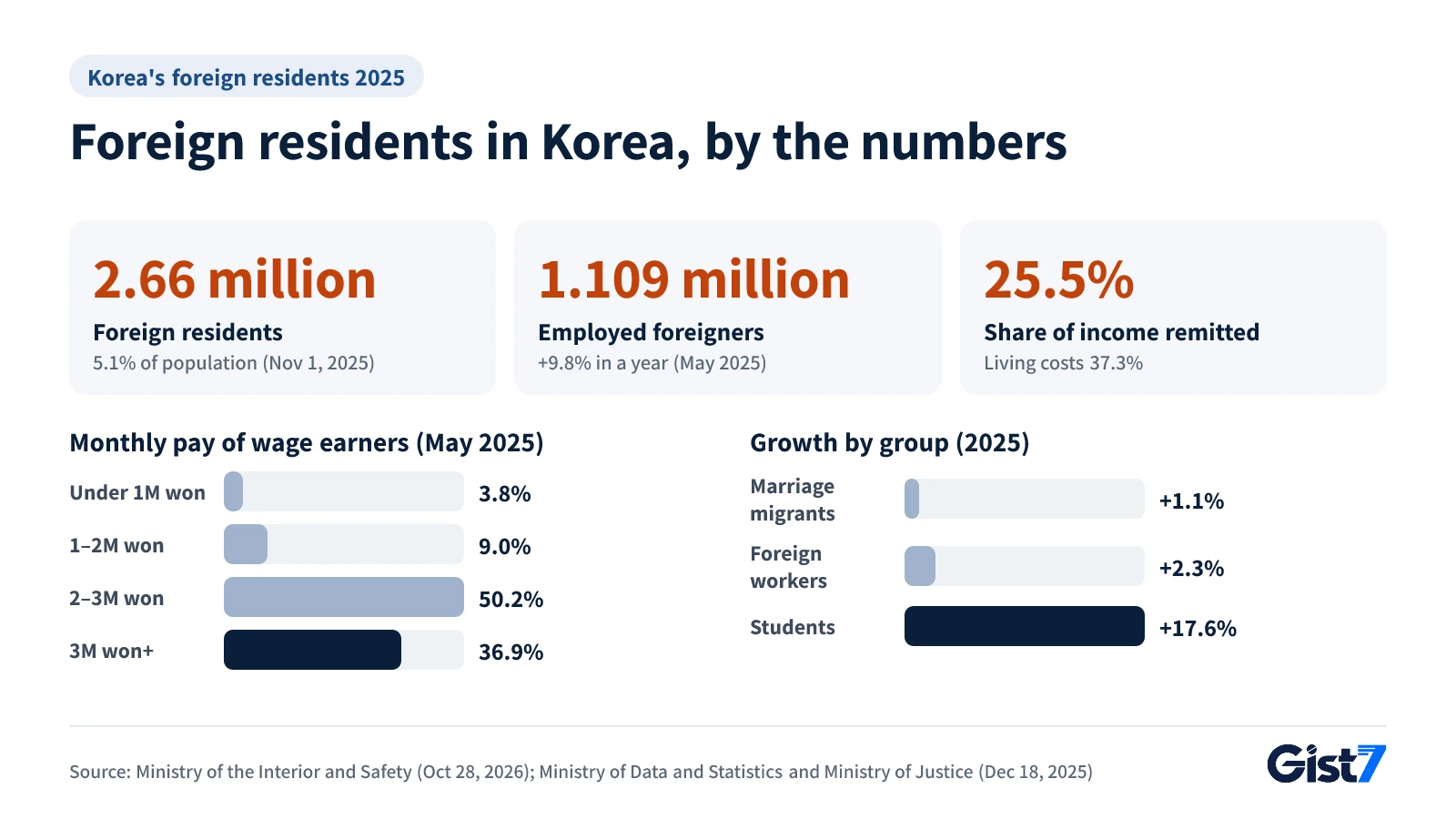
Foreigners in Korea numbered 2,662,967 on Nov 1, 2025, or 5.1% of the population. Half (50.2%) of foreign wage earners make 2–3 million won a month, and foreigners send 25.5% of income as remittances (May 2025). Students, up 17.6%, drove the growth.
- 2,662,967 foreign residents, 5.1% of Korea's population, a fourth straight annual rise (Nov 1, 2025, Ministry of the Interior and Safety)
- 1.109 million foreigners employed (+9.8%); 44.9% work in mining and manufacturing (May 2025)
- 50.2% of foreign wage earners make 2–3 million won a month and 36.9% make 3 million or more; 59.3% of permanent residents (F-5) but 27.1% of marriage migrants (F-6) are in the top band
- Foreigners send 25.5% of total income as remittances, E-9 workers 56.5%; Bank of Korea wage payments to non-residents hit $3.03 billion in 2025, about 1.9 times 2022
- 274,329 international students (+17.6%) accounted for 52% of the increase in foreign residents; working students rose 71.8% to 56,000
Foreigners in Korea reached 2,662,967 on November 1, 2025, equal to 5.1% of the total population of 51,817,499. According to the Ministry of the Interior and Safety, which published its 2025 local government foreign resident report on October 28, 2026, the number rose by 79,341 (3.1%) in a year, the fourth straight increase. A separate survey by the Ministry of Data and Statistics and the Ministry of Justice shows that half (50.2%) of foreign wage earners make 2–3 million won a month (about $1,495–2,243 at the Bank of Korea's October 2026 average rate), and that foreigners put 25.5% of their total income toward remittances.
Foreigners in Korea: who the 2.66 million are and where they live
The 2.66 million "foreign residents" combine 2,109,057 foreign nationals, 256,491 people who acquired Korean citizenship, and 297,419 of their children born in Korea. The ministry counts anyone living in Korea for more than 90 days who, or whose parent, held or holds a foreign nationality. Because the data come from the population and housing census, short-term visitors are excluded.
| Group (Nov 1, 2025) | People | vs. a year earlier |
|---|---|---|
| Foreign workers | 514,043 | +2.3% |
| Overseas Koreans with foreign nationality | 411,314 | -1.1% |
| International students | 274,329 | +17.6% |
| Marriage migrants | 194,017 | +1.1% |
| Other foreigners | 715,354 | +2.3% |
| Naturalized Korean citizens | 256,491 | +4.4% |
| Children of foreign residents (born in Korea) | 297,419 | +0.7% |
| Total | 2,662,967 | +3.1% |
Source: Ministry of the Interior and Safety, 2025 Local Government Foreign Resident Status (Oct 28, 2026). "Other foreigners" covers visa types outside the four groups above, such as corporate investment or journalism, plus people who overstayed.
The capital region holds 55.9% (1,487,968 people). By province, Gyeonggi (859,943), Seoul (453,201) and South Chungcheong (178,229) lead; by city, Ansan (109,544), Hwaseong, Siheung, Suwon and Bucheon rank first to fifth. As a share of local population, rural counties with industrial parks stand out: 22.4% of residents in Yeongam, South Jeolla, and 19.7% in Eumseong, North Chungcheong, are foreign residents. Growth was also fastest outside the capital region, in North Gyeongsang (8.0%), Gangwon (7.9%) and South Jeolla (7.8%).
For the latest breakdown by visa, the Ministry of Justice's statistics on foreigners staying in Korea are more current. At the end of September 2026, 2,281,331 foreigners were registered or had filed residence reports. Overseas Koreans (F-4) numbered 608,374, non-professional workers (E-9) 340,948, students (D-2) 263,930 and permanent residents (F-5) 233,431, with 72,506 seasonal farm and fishery workers (E-8). The two ministries count differently, so their totals cannot be compared directly.
How much do foreign workers in Korea earn, and what do they do?
As of May 2025, 1.109 million foreigners were working in Korea, up 9.8% from a year earlier. Of 1.047 million wage earners, 50.2% made 2–3 million won a month and 36.9% made 3 million won or more. Those figures come from the 2025 Survey on Immigrants' Living Conditions and Labour Force, released on December 18, 2025, by the Ministry of Data and Statistics and the Ministry of Justice. Among 1.692 million foreign residents aged 15 and over, the employment rate was 65.5% and the unemployment rate 6.4%.
That employment count is more than twice the 514,043 "foreign workers" in the table above. The interior ministry counts only people holding work visas, while the survey counts everyone who works, including overseas Koreans, permanent residents and marriage migrants.
By industry, factories employ almost half.
| Industry (May 2025) | Foreign workers | Share | vs. a year earlier |
|---|---|---|---|
| Mining and manufacturing | 498,000 | 44.9% | +8.0% |
| Wholesale, retail, lodging and restaurants | 226,000 | 20.4% | +18.4% |
| Business, personal and public services | 148,000 | 13.4% | +3.1% |
| Construction | 107,000 | 9.6% | -0.5% |
| Agriculture, forestry and fishing | 100,000 | 9.0% | +20.0% |
| Utilities, transport, telecom and finance | 30,000 | 2.7% | +28.6% |
Source: Ministry of Data and Statistics and Ministry of Justice, 2025 Survey on Immigrants' Living Conditions and Labour Force (Dec 18, 2025).
Pay varies sharply by visa. A breakdown by visa status that the statistics ministry released on March 10, 2026, shows that 59.3% of permanent residents (F-5) earn 3 million won or more, compared with 27.1% of marriage migrants (F-6).
| Visa (May 2025) | Earning 3 million won+ | Largest industry | Share of income remitted |
|---|---|---|---|
| Permanent resident (F-5) | 59.3% | Mining and manufacturing 29.8% | 5.5% |
| Professional (E-1 to E-7) | 50.8% | Mining and manufacturing 57.4% | 36.1% |
| Overseas Korean (F-4) | 46.3% | Mining and manufacturing 30.7% | 7.8% |
| Working visit (H-2) | 42.4% | Wholesale, retail, lodging and restaurants 36.6% | 13.0% |
| Non-professional worker (E-9) | 30.6% | Mining and manufacturing 79.7% | 56.5% |
| Marriage migrant (F-6) | 27.1% | Mining and manufacturing 35.6% | 9.1% |
| Student (D-2 etc.) | No data | Wholesale, retail, lodging and restaurants 83.4% | 3.2% |
Source: Ministry of Data and Statistics and Ministry of Justice, Life in Korea by Visa Status, 2025 survey (Mar 10, 2026). Among working students, 51.2% earn 1–2 million won a month and 36.2% under 1 million won.
The E-9 visa covers workers hired through Korea's Employment Permit System, mostly in small manufacturers, farms, livestock and fishing. Some 68.9% of them earn 2–3 million won a month, and at 45.9 hours a week they work the longest of any visa group. Gist 7's reading: "foreign workers" are not one group. E-9 holders send home more than half of what they earn, while permanent residents and overseas Koreans spend and save in Korea. How much a rising foreign population adds to domestic consumption depends on which visa groups are growing.
Where does the money go? 37.3% living costs, 25.5% remittances
Foreigners spend 37.3% of total income on living costs, 25.5% on remittances at home or abroad, 15.4% on savings and 11.9% on housing (May 2025, Ministry of Data and Statistics and Ministry of Justice). The remittance share rose 2.3 percentage points from the 2023 survey. Remittances from foreigners in Korea are routine: 39.1% send money to family or relatives abroad, and 29.1% of all foreigners do so 12 or more times a year, meaning roughly three in four senders (74%) send almost every month. Among those who send money, 30.9% send 20 million won or more a year.
The national picture appears in the Bank of Korea's balance of payments. "Compensation of employees paid" is wages paid to non-residents such as foreign workers staying under a year, and "personal transfers paid" is money residents send abroad without anything in return. Personal transfers also include money sent by Koreans, so they are not a pure measure of foreigners' remittances.
| Bank of Korea balance of payments (annual) | 2022 | 2025 | Change |
|---|---|---|---|
| Compensation of employees paid | $1.61 billion | $3.03 billion | +88% |
| Personal transfers paid | $8.24 billion | $11.28 billion | +37% |
Source: Bank of Korea Economic Statistics System (ECOS), table 2.5.1.1 Balance of Payments (301Y013), retrieved Nov 22, 2026. Together the two items came to $14.31 billion in 2025, about 12% of that year's current account surplus of $123.05 billion.
In 2026, the exchange rate moved the numbers. Wage payments to non-residents in January–September totaled $2.20 billion, 6.2% less than a year earlier ($2.35 billion). In April–June, when the won was weak at 1,487–1,527 per dollar on a monthly average, they ran at only $170–220 million a month. In July–September they reached $970 million, 39% more than a year earlier ($700 million), according to ECOS. Because wages are paid in won, their dollar value moves with the exchange rate. Still, the won only strengthened clearly in August (1,406.3) and September (1,359); in July (1,497.43) it was close to April–May levels, yet payments were a large $320 million. Headcount and seasonal factors are mixed in, so the swing is not purely a currency effect.
Why the 17.6% jump in international students matters
The rise in international students was the standout in Korea's 2025 foreign resident data. Their number grew by 41,092 (17.6%) to 274,329, accounting for 52% of the total increase of 79,341. They are spenders in Korea today and potential workers after graduation, which gives them an outsized economic role.
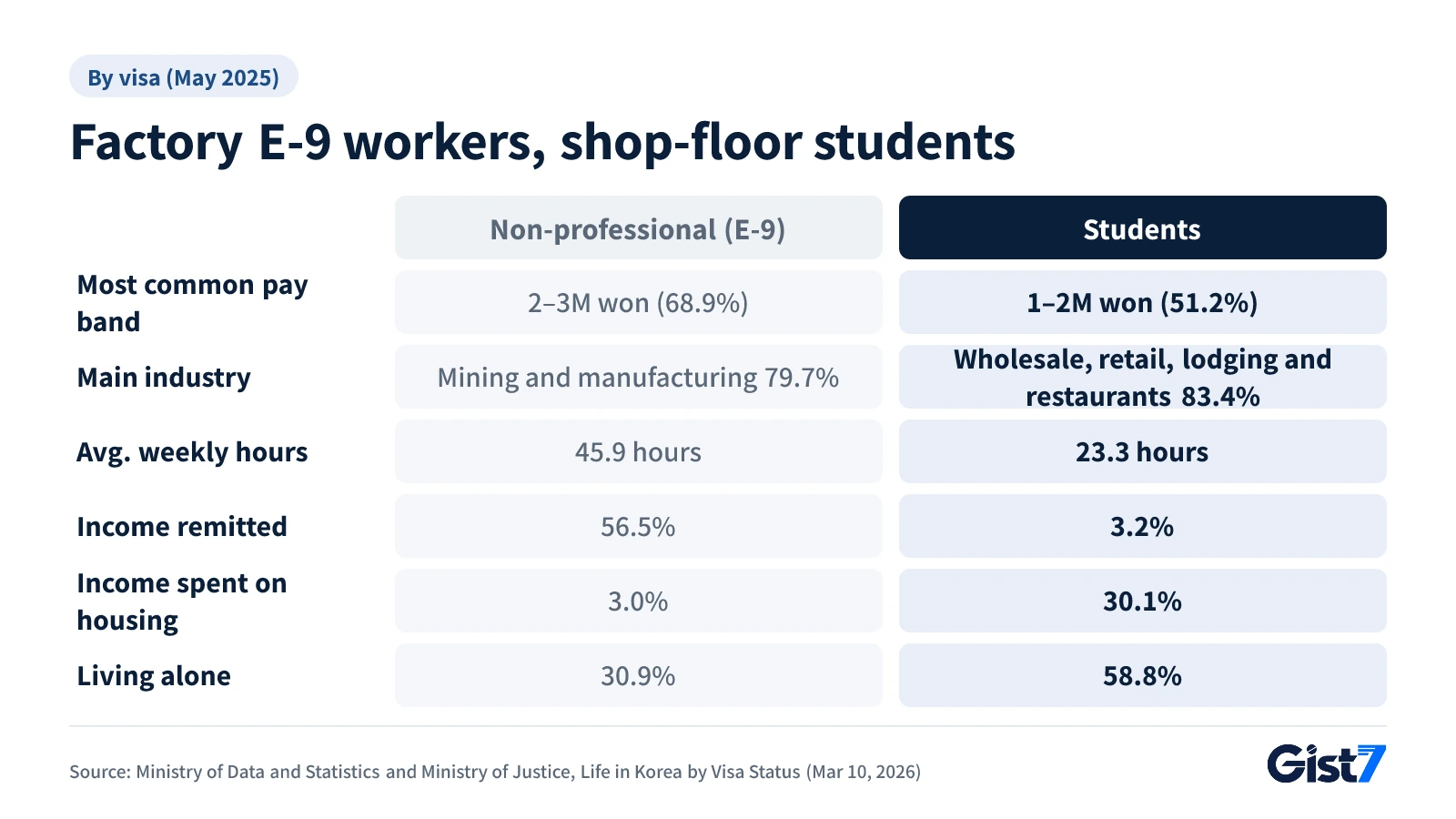
On the spending side, students put 52.6% of total income toward living costs and 30.1% toward housing, and send only 3.2% abroad. Some 91.9% rent their homes. Of 236,000 resident students aged 15 and over, 122,000 live outside the capital region, more than the 115,000 inside it. By nationality, Vietnam (100,000), China (45,000) and Uzbekistan (17,000) lead (May 2025).
On the work side, change is fast. Working students numbered 56,000, up 71.8% in a year. Of them, 83.4% work in wholesale, retail, lodging and restaurants, averaging 23.3 hours a week, which suggests part-time student jobs are filling staff shortages at restaurants and convenience stores. Asked about plans after graduation, 65.5% said they would stay in Korea (36.2% to work, 29.3% for further study); among Vietnamese students the figure was 78.9%.
The strain is real too. Some 22.0% of students reported financial hardship in the past year, the highest of any visa group. In a country where the school-age population is shrinking, international students are both enrollment for regional universities and a future workforce. Why Korea is running short of workers is covered in Korea's birth rate rebound to 0.80 and the gap with Germany.
Market impact map
| Asset / indicator | Direction | Strength | Link (why) |
|---|---|---|---|
| Regional universities and language schools | ↑ | Medium | 274,329 students (+17.6%); more than half live outside the capital region |
| Remittance and FX services | ↑ with more people / ↓ in dollar terms when the won is weak | Medium | 39.1% of foreigners send money abroad; wage payments fell 6.2% in Jan–Sep 2026 but rose 39% in Jul–Sep |
| Restaurants, lodging, convenience stores | ↑ | Low | Foreign workers in the sector +18.4%; 83.4% of working students are in it |
| Studio and small multi-unit rentals | ↑ | Low | 59.3% of foreigners rent on deposit or monthly terms; 91.9% of students |
| Labor supply for small factories and farms | ↑ (labor supply) | Low | 44.9% of foreign workers are in mining and manufacturing; foreign farm and fishery workers +20.0% |
Little direct impact: 2-year Treasury, 10-year Treasury, dollar index, won-dollar rate (wage and personal transfer payments of $14.31 billion are about 12% of the current account surplus and recur every year), gold, oil (WTI), bitcoin, S&P 500, Nasdaq, KOSPI
- Remittance timing: a 3 million won salary converted at June's average rate (1,527.3 won) is worth $1,964; at October's average (1,337.66 won) it is $2,243, or 14.2% more (ECOS table 3.1.2.1 Exchange Rates of Major Currencies against the Won, Gist 7 calculation, before fees).
- Housing: 11.9% of foreigners' total income goes to housing, and 30.1% for students. What foreign tenants pay in Seoul is calculated in Seoul rent prices and foreign tenants.
- Living costs: Korea's consumer prices in October 2026 were 2.8% higher than a year earlier (ECOS table 4.2.1 Consumer Price Index). Students, who spend 52.6% of income on living costs, feel it first.
- Medical bills: among foreigners who faced financial hardship (12.9%), 36.2% skipped medical care because of the cost.
Market reactions can vary with other factors, and this table is not a basis for investment decisions.
What to watch next
| Date (Korea time) | Indicator / event | Previous | Why it matters here | If it comes in... |
|---|---|---|---|---|
| Late Nov (expected) | Ministry of Justice monthly immigration statistics, October issue | 2,281,331 registered foreigners at end-September | Latest count of foreigners staying in Korea | Continued growth in students (D-2) and E-9 workers would extend the trend in this article |
| Dec 2 (Wed) | Ministry of Data and Statistics November consumer prices | October +2.8% y/y (ECOS) | 37.3% of foreigners' income goes to living costs | A higher reading would squeeze room for remittances and savings |
| Early Dec (expected) | Bank of Korea October balance of payments (preliminary) | September wage payments to non-residents $308 million (ECOS) | Foreign wage payments amid a stronger won | Payments above a year earlier would point to both labor demand and the won's strength |
| December (expected) | 2026 Survey on Immigrants' Living Conditions and Labour Force | 2025: 36.9% earning 3 million won+, 1.109 million employed | New data on pay, industries and remittances | A higher top-band share would signal more skilled, long-term workers; also check whether student employment keeps rising |
Korea time is 14 hours ahead of US Eastern time. The consumer price date comes from the statistics ministry's 2026 release calendar and the immigrant survey from the KOSIS release month (December 2026). The October immigration bulletin is estimated from the posting dates of the August (Sep 22) and September (Oct 21) issues, and the balance of payments from past release intervals, so check each agency's calendar for exact dates.
Frequently asked questions
How many foreigners live in Korea?
According to the Ministry of the Interior and Safety, Korea had 2,662,967 foreign residents as of November 1, 2025, or 5.1% of the population. That total combines 2,109,057 foreign nationals, 256,491 naturalized citizens and 297,419 of their children born in Korea. By Ministry of Justice count, 2,281,331 foreigners were registered or had filed residence reports at the end of September 2026.
How much do foreign workers earn in Korea?
As of May 2025, 50.2% of foreign wage earners made 2–3 million won a month and 36.9% made 3 million won or more (Ministry of Data and Statistics and Ministry of Justice). By visa, 59.3% of permanent residents (F-5) and 50.8% of professionals earn 3 million won or more, while 68.9% of non-professional E-9 workers fall in the 2–3 million won band.
Which industries employ the most foreign workers in Korea?
Mining and manufacturing employs the most, 498,000 (44.9%), followed by wholesale, retail, lodging and restaurants with 226,000 (20.4%) and business, personal and public services with 148,000 (13.4%), as of May 2025. The fastest growth over the year came in agriculture, forestry and fishing (+20.0%) and wholesale, retail, lodging and restaurants (+18.4%).
How much money do foreigners in Korea send home?
Foreigners spend 25.5% of total income on remittances at home or abroad, and 39.1% send money to family or relatives overseas (May 2025). Among senders, 30.9% send 20 million won or more a year, and E-9 workers remit 56.5% of their income.
What does the rise in international students mean for Korea's economy?
International students rose 17.6% to 274,329 in 2025, accounting for 52% of the increase in foreign residents. They spend most of their income in Korea on living costs (52.6%) and housing (30.1%), and 83.4% of the 56,000 working students are in wholesale, retail, lodging and restaurants. With 65.5% planning to stay after graduation, they also matter for Korea's future workforce.
Where do most foreigners in Korea live?
By province, Gyeonggi (859,943), Seoul (453,201) and South Chungcheong (178,229) lead, and 55.9% live in the capital region. Ansan has the most foreign residents of any city (109,544), while Yeongam (22.4%) and Eumseong (19.7%) have the highest shares of their populations (Nov 1, 2025, Ministry of the Interior and Safety).
References
- Foreign residents in Korea reach 2.66 million, 5.1% of population (2025 Local Government Foreign Resident Status, Oct 28, 2026), Ministry of the Interior and Safety (via KDI Economic Information and Education Center)
- Results of the 2025 Survey on Immigrants' Living Conditions and Labour Force (Dec 18, 2025), Ministry of Data and Statistics and Ministry of Justice (Korea.kr)
- 2025 Survey on Immigrants' Living Conditions and Labour Force: Life in Korea by Visa Status (Mar 10, 2026), Ministry of Data and Statistics and Ministry of Justice (Korea.kr)
- Foreigners by region (registered and residence reports), end of September 2026, Ministry of Justice Korea Immigration Service
- Economic Statistics System (ECOS): 2.5.1.1 Balance of Payments (301Y013), 3.1.2.1 Exchange Rates of Major Currencies against the Won (731Y004), 4.2.1 Consumer Price Index (901Y009), Bank of Korea