Mexico tariffs on Korea: why exports still rose 34%

Key summary
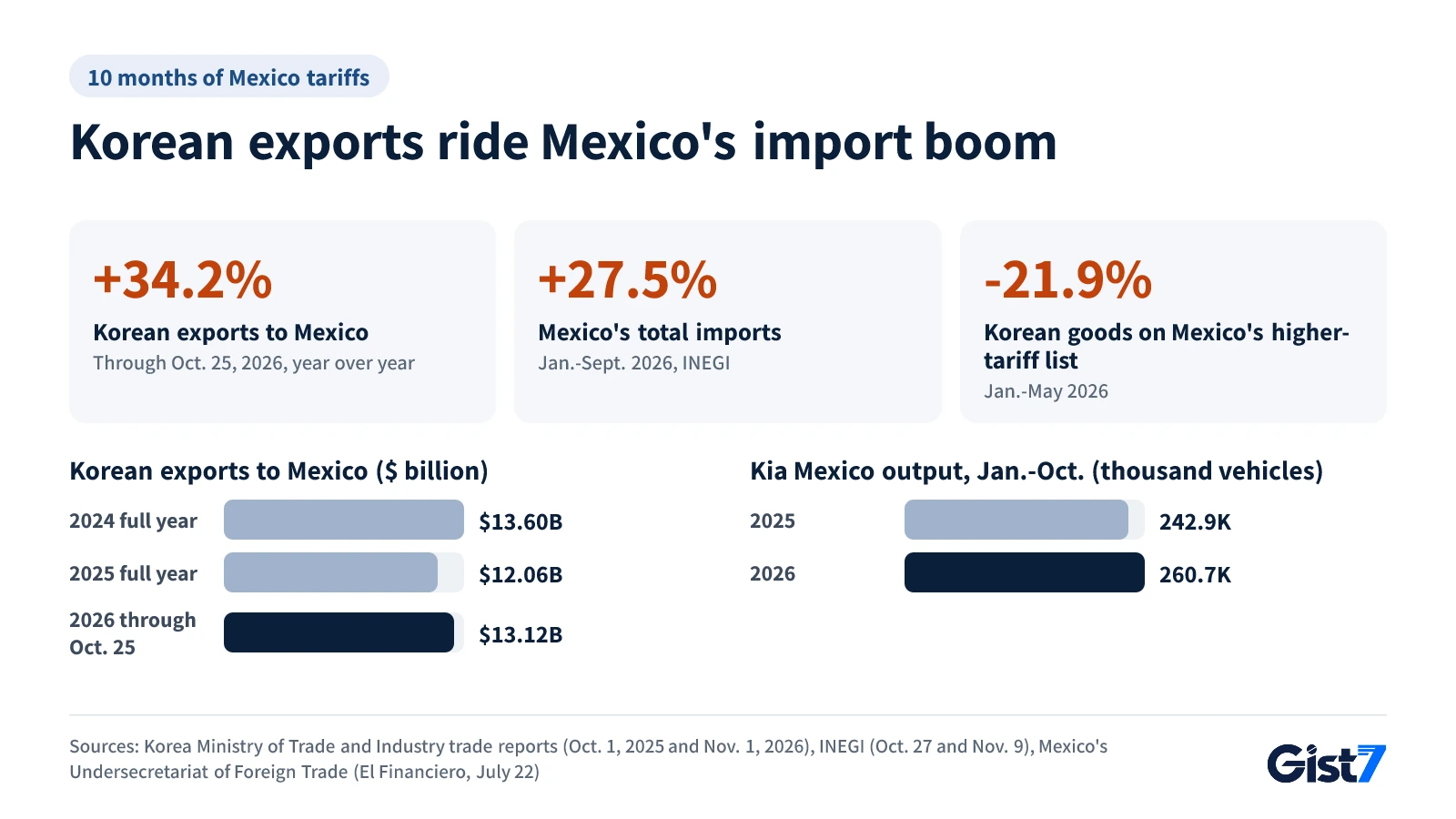
With no FTA, Korea has faced higher Mexican tariffs since 2026. Still, exports to Mexico rose 34.2% through Oct. 25 (Ministry of Trade and Industry) as Mexico's Jan.-Sept. imports grew 27.5% and intermediate goods 33.4%. The gain likely came from parts outside the tariff hikes and local plants.
- Korean exports to Mexico reached $13.12 billion through October 25, 2026, up 34.2%. After an 11.4% drop in 2025, they have already matched 96.5% of the full 2024 total (Ministry of Trade and Industry)
- Mexico's total imports rose 27.5% in January-September and intermediate goods imports rose 33.4%, so import demand grew despite the tariffs (INEGI)
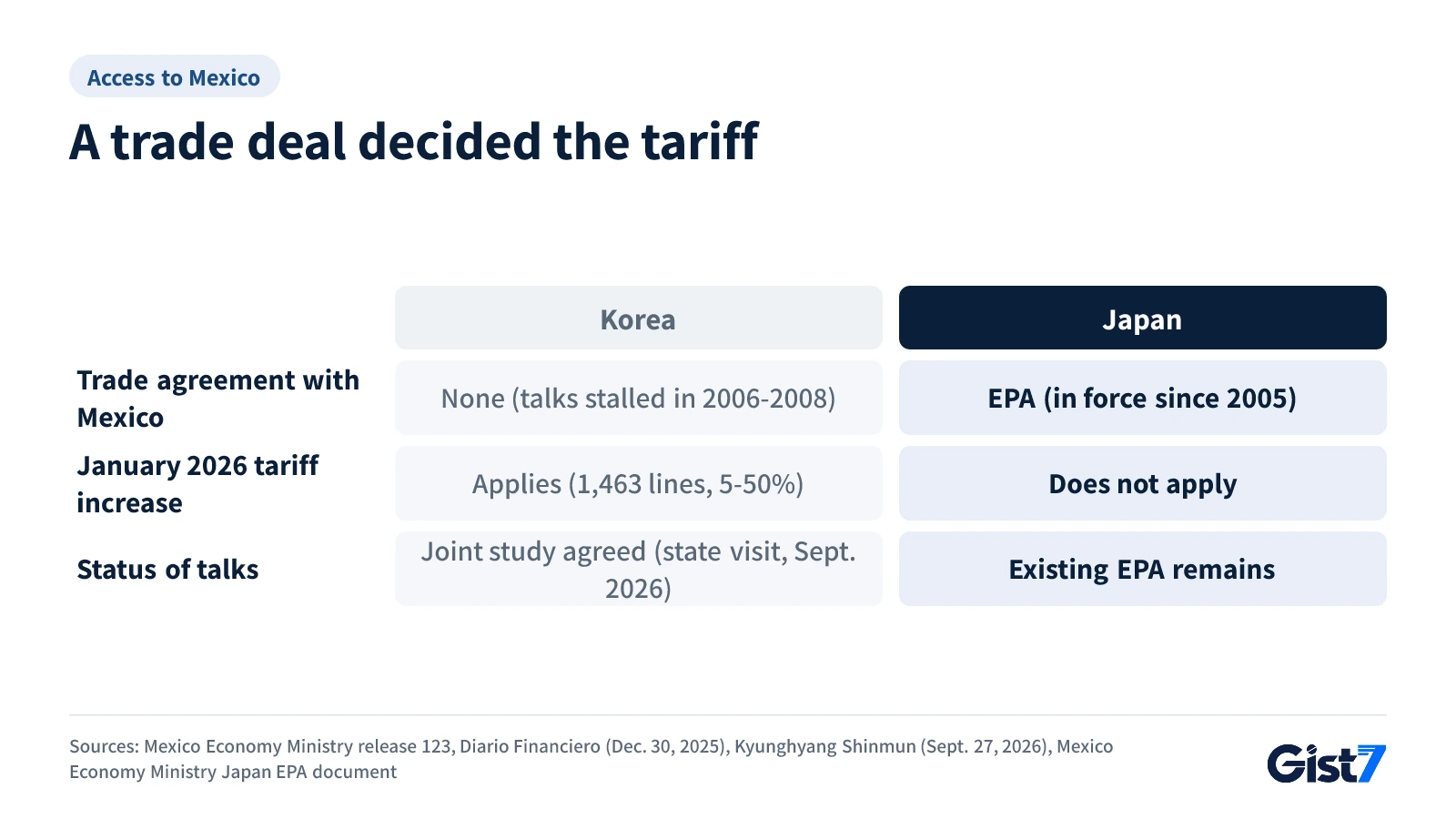
- Without an FTA, Korea became subject to Mexico's January 2026 tariff increase on 1,463 product lines (5% to 50%). Japan, whose economic partnership agreement took effect in 2005, avoided it
- Mexican imports of Korean goods on the higher-tariff list fell 21.9% in January-May, and Korean steel fell 29% in January-September (Mexico's Economy Ministry). The growth appears to come from parts using duty-relief programs (IMMEX, PROSEC) and demand from Korean-owned factories such as Samsung Electronics and LG Electronics
- Kia's Mexico plant widened its export markets to Latin America and Europe and started EV3 production, lifting January-October output 7.3%. Mexico's total light-vehicle output fell 3.9% in the same period (INEGI)
South Korea has no free trade agreement (FTA) with Mexico, which put Korean goods under Mexico's higher tariffs from January 2026. Even so, Korean exports to Mexico totaled $13.12 billion through October 25, up 34.2% from a year earlier, according to Korea's October trade report from the Ministry of Trade and Industry. Mexico tariffs on Korea mattered less than how fast Mexico's own import demand grew.
Why Korean exports grew despite Mexico tariffs
Mexico's total imports reached $617.94 billion in January-September 2026, up 27.5%, and imports of intermediate goods (parts and raw materials) rose 33.4%, according to INEGI's merchandise trade report released October 27. Tariffs did not stop Mexico from buying more from abroad, and Korean exports rode that wave.
| Ten months of tariffs, by the numbers | Period | Value | Source (statistics basis) |
|---|---|---|---|
| Mexico's total imports | Jan.-Sept. 2026 | $617.94 billion (+27.5%) | INEGI (Mexican data) |
| Korea's total exports to Mexico | Jan. 1-Oct. 25, 2026 | $13.12 billion (+34.2%) | Ministry of Trade and Industry (Korean data) |
| Mexican imports of Korean goods on the higher-tariff list | Jan.-May 2026 | $1.374 billion → $1.074 billion (-21.9%) | Mexico's Undersecretariat of Foreign Trade (Mexican data) |
| Mexican imports of Korean steel | Jan.-Sept. 2026 | -29% | Mexico's deputy economy minister (Mexican data) |
| Kia (KOSPI: 000270) Mexico plant output | Jan.-Oct. 2026 | 260,700 units (+7.3%) | INEGI (Mexican data) |
Sources: INEGI (Oct. 27 and Nov. 9), Ministry of Trade and Industry (Nov. 1), Mexican Economy Ministry data cited in an El Financiero column (July 22), BusinessPost (Nov. 12).
Goods on the higher-tariff list fell while the total rose, so the extra sales likely came from products outside the list, from duty-relief programs and from local factory demand. According to Korea's trade ministry, most Korean companies limited the damage from Mexico's 2023 and 2024 tariff increases by using IMMEX, which defers duties on inputs used for export production, and PROSEC, which grants lower tariff rates. Samsung Electronics (KOSPI: 005930) runs plants in Querétaro (refrigerators, washers and dryers) and Tijuana (TVs and monitors), and LG Electronics (KOSPI: 066570) has plants in Reynosa (TVs) and Monterrey (refrigerators), Korea JoongAng Daily reported on August 13, 2025. The electronic parts and intermediate goods those plants use likely supported the rise in exports.
The comparison base was low: Korean exports to Mexico fell 11.4% in 2025. Still, by October 25 this year they had already reached 96.5% of the full-year 2024 total of $13.604 billion.
The ministry's monthly release does not break out products for Mexico alone. For Latin America as a whole, semiconductor exports rose 156.4% and auto parts 31.9% in October 1-25, and the chip figure also reflects higher memory prices (see chip equipment exports and the KOSDAQ rebound). Korea's reliance on chips is covered separately in why Taiwan overtook Korea in GDP per capita.
Why Korean and Mexican trade data differ by more than $10 billion
Korea counts exports by where the ship leaves (port of shipment), while Mexico counts imports by where the goods were made (country of origin). The gap is likely because Korean-made goods routed through third countries are counted in Mexico's figures. In 2025, Mexico recorded $23.07 billion of imports from Korea, while Korea recorded only $12.056 billion of exports to Mexico.
| Data source and period | Korea → Mexico | Mexico → Korea |
|---|---|---|
| Korean data, 2025 | $12.056 billion (-11.4%) | $8.466 billion (+12.7%) |
| Mexican data (Banxico), 2025 | $23.07 billion | About $6.596 billion |
| Korean data, Jan. 1-Oct. 25, 2026 | $13.124 billion (+34.2%) | $8.191 billion (+16.6%) |
| Trade balance, 2025 | Korean data: Korea surplus of $3.59 billion | Mexican data: Mexico deficit of about $16.474 billion |
Sources: Ministry of Trade and Industry (Nov. 1, exports and imports by region). Mexican figures are Banxico data cited by El CEO. Mexico's trade balance is a Gist 7 calculation.
On Korean data, Korea's surplus with Mexico through October 25 this year was $4.933 billion, already larger than all of 2025.
Why Kia's Mexico plant grew while Mexico's auto output fell
Kia's plant in Pesquería, Nuevo León, shifted exports from the United States toward Latin America and Europe and began building the EV3 in August. Output rose 7.3% to 260,700 vehicles in January-October 2026 (INEGI).
Company snapshot
| Item | Kia |
|---|---|
| Legal name | Kia Corporation |
| Listing | KOSPI: 000270 (listed July 21, 1973) |
| Headquarters | 12 Heolleung-ro, Seocho-gu, Seoul |
| Founded | December 1944 |
| Main business | Manufacturing and selling vehicles |
| 2025 revenue | KRW 114.1409 trillion, consolidated (preliminary filing, January 2026) |
| Market capitalization | About KRW 35.7 trillion (based on the Nov. 19, 2026 close of KRW 91,500, Korea Exchange) |
| Mexico plant | Pesquería; production began May 2016; annual capacity of 400,000 vehicles |
Sources: Kia IR company information, filings and Kia workplaces; market cap from Korea Exchange prices; plant details from a Kia announcement (Sept. 7, 2016).
According to INEGI's November 9 data, exports led the gain at 197,660 vehicles (+7.9%), while Mexico's total light-vehicle production fell 3.9% over the same period.
According to Expansión, the U.S. share of the plant's exports fell from 81% in 2024 to 65% in 2025. Exports to Latin America grew, with Kia's Mexican-built vehicles shipped to Colombia rising from fewer than 2,000 a year to 8,750, and the K4 hatchback went to Europe for the first time, including Spain and Switzerland. The first EV3 rolled off the line in early August (Por Esto, Aug. 6).
Korean foreign direct investment (FDI) in Mexico also rose 34.47% to $649 million in the first half of 2026 (El CEO), with 90% going into manufacturing, according to Comce data cited by Expansión.
Finished cars shipped from Korea are a different story. In March, the head of Mexico's auto dealers' association (AMDA) said inventory brought in ahead of the tariffs would keep prices flat in the first half (Forbes México). Whether prices rose in the second half had not been confirmed as of November 20.
Why Korea could not avoid Mexico's tariffs
Because it has no trade agreement with Mexico. According to Mexico's Economy Ministry press release 123, tariffs rose from January 1, 2026, on 1,463 product lines from countries without a trade deal. Rates range from 5% to 50%, as summarized by Diario Financiero, and imported finished cars jumped from an average of around 20% in 2025 to 50%.
According to Kyunghyang Shinmun, the two countries' trade agreement talks in 2006-2008 stalled over how far to open their markets. During the Korean president's state visit to Mexico in September 2026, they agreed on a joint study of the benefits of a trade agreement. Japan avoided the new tariffs thanks to its economic partnership agreement (EPA) with Mexico, which took effect on April 1, 2005 (Mexico's Economy Ministry, Japan EPA document).
There is a catch for cars made in Mexico and sold to the United States: they pay an average U.S. tariff of 18.75%, more than some vehicles shipped directly from Korea or Japan (15%), according to a document obtained by Bloomberg and cited by El Financiero on June 9.
The bigger variable is the review of the U.S.-Mexico-Canada Agreement (USMCA). As of the BusinessPost report, no date had been set for a fourth round of talks. Stricter rules of origin would weigh most on plants that rely heavily on Korean parts.
Gist 7 reads the current phase as one in which imports of finished Korean goods shrink while exports of parts and local production in Mexico expand.
Market impact map
| Asset or sector | Direction | Strength | Why |
|---|---|---|---|
| Korean steel (steelmakers with high exposure to Mexico) | ↓ | Weak | Most steel tariffs are 35%, up to 50%. Mexico took 5.9% of Korea's 2025 steel exports by volume (1.67 million of 28.25 million tonnes, Korea Iron & Steel Association data via BusinessPost) |
| Korean intermediate goods such as auto parts and electronic components | ↑ | Weak | Mexico's intermediate goods imports +33.4% in Jan.-Sept. Duty-relief programs ease the cost, and orders follow local factories |
| Korean cars built in Mexico | ↑ | Medium | Cars made in Mexico are not subject to import tariffs, an edge in the Mexican market over imported cars facing 50% |
| Korean auto stocks (KOSPI) | ↑↓ | Weak | Depends on the U.S. export route: stricter USMCA origin rules raise the burden; progress on a Korea-Mexico agreement would lower it |
Little direct impact: 2-year Treasury yield, 10-year Treasury yield, dollar index, won-dollar rate, gold, oil (WTI), bitcoin, S&P 500, Nasdaq, KOSPI, Mexican peso (MXN)
- Everyday impact: Mexican consumers still face upward price pressure on Korean and Chinese cars from the 50% import tariff. In Korea, orders at suppliers shipping parts to Mexico depend on whether their goods qualify for duty relief.
Market reactions can vary with other factors, and this table is not a basis for investment decisions.
What to watch next
| Date (Korea time / ET) | Indicator or event | Previous | Why it matters here | If it comes in like this |
|---|---|---|---|---|
| Fri., Nov. 27, 9:00 p.m. KST (7:00 a.m. ET) | Mexico's October trade balance (INEGI) | Jan.-Sept. imports +27.5%, intermediate goods +33.4% | Whether Mexico's import boom continues | Continued growth keeps the base for Korean export gains in place |
| Tue., Dec. 1, morning KST (evening of Nov. 30 ET), expected | Korea's November trade report (Ministry of Trade and Industry) | Exports to Mexico of $13.124 billion through Oct. 25 | Whether the 2024 full-year total is surpassed | If the cumulative figure in the November release tops $13.604 billion, exports will exceed full-year 2024 |
| Wed., Dec. 2, 9:00 p.m. KST (7:00 a.m. ET) | Mexico's November light-vehicle sales (INEGI) | October Kia sales of 10,401 (+10.3%) | Inventory and prices of imported models | If sales of models shipped from Korea (Hyundai Motor (KOSPI: 005380) and other import brands) weaken, tariffs may be starting to show up in prices. Kia's sales mix in locally built K3, K4 and EV3, so they need a separate look |
| Mon., Dec. 7, 9:00 p.m. KST (7:00 a.m. ET) | Mexico's November light-vehicle production and exports (INEGI) | Kia Jan.-Oct. output +7.3% | Kia plant utilization | A slowdown would signal export pressure |
| Around Tue., Dec. 15 (expected) | Korea's final November trade data (Korea Customs Service) | Final October data released Nov. 16 | Exports for all of November | If the direction matches the Dec. 1 preliminary report, the rise in exports to Mexico holds for the full month |
Mexican dates follow INEGI's 2026 release calendar (6:00 a.m. Mexico City time). December 1 reflects the ministry's practice of publishing on the first of each month, and "around December 15" follows the note in the October release that final customs data come out around the 15th; both are expected dates. Country-level exports in the October release covered January 1 through October 25.
Frequently asked questions
Does Mexico's 50% tariff apply to all Korean products?
No. Since January 2026, rates of 5% to 50% apply to 1,463 product lines from countries without an FTA, and 50% applies to items such as imported finished cars. Most steel faces 35%, with some up to 50%. Parts brought in under IMMEX, which defers duties on inputs for export production, or PROSEC, which grants lower rates, face a much smaller burden.
Have Mexico's tariffs reduced Korean exports to Mexico?
Not in total. Korea's Ministry of Trade and Industry says exports to Mexico rose 34.2% year over year through October 25, 2026, and Mexico's total imports rose 27.5% in January-September (INEGI). Goods on the higher-tariff list did fall, though: Mexico's Economy Ministry says imports of those Korean goods dropped 21.9% in January-May, and Korean steel dropped 29% in January-September. Korea counts by port of shipment and Mexico by country of origin, so the two sets of figures cannot be compared directly.
Do cars made at Kia's Mexico plant pay tariffs?
Cars made in Mexico are not subject to Mexican import tariffs. Kia's Mexico plant widened its markets to Latin America and Europe, raising exports 7.9% and output 7.3% in January-October 2026. Parts brought in from Korea can still face tariffs if they do not qualify for relief programs, and U.S. tariffs on exports to the United States depend on USMCA rules of origin.
Why doesn't Korea have an FTA with Mexico, and how did Japan avoid the tariffs?
The two countries negotiated in 2006-2008, but talks stalled over how far to open their markets. Japan avoided the new tariffs because its economic partnership agreement (EPA) with Mexico took effect on April 1, 2005. During the Korean president's state visit to Mexico in September 2026, Korea and Mexico agreed on a joint study of the benefits of a trade agreement.
Will Korean cars get more expensive in Mexico?
In March 2026, Mexico's auto dealers' association (AMDA) said import brands had brought in inventory ahead of time in late 2025, so it expected no price increases in the first half. No data had been published on second-half price changes for models imported from Korea. Models Kia builds at its Pesquería plant, such as the K3, K4 and EV3, are not affected by these import tariffs.
References
- October 2026 trade report — Korea Ministry of Trade and Industry (2026-11-01)
- September 2025 trade report (includes 2024 full-year results by region) — Korea Ministry of Trade, Industry and Energy (2025-10-01)
- 2024 annual and December trade report (includes 2023 full-year results by region) — Korea Ministry of Trade, Industry and Energy (2025-01-01)
- Mexico's imports of Korean steel fell 29% in January-September (in Korean) — BusinessPost (2026-11-12)
- La ayudita de México a EU en aranceles (Víctor Piz, citing Mexico's Undersecretariat of Foreign Trade data) — El Financiero (2026-07-22)
- Registro Administrativo de la Industria Automotriz de Vehículos Ligeros, octubre de 2026 — INEGI (2026-11-09)
- Balanza Comercial de Mercancías de México, septiembre de 2026 — INEGI (2026-10-27)
- Tariffs send appliance makers looking down Mexico's way for optimal production base — Korea JoongAng Daily (2025-08-13)
- Se publica en el DOF la modificación de aranceles de la LIGIE (Comunicado 123) — Secretaría de Economía (2025-12-30)
- México alista nuevos aranceles a productos de países sin acuerdo comercial a partir del 1 de enero — Diario Financiero (2025-12-30)
- Review of the impact of Mexico's planned import tariff increase and response measures (in Korean) — Korea Ministry of Trade, Industry and Energy (2025-09-17)
- Kia officially opens Mexico production facility — Kia (2016-09-07)
- La estrategia de Kia México para reducir exportaciones a Estados Unidos — Expansión (2026-02-13)
- Samuel García presume primer Kia EV3 eléctrico fabricado en Nuevo León — Por Esto (2026-08-06)
- Armadoras asiáticas trajeron inventario por adelantado para blindarse de los aranceles en México, dice la AMDA — Forbes México (2026-03-04)
- Will stalled Korea-Mexico trade agreement talks restart? (in Korean) — Kyunghyang Shinmun (2026-09-27)
- Automotrices en México pagan más aranceles a EU que los fabricantes de Corea del Sur — El Financiero (2026-06-09)
- México y Corea del Sur: una relación económica con Samsung, LG, Kia y aranceles — El CEO (2026-09-24)
- Corea lleva su apuesta por México a una nueva etapa con IA, aeroespacial y más inversión — Expansión (2026-09-25)
- Mexico-Japan Economic Partnership Agreement (in force April 1, 2005) — Mexico Ministry of Economy
- Kia IR company information (listed July 21, 1973) — Kia