Kimchi premium: why bitcoin costs more in Korea
Key summary
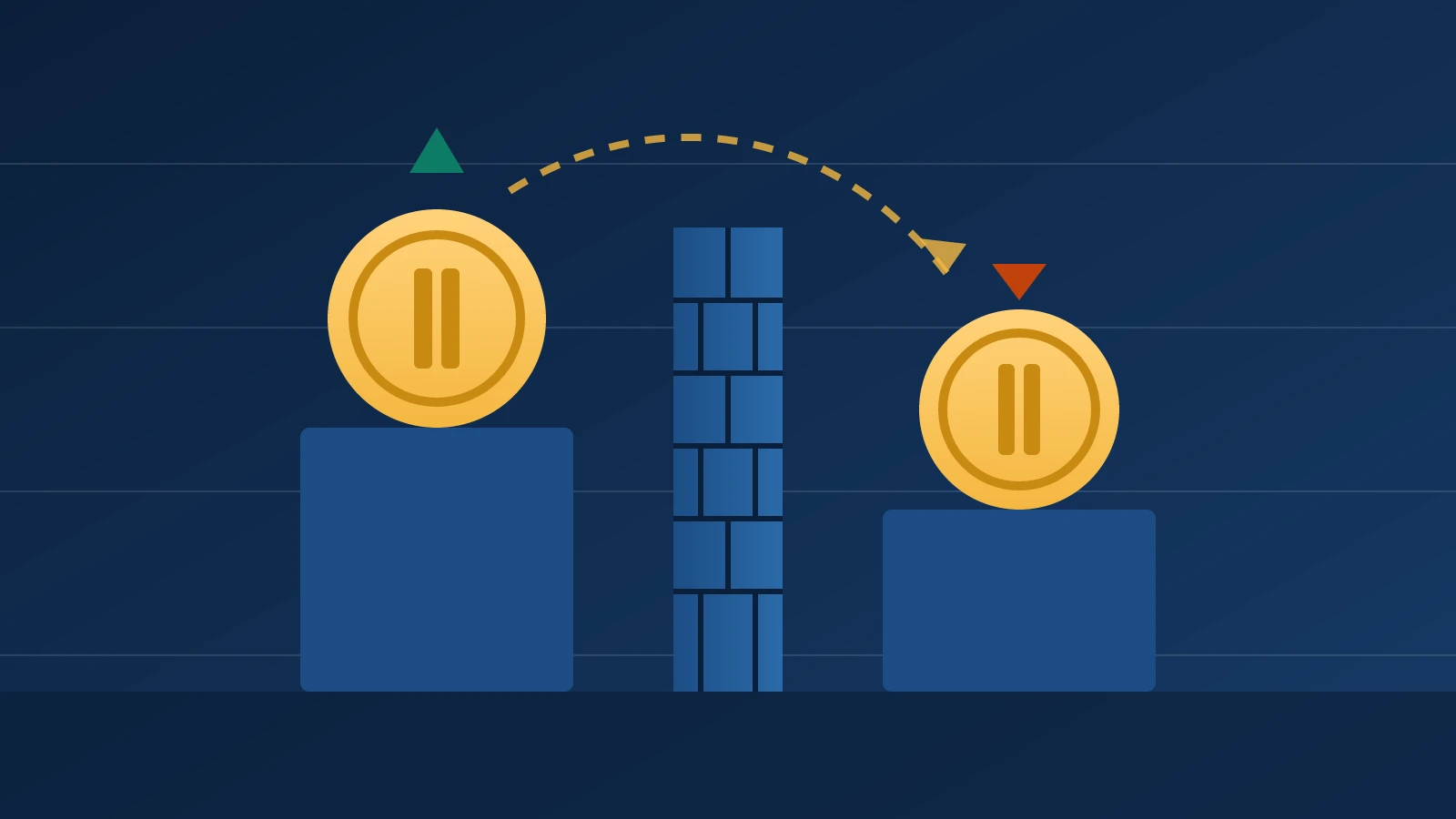
The kimchi premium is how much more bitcoin costs in Korea than abroad in dollar terms. It was +1.0% at the November 27, 2026, close, after a weekday high of +3.38% (November 20). Real-name accounts, remittance caps, transfer rules and limits on companies and foreigners block arbitrage.
- Formula: Upbit price in won ÷ won-dollar rate ÷ global dollar price − 1 (negative means a reverse premium)
- In the 1% range at the end of November. From Nov. 2 to 27 it ranged from -0.25% (Nov. 9) to +3.89% (Nov. 14, a Saturday using the Nov. 13 exchange rate), with a weekday high of +3.38% (Nov. 20); it widened to 2-4% during the Nov. 13-22 slide and fell back to the 1% range after Nov. 23
- In late 2017 and early 2018, bitcoin in Korea traded about 40% above US prices on several days (Makarov and Schoar)
- Through early August 2026, bitcoin was cheaper in Korea on more days, including a record 35-day reverse premium in June and July (CryptoQuant)
- The walls against arbitrage: real-name won accounts, a $100,000 yearly cap on undocumented remittances, the travel rule, and limits on companies and foreigners
The kimchi premium, the gap between bitcoin's price in South Korea and abroad, shows up clearly on Upbit. Bitcoin closed the trading day of November 27, 2026, at 81,240,000 won. Divided by that day's won-dollar rate of 1,343.53 (Yahoo Finance KRW=X daily close), that is about $60,468, or 1.0% more than the global price of $59,866.37 (BTC-USD daily close, UTC).
What is the kimchi premium? Formula and November 2026 numbers
The kimchi premium is how much more bitcoin costs on a Korean exchange, in won, than on global markets once the won price is converted into dollars. The formula is Upbit price in won ÷ won-dollar rate ÷ global dollar price − 1. A negative value means bitcoin is cheaper in Korea, a "reverse" premium. At the end of November 2026, the kimchi premium sat in the 1% range, a fairly small level.
Because bitcoin trades around the clock, the two prices have to be taken at the same moment. Upbit's daily candle closes at 9 a.m. Korea Standard Time (KST) the next day, and Yahoo's BTC-USD daily candle closes at midnight UTC, which is the same instant. On Saturday, November 28, the Seoul foreign exchange market was closed, so the result depends on which exchange rate you use.
| Basis | Upbit (won) | Won per dollar | Global price (BTC-USD) | Kimchi premium |
|---|---|---|---|---|
| Nov. 27 daily close (same moment) | 81,240,000 | 1,343.53 (Nov. 27 close) | $59,866.37 (UTC daily close) | +1.0% |
| Nov. 28, 4:15 p.m. KST | 81,044,000 | 1,343.53 (Nov. 27 close) | $59,559.87 (UTC, day in progress) | +1.3% |
| Nov. 28, 4:15 p.m. KST | 81,044,000 | 1,333.90 (weekend Yahoo KRW=X quote) | $59,559.87 (UTC, day in progress) | +2.0% |
Data: Upbit public market data (daily candles and ticker), Yahoo Finance BTC-USD and KRW=X daily prices. Kimchi premium calculated by Gist 7. 4:15 p.m. KST is 2:15 a.m. ET.
Day by day, the premium was anything but fixed in November. BTC-USD fell 23.9%, from $78,248.45 on November 1 to $59,559.87 on November 28 (UTC, day in progress), and 2.6% from November 22. Between November 2 and 27, the kimchi premium ranged from -0.25% (November 9) to +3.89% (November 14). It widened to 2-4% from November 13 to 22, when prices fell fastest, then narrowed back to the 1% range from November 23.
| Date (daily close) | Upbit (won) | BTC-USD | Kimchi premium |
|---|---|---|---|
| Nov. 2 | 103,650,000 | $76,677.30 | +1.98% |
| Nov. 9 | 102,254,000 | $75,223.15 | -0.25% (November low) |
| Nov. 14 (Sat.) | 88,858,000 | $64,128.05 | +3.89% (November high, Nov. 13 exchange rate) |
| Nov. 20 | 81,134,000 | $58,798.98 | +3.38% (weekday high) |
| Nov. 23 | 83,726,000 | $61,210.98 | +1.75% |
| Nov. 27 | 81,240,000 | $59,866.37 | +1.00% |
Data: Upbit daily close ÷ Yahoo KRW=X close on the same day (previous value if none) ÷ Yahoo BTC-USD UTC daily close on the same day − 1, calculated by Gist 7. We covered the reasons for the November slide in why bitcoin fell below $60,000 with the Nasdaq.
How high has the kimchi premium gone? From 40% to a discount
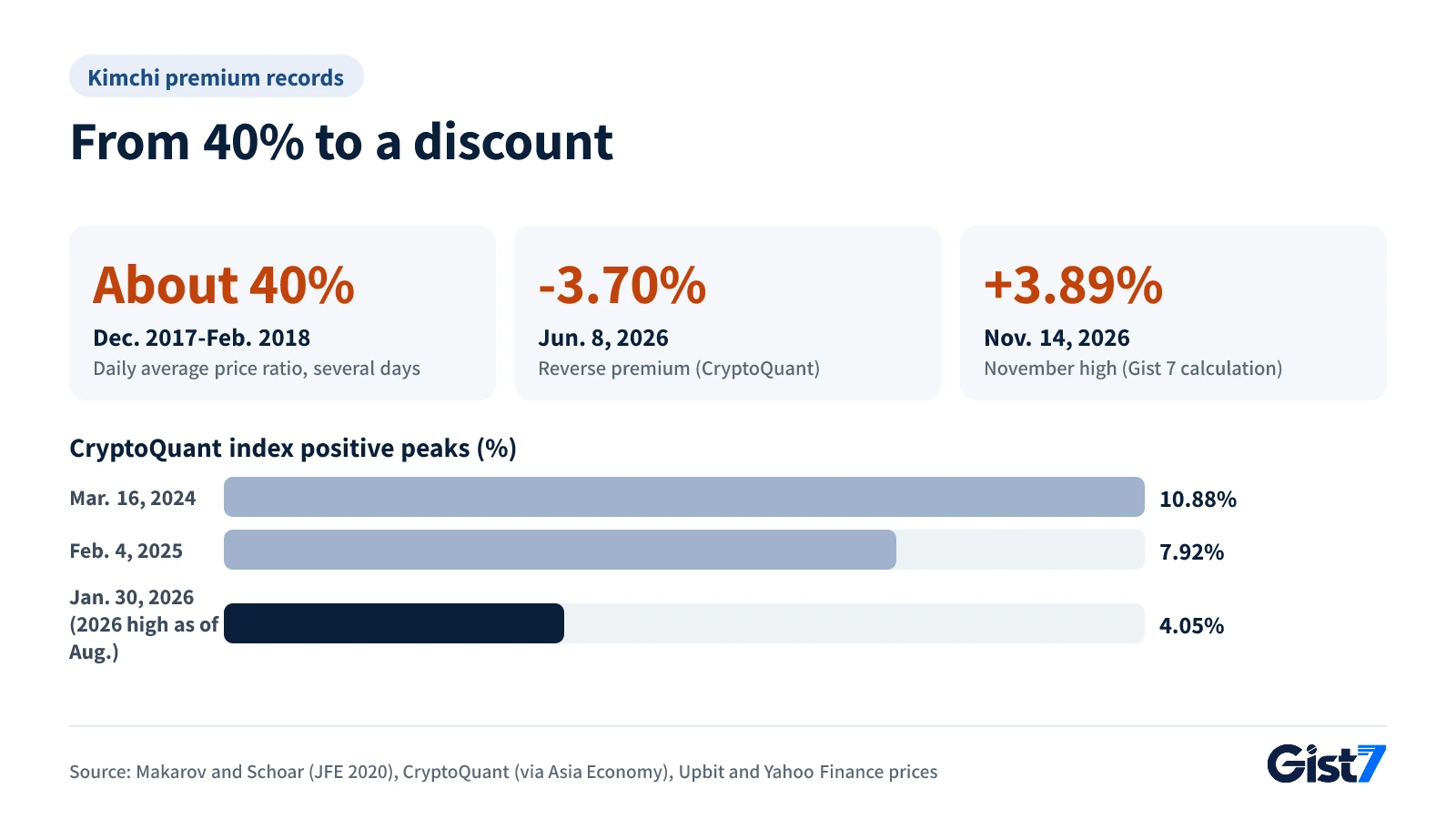
The kimchi premium peaked in late 2017 and early 2018. According to research by Igor Makarov (London School of Economics) and Antoinette Schoar (MIT), the daily average price ratio between the US and Korea reached 40% on several days between December 2017 and February 2018. Through early August 2026, by contrast, bitcoin was cheaper in Korea on more days than it was more expensive.
| Period | Kimchi premium | Source |
|---|---|---|
| Dec. 2017-Feb. 2018 | About 40% on several days (daily average price ratio) | Makarov and Schoar, Journal of Financial Economics (2020) |
| Mar. 16, 2024 | +10.88% | CryptoQuant index (reported by Asia Economy) |
| Feb. 4, 2025 | +7.92% | Same |
| Jan. 30, 2026 | +4.05% (2026 high as of the August report) | Same |
| Jun. 8, 2026 | -3.70% | Same |
| Nov. 2-27, 2026 | -0.25% to +3.89% | Gist 7 calculation |
The CryptoQuant index expresses the price gap between Korea's five major won-based exchanges and overseas exchanges as a percentage. It is built differently from the Gist 7 calculation, so the two can differ on the same day.
Why doesn't arbitrage close the gap? Four walls
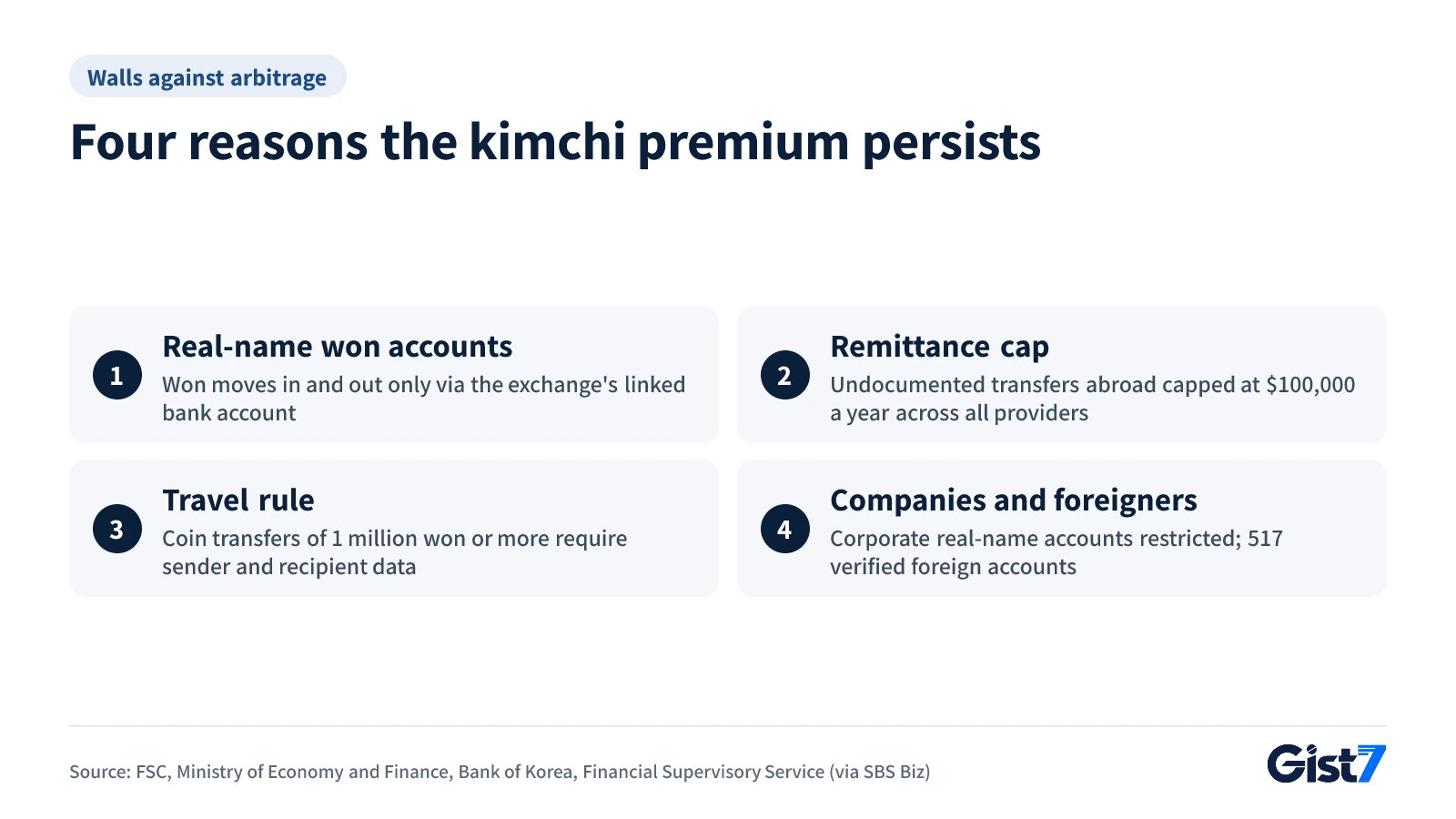
Arbitrage means buying the same asset where it is cheap and selling it where it is expensive to pocket the difference. The kimchi premium lingers because every route across Korea's borders is narrow: for won, for dollars, for coins and for big investors. Makarov and Schoar also conjectured that capital controls may contribute to large price gaps between regions.
- Won moves only through real-name bank accounts. Under the amended Act on Reporting and Using Specified Financial Transaction Information (in force since March 2021), an exchange needs a real-name verified deposit and withdrawal account at a bank to offer won trading. According to the Financial Services Commission (FSC), only four exchanges that had secured such accounts kept their won markets when the registration deadline passed in September 2021, and 25 closed theirs.
- There is a cap on money sent abroad. In a December 2025 announcement, the Ministry of Economy and Finance (the finance ministry) said that from January 2026 up to $100,000 a year could be sent abroad without supporting documents, counted across all banks and non-bank providers combined. Anything above that needs paperwork, which makes it hard to move large arbitrage funds quickly.
- Coin transfers are screened too. Under the travel rule in force since March 25, 2022, exchanges must pass on sender and recipient details when moving virtual assets worth 1 million won or more between exchanges, the threshold set when the rule took effect. Transfers to overseas exchanges without the rule are allowed only when sender and recipient are the same person and the exchange is judged low risk for money laundering (FSC).
- Big investors cannot get in.
- Companies: The FSC has said banks have, by custom, blocked real-name accounts for corporations since 2017. In February 2025 it published a roadmap for a pilot that would let about 3,500 listed companies and professional investors trade, but the Bank of Korea (BOK) said in September 2026 that corporate participation remained limited.
- Foreigners: As of the end of July 2026, the five major exchanges had 566,352 foreign accounts. Only 517 had completed real-name verification, and 90 were active, meaning they traded or moved money at least once in a month (Financial Supervisory Service data, reported by SBS Biz).
In a BOK Issue Note dated September 3, 2026, Kim Jihyun and Cho Sangheum of the BOK's International Finance Research Team put numbers on the result. Korea's USD stablecoin (USDT) premium had a median of 1.67% since 2022, about twice the median of roughly 0.8% across the 30 currencies studied, and close to Ukraine (1.86%) and South Africa (1.80%), which have tighter capital controls. The note says Korea's market is dominated by retail investors because corporate and foreign participation is limited, so arbitrage by global intermediaries active in both stablecoin and FX markets is constrained, weakening the mechanism that would narrow price gaps (BOK report).
What does a reverse kimchi premium signal?
A reverse premium means bitcoin is cheaper in Korea than abroad, and it is usually read as a sign that Korean demand is weaker than global demand. According to Asia Economy, citing CryptoQuant data, a reverse premium lasted 35 straight days from June 20 to July 24, 2026, a record, and 123 of the first 221 days of 2026 showed a reverse premium. As of the August 2026 report, it was the first year since tracking began in July 2020 with more reverse-premium days than premium days.
The same report pointed to money moving into Korean stocks and overseas exchanges, domestic exchanges unable to launch new products while the Digital Asset Basic Act is delayed, and a planned crypto tax. Trading on the five major exchanges in the second quarter of 2026 came to $146.43 billion, down 49.5% from a year earlier. For the stock-market side, see our analysis of the Kosdaq's 8.13% surge.
November swung back to the positive side. By Gist 7's calculation, the lowest reading between November 2 and 27 was only -0.25% (November 9), and the premium actually widened to 2-4% from November 13 to 22, when global prices dropped fastest.
The Gist 7 view: The premium widened during the sell-off because Korean prices did not follow the global drop right away and came down later. Since arbitrage that buys cheap abroad and sells at home cannot move in quickly, the difference in the size of the decline stayed in the price as a premium for several days. Once the slide eased after November 23, the premium returned to the 1% range. The premium is a thermometer for Korean demand, not a guide to where prices go next, and its value on the same day depends on which exchange rate and time you use.
Market impact map
These are the indicators that usually move with the kimchi premium as it widens or narrows.
| Asset / indicator | Direction | Strength | Link (why) |
|---|---|---|---|
| Bitcoin price in won (Upbit) | ↑↓ | Strong | When Korean demand outpaces global demand, the won price rises above the converted global price |
| Won price of USD stablecoins | ↑↓ | Medium | Supply and demand clear only inside Korean exchanges, so stablecoins carry a premium too (BOK report, median 1.67% since 2022) |
| Trading volume on Korean exchanges | ↑↓ | Medium | During 2026's long reverse premium, second-quarter volume on the five major exchanges fell 49.5% from a year earlier |
| Won-dollar rate | ↑↓ | Weak | With no direct won-stablecoin trading, the channel from the kimchi premium to the exchange rate is still weak. It could strengthen as corporate and foreign participation grows (BOK report) |
| KOSPI | ↑↓ | Weak | Analysts say 2026's reverse premium coincided with money moving into Korean stocks |
Little direct impact: 2-year Treasury, 10-year Treasury, dollar index, gold, oil (WTI), bitcoin's global dollar price, S&P 500, Nasdaq
- Everyday impact: Buying in Korea when the premium is high means paying more than overseas buyers. Arbitrage through overseas exchanges runs into remittance caps, the travel rule, price swings while coins are in transit and tax questions.
- When the dollar rises against the won, the won price of bitcoin goes up even if the global price stays put. The kimchi premium strips out that currency effect. How a strong dollar reaches the won is covered in why emerging-market stocks lag the US when the dollar is strong.
Market reactions can vary with other factors, and this table is not a basis for investment decisions.
What to watch next
The kimchi premium changes every day, so watch the US events that move global prices and the exchange rate, along with the Korean policy calendar that affects local demand.
| Date (KST / ET) | Indicator / event | Previous | Why it matters here | If it comes in... |
|---|---|---|---|---|
| Dec. 4 (Fri.) 10:30 p.m. KST / 8:30 a.m. ET | US November jobs report | October nonfarm payrolls +165,000, unemployment 4.1% (Bureau of Labor Statistics) | Direction of global bitcoin prices and the dollar | Strong hiring tends to lift yields and the dollar and weigh on bitcoin. If global prices fall first, the premium can widen briefly |
| Dec. 10 (Thu.) 4:00 a.m. KST / Dec. 9, 2:00 p.m. ET | December FOMC rate decision and projections (Dec. 8-9 meeting) | 3.75-4.00% (Federal Reserve) | High rates and the chance of more hikes, cited as factors that deepened November's drop | A hike plus signals of more tends to weigh on risk assets |
| Dec. 10 (Thu.) 10:30 p.m. KST / 8:30 a.m. ET | US November Consumer Price Index (CPI) | October +0.4% month over month, core +0.3% (Bureau of Labor Statistics) | Path for rates in January | A hot reading tends to lift the dollar and the won-dollar rate, which can shake the won price and the premium calculation |
| Jan. 1, 2027 (start date under current Income Tax Act) | Whether Korea's tax on crypto income begins | On Nov. 5 the government said it would seek a two-year delay to 2029 in consultation with the National Assembly (Ministry of Economy and Finance) | A tax schedule cited as a cause of the reverse premium, affecting Korean exchange demand | If lawmakers confirm the delay, tax worries ease; if not, taxation starts in 2027 under current law |
Schedule sources: Federal Reserve FOMC calendar, Bureau of Labor Statistics December 2026 release schedule, Ministry of Economy and Finance (Korea.kr). Korea is 14 hours ahead of US Eastern time in December.
Frequently asked questions
How is the kimchi premium calculated?
Divide the won price of bitcoin on a Korean exchange such as Upbit by the won-dollar rate to get a dollar price, divide that by the global dollar price, and subtract 1. At the November 27, 2026, daily close: 81,240,000 won ÷ 1,343.53 (Yahoo KRW=X daily close) ÷ $59,866.37 (BTC-USD UTC daily close) − 1 = roughly 1%. Because bitcoin trades 24 hours a day, both prices must be taken at the same moment.
What is the kimchi premium right now?
It was +1.0% at the November 27, 2026, daily close. Using the 4:15 p.m. KST price on November 28 with the November 27 exchange rate gives +1.3%. Between November 2 and 27 it moved from -0.25% (November 9) to +3.89% (November 14, a Saturday using the November 13 exchange rate) and narrowed to the 1% range after November 23 (Upbit and Yahoo Finance prices, Gist 7 calculation).
Can foreigners buy bitcoin on Upbit?
In practice, very few can. Trading in won requires a real-name verified account at the bank linked to the exchange. According to Financial Supervisory Service data reported by SBS Biz, of 566,352 foreign accounts at the five major exchanges at the end of July 2026, only 517 had completed real-name verification and 90 were active, meaning they traded or moved money at least once in a month.
Can you profit by buying bitcoin abroad and selling it in Korea when the premium is high?
A gap on paper does not guarantee a real profit. Undocumented remittances abroad are capped at $100,000 a year across all financial firms, transfers between exchanges must clear travel-rule checks, and prices and exchange rates can move while coins are in transit. Taxes and fees also matter, so this is an area for professional advice.
What is a normal kimchi premium?
There is no fixed normal level; it varies widely over time. On the CryptoQuant index it reached +10.88% on March 16, 2024, +7.92% on February 4, 2025, and +4.05% on January 30, 2026, and through early August 2026 there were more reverse-premium days. From November 2 to 27, 2026, it ranged from -0.25% to +3.89%. The Bank of Korea put the median USD stablecoin (USDT) premium since 2022 at 1.67%.
Is a high kimchi premium a sign that bitcoin has peaked?
Not necessarily. The premium signals that Korean demand is stronger than global demand; it does not tell you which way prices will go. Large premiums have coincided with overheated markets, as in late 2017 and early 2018, but the same reading can change depending on the exchange rate and timing used.
References
- 기준 시세: BTC-USD·KRW=X 일별 시세 — Yahoo Finance, KRW-BTC 일봉 — 업비트 공개 시세 API
- Trading and Arbitrage in Cryptocurrency Markets (Makarov·Schoar, JFE 2020 요약) — Harvard Law School Forum on Corporate Governance
- [비트코인 나우] 이젠 한국이 더 싸다…김치 프리미엄이 김치 디스카운트로 (2026.8.11) — 아시아경제
- Stablecoin–FX Linkages: Evidence from Fiat–Stablecoin Pair Listings on a Global Exchange (BOK Issue Note No. 2026-22, 2026.9.3) — 한국은행
- 가상자산사업자 신고 및 영업현황 점검 (2021.9.27) — 금융위원회
- 3.25일 특정금융정보법상 트래블룰이 시행됩니다 (2022.3.24) — 금융위원회
- 법인의 단계적인 가상자산시장 참여를 추진합니다 (2025.2.13) — 금융위원회
- 내년부터 '무증빙 해외송금' 업권 구분 없이 연 10만 달러까지 가능 (2025.12.8) — 기획재정부, 대한민국 정책브리핑
- 가상자산 소득과세 2년 유예 추진…2029년 시행 기반 마련 (2026.11.5) — 재정경제부, 대한민국 정책브리핑
- 국내 거래소 외국인 계정 56만개인데…실제 거래는 고작 90개 (2026.8.23) — SBS Biz
- Meeting calendars and information (FOMC) — Federal Reserve
- Schedule of Releases for December 2026 — U.S. Bureau of Labor Statistics