Korean salaries vs Taiwan's: 1.4x, near parity after prices
Key summary
Korean salaries averaged 1.42 times Taiwan's in August 2026 and 1.49 times at the 2024 median. On purchasing power, the gap shrinks to 1.08x; on the IMF's 2026 estimate (October World Economic Outlook) Taiwan is ahead. In 2027 employees pay 10.0% in social insurance in Korea, 4.15% in Taiwan.
- Average monthly pay, August 2026: Korea 4,093,000 won, Taiwan NT$65,826 (about 2,888,000 won), 1.42x
- Median monthly pay (2024): Korea 2,880,000 won, Taiwan about 1,933,000 won, 1.49x
- 2027 minimum wage: Korea 10,700 won an hour / 2,236,300 won a month; Taiwan NT$30,900 a month / NT$205 an hour (1.78x monthly, 1.28x hourly). In Korea, weekly holiday pay applies to those scheduled for 15+ hours a week with full attendance
- Adjusted for purchasing power, the average pay gap is 1.08x (2025 PPP) and 0.93x on the IMF's 2026 PPP estimate, putting Taiwan ahead
- Employee share of social insurance in 2027: Korea about 10.0% (pension, health, employment, long-term care), Taiwan about 4.15% (labor, employment, health insurance)
Korean salaries averaged 4,093,000 won a month per worker in August 2026, according to the Ministry of Employment and Labor. In Taiwan, the average total monthly pay that month was NT$65,826, according to the Directorate-General of Budget, Accounting and Statistics (DGBAS). Converted at August's average exchange rate (43.88 won per Taiwan dollar, Bank of Korea), Taiwan's figure comes to about 2,888,000 won, so Korean salaries at market exchange rates are roughly 1.4 times Taiwan's. Adjust for the fact that the same money buys more in Taiwan, however, and the gap nearly disappears. Taiwan will raise its minimum wage in January 2027 for the 11th year in a row (Taiwan Ministry of Labor).
How much more do Korean salaries pay than Taiwan's? 1.42x on average, 1.49x at the median
Korean pay is 1.42 times Taiwan's on average and 1.49 times at the median. The median is the income of the worker in the exact middle when everyone is lined up by earnings, which strips out the pull that high earners exert on the average.
| Item | South Korea | Taiwan | Taiwan in won | Korea ÷ Taiwan |
|---|---|---|---|---|
| Average monthly pay (Aug 2026, incl. bonuses) | 4,093,000 won | NT$65,826 | about 2,888,000 won | 1.42x |
| Median monthly pay (both 2024) | 2,880,000 won | NT$546,000 a year (NT$45,500 a month) | about 1,933,000 won | 1.49x |
| 2027 minimum wage (monthly) | 2,236,300 won | NT$30,900 | about 1,259,000 won | 1.78x |
| 2027 minimum wage (hourly) | 10,700 won | NT$205 | about 8,352 won | 1.28x |
Sources: Korea's Ministry of Employment and Labor establishment labor survey (total wages of all workers at firms with one or more employees); Statistics Korea (now the National Data Office) 2024 income from wage jobs (pre-tax, excluding non-taxable expense reimbursements); Taiwan DGBAS (all employees in industry and services, including part-timers and foreign workers). Exchange rates are Bank of Korea won/Taiwan dollar reference rates: the August 2026 monthly average of 43.88 won for average pay, the 2024 annual average of 42.48 won for median pay, and the Nov. 25, 2026 rate of 40.74 won for minimum wages (Gist 7 conversions).
A single month can swing. On the same coverage, Taiwan's average total pay in September was NT$60,297, about 8% below August, likely because August included a large amount of irregular pay such as bonuses (NT$16,308). Converted at September's average rate (42.87 won), the September figure is about 2,585,000 won. Korea's September wage data are due at the end of November.
That is why any Korea Taiwan salary comparison depends on which month and which dataset you pick. The two countries also measure differently (Korea's median is average monthly income from administrative records; Taiwan's is annual total pay divided by 12), so differences of 0.1x carry little meaning. The exchange rate moves the ratio more. The won/Taiwan dollar rate fell about 16%, from a June 2026 monthly average of 48.28 won to 40.74 won on Nov. 25. Convert Taiwan's August average at the Nov. 25 rate and the gap widens to 1.53x. Because that change comes from a stronger won rather than from pay itself, the ratio can shift within a few months. We compared the size of the two economies separately in Korea and Taiwan's GDP per capita reversal.
2027 minimum wage in Korea vs Taiwan: why it is 1.78x per month but only 1.28x per hour
Korea's Minimum Wage Commission voted on July 14, 2026 to set the 2027 minimum wage at 10,700 won an hour, up 380 won (3.7%) from this year (Ministry of Employment and Labor). Taiwan's Minimum Wage Review Committee under the Ministry of Labor decided on Sept. 24 to raise the monthly minimum wage 4.745%, from NT$29,500 to NT$30,900, and the hourly minimum from NT$196 to NT$205 (about 4.6%). The plan was reported to the Executive Yuan's cabinet meeting on Oct. 1 (Executive Yuan). On Nov. 17, Taiwan's Ministry of Labor revised the insured-salary grade table (投保薪資, the reference wage on which premiums are charged) for labor insurance, setting the lowest grade at NT$30,900 from January 2027 (posted by the Bureau of Labor Insurance). Both countries apply the new minimums from Jan. 1, 2027.
The monthly gap and the hourly gap differ because Taiwan sets its hourly rate high relative to the monthly one. For a full-time worker in Taiwan (40 hours a week, about 173 hours a month), the monthly minimum of NT$30,900 works out to roughly NT$178 an hour, below the statutory hourly rate of NT$205. When Taiwan's Ministry of Labor raised the hourly rate faster than the monthly rate in 2019 (5.33% vs 3.03%), it said the aim was to protect young people, women returning to work and middle-aged and older workers who are mostly paid by the hour. In Korea, the monthly figure is based on 209 hours a month including paid weekly rest hours, so monthly and hourly minimums move together. Korean workers scheduled for 15 hours or more a week who attend all scheduled workdays that week also receive weekly holiday pay, so what they earn per hour actually worked is higher than the hourly rate.
For full-time workers, the 1.78x monthly ratio is the closer comparison; for part-timers, the 1.28x hourly ratio is.
Are Korean salaries still higher after adjusting for prices? A purchasing power view
After adjusting for prices, the gap in average pay shrinks to 1.08x, and on the 2026 estimate Taiwan comes out ahead. Purchasing power parity (PPP) exchange rates line up currencies by what it costs to buy the same goods. Using International Monetary Fund (IMF) figures, one Taiwan dollar in 2025 bought about 57.74 won worth of goods, roughly 26% more than the market exchange rate implies.
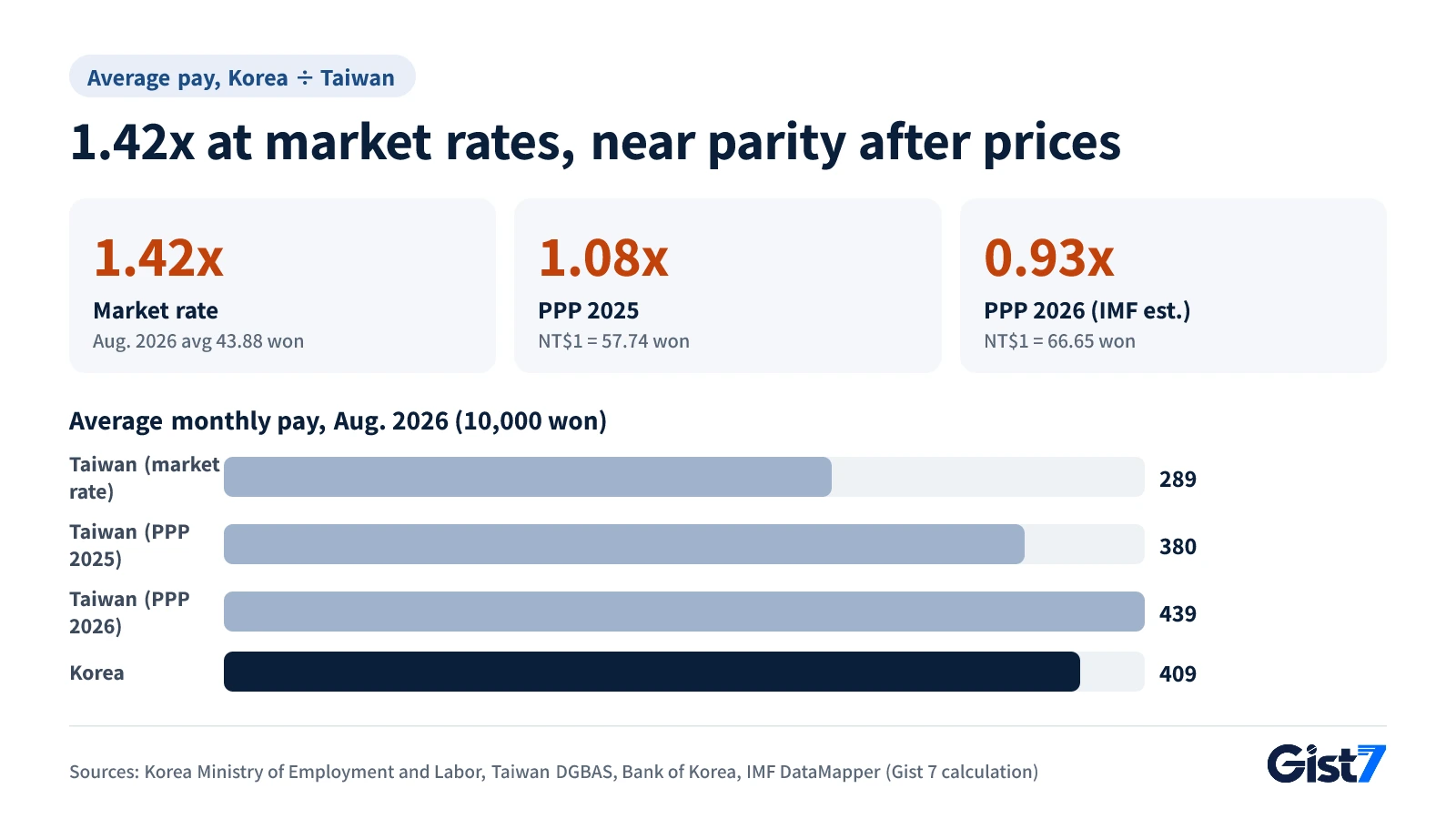
| Korea ÷ Taiwan | Market rate | PPP 2025 (NT$1 = 57.74 won) | PPP 2026, IMF estimate (66.65 won) |
|---|---|---|---|
| Average monthly pay (Aug 2026) | 1.42x (Taiwan 2,888,000 won) | 1.08x (Taiwan 3,801,000 won) | 0.93x (Taiwan 4,387,000 won) |
| Minimum wage (monthly) | 1.78x | 1.25x (Taiwan 1,784,000 won) | 1.09x (Taiwan 2,059,000 won) |
| Minimum wage (hourly) | 1.28x | 0.90x (Taiwan 11,837 won) | 0.78x (Taiwan 13,662 won) |
Source: IMF DataMapper implied PPP conversion rates (PPPEX; won and Taiwan dollar values per international dollar divided), Gist 7 calculations. Using 2024 PPP (57.39 won), the median pay gap is 1.10x.
The difference between the two PPP readings comes from a sharp rise in Korea's PPP rate (from 788.4 won to 898.1 won per international dollar). Because PPP is a GDP-based estimate, it can differ from everyday living costs. Consumer prices rose 2.8% in Korea in October (National Data Office) and 2.33% in Taiwan (DGBAS).
Gist 7's view: Korean pay is higher on paper, but the difference in living standards is much smaller than the market-rate ratio suggests. Taiwanese readers thinking of working in Seoul should also factor in Seoul rent levels to see the real gap.
Do Korean workers pay more than twice as much in social insurance as Taiwan's?
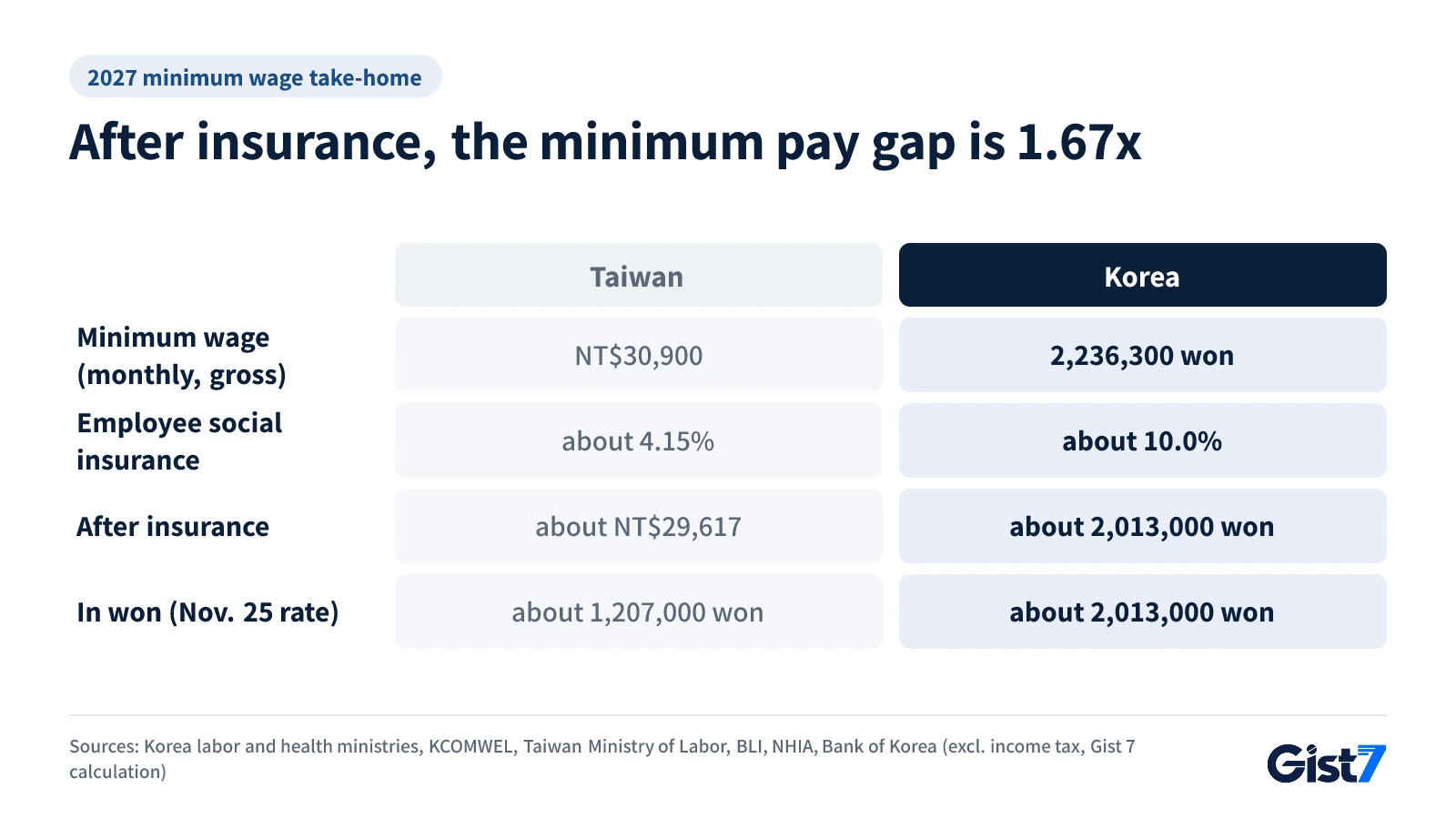
On a like-for-like basis, the employee share of social insurance in 2027 is about 10.0% in Korea and about 4.15% in Taiwan. Korea has high pension contribution rates split evenly between worker and employer, while in Taiwan employers pay 60% to 70% of premiums.
| Employee share, 2027 | South Korea | Taiwan |
|---|---|---|
| Pension | Half of the 10% National Pension rate, 5% | 20% of the 12% labor insurance rate, 2.4% |
| Unemployment | Half of the 1.8% employment insurance rate, 0.9% | 20% of the 1% employment insurance rate, 0.2% |
| Health | Half of the 7.19% health insurance rate, 3.595% | 30% of the 5.17% National Health Insurance rate (2026 rate), 1.551% |
| Long-term care | Half of 0.9994% of income, about 0.5% | No separate insurance |
| Total | about 10.0% | about 4.15% |
Sources: Korea's Ministry of Health and Welfare (pension reform Q&A, Health Insurance Policy Review Committee on Sept. 8, long-term care committee results reported Nov. 2), Korea Workers' Compensation and Welfare Service, Taiwan Bureau of Labor Insurance notice of Oct. 21 and Article 15 of the Labor Insurance Act, Taiwan's National Health Insurance Administration. In Taiwan, the employee's health premium rises with the number of dependents, and the 2027 rate has not been finalized.
Apply these rates to the minimum wage and Korea's 2027 monthly minimum comes to about 2,013,000 won after insurance, versus about NT$29,617 (about 1,207,000 won) in Taiwan, a gap of 1.67x. Taiwan's labor insurance also has a cap on insured salary (NT$45,800 in 2027), so a worker on the average wage pays only about 1.8% of pay in labor and employment insurance (Korea's National Pension also has a cap). Income tax is not calculated here because the two countries' deduction systems differ.
Market impact map
| Asset / indicator | Direction | Strength | Link (why) |
|---|---|---|---|
| Won/Taiwan dollar | ↓ (stronger won) | Medium | The variable that moves the pay ratio (June monthly average 48.28 won → 40.74 won on Nov. 25). If the won keeps strengthening, Taiwanese who fund their living costs in Taiwan dollars face higher costs to stay or study in Korea |
| Low-wage domestic industries in Korea (restaurants, lodging) | ↓ tendency (costs) | Weak | 2027 minimum wage up 3.7%. In the labor ministry's survey (August 2026), lodging and food services had the lowest total wages at 2,347,000 won, so they are most exposed to the increase |
| Taiwanese small and midsize firms in services and manufacturing | ↓ tendency (costs) | Weak | The 4.745% minimum wage increase and the labor insurance rate rise to 13% (from 12.5%, including employment insurance) both take effect in January 2027; employers pay 70% of labor insurance premiums |
Little direct impact: 2-year Treasury, 10-year Treasury, dollar index, won/dollar, gold, oil (WTI), bitcoin, S&P 500, Nasdaq, KOSPI
- Daily life: Korea's 2027 monthly minimum wage is 2,236,300 won before tax; after the employee share of pension, health, employment and long-term care insurance (about 10.0%), about 2,013,000 won remains (excluding income tax, Gist 7 calculation).
- Anyone converting Taiwan dollars into won is heavily exposed to the exchange rate. Comparing the June monthly average with the Nov. 25 rate, the same Taiwan dollar amount is worth about 16% less in won.
Market reactions can vary with other factors, and this table is not a basis for investment decisions.
What to watch next
| Date (Korea time) | Indicator / event | Previous | Link to this article | If it comes in like this |
|---|---|---|---|---|
| Late Nov.–Dec. (last year released Nov. 25) | DGBAS 2025 median annual total pay of employees | 2024: NT$546,000, +4.03% (DGBAS) | Updates the median pay comparison to 2025 | A rise of 4% or more tends to narrow the median gap |
| Late Nov. (expected) | Korea labor ministry October establishment survey (September wages) | August total wages 4,093,000 won, +3.9% (Ministry of Employment and Labor) | Trend in Korean average pay | Growth above inflation (2.8% in October) means real wages are rising |
| Around Dec. 10 (expected) | DGBAS October wage statistics | September average total pay, all employees: NT$60,297, +4.83% (DGBAS) | Trend in Taiwanese average pay | Growth above inflation (2.33% in October) means Taiwanese real wages are rising |
| Jan. 1, 2027 (Fri) | 2027 minimum wages take effect in Korea and Taiwan; Taiwan labor insurance rate 13%; Korea National Pension rate 10% | Korea 10,320 won an hour; Taiwan NT$29,500 a month | The basis for comparing minimum wages and premiums changes | Check January–February data to see whether the increases show up in wage statistics |
DGBAS released the 2024 median on Nov. 25, 2025; as of Nov. 25, 2026, the 2025 figure was not yet in its release list. DGBAS monthly wage statistics usually come out around the 10th to 15th of each month. Korea's establishment survey is normally released at the end of each month, and schedules can change.
Frequently asked questions
How many times higher are Korean salaries than Taiwan's?
About 1.4 to 1.5 times at market exchange rates. In August 2026, average monthly pay was 4,093,000 won in Korea and about 2,888,000 won in Taiwan, or 1.42x, and the 2024 median gap was 1.49x. The won/Taiwan dollar rate has fallen about 16% since June, so the ratio shifts a lot with the exchange rate.
What is the median salary in South Korea?
According to Korea's National Data Office, the median of average monthly income for wage earners in 2024 was 2,880,000 won before tax, up 3.6% from a year earlier; the average was 3,750,000 won. Taiwan's median for the same year was NT$546,000 a year, or NT$45,500 a month (about 1,930,000 won).
What are the 2027 minimum wages in Korea and Taiwan?
Korea's is 10,700 won an hour, or 2,236,300 won a month (based on 209 hours). Taiwan's is NT$30,900 a month (up 4.745%) and NT$205 an hour. Both take effect on Jan. 1, 2027. In Korea, people scheduled for 15 hours or more a week who attend all scheduled workdays that week also receive weekly holiday pay, so what they earn per hour actually worked is higher than the hourly rate (the 209-hour monthly figure includes those holiday hours).
How much social insurance is deducted from a Korean salary?
In 2027 the employee pays 5% for the National Pension, 3.595% for health insurance, 0.9% for employment insurance and about 0.5% for long-term care, about 10.0% in total. In Taiwan, labor and employment insurance (2.6%) plus health insurance (1.551%) come to about 4.15%. Income tax must be calculated separately because deduction rules differ.
Are Korean salaries still higher after adjusting for prices?
On 2025 PPP, average pay is 1.08 times higher in Korea, only slightly ahead, while on the IMF's 2026 PPP estimate Taiwan comes out higher (0.93x). The hourly minimum wage is higher in Taiwan on a PPP basis. PPP is a GDP-based estimate and can differ from everyday living costs.
References
- 2027년 적용 최저임금안 시간급 10,700원 (2026년 7월 14일) — 고용노동부
- 단시간 근로자도 주휴수당을 받을 수 있나요? (주 소정 근로시간 15시간 이상, 소정 근로일 모두 출근, 정보제공 고용노동부) — 복지로
- 最低工資連11漲, 116年1月1日起 月 30,900元·時 205元 (2026년 9월 24일) — 대만 勞動部
- 最低工資 (院會議案, 2026년 10월 1일 행정원 회의 보고) — 대만 行政院
- 基本工資 時薪 調幅 5.33%, 部分工時 근로자 보호 취지 (2019년 8월 14일) — 대만 勞動部
- 2024년 임금근로일자리 소득(보수) 결과 (2026년 2월 23일) — 국가데이터처
- 월평균 근로일수, 근로시간, 임금총액 (2026년 8월 임금) — e-나라지표(고용노동부 사업체노동력조사)
- 115年8月 工業及服務業 受僱員工薪資 (2026년 10월 15일) — 대만 행정원 주계총처
- 115年9月 工業及服務業 受僱員工薪資 (2026년 11월 11일) — 대만 행정원 주계총처
- 113年 受僱員工全年總薪資中位數及分布統計結果 (2025년 11월 25일) — 대만 행정원 주계총처
- 원/대만달러 매매기준율 월평균 2026년 — 한국은행 ECOS
- 원/대만달러 매매기준율 연평균 2024~2025 — 한국은행 ECOS
- 원/대만달러 매매기준율 일별 (2026년 11월 16~25일) — 한국은행 ECOS
- Implied PPP conversion rate (PPPEX), Korea·Taiwan — IMF DataMapper (API: https://www.imf.org/external/datamapper/api/v1/PPPEX/KOR/TWN)
- 2026년 10월 소비자물가동향 (2026년 11월 3일, 국가데이터처) — KDI 경제정보센터
- 115年10月 消費者物價指數 年增率 2.33% (2026년 11월 5일) — 대만 행정원 주계총처
- 연금개혁 Q&A: 보험료율 ’26년 9.5% → ’27년 10.0% — 보건복지부
- 제15차 건강보험정책심의위원회 결과 브리핑, 2027년 보험료율 7.19% (2026년 9월 8일) — 보건복지부(정책브리핑)
- 2027년 장기요양보험료율 소득 대비 0.9994% (2026년 11월 2일) — 보건복지부(정책브리핑)
- 고용보험기금 소개: 실업급여 보험료(1.8%)는 노·사가 각각 1/2씩 부담 — 고용노동부
- 自116年1月1日起,勞工保險費率依法調整為13%(含就業保險費率1%) (2026년 10월 21일) — 대만 勞工保險局
- 勞工保險條例 제15조 (피보험자 20%·투보단위 70%·정부 10%) — 대만 勞工保險局
- 勞工保險投保薪資分級表 (116年1月1日起適用, 최고 45,800元) — 대만 勞工保險局
- 公、民營事業、機構及有一定雇主之受僱者 保險費負擔金額表 (115.1.1 생효, 被保險人 30%·投保單位 60%·政府 10%) — 대만 衛生福利部 中央健康保險署