Korea Dermatology VAT Refund Ends: Why Spending Rose 49.5%
Key summary
The Korea dermatology VAT refund ended with 2025 procedures, so foreigners now pay 10% more, or 24.1% more in yen at Nov. 27 rates. Yet foreign patients' dermatology card spending rose 49.5% in H1 2026, as non-surgical demand, visa-free Chinese tour groups and more flights outweighed the change.
- Korea's VAT refund for foreigners' cosmetic procedures covered only services received by December 31, 2025 (Restriction of Special Taxation Act Art. 107-3, checked Nov. 28, 2026)
- The average 2025 refund was about 114,000 won ($85) per case; from 2026 patients pay it. At Nov. 27 rates that is +24.1% in yen, +16.5% in dollars
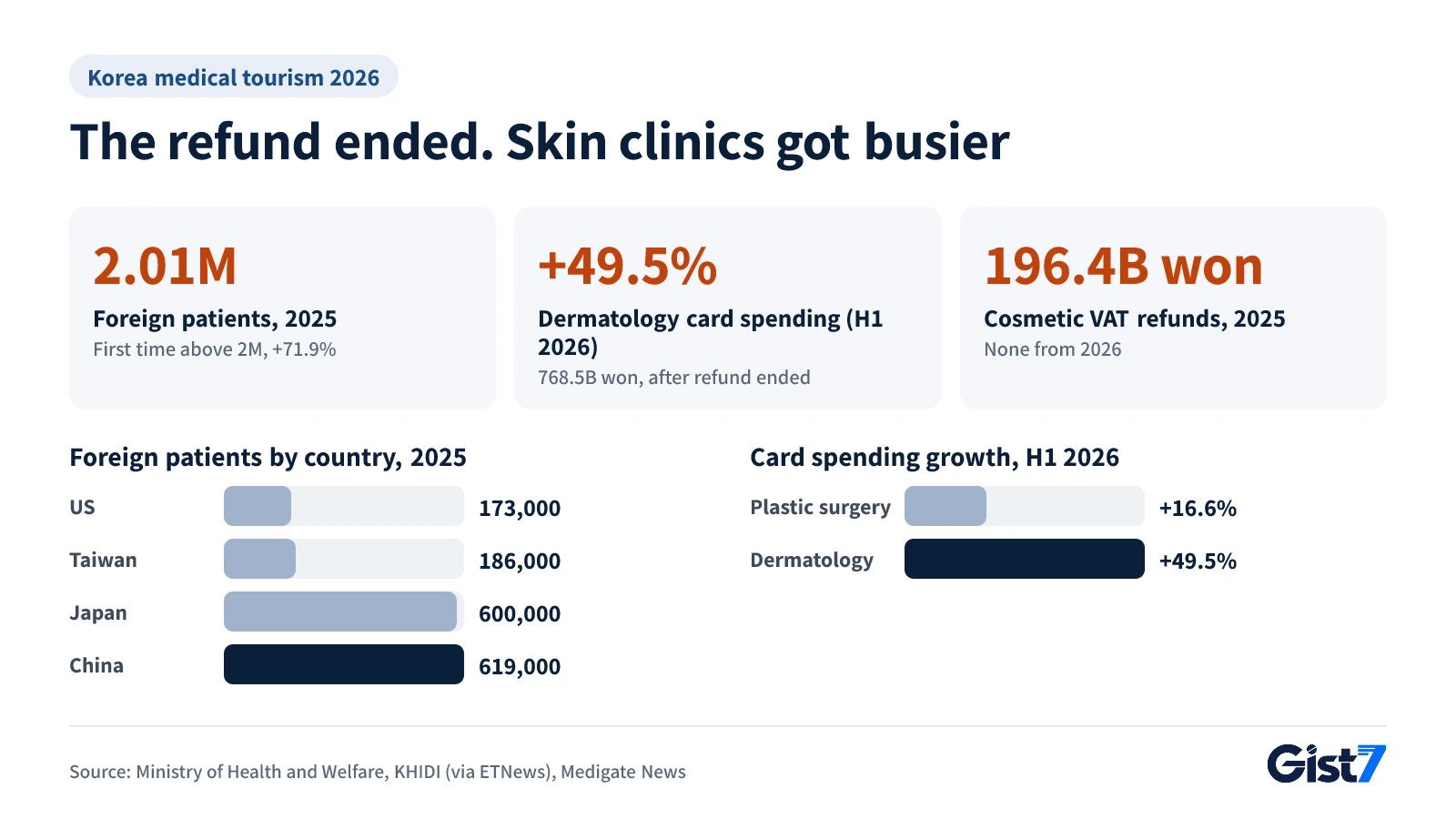
- Foreign patients' dermatology card spending hit 768.5 billion won in H1 2026 (+49.5%); plastic surgery rose only 16.6%
- Foreign patients totaled 2,011,822 in 2025 (+71.9%): China 619,000, Japan 600,000; 1.313 million dermatology patients
- Of 12.5 trillion won in medical tourism spending, 3.3 trillion won went to medical care; 87.2% of patients were treated in Seoul
Since January 1, 2026, foreigners no longer get a value-added tax (VAT) refund on cosmetic treatments at Korean dermatology and plastic surgery clinics. The special rule behind the Korea dermatology VAT refund covered only procedures received by December 31, 2025. Yet foreign patients' card spending at dermatology clinics reached 768.5 billion won (about $572 million) in the first half of 2026, up 49.5% from a year earlier, according to an analysis by the Korea Health Industry Development Institute (KHIDI). One of the drivers, 15-day visa-free entry for Chinese tour groups, was reported on November 26 to be extended through December 31, 2027 (Insight, November 27).
How much more do foreigners pay now that the Korea dermatology VAT refund is gone?
At the same price, the real cost in won is 10% higher. Add the stronger won, and at November 27 exchange rates the bill is 24.1% higher in yen and 16.5% higher in dollars. Korea's VAT is 10% of the pre-tax price. Medical treatment is exempt, but cosmetic surgery and cosmetic skin procedures are taxed. Starting in April 2016, foreign tourists could reclaim that VAT on cosmetic procedures at clinics registered with the Ministry of Health and Welfare to treat foreign patients.
Article 107-3 of the Restriction of Special Taxation Act, as published by the Korea Law Information Center (checked November 28, 2026), still limits the refund to services "received by December 31, 2025." According to Medigate News, which reported audit data that KHIDI submitted to lawmaker Nam In-soon's office, refunds looked like this:
| Cosmetic procedure VAT refunds | 2024 | 2025 |
|---|---|---|
| Total refunded | 95.5 billion won | 196.4 billion won |
| Number of refunds | 1,012,935 | 1,721,095 |
| Average refund per case (Gist 7 calculation) | about 94,000 won | about 114,000 won ($85) |
| Implied average bill per case (Gist 7 calculation) | about 1.04 million won | about 1.25 million won ($931) |
Source: Medigate News (October 9, 2026). The implied bill uses the fact that the VAT refund equals 1/11 of the tax-inclusive price and assumes a full refund with no handling fee. Dollar figures use the November 27 rate.
On average, then, a foreign patient in 2025 paid around 1.25 million won and got a little over 110,000 won back. From 2026 that money stays with the patient's bill. Exchange rates add to it.
| Currency | Change in real cost (H1 2026 average rate) | Change in real cost (Nov. 27 rate) |
|---|---|---|
| Korean won | +10.0% | +10.0% |
| US dollar | +5.5% | +16.5% |
| Japanese yen | +11.6% | +24.1% |
| Taiwan dollar | +7.1% | +23.2% |
| Chinese yuan | +0.7% | +8.0% |
Baseline: the same won-priced procedure with the refund, at the 2025 average exchange rate. Rates are from the Bank of Korea's Economic Statistics System (ECOS). The H1 2026 average (simple mean of January to June monthly averages) was 1,482.88 won per dollar and 937.53 won per 100 yen; on November 27 the rates were 1,342.70 won and 842.95 won. Calculations by Gist 7.
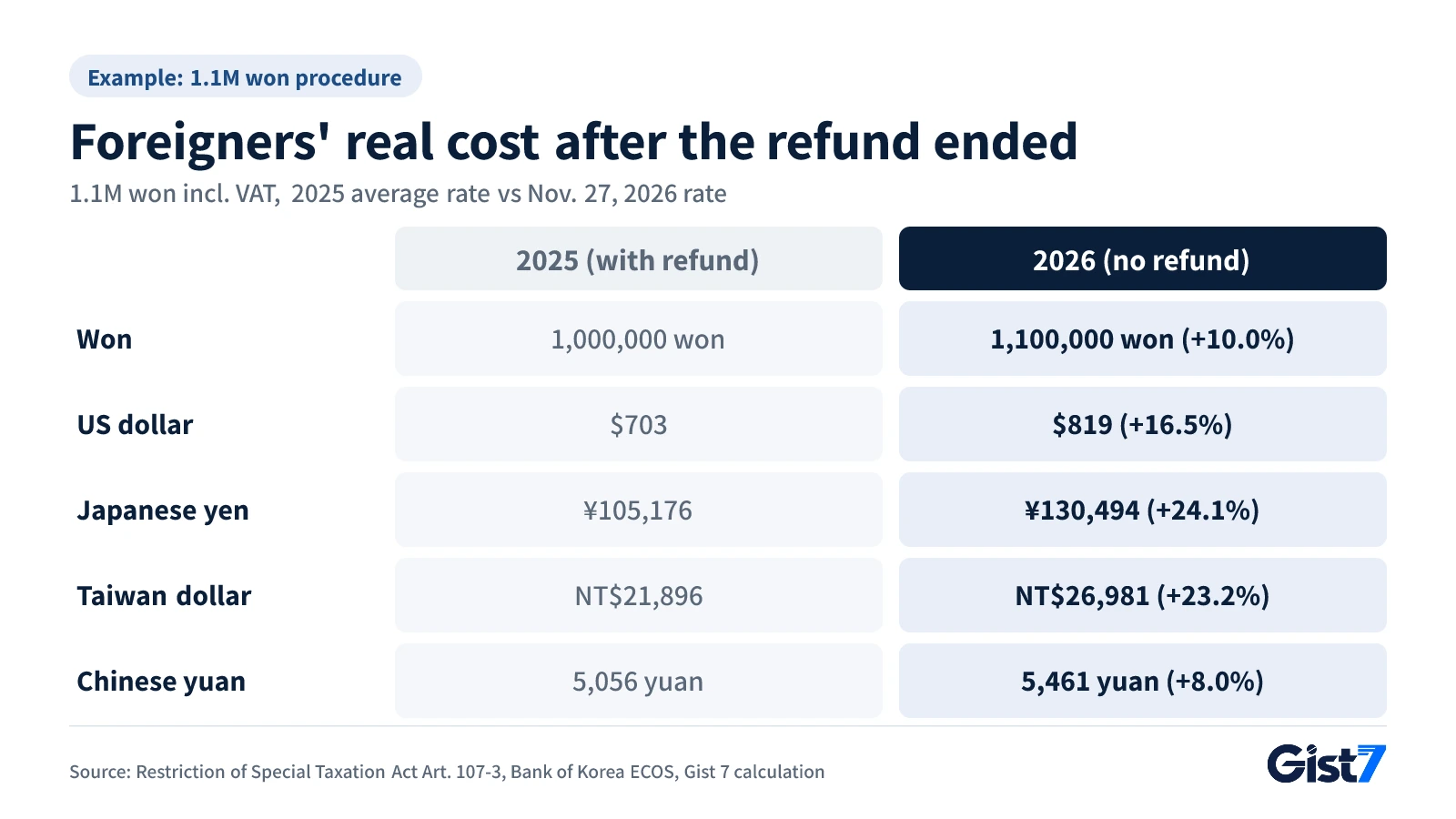
The currency effect was small in the first half; the pain arrived in the second half. In January to June the won was weaker than in 2025, so for patients paying in dollars or yuan a large part of the 10% was hidden. For Chinese patients the increase was just 0.7%. As the ECOS monthly average won-dollar rate fell from 1,497.43 in July to 1,406.30 in August and 1,337.66 in October, the extra cost for Japanese and Taiwanese patients rose above 20% by November 27. For broader price levels, see our Korea vs. Japan price comparison; for currency trends and total travel costs, see Korea's 20 million tourists and travel costs.
Why did dermatology spending rise 49.5% after the refund ended?
In Gist 7's reading, other forces outweighed the 10% hit: demand for non-surgical cosmetic procedures, visa-free entry for Chinese tour groups and more flights. As a result, foreign patients' dermatology card spending rose 49.5% to 768.5 billion won in the first half of 2026. According to ETNews, KHIDI reached that figure on August 27 by analyzing domestic payments with overseas-issued Hana Card cards by short-stay foreign patients. Hana Card is unlisted; it is a subsidiary of Hana Financial Group (KOSPI: 086790).
| H1 2026 | Card spending | Year on year | Share of medical spending |
|---|---|---|---|
| Dermatology | 768.5 billion won | +49.5% | 50.2% → 54.1% |
| Plastic surgery | 256.1 billion won | +16.6% | 21.4% → 18.0% |
| Internal medicine | 100.1 billion won | +66.5% | - |
| Dentistry | 49.9 billion won | +41.0% | - |
| All medical | 1.42 trillion won | +38.6% | - |
| Non-medical | - | +16.3% | - |
| For reference: visitors to Korea | 10.71 million | +21.3% | - |
Source: KHIDI analysis of foreign patients' domestic card spending, H1 2026 (ETNews, August 27, 2026). Cash and other non-card payments are excluded.
Plastic surgery is where the paths split. The Korea Economic Daily reported on July 31 that the Korean Association of Plastic Surgeons estimated a 20% to 30% drop in foreign patients after the refund ended. That is the association's own estimate, not official data.
Gist 7 sees two reasons for the gap. First, 10% weighs differently depending on the bill. According to KHIDI's analysis (reported by ETNews), average medical spending per card in the first half was 938,000 won (about $699). At that level 10% is around 90,000 won, but the bigger the surgery, the bigger the absolute amount, and the more carefully patients compare prices across countries. Second, the other drivers of dermatology demand stayed in place. The health ministry cited demand for cosmetic and non-surgical care centered on dermatology, China's visa-free policy and more flights as reasons for 2025 growth, and visa-free entry for Chinese groups continued throughout 2026. Many skin procedures also fit into a short trip. There are no official statistics comparing foreign patients' dermatology prices across countries, so this remains an interpretation; patient counts by specialty will only be confirmed when full-year 2026 data come out.
Where did Korea's 2.01 million foreign patients come from?
China and Japan made up 60.6% of the 2,011,822 foreign patients in 2025, and China took first place for the first time. The Ministry of Health and Welfare said on April 24, 2026 that the total rose 71.9% and topped 2 million for the first time since records began in 2009. Under the ministry's definition, a foreign patient is a foreigner who does not reside in Korea and is not enrolled in, or a dependent under, the National Health Insurance.
| Nationality | 2024 | 2025 | Growth | 2025 dermatology patients |
|---|---|---|---|---|
| China | 261,000 | 619,000 | +137.5% | 460,000 |
| Japan | 441,000 | 600,000 | +36.0% | 400,000 |
| Taiwan | 83,000 | 186,000 | +122.5% | 149,000 |
| United States | 102,000 | 173,000 | +70.4% | 85,000 |
| Thailand | 38,000 | 58,000 | +52.3% | 40,000 |
| Total | 1,170,000 | 2,012,000 | +71.9% | 1,313,000 |
Source: Ministry of Health and Welfare, 2025 foreign patient results (April 24, 2026), main text and annex table on specialties by nationality. Patients who visit several specialties are counted once per specialty, so the 1.313 million dermatology patients equal 62.9% of the specialty-based total of 2.087 million.
For all five countries in the table, dermatology was the most visited specialty. The ministry linked the more-than-doubling from China and Taiwan to cosmetic and non-surgical demand, 15-day visa-free entry for Chinese tour groups (from September 29, 2025) and more flights. Affinity for Korean cosmetics also fed K-beauty medical tourism: in KHIDI's 2025 overseas perception survey, Korea ranked first among 12 leading bio-health countries for cosmetics for the second year running. Americans are different. On a specialty basis (patients counted once per specialty), 44.3% of US patients went to dermatology, 13.2% to internal medicine and 9.3% to plastic surgery, so they were not concentrated in beauty care.
Where does the money foreign patients spend go?
Of the 12.5 trillion won (about $9.3 billion) that foreign patients and companions spent on medical tourism in 2025, 3.3 trillion won went to medical care. The remaining 9.2 trillion won or so (74%) was spent outside hospitals on lodging, shopping and meals (Gist 7 calculation). The figures come from a Korea Institute for Industrial Economics and Trade analysis cited by the health ministry. In other words, three quarters of Korea medical tourism costs flowed outside the clinic.
| Medical tourism, 2025 | Value |
|---|---|
| Medical tourism spending (patients + companions) | 12.5 trillion won |
| Of which medical care | 3.3 trillion won |
| Value-added effect | 10.5 trillion won |
| Domestic production effect | 22.8 trillion won |
| Patients treated in Seoul | 87.2% (1,755,002) |
| Patients at clinic-level facilities | 87.7% |
| Fastest growth outside the capital area | Busan +151.5%, Jeju +114.7% |
Source: Ministry of Health and Welfare, citing the Korea Institute for Industrial Economics and Trade, April 24, 2026.
The money flows to small Seoul clinics and the shopping streets around them. Seoul hosts 62.5% (2,555) of the medical institutions registered to treat foreign patients. In the first half of 2026, spending outside hospitals grew more slowly than medical spending, a sign that each patient's budget is shifting toward procedures.
For public finances, refunds worth 196.4 billion won a year (2025 basis) disappeared from 2026. A bill would bring them back. According to the Korea Economic Daily, an amendment introduced in April by lawmaker Cho Kye-won and 11 others would restore the refund through December 31, 2027; it was referred to a National Assembly subcommittee on July 29. As of November 28 the law text had not changed.
Market impact map
| Asset/indicator | Direction | Strength | Link (why) |
|---|---|---|---|
| Aesthetic devices, fillers and botulinum toxin makers | ↑ | Medium | Dermatology card spending +49.5% can feed demand for equipment and consumables |
| Tax refund agents | ↓ | Medium | Cosmetic VAT refunds worth 196.4 billion won in 2025 ended in 2026 |
| Clinics focused on plastic surgery | ↓ | Low | Spending grew 16.6%, below dermatology; the surgeons' association claims a 20-30% patient drop |
| Duty-free and cosmetics retail | ↑ | Low | About 9.2 trillion won of medical tourism spending went outside hospitals |
Little direct impact: Won-dollar rate (medical tourism brings in foreign currency but is small relative to the current account), 2-year Treasury, 10-year Treasury, dollar index, gold, oil (WTI), bitcoin, S&P 500, Nasdaq, KOSPI
- Procedure costs: since 2026 foreigners cannot reclaim VAT on cosmetic procedures (Restriction of Special Taxation Act Article 107-3, checked November 28, 2026). Medical treatment carries no VAT. Tax refunds on shopping are a separate system.
- Exchange rates: at the November 27 rate, the same won price costs 5.9% more in dollars and 12.8% more in yen than at the 2025 average.
- Payment: overseas cards carry foreign transaction fees, and choosing to pay in your home currency at the terminal (dynamic currency conversion) can add a second conversion cost.
- Taxes: foreigners now pay the same VAT as Koreans, and the government keeps roughly 200 billion won a year (2025 refund basis) it used to return.
Market reactions can vary with other factors, and this table is not a basis for investment decisions.
What to watch next
| Date (KST) | Indicator/event | Previous | Link to this story | If it comes in... |
|---|---|---|---|---|
| Dec. 2 (Wed) | Statistics Korea (National Data Office) November CPI | October +2.8% y/y | The won prices foreigners face | Higher inflation adds to foreigners' costs on top of the currency |
| Dec. 8 (Tue) 08:00 (Dec. 7, 18:00 ET) | Bank of Korea October balance of payments (preliminary) | September travel receipts $2.49B, travel balance -$0.77B (ECOS) | The channel for foreign medical and tourism spending | Continued growth in travel receipts signals spending is holding up despite the strong won |
| December (expected) | Culture ministry and Korea Tourism Organization monthly inbound tourism data | Jan-Sep 2026: 17.11 million, +21.5% | Visitor flows underpinning medical tourism | Growth in the 20% range would suggest medical tourism demand stays supported |
| Not scheduled | National Assembly subcommittee review of the refund extension bill (through end-2027) | Referred July 29 (Korea Economic Daily) | Whether refunds return | Passage would cut foreigners' real cost by close to 10% again; if stalled, the 2026 setup continues |
Official schedules: National Data Office 2026 CPI release calendar and Bank of Korea SDDS release calendar. The first full year of patient counts without the refund will come in the health ministry's 2026 foreign patient report, likely around April 2027, since the 2025 results were released on April 24, 2026.
Frequently asked questions
Can foreigners still get a VAT refund at Korean dermatology clinics in 2026?
No. Article 107-3 of the Restriction of Special Taxation Act limits the refund to cosmetic procedures received by December 31, 2025, and as of November 28, 2026 the deadline has not been extended. A bill to restore it through 2027 is pending, but the law has not changed.
How much more do foreigners pay without the VAT refund?
At the same price, 10% more in won. A procedure costing 1.1 million won including VAT used to come with a 100,000 won refund, so the real cost was 1 million won; in 2026 it is 1.1 million won. Comparing the 2025 average with the November 27 exchange rate, the increase is 24.1% in yen and 16.5% in dollars.
Did foreign patients drop after the refund ended?
Dermatology rose instead. In KHIDI's analysis, foreign patients' dermatology card spending in the first half of 2026 grew 49.5%. Plastic surgery grew only 16.6%, and the Korean Association of Plastic Surgeons says patients fell 20% to 30%. Official patient counts will come from the health ministry around April 2027.
Which countries send the most foreign patients to Korea?
In 2025 China (618,973) overtook Japan (600,009) for first place, followed by Taiwan (185,715), the United States (173,363) and Thailand (58,124). Dermatology was the top specialty for all five, according to the Ministry of Health and Welfare.
Is VAT charged on medical treatment in Korea?
Ordinary medical treatment is VAT-exempt. VAT applies to cosmetic surgery and cosmetic skin procedures, and from April 2016 to the end of 2025 only foreigners could get it refunded. Ask the clinic whether a specific procedure is taxable.
How much do medical tourists spend in Korea?
The Korea Institute for Industrial Economics and Trade estimated 2025 medical tourism spending by foreign patients and companions at 12.5 trillion won (about $9.3 billion), of which 3.3 trillion won went to medical care, as cited by the health ministry. The remaining 9.2 trillion won or so was spent outside hospitals on lodging, shopping and meals.
References
- 2025 foreign patient results top 2 million (Ministry of Health and Welfare press release, via KDI Economic Information Center)
- Restriction of Special Taxation Act, Article 107-3: VAT refund for foreign tourists' cosmetic procedures (Korea Law Information Center)
- 2025 foreign dermatology and plastic surgery patients reach 1.55 million (Medigate News)
- Foreign medical card spending up 38.6% (ETNews)
- Bill to extend cosmetic surgery VAT refund referred to subcommittee (Korea Economic Daily)
- Report: visa-free entry for Chinese tour groups extended to end-2027 (Insight, Nov. 27, 2026)