Norovirus Prevention: Oyster Safety and Korea Oyster Prices
Key summary
Norovirus prevention means cooking oysters to 85°C (185°F) for at least one minute and washing hands with soap for 30 seconds. There is no cure, so fluids matter most. In October 2026, Korean shucked oysters cost about 13,800 won/kg wholesale (about US$10.3), up sharply but below US dockside prices.
- Norovirus circulates from November to March in Korea, the same months as oyster season, and as few as 10 viral particles can cause infection.
- Symptoms are vomiting and diarrhea, usually 12 to 48 hours after exposure; most people recover in 2 to 3 days, and dehydration is the real danger.
- Prevention: heat to 85°C for 1 minute or more, wash hands with soap for 30 seconds, disinfect with a 1:50 bleach solution.
- In the second week of October 2026, shucked oysters at Seoul's Noryangjin market averaged 13,800 won per kg, up 60.47% from a year earlier.
- Korean oysters look cheap largely because of how they are sold (by weight, not per piece) and because production is concentrated on the southern coast.
Norovirus prevention becomes a daily concern in Korea every November, just as oyster season begins. According to the Korea Disease Control and Prevention Agency (KDCA), norovirus infections circulate mainly from November to March, the same months when Koreans eat the most fresh oysters. This year, prices have jumped too. In the second week of October 2026, shucked oysters at Seoul's Noryangjin Fisheries Market averaged 13,800 won per kg, 60.47% above the 8,600 won of a year earlier (Korea Economic Daily). This article covers the health side (symptoms, prevention, treatment) and the price side (what Korean oysters cost and why they are cheaper than abroad).
What is norovirus, and why are oysters a risk?
Norovirus is a virus that multiplies in the human gut and causes vomiting and diarrhea. It spreads by the fecal-oral route (KDCA). People catch it by eating contaminated water or shellfish, by touching a patient's vomit or stool, or through droplets released when someone vomits. Oysters and other bivalves filter seawater to feed, so in polluted waters they can accumulate viruses, which is why eating them raw is considered riskier.
According to the Ministry of Food and Drug Safety (MFDS), as reported by the Segye Ilbo, norovirus survives even at minus 20°C and about 10 viral particles can be enough to infect a person. Between November 2022 and February 2023, suspected food-poisoning reports tied to oysters and oyster dishes reached 542, roughly eight times the 68 reported a year before. Freezing an oyster therefore does not make it safe.
Norovirus symptoms and incubation period
Norovirus symptoms center on vomiting and diarrhea, sometimes with stomach pain, chills and fever. KDCA data put the incubation period at about 10 to 50 hours, and symptoms often start 12 to 48 hours after infection. Most people get better on their own within 2 to 3 days.
The real danger is dehydration. Warning signs include less urine, a dry mouth and throat, dizziness, fewer tears and unusual sleepiness (Digital Daily, November 19, 2025). Infants, older adults and people with weak immunity need extra care. In KDCA data from January 2025, 58.8% of patients during the outbreak season were children aged 0 to 6.
Norovirus prevention: seven rules that matter
- Cook oysters through. Heat them to a core temperature of 85°C for at least one minute. If the package says "for cooking" or "eat cooked," do not eat it raw.
- Wash hands with soap for 30 seconds or more. Do it after going out, before meals and after using the toilet, under running water. KDCA recommends soap over hand sanitizer.
- Boil drinking water and wash produce. Peeling fruit is safer.
- Separate kitchen tools. Use different knives and cutting boards for raw and cooked food, and disinfect them.
- Clean contaminated areas with bleach. Use one part bleach to 50 parts water on vomit or stool, and wash laundry at 70°C or higher or soak it in diluted bleach (1:330) for 5 minutes or more (Digital Daily).
- Stay home when sick. Avoid school, daycare and work until 48 hours after symptoms end.
- Do not harvest shellfish yourself. Never gather shellfish from areas where harvesting is banned (MFDS).
Digital Daily reported that raw oyster dishes and salted oysters (eori gul-jeot) were named in recent cases in Gangwon Province. The KDCA and MFDS material behind this article identifies shellfish and contaminated water or food as the carriers. If you eat sashimi or gwamegi (semi-dried fish) in winter, treat any oysters, salted seafood or unwashed leafy wraps served alongside by the same rules.
What to do if you catch norovirus
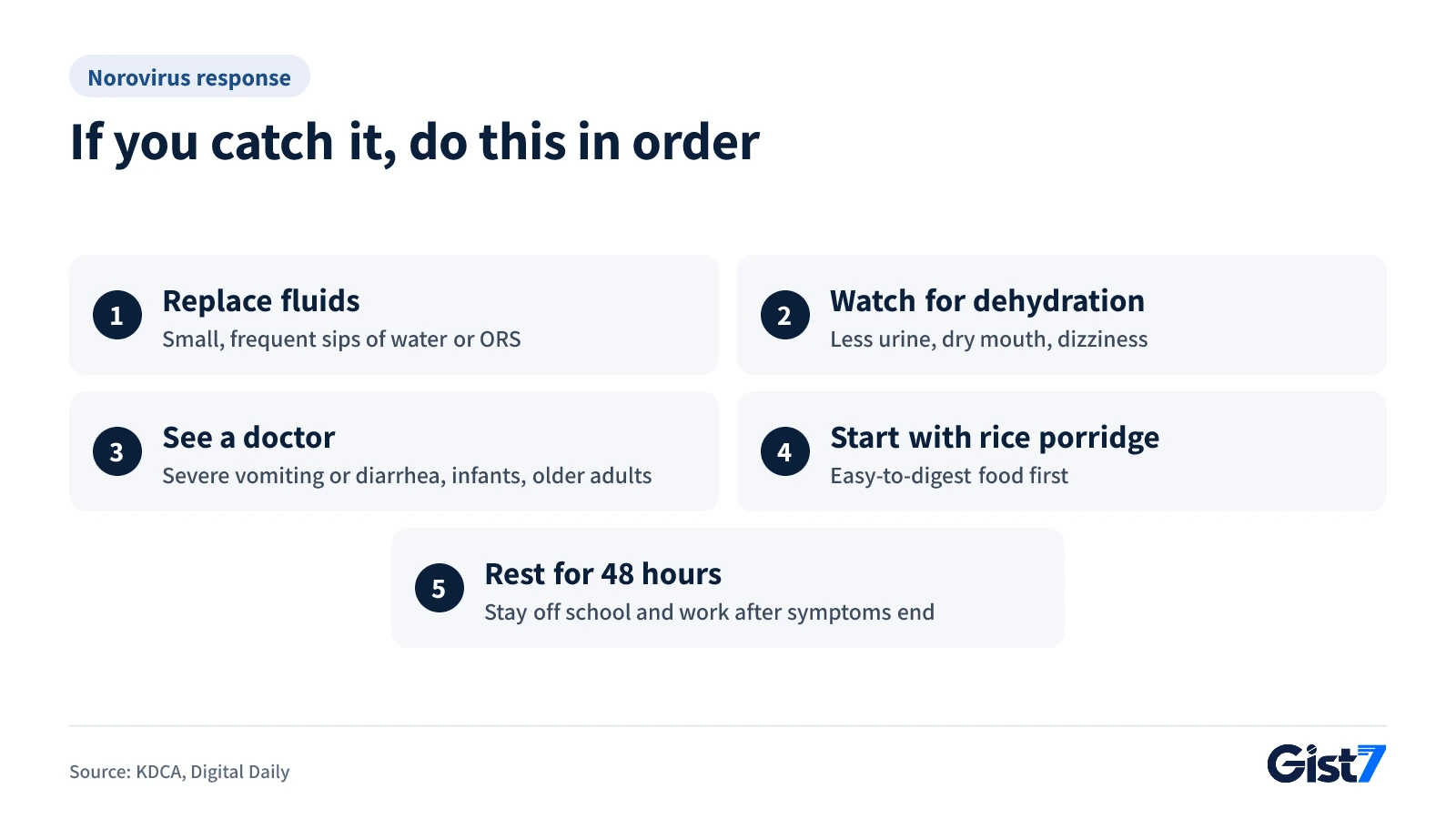
There is no specific drug for norovirus, and treatment means managing symptoms (KDCA). The key is replacing fluids and electrolytes. Start with small, frequent sips of water or an oral rehydration drink, and see a doctor for an IV drip if vomiting and diarrhea are severe or dehydration is suspected. Infants, older adults and people with weak immunity should be seen early.
During recovery, begin with easy foods such as rice porridge and widen the diet gradually (Digital Daily). Ask a doctor or pharmacist before taking anti-diarrheal medicine. Even after symptoms fade you can spread the virus for 48 hours, so keep a separate living space, close the toilet lid before flushing and wash your hands every time.
How much do oysters cost in Korea? (October 2026)
As of October 2026, ordinary-grade shucked oysters at the farm gate cost about 11,000 to 12,000 won per kg, Noryangjin wholesale is 13,800 won, and a 150 g retail pack at a major supermarket is 4,990 won. According to the Busan Ilbo, farm-gate prices are more than 10% above a typical year, and the opening auction in 2025 cleared at 80,000 to 90,000 won per 10 kg. The conversions below are approximate (Banque de France reference rates for October 9, 2026: about 1,342 won per US dollar and 1,503 won per euro; about 843 won per 100 yen).
| Item | KRW | USD | EUR | JPY |
|---|---|---|---|---|
| Farm-gate shucked oysters, ordinary grade (per kg) | 11,000-12,000 won | about $8.2-8.9 | about €7.3-8.0 | about ¥1,300-1,420 |
| Noryangjin wholesale shucked oysters (per kg, 2nd week of Oct.) | 13,800 won | about $10.3 | about €9.2 | about ¥1,640 |
| Lotte Mart retail pack, 150 g (Oct. 15-21) | 4,990 won | about $3.7 | about €3.3 | about ¥590 |
Converted to a kilogram, the retail pack comes to about 33,300 won, far above wholesale, because distribution and packaging costs are added. The Buyer expects prices to ease once main shipments from the southern coast grow after mid-November.
Why oyster prices rose this year
There is more than one cause. According to the Korea Economic Daily, strong export demand from Japan in the first half led to heavier spring harvesting, and by the end of May the stock of two-year-old oysters left in the sea was 37.4% smaller than a year earlier. Summer heat and bad weather then slowed the growth of this season's young oysters. The Buyer added mass die-offs from high water temperatures and low-oxygen water, labor shortages and a rush of demand during kimchi-making season.
The harvest itself is not poor, though. The Busan Ilbo reported little typhoon or current damage and plenty of nutrients from frequent rain, so one-year-old oysters are growing well. Tongyeong, Geoje and Goseong are expected to produce about 40,000 tonnes this season, around 70% of Korea's oyster output. Japan is the biggest export market, but a weak yen and tariffs have eroded the price competitiveness of Korean oysters there.
Why Korean oysters feel cheap compared with abroad
The biggest difference is how they are sold. In the United States, Britain and France oysters are priced per piece and served a few to a plate, which pushes the menu price up, while in Korea they are sold by weight and a single pack holds many more (a Daum "Pomnaneun Bapsang" article, July 2025). The same article says most Korean oysters come from Tongyeong and the southern sea, where water temperature and currents suit farming and supply is stable, and that the Pacific oyster raised in Korea is resistant to disease and adapts well.
Farm-gate numbers show the gap too. In a Mississippi State University Extension report, the 2021-2024 average dockside price (meat basis) was $10.90 per pound for Eastern oysters (about $24 per kg) and $6.13 for Pacific oysters (about $13.5 per kg). On a comparable meat basis, Korea's wholesale price is about $10.3 per kg.
| Item | Price per kg (meat basis) | Period |
|---|---|---|
| US Eastern oyster, dockside | about $24 | 2021-2024 average |
| US Pacific oyster, dockside | about $13.5 | 2021-2024 average |
| Korea, Noryangjin wholesale shucked oysters | about $10.3 | October 2026 |
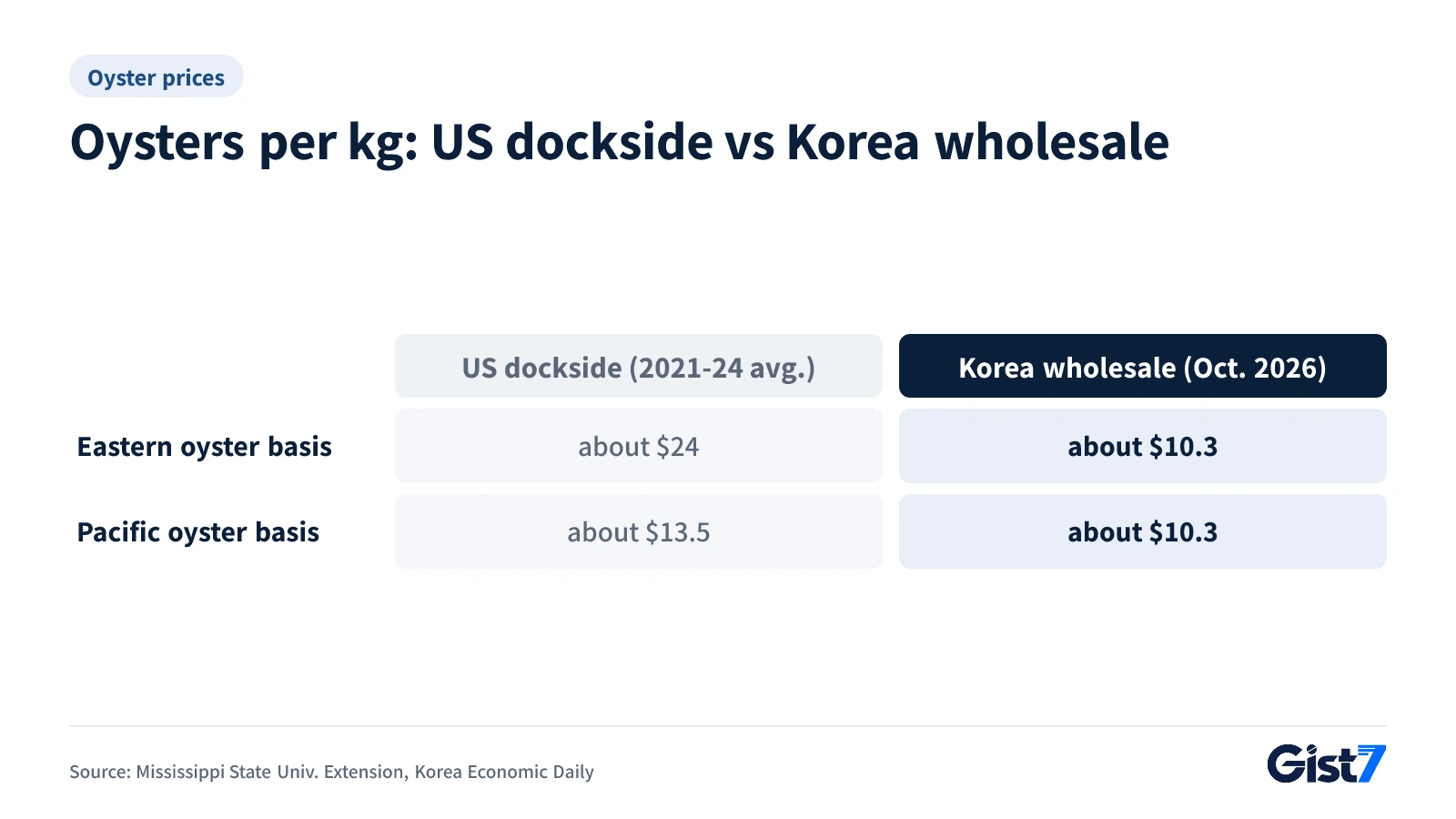
This comparison has limits. The species and the periods differ, so the figures are not exact, and restaurant prices abroad are plate prices, not dockside prices.
Gist7's take: prices are rising, the risk is not
"Cheap" is relative. In October the wholesale price of shucked oysters jumped more than 60% in a year, and if hot summers keep recurring, supply swings may become more frequent. Three things are worth watching: whether wholesale prices actually fall after mid-November, how far the stock of two-year-old oysters recovers, and how exports shift once Japan's own oysters reach the market.
Safety does not depend on price. If prices drop just as norovirus peaks in December and January, people may eat more oysters. The rule stays the same: cook them to 85°C for a minute or more and wash your hands with soap. If you cannot give up raw oysters, eat them knowing the risk you are taking.
Frequently asked questions
How long do you have to cook oysters to kill norovirus?
Heat them to a core temperature of 85°C for at least one minute. The MFDS says products labeled for cooking must be heated to this standard before eating.
Does freezing oysters get rid of norovirus?
No. According to the MFDS, norovirus survives even at minus 20°C, so freezing alone does not make oysters safe.
How long do norovirus symptoms last?
Usually 2 to 3 days. The incubation period is most often 12 to 48 hours, and it is wise to stay away from school or work for 48 hours after symptoms stop.
Is hand sanitizer enough to stop norovirus?
The KDCA recommends washing hands with soap under running water for at least 30 seconds rather than relying on hand sanitizer.
How much do oysters cost in Korea right now?
As of October 2026, Noryangjin wholesale shucked oysters cost 13,800 won per kg (about $10.3), and a 150 g retail pack at a major supermarket costs 4,990 won. Prices are expected to fall after mid-November.
Why are Korean oysters cheaper than oysters abroad?
Korea sells oysters by weight, produces most of them on the southern coast and farms the hardy Pacific oyster. Species and periods differ, so direct comparisons are only rough.
References
- 최근 5주간 노로바이러스감염증 환자 증가 추세, 올바른 손씻기로 예방하세요 (보도참고자료) — 질병관리청
- "겨울 노로바이러스 식중독 때문…85도·1분 이상 가열해 섭취해야" — 세계일보
- 찬바람 부니 고개 드는 '노로바이러스'…주의할 음식은? — 디지털데일리
- 작황도 좋고 수출 물꼬도 텄는데…제철 앞둔 남해안 굴 양식업계 — 부산일보
- "제철 굴 실컷 먹으려 했는데"…마트 갔다가 '한숨' — 한국경제
- 깐굴 일주일 새 47% 급등 …굴 가격 치솟는 이유는 — 더바이어
- US Oyster Prices, Landings, Imports, Exports — Mississippi State University Extension
- 1kg에 약 7천 원… 해외선 귀하디 귀한데 유독 한국서 저렴하다는 수산물 — 다음(폼나는 밥상)